

Adding schema markup isn't enough to make a website easier for AI search engines to understand. The stronger approach is to publish important facts in crawlable HTML, organise them under descriptive headings, and keep business details consistent across page content, structured data and external listings. For a Melbourne service business, the useful test isn't whether an AI plugin is installed. It's whether search tools correctly identify the business, its services, its service area and any limits on availability or pricing.
Table of Contents
- How AI Search Engines Read Your Website
- Structure Content So Answers Are Easy to Extract
- Add Structured Data That Matches Your Visible Content
- Fix Technical Barriers That Block Crawlers
- Build Consistent Business and Local Signals
- Test and Monitor How AI Interprets Your Site
- AI Search Readiness Checklist and Next Steps
How AI Search Engines Read Your Website
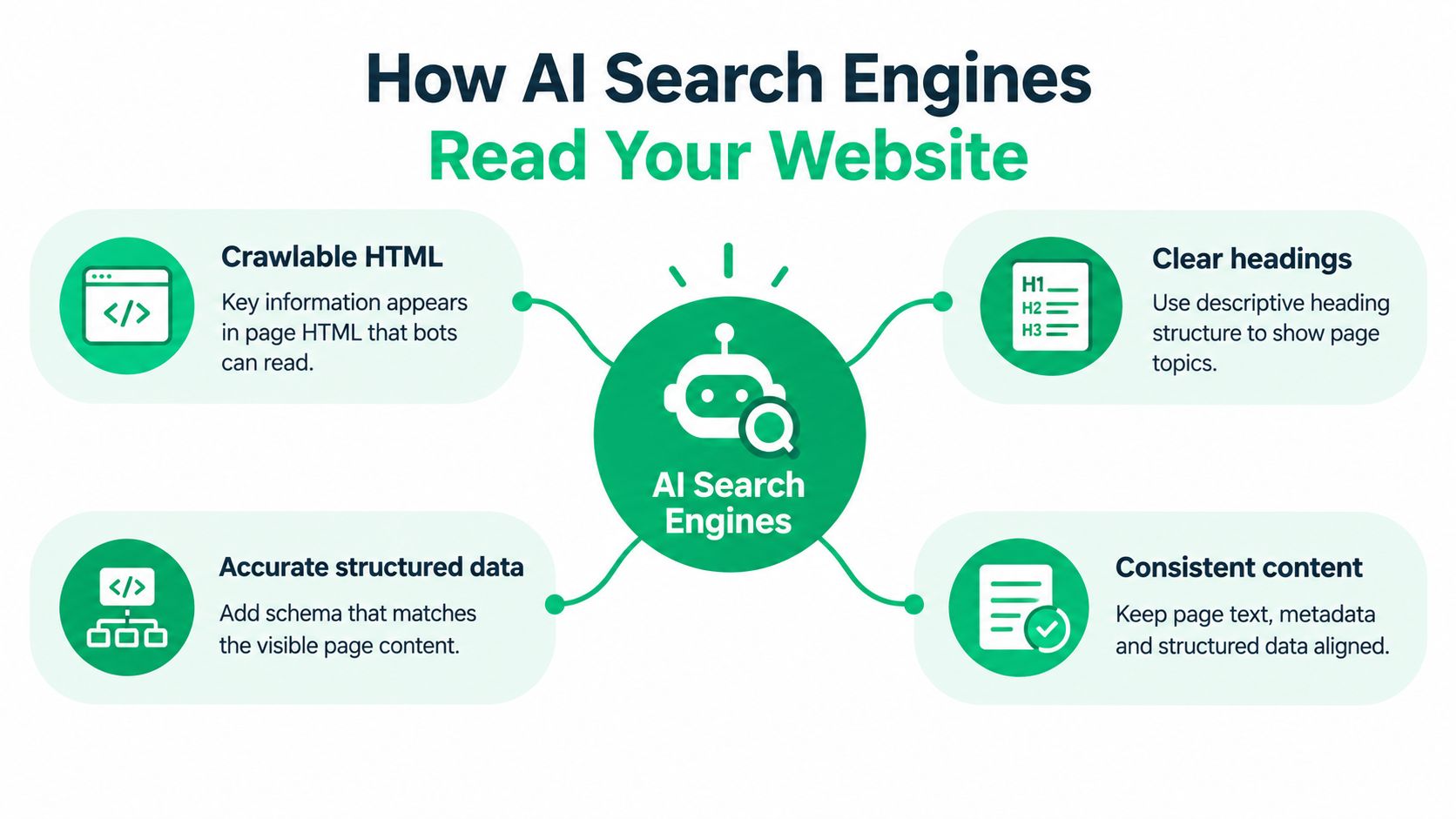
AI search readiness starts with interpretability, meaning how reliably a system can work out what a page says and which business it describes. A page needs to make its main subject clear without requiring a machine to infer essential details from photographs, promotional slogans or disconnected snippets.
Conventional search results primarily help people choose links. AI-supported search experiences can assemble answers from different sources, making correct attribution and accurate qualifications important alongside visibility. The practical distinction is between appearing as a result and being represented correctly within an answer.
What machines need to distinguish
For a local service page, the essential relationships are straightforward:
- Business identity: Which organisation provides the service?
- Service scope: What work does it perform, and what falls outside that scope?
- Location: Where is the business based, and which suburbs does it serve?
- Conditions: What restrictions apply to bookings, availability, eligibility or pricing?
Australia's search market supports building for more than a single interface. The ACCC's September 2024 search issues paper cited Australian desktop figures showing Google's share moving from 89.1% to 86.34%, while Bing's rose from 8.4% to 11.19%, between September 2021 and January 2024; Google held approximately 98% of mobile search during the measured period.
Those historical figures aren't an AI-search forecast. They support a more durable recommendation: maintain accessible, standards-based content rather than building around a particular provider's presentation format.
Clarity before technical decoration
A dental practice's page should distinguish its physical location from its service area. An accounting firm should distinguish general business advice from services it offers. A plumber should distinguish emergency enquiries from guaranteed attendance.
These distinctions also support experience, expertise, authoritativeness and trustworthiness in AI search. A business becomes easier to assess when its claims have clear owners, evidence and boundaries.
Practical rule: Optimise for an accurate description of the business before optimising for a mention.
No markup guarantees a citation. Ambiguity doesn't guarantee exclusion either, but it leaves more room for an incomplete or incorrect answer.
Structure Content So Answers Are Easy to Extract
An extractable answer states the service, location and relevant conditions before expanding into supporting detail. It shouldn't force a customer or automated system to combine scattered statements to answer a basic question.
The Australian Government Digital Service Standard emphasises user-friendly, inclusive and adaptable services. For a commercial website, that offers a useful editorial principle: information should be understandable to people before technical enhancements are added.
Replace promotional introductions with useful answers
Consider this hypothetical plumber's homepage copy:
A trusted team delivering quality plumbing solutions across Melbourne, with friendly service and a commitment to customer satisfaction.
It doesn't identify the work, the service area boundary or the booking conditions. A clearer version, assuming every detail is true, would be:
The business provides residential blocked-drain clearing and leaking-tap repairs in Brunswick and its published service area. Customers can request an appointment by phone; after-hours availability must be confirmed before booking.
The rewrite isn't more elaborate. It separates verifiable service facts from general sales language and makes the availability limitation explicit.
A dental page could use the same pattern to explain what a check-up includes and whether additional treatment costs are separate. An accounting page could identify the clients it supports, the work included in an engagement and what requires a separate quote.
Give each page a predictable reading order
Use a clear primary heading, followed by descriptive subheadings that identify actual topics. Under each heading, lead with a short direct answer, then add necessary detail, exceptions and evidence.
- Name the subject: Prefer “Blocked-drain services in Brunswick” to “Solutions that deliver”.
- Explain terminology: Define specialist language before relying on it, particularly for healthcare and accounting services.
- Use meaningful links: “View the service-area suburbs” explains the destination better than “click here”.
- Keep facts in text: Publish services, opening hours, qualifications and genuine pricing information as ordinary page text.
- Support other formats: Provide useful text alternatives for informative images and transcripts for explanatory videos.
The WA Digital Services Content Guidelines provide a relevant Australian reference for accessible, understandable content and exposing information to search engines.
Concise doesn't mean incomplete. A short summary can sit above detailed treatment information or engagement conditions. The trade-off is between useful depth and repetition: extra words help only when they answer another genuine question or clarify an important limitation.
Add Structured Data That Matches Your Visible Content
Schema markup is a machine-readable description of information already published on a page. It labels entities and their relationships, such as a business providing a service at a particular location.
The National Archives of Australia's guidance on web metadata explains that metadata helps search engines understand web content and identifies HTML elements and Schema.org markup as information used in search results. That supports schema as a clarification layer, not a replacement for readable copy.
Schema Types a Service Business Actually Needs
| Schema type | Where to use it | What it clarifies |
|---|---|---|
LocalBusiness | Relevant business or location pages | Business identity, public address, contact details and opening hours |
Service | Pages describing actual offerings | The service provided, its provider and applicable service area |
Organization | Organisation-level information | The entity behind the website and its relationships |
BreadcrumbList | Pages with a meaningful navigation hierarchy | The page's position within the website |
FAQPage | Pages containing genuine questions and answers | The visible question-and-answer content |
These aren't mandatory additions to every page. The appropriate selection depends on the page's purpose and the information available.
For example, an accounting firm's service page might describe bookkeeping support through Service, connected to the same organisation described elsewhere. It doesn't need a separate, conflicting business identity just because a different plugin controls that template.
Keep the labels and the page aligned
The golden rule is visible content first, matching markup second. If a dental practice doesn't publish an emergency service on the page, schema shouldn't imply that it offers one.
Likewise, a slogan isn't a frequently asked question. FAQPage belongs with genuine questions and answers, not a set of promotional claims rewritten to resemble a conversation.
A practical implementation sequence is:
- Establish the entity: Agree on the business name, public contact details and relationship between any locations.
- Map the templates: Decide which page types need business, service or breadcrumb descriptions.
- Generate the markup: Use JSON-LD where appropriate, with values drawn from maintained content fields.
- Review the output: Check the actual published code rather than trusting a plugin's settings screen.
Common failures include duplicated organisation records, outdated addresses and automatically generated services that aren't described on the page. More code can make those contradictions harder to spot.
A plain-English explanation of schema markup can help a business owner review a developer's proposal without needing to write the code.
The useful handover isn't just “schema installed”. It should identify what each type describes, where its values come from and who updates them when business information changes. Detailed validation belongs in the ongoing testing routine, not just the initial setup.
Fix Technical Barriers That Block Crawlers
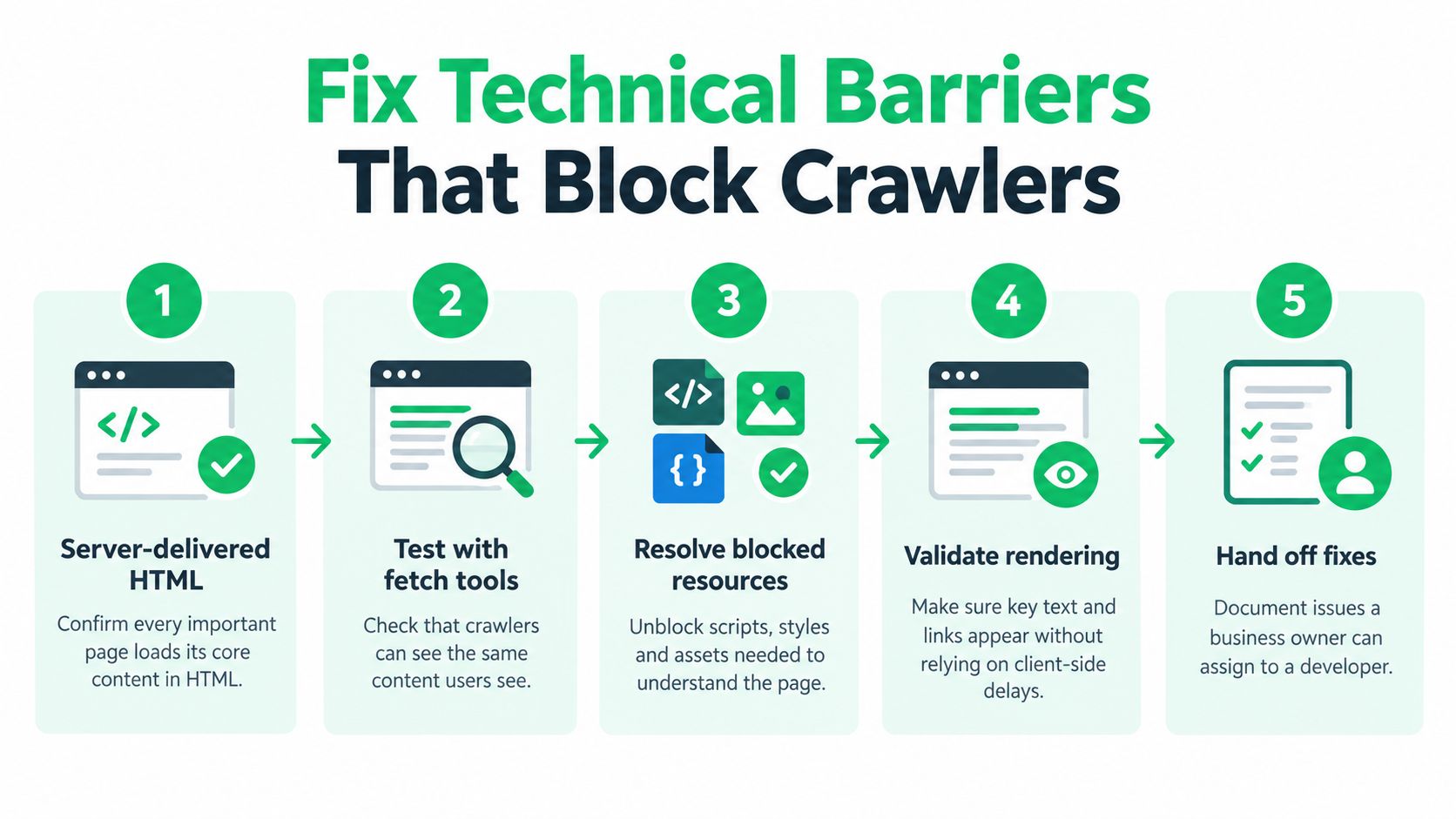
Technical work should begin with the pages that matter commercially: core service pages, location information and contact pathways. A crawler needs to reach those pages and retrieve their essential meaning before any content refinement can help.
A staged audit is easier to assign and verify than a broad instruction to “improve technical SEO”. Each issue should include an affected URL, the observed problem, the required change and a way to confirm the fix.
Start with retrieval, then indexing
Check the delivered HTML. A developer should compare the original page response with the rendered document, often called the DOM. Testing with JavaScript disabled helps reveal whether service descriptions, contact information or navigation depend entirely on client-side execution.
JavaScript isn't automatically a problem. The safer approach is to make essential content available without waiting for an interactive component to load.
Classify important URLs. Separate pages intended for indexing from private, duplicate or intentionally excluded pages. Review accidental noindex directives and crawl restrictions rather than removing every restriction indiscriminately.
The guide to robots.txt explains the role of crawl instructions. Access decisions should reflect the site's publishing policy, not an assumption that every automated visitor needs unrestricted access.
Clean up discovery signals. Maintain an XML sitemap containing canonical, indexable URLs. Use canonical tags and redirects deliberately when consolidating duplicate variants, and ensure internal links point to the intended destination.
Check links and page behaviour
A crawler should be able to follow ordinary anchor links between related pages. A clickable visual card isn't enough if the implementation doesn't expose a usable link destination.
- Link by topic: Connect a service page to relevant service-area information and booking details.
- Inspect resources: Avoid blocking scripts or styles required to interpret the page.
- Review performance: Use Core Web Vitals and practical mobile testing to identify slow loading, delayed interaction and unstable layouts.
- Remove format barriers: Don't make an image-only PDF the sole source of service information.
Fast, stable pages are a sensible usability priority, but a performance score isn't proof that an AI system can retrieve the content. The technical check still needs to inspect the actual response and rendered page.
A page that looks correct in a browser can still fail a content-retrieval test.
Near-identical suburb pages deserve scrutiny too. A separate Brunswick page should offer meaningful local service information, not merely replace another suburb's name. Where no useful distinction exists, a clear service-area page may be the more maintainable choice.
Build Consistent Business and Local Signals
Consider a hypothetical Richmond dental practice whose website shows its current address while an old directory still lists South Yarra. The contradiction creates a practical interpretation problem: which location should an answer describe?
Correct schema on the website doesn't remove the stale listing. The business needs to reconcile the public record, especially where an old address could send a patient to the wrong place.
A plumber can face a different mismatch. Emergency availability might appear on Google Business Profile while the website only describes standard appointments, leaving the actual after-hours conditions unclear.
Audit the business, not just individual pages
Create a reference record of the business's approved public facts. Compare it against the website, Google Business Profile, Australian Business Number details where relevant, major directories and authoritative third-party references.
| Detail | Question for the audit |
|---|---|
| Trading identity | Are the legal entity and public trading name connected clearly? |
| Location | Is an old address being mistaken for a current practice or office? |
| Service area | Are travel boundaries distinguished from physical premises? |
| Availability | Do emergency or after-hours claims include their actual conditions? |
| Contact pathway | Can customers reach the correct team for the advertised service? |
The practical aim isn't to make every record use identical prose. It's to ensure the records describe the same underlying facts. Legal and trading names may legitimately differ, but the relationship should be understandable.
For the dental example, the correction would include the outdated directory, location page and any related appointment instructions. For the plumber, the website should state whether after-hours calls are accepted and whether attendance depends on availability.
Make Melbourne relevance specific
An accounting firm based in Melbourne's CBD may serve businesses across the metropolitan area without maintaining suburban offices. Its pages should explain that arrangement rather than imply a physical presence in every suburb.
Clear service-and-location pages can clarify relevance to searches such as “dentist Richmond” or “plumber Brunswick”. Their usefulness comes from accurate local facts, including where appointments occur, where technicians travel and which services are available.
A name, address and phone consistency audit provides a starting point, but service scope and availability deserve the same attention.
Genuine reviews and relevant third-party references can provide corroborating context. They shouldn't be treated as guaranteed triggers for AI recommendations, and fabricated local references would undermine the accuracy this work is meant to establish.
Test and Monitor How AI Interprets Your Site
A successful implementation needs verification at separate levels: the code is valid, the page is discoverable, and the business is described correctly. Passing a schema test doesn't establish the other outcomes.
Release discipline matters here. The WA Government accessibility and inclusivity standard requires testing and review around major releases for its government services. Although that requirement doesn't apply to every commercial website, the same discipline is useful after a redesign, theme change or CMS update.
Verify the implementation
Use a Schema.org validator to inspect structured-data syntax and relationships. Google's Rich Results Test provides a separate check for supported Google search features; it isn't a universal approval test for every schema type or AI system.
Then inspect Search Console indexing reports, crawl statistics and relevant queries. Where available, server logs and crawl reports help investigate failed requests, inaccessible templates or pages that have become unexpectedly difficult to reach.
The Australian Government Style Manual's accessibility responsibilities also support testing content against WCAG criteria. Keyboard access, labelled controls and meaningful headings need checking alongside search access, particularly around enquiry forms.
Ask factual questions about the business
Maintain a repeatable prompt set in ChatGPT, Gemini and Perplexity. Use search-enabled experiences where available, and record whether the response cites retrievable sources.
- Service boundary: Does the named plumber service Brunswick, and are any exclusions stated?
- Pricing qualification: What does the named dental practice publish about check-up pricing and inclusions?
- Client eligibility: Does the named accounting firm support the relevant business type?
- Availability: Is emergency attendance confirmed, conditional or not offered?
- Conversion path: Which contact method does the answer recommend?
Record the prompt, date, tool, answer, cited pages and factual errors. Include questions whose correct answer is “not published”, because an invented price is a failure even when it sounds plausible.
Measurement caution: An accurate answer, a brand mention, a citation and a qualified enquiry are different outcomes.
Responses can vary with wording, timing and context. A single answer shouldn't be treated as a stable ranking or proof that a website change caused an improvement.
Track factual accuracy and cited-source presence alongside qualified enquiries and branded search demand. After major releases, repeat the technical tests and the same business questions. A visual refresh can leave a site looking polished while changing what machines and customers can access.
AI Search Readiness Checklist and Next Steps
The most useful priority order is based on consequences. Incorrect opening hours or a hidden contact pathway should be fixed before an optional schema enhancement, because the former can directly mislead a prospective customer.
Accessibility provides a useful quality-control framework. The WA accessibility and inclusivity guidelines describe content as perceivable, operable, understandable and reliable, principles that help teams replace vague design judgements with practical checks.
Prioritise the work
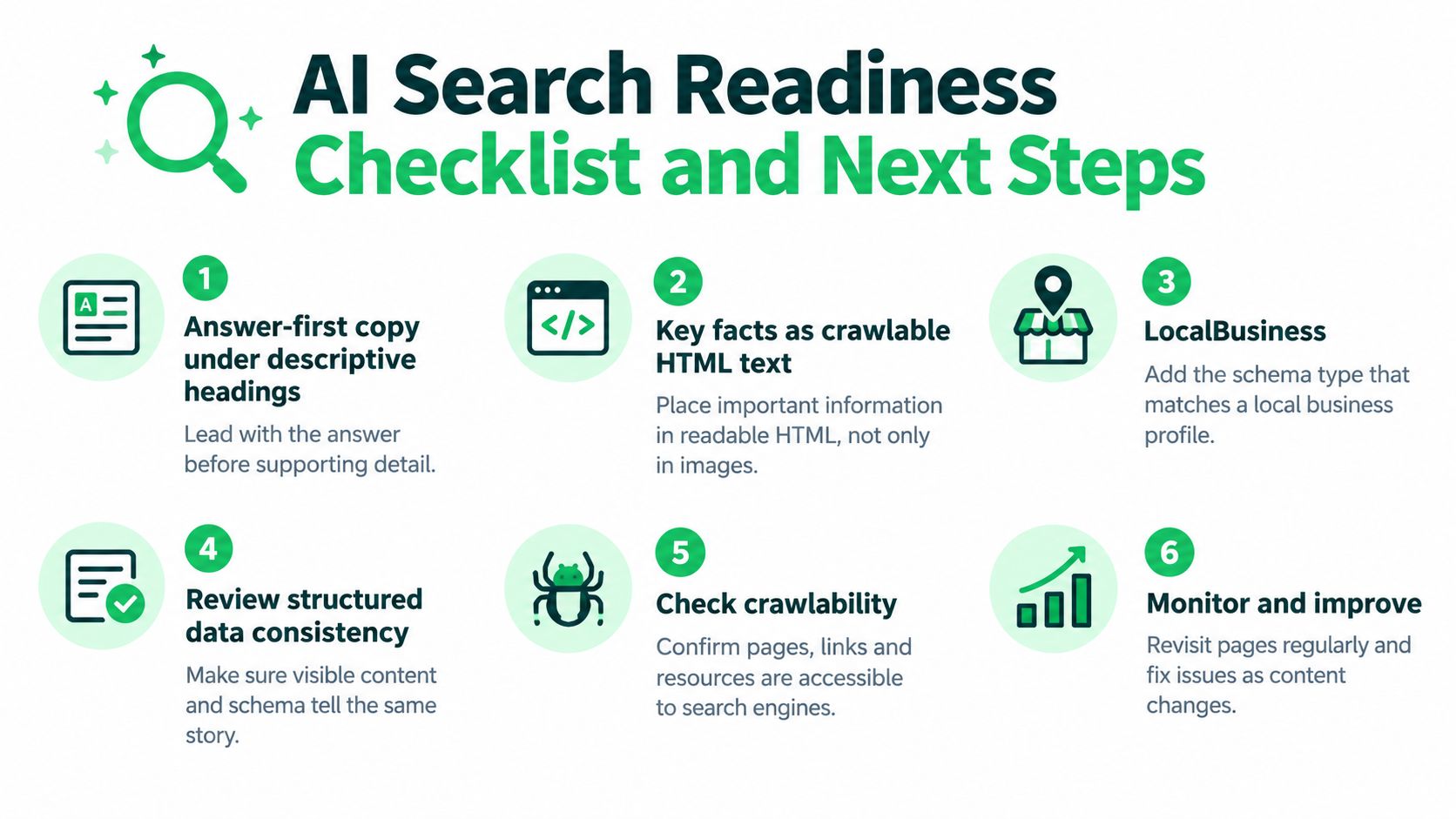
- Clarify the answer: Give core service pages descriptive headings and direct summaries, with important conditions kept close to the claim.
- Expose essential facts: Confirm service scope, location, hours and contact instructions are available as readable HTML.
- Align structured descriptions: Check that relevant
LocalBusiness,ServiceandBreadcrumbListmarkup describes the published page accurately. - Remove access barriers: Review sitemap entries, crawl restrictions, indexing directives, canonical URLs and internal links.
- Protect usability: Check mobile performance, layout stability, accessible controls and enquiry completion.
- Reconcile public records: Correct contradictory business details across the website, Google Business Profile and important directories.
- Schedule verification: Run a quarterly review using validators, Search Console and a maintained AI prompt set, with additional checks after significant changes.
Assign ownership, not just recommendations
Each correction needs someone responsible for maintaining it. The practice manager might own opening hours, the business owner might approve service boundaries, and the developer might maintain templates and structured-data output.
Budget and platform constraints can affect implementation. Where a full rebuild isn't justified, correcting the most important service pages and public business records offers a practical starting point.
Knowing how to make your website easier for AI search engines to understand ultimately means knowing whether machines can retrieve and correctly interpret the business's published facts. Clarity and consistency matter more than markup tricks, and verification matters more than assuming an installation has worked.
For Melbourne businesses needing help prioritising these issues, SEO2RANK offers a free high-level SEO Snapshot covering crawlability, structured-data and business-entity concerns. Business owners can visit the website to request a starting assessment and discuss whether further audit or implementation work is appropriate.
Find Out What Is Holding Your
Website Back
Get a practical SEO Snapshot showing the biggest issues and opportunities we can see across your search visibility, website and local presence.
Get Your Free SEO Snapshot→