
Schema helps AI search indirectly by making business facts machine-readable and making some pages eligible for supported search features, but it isn't a proven shortcut into AI Overviews or AI answers. Understanding a page, qualifying for a search feature and earning an AI citation are separate outcomes, not interchangeable benefits.
The popular advice to add schema and wait for AI visibility skips that distinction. For a Melbourne plumber, dental practice or accounting firm, the useful question is whether structured data resolves genuine ambiguity, supports an eligible search appearance or improves the quality of information search systems can interpret.
Table of Contents
- Does Schema Help With AI Search in 2026
- Schema Types for Local and Service Businesses
- How to Add Schema Without Creating Problems
- How to Measure Whether Schema Is Making a Difference
- Limits, Mistakes and What the Evidence Still Lacks
- Confirm Your Core Pages Before Adding More Schema
Does Schema Help With AI Search in 2026
The fastest way to overvalue schema in 2026 is to treat it as an AI ranking lever. Google's AI features guidance says websites do not need special Schema.org markup or new machine-readable files to appear in AI Overviews or AI Mode. Pages still need to be indexed and eligible to appear in normal Search with a snippet.
The commercial promise often runs ahead of the documented benefit. A business can implement valid structured data without gaining a rich result, an AI mention or another enquiry. Those are separate outcomes, and each needs its own test.
Google introduced AI Overviews across Australia on 29 October 2024, according to its Australian launch announcement. That created a local milestone for AI-mediated search. It did not turn schema into a guaranteed visibility tactic.
What schema can and cannot do in AI search
| Claim | Basis | Status |
|---|---|---|
| Makes business facts and page content machine-readable | Google structured data documentation | Well supported |
| Makes a page eligible for supported rich results | Google Search documentation | Supported, but display is not guaranteed |
| Guarantees inclusion in AI Overviews or AI Mode | Google says special markup is not required for these | Not supported |
| Causes AI citations on its own | Controlled testing summarised by ROI.com.au's Australian AI Overviews guide found no meaningful citation increase | Not established |
| Replaces crawlable, useful visible content | Google requires markup to match visible content | Not supported |
Google's structured data documentation describes structured data as a standardised format for classifying page content and helping its systems understand information. It also separates the broad Schema.org vocabulary from the smaller set of features that Google Search supports.
That separation has practical consequences. A valid Service description may communicate what a company offers without producing a dedicated visual enhancement. Adding more properties does not automatically open more search features.
Rich-result eligibility is different from selection. Eligibility means a page can be considered for a supported presentation. Google may still choose not to display that presentation, and neither outcome proves that an AI answer will cite the page.
How machine-readable facts reduce ambiguity
A labelled card works like a covering note for a letter: the sender, address, subject and contact details are explicit before anyone reads the contents. The card does not make a weak letter persuasive. Schema plays a similar role. Schema.org supplies a shared vocabulary, usually implemented on business websites as JSON-LD, that labels entities and their relationships. The National Archives of Australia's metadata guidance explains that major search engines use HTML elements and Schema.org markup to interpret web content, identifying Schema.org as a standard developed and used by Google, Microsoft and Yahoo.
Two plumbing businesses can share similar names while operating in different parts of Melbourne. Plain text may mention the business name, a suburb and a phone number in separate parts of a page. Structured data can associate those details with the same business entity.
A practical relationship chain is:
- Organisation: the business being described.
- Services: the work that business provides.
- Service areas: the locations covered by those services.
- Contact details: the address, telephone and other published contact information.
- Authoritative profiles: official identity references connected through
sameAs.
The useful benefit is disambiguation: helping a system distinguish one entity from another. Clearer entity data does not prove that every AI assistant reads every JSON-LD property, or that recognising the business leads an assistant to recommend it.
For local operators, the relationship between AI Overviews and traditional SEO is more useful than a supposed schema-only strategy. Service relevance, accessible pages and credible business information still need attention.
Working rule: Add accurate schema that describes real facts, test the outcome, and do not expect clearer entity data to make thin content authoritative.
A strong implementation makes business information explicit without asking markup to do the job of useful content. That is a defensible reason to maintain schema even when AI citation gains remain uncertain.
Schema Types for Local and Service Businesses
The starting point is what the page really shows, not the longest list of schema types a plugin can generate. Each type should describe the page's real purpose, using the most specific accurate option.
For a local business, that may mean LocalBusiness or a suitable subtype such as Dentist, Electrician, Plumber or AccountingService. The current vocabulary should be checked before implementation, particularly when an industry label could describe several different kinds of organisation.
Schema types for local and service businesses
| Schema type | Best used for | Key properties | Visible content to match |
|---|---|---|---|
| LocalBusiness or subtype, such as Dentist or Electrician | Business identity, address, hours and service area | name, address, telephone, openingHours, areaServed, url | Published address, phone and hours, consistent with Google Business Profile |
| Organization | Company identity on the home or about page | name, logo, url, sameAs, contactPoint | Company description, logo and official profile links |
| Service | Individual service pages | name, description, provider, areaServed, serviceType | Service description and locations served |
| BreadcrumbList | Page hierarchy on service and location pages | itemListElement, position, name, item | Visible breadcrumb trail |
| Person | Named practitioners, principals or authors | name, jobTitle, url, worksFor | Published biography, role and credentials |
| Article or BlogPosting | Editorial content and guides | headline, datePublished, dateModified, author, publisher | Headline, dates and byline |
| FAQPage | Visible question-and-answer sections | mainEntity, Question, acceptedAnswer | Each question and answer; rich-result eligibility is limited |
| Review or AggregateRating | Real, first-party reviews where eligible | itemReviewed, ratingValue, author | Visible reviews and ratings that satisfy current eligibility rules |
These are implementation starting points, not complete specifications. Required properties and supported Search appearances should be checked for the relevant feature before deployment.
A service page deserves particular care. Markup can label the provider and service area, but the page still needs to explain the work, suitability and practical details a prospective customer needs. Those elements are central to a useful SEO service page, independently of structured data.
Priorities and eligibility cautions
A tradie would usually begin with the relevant business subtype and Service markup. A dental practice can add Person descriptions for named dentists, while an accounting firm can connect practitioner biographies with genuinely distinct specialty pages.
- FAQ eligibility: Most ordinary service businesses shouldn't expect FAQ markup to produce a visible Google enhancement. Current eligibility needs checking rather than relying on older implementation advice.
- Review restrictions: A genuine review isn't automatically eligible for a review rich result. The reviewed entity, presentation and applicable Google rules all matter.
- Visible answers: An FAQ section only warrants corresponding markup when its questions and answers appear on the page.
Google's guidance on succeeding in AI search reinforces the relevant principle: structured data can share information in machine-readable form, but the represented content should also be visible and the implementation validated.
The sensible priority is a small, coherent description of the business and its important pages. An extensive collection of loosely connected types creates more maintenance work without establishing an additional AI-search benefit.
How to Add Schema Without Creating Problems
Before implementation, the core commercial pages should be checked for indexing, and business details should agree across the website and Google Business Profile. Otherwise, adding markup risks formalising an existing inconsistency rather than resolving it.
Google's structured-data policies accept JSON-LD, Microdata and RDFa, with JSON-LD recommended. The same policies require accurate representation of visible content and the most specific applicable types and properties.
An implementation process that stays maintainable
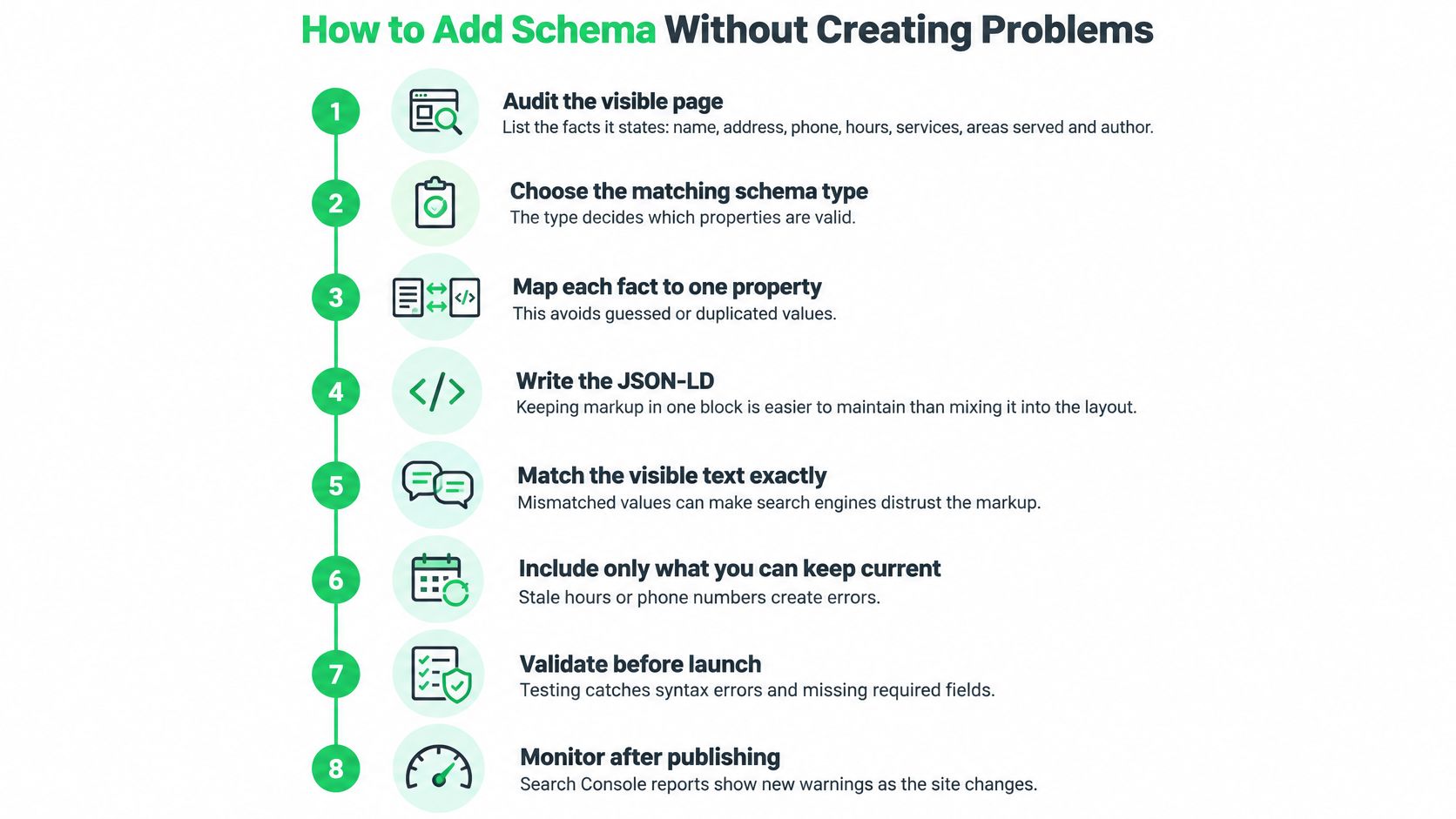
Audit the visible page. Record the business name, address, phone, hours, services, areas served and named author where applicable. A page-level inventory prevents assumptions from entering the markup.
Choose the matching type. Select the most specific accurate business or content type. A service page and an author biography describe different things, even when both belong to the same company.
Map facts into JSON-LD. Include only substantiated properties and keep contact details consistent with the site footer and Business Profile. A dental practice shouldn't insert unpublished prices or services just because a field is available.
Integrate the script into the template. Maintain a consistent business identity across the site, with page-specific entities connected to it. Check whether the theme, SEO plugin and custom code already output overlapping organisation details.
Validate syntax and Search eligibility. Use Google's Rich Results Test for supported Google features and the Schema Markup Validator for vocabulary and syntax checks. The tools answer different questions, so a result from either shouldn't be treated as a complete audit.
Deploy to representative pages first. Test the homepage, a service page and other relevant template types before a site-wide rollout. This makes template errors easier to identify and reverse.
Monitor after publishing. Check applicable rich-result status reports in Search Console and investigate new errors. Not every valid schema type has a dedicated enhancement report.
Re-audit after changes. Redesigns, plugin updates, relocated premises and new locations can alter previously correct markup. Maintenance needs a named owner rather than an assumption that the plugin will handle everything.
The following visual summarises the checks that support a reliable implementation.
Effort, cost and quality control
There's no defensible universal price for this work. A small CMS-based site may be manageable in-house using a plugin and manual checking, while a multi-location business or custom-built website may need a developer to handle templates, entity relationships and deployment.
The larger cost often comes from reconciling unclear business information, not writing the JSON-LD itself. Conflicting addresses, duplicated location pages and undocumented plugin output need investigation before automation is sensible.
A clean validation result confirms technical checks, not a commercial outcome. It doesn't guarantee a rich result, an AI citation or an enquiry.
Schema should sit within a broader small-business technical SEO checklist. That keeps implementation connected to crawlability, page templates and ongoing site maintenance rather than treating it as an isolated code insertion.
How to Measure Whether Schema Is Making a Difference
Attribution is the difficult part. Content edits, new links, ranking changes, seasonality and technical fixes can all coincide with a schema deployment, while AI referrals may be incomplete or unattributed.
An Australian measurement framework outlined by Aemorph combines search visibility, indexing, Business Profile actions, conversions and observable AI mentions. That's a more useful starting point than assuming an increase in citations proves that markup worked.
Build a comparison before drawing a conclusion
Record baseline performance before deployment. Select accurately marked-up pages and comparable pages without the new markup, ideally covering similar services with similar demand and existing visibility.
Keep other changes separate where practical. When content, internal links and schema must change together, record the work as a combined intervention rather than attributing the outcome to structured data alone.
For low-volume local services, a useful observation window may require months rather than weeks. The right window should cover normal demand fluctuations and enough enquiries to avoid drawing conclusions from an isolated call.
Metrics for judging schema's indirect effect
| Metric | Where to find it | What it suggests | Limit |
|---|---|---|---|
| Indexed pages for marked-up URLs | Search Console Pages report | Indexing, a prerequisite for normal Search eligibility | Doesn't establish AI answer selection |
| Rich-result status and errors | Search Console enhancement reports | Supported markup has been detected; reported issues can be checked | Doesn't guarantee a visible result |
| Branded and suburb-query impressions | Search Console performance, filtered by query | Visibility for relevant local demand | Other changes can affect impressions |
| Google Business Profile actions, including calls, directions and website clicks | Business Profile performance | Local discovery and intent | Profile edits can also affect activity |
| Calls and form submissions from landing pages | Call tracking and form analytics | Actual enquiries | Tracking must work before deployment |
| Referrals from AI platforms | Analytics referral reports | Visits arriving from identifiable AI tools | Incomplete; an answer may produce no click |
| Sampled AI answer mentions | Fixed-query manual or tool-based checks | Whether the business appears in sampled answers | Sensitive to location, time and user context |
For sampled AI checks, keep the query list, location settings and checking method consistent. Record the cited URL as well as the business name, because a mention and a citation to the changed page aren't the same observation.
Measurement safeguard: A visibility change is a signal to investigate, not automatic evidence of causation.
The possibility that AI search reduces website clicks makes enquiry quality and assisted discovery important alongside visits. A business can attract fewer clicks without necessarily losing every commercial benefit, but that possibility still needs evidence from calls, forms and customer journeys.
AI mention counts shouldn't be reported as schema return on investment. Nor should a lead be credited to schema when a Business Profile update or substantial content improvement happened during the same reporting period.
Limits, Mistakes and What the Evidence Still Lacks
Schema isn't required for generative AI search, and a citation uplift caused by schema alone hasn't been established. An Australian AI Overviews guide from ROI.com.au summarises controlled testing that found no meaningful citation increase after schema was added, despite an observed association between AI-cited pages and JSON-LD.
That association needs careful interpretation. Better-maintained websites may be more likely to have both structured data and the content, reputation and technical quality that support discovery. The markup's presence doesn't identify which factor caused the citation.
What the evidence doesn't settle
Public evidence includes experiments and vendor analyses with different page populations, platforms and measurement methods. A result from an established, frequently cited website may not answer what happens to an unfamiliar local business with an ambiguous name.
That uncertainty doesn't justify promising a benefit. It supports a narrower judgement: entity clarification is a reasonable implementation objective, while an Australia-specific citation or lead uplift remains unproven.
For Bing's AI experiences and other assistants, the evidence discussed here is largely Google-focused. Each platform's published guidance should be checked before assuming the same indexing, retrieval or structured-data behaviour applies.
Mistakes that turn a supporting layer into a distraction
Schema won't repair thin service pages, inaccessible URLs or conflicting business details across the web. Hidden reviews and unpublished FAQs also remain unsuitable material for markup, regardless of whether a validator accepts the code.
Beyond the implementation checks, common strategic mistakes include:
- Copying identical markup everywhere: Each page should describe its own purpose, not merely repeat a generic business block.
- Stuffing descriptions with keywords: Properties should communicate facts rather than lists of suburbs and search phrases.
- Treating plugin output as a strategy: Automation still needs a page-level reason for each entity and relationship.
- Expecting ranking jumps: A deployment date isn't a deadline for improved rankings or enquiries.
- Equating validation with impact: Technical acceptance doesn't demonstrate that search systems changed their presentation or source selection.
The maintenance process should catch stale opening hours, conflicting identities and unsupported claims. Those are operational defects, not advanced AI optimisation opportunities.
Professional help becomes sensible when a business has multiple locations, an e-commerce catalogue, custom templates or markup changes that affect rendering and performance. The purpose of that assistance should be accurate implementation and controlled testing, not a guaranteed AI-search outcome.
Confirm Your Core Pages Before Adding More Schema
Schema is worth maintaining once the foundations are in place. For a local service business, those foundations are indexed core pages, crawlable service information, an accurate Google Business Profile, useful visible content and working enquiry tracking.
A short readiness check is more useful than another bulk schema deployment:
- Confirm commercial access: Check the homepage, about page and priority service pages in Search Console. Investigate unexpected exclusions before adding more markup.
- Reconcile business details: Compare the published name, address, phone and hours with the Business Profile and important directories. Resolve genuine discrepancies rather than reproducing them.
- Choose a manageable scope: Begin with the business identity and priority service pages, using the implementation process and measurement framework above.
- Review before expanding: Assess errors, search presentation and enquiry evidence after a suitable observation window. Extend markup to location or editorial pages only where the content justifies it.
Thin pages need better information first. Pages that search engines struggle to access need technical remediation, and a site without editing access will usually require cooperation from its developer or agency.
The decision rule is straightforward: maintain structured data that describes a real, useful website. Don't build an AI-search strategy around properties that can be added more easily than their value can be demonstrated.
SEO2RANK offers a free high-level SEO Snapshot and a paid Full SEO Audit & Strategy for deeper checks of indexing, local signals and structured data. Businesses seeking a practical assessment can visit SEO2RANK to choose an appropriate starting point, without any guaranteed AI-search outcome.
Find Out What Is Holding Your
Website Back
Get a practical SEO Snapshot showing the biggest issues and opportunities we can see across your search visibility, website and local presence.
Get Your Free SEO Snapshot→