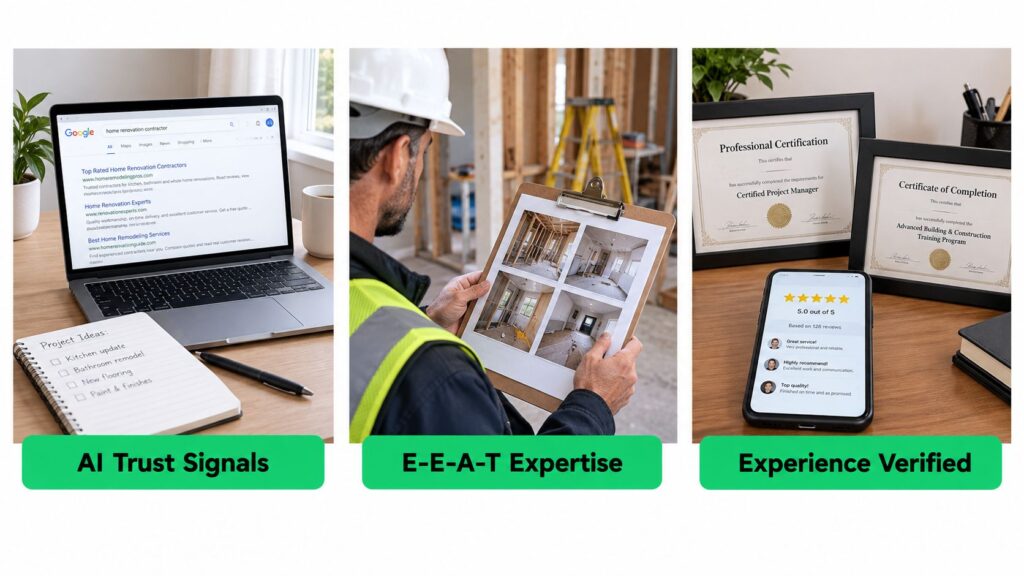
E-E-A-T in the age of AI search is not a neat Google ranking checkbox. It's the proof layer that tells both search systems and customers whether a Melbourne business is real, competent, and worth trusting. If a page can't show experience, expertise, authoritativeness, and trustworthiness, AI summaries are far more likely to ignore it, flatten it, or quote it badly.
Table of Contents
- What E-E-A-T Actually Means Beyond the Acronym
- The Four Pillars in Plain English for Service Businesses
- How AI Search Changes the Weighting of Trust Signals
- What Verifiable Experience Looks Like in Practice
- A Small-Business Playbook for Building E-E-A-T Signals
- Why AI Citations Are an Intermediate Signal Not the Prize
- Common Mistakes and Where to Start This Quarter
What E-E-A-T Actually Means Beyond the Acronym
Google has never treated E-E-A-T as a single ranking factor, and that's the first thing to get straight. It's a way of judging whether content looks useful, credible, and made by people who know the topic, rather than by a machine churning out safe-sounding text. In AI search, that matters even more because the system is compressing the web into answers, not just listing pages.
For a tradie, it's the difference between a quote that feels grounded and one that reads like a brochure. A plumber who's repaired heritage pipework in Northcote, a dentist who can show qualifications and clinical review, or an accountant who publishes under a named practitioner with proper credentials has something an AI can verify and a homeowner can trust. That's the job of E-E-A-T now.
The part most businesses get wrong
Too many owners still think E-E-A-T is about writing more content. It isn't. It's about making the source of the content obvious, checkable, and tied to real-world work.
Practical rule: if a claim can't be checked, it shouldn't be on the page.
That's why AI search has sharpened the stakes. A page that reads fine to a human can still fail the machine test if it doesn't clearly show who is speaking, what they've done, and why anyone should believe them. In other words, What E-E-A-T Means in the Age of AI Search is simple. It's a verification system, not a writing style.
The Four Pillars in Plain English for Service Businesses
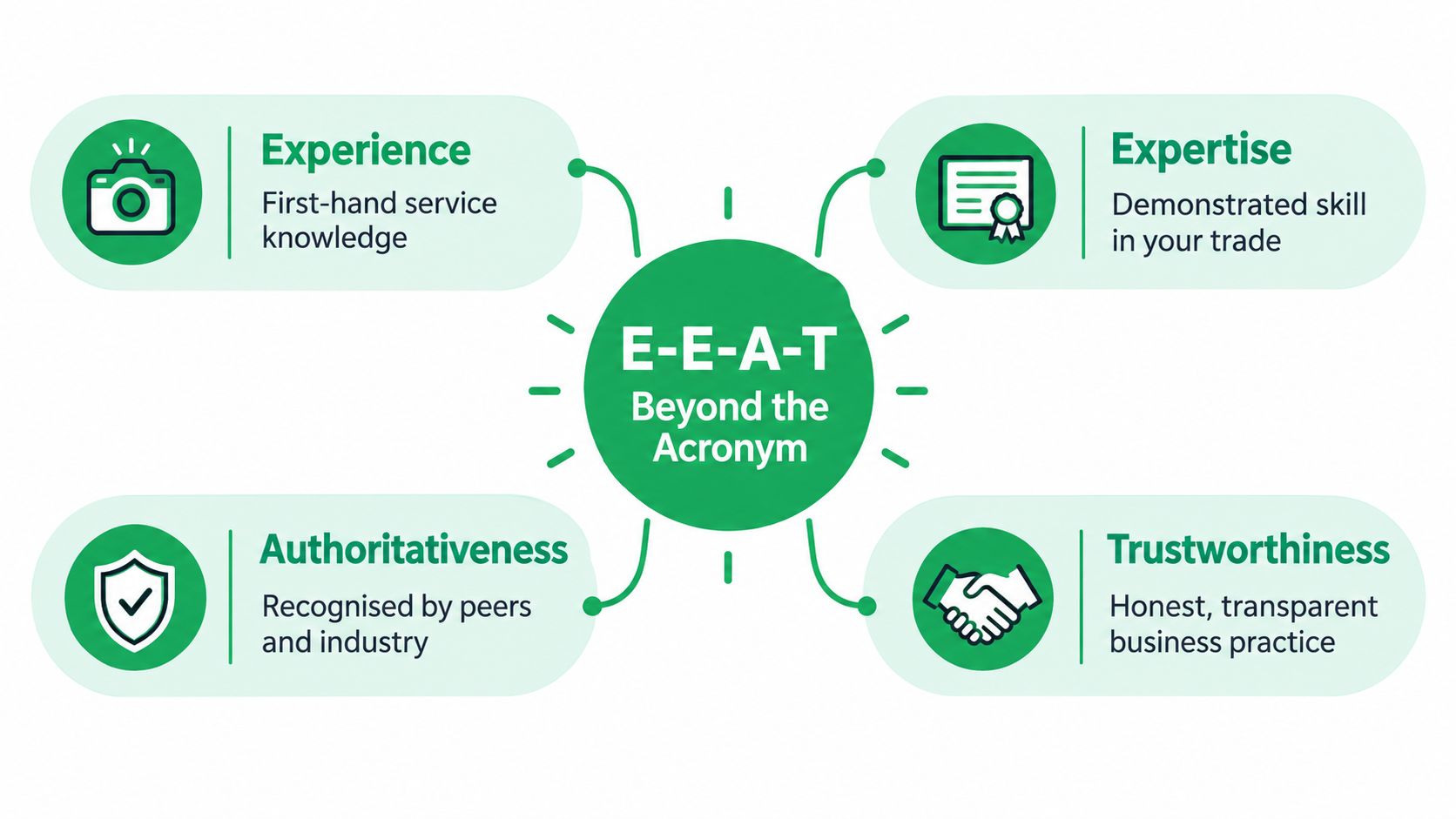
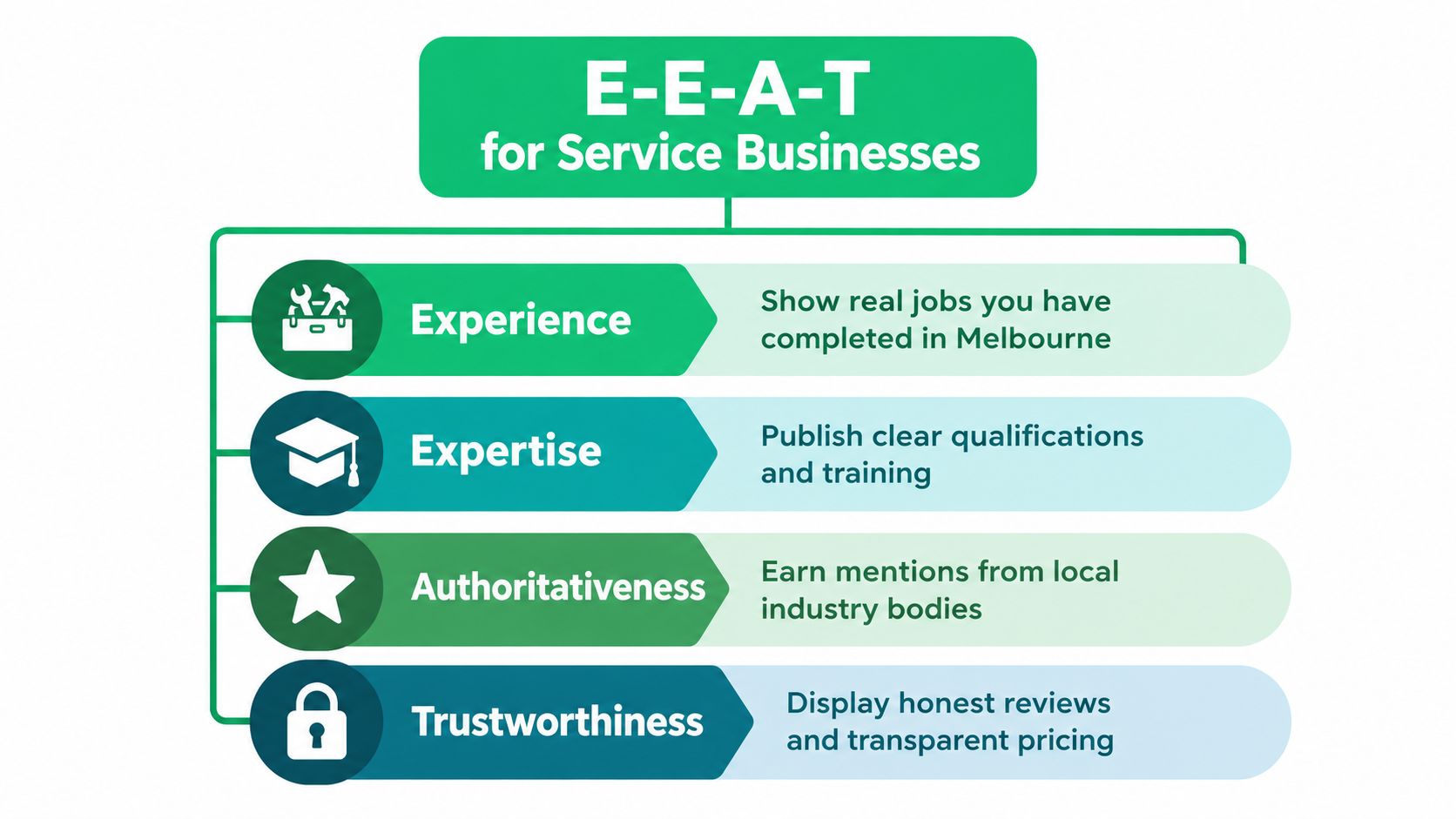
Each pillar only matters when it leaves evidence behind. Experience means first-hand work, not vague confidence. Expertise means the person or business can prove subject knowledge. Authoritativeness means other credible places recognise the business. Trustworthiness means the website and the business don't hide behind fluff.
Experience and expertise
A plumber showing a dated photo set from a re-pipe job in a Carlton terrace proves more than a page full of “decades of experience” copy. A dentist with a named practitioner page and clear clinical credentials does the same. An accountant who links the author bio to qualifications and professional memberships gives both users and AI something concrete to work with.
Authoritativeness and trustworthiness
Authoritativeness is mostly external. Reviews, mentions, citations, and consistent business details across the web tell search systems that the business exists in the world and is talked about by others. Trustworthiness is more operational, which means ownership, accurate contact details, clear correction processes, and no false claims.
Here's the blunt version.
| Pillar | What it needs |
|---|---|
| Experience | Real jobs, real photos, real service-area detail |
| Expertise | Qualifications, training, specialist knowledge |
| Authoritativeness | Reviews, mentions, citations, consistent business identity |
| Trustworthiness | Accurate claims, clear contact details, correction process |
Small Melbourne operators usually fall down hardest on authoritativeness and visible experience. That hurts most in AI-mediated results because there's no long scroll of blue links to rescue a weak brand story.
How AI Search Changes the Weighting of Trust Signals
AI search compresses the web into a short answer, and that changes what gets noticed. A classic search result can afford to show a page that's merely decent. An AI answer has to choose a handful of sources, and it leans harder on signals it can verify quickly, especially when the topic affects money, health, or local service decisions.
Australian trust conditions make this more serious. KPMG's 2025 Australia snapshot found that only 36% of Australians were willing to trust AI, while 46% believed AI risks outweigh its benefits. It also found that 77% were unsure whether online content could be trusted because it might be AI-generated, and 90% wanted laws or action to combat AI-generated misinformation. That is a credibility gap, not a branding nuance. KPMG's 2025 Australia snapshot on trust in AI
Classic ranking versus AI summarisation
| Signal | Classic ranking | AI summarisation |
|---|---|---|
| Keywords and backlinks | Important | Still useful, but not enough |
| Verified reviews | Helpful | Much more influential |
| Business consistency | Helpful | Critical |
| Author credentials | Helpful | Heavily weighted |
| Clear sourcing | Nice to have | Expected |
The point isn't that old SEO stopped working. It's that AI search demands a tighter proof chain. Google says E-E-A-T isn't a direct ranking factor, and its systems use multiple signals to find helpful, reliable content. Google also says AI-generated content gets no special advantage and becomes a problem when it's used to manipulate rankings, which is why AI-assisted drafts need subject-matter review and local validation. Google's guidance on creating helpful content
What schema markup does for search visibility
AI doesn't need more words. It needs fewer weak claims and more checkable ones.
What Verifiable Experience Looks Like in Practice
A strong service page reads like a record of work, not a marketing exercise. A weak page sounds polished, but it hides the very things that prove the business can do the job. AI search tends to prefer the first version because it can be checked, summarised, and linked back to a real entity.

The version that holds up
A Melbourne plumber publishes a case note about a blocked sewer in Brunswick. The page includes the suburb, the problem, the method used, dated before-and-after photos, the name of the licensed plumber, and a plain explanation of what was done and what wasn't necessary. That sort of page survives AI summarisation because it gives a machine and a customer the same thing, evidence.
A dental practice can do the same with a procedure explainer reviewed by a named clinician, not “the team”. An accounting firm can post a tax note with the author's credentials, the review date, and a link to a relevant professional body. That's the difference between content and proof.
The version that gets ignored
Generic copy has none of that. It says the business is trusted, experienced, and local, but it doesn't name the person, show the job, or explain the method. AI systems have very little to work with, so the page gets flattened into something forgettable or, worse, misread.
How a Melbourne dentist can strengthen search trust
The rule is simple. If the page can't show who did the work, when it was done, and how the claim was checked, it's weak E-E-A-T.
A Small-Business Playbook for Building E-E-A-T Signals
Start with the local stuff, because that's where service businesses usually win or lose trust fastest. A complete Google Business Profile, consistent suburb and service-area pages, and independent reviews build a trail that search systems can cross-check. For Melbourne firms, a matching NAP, clear areas served, and realistic service descriptions matter more than broad claims about being “Australia's favourite” anything.
What to fix first
- Local proof: Tighten business details everywhere they appear, then make sure suburb pages say what work is done in each area.
- On-page proof: Add named author bios, qualifications, review dates, source references, and clear notes on whether AI helped draft the page.
- Technical proof: Use structured data for organisation and author pages, make sure the site is crawlable, and keep the pages that show evidence easy to reach.
- Measurement proof: Track whether the work brings better enquiries, not just more impressions.
The privacy layer most guides skip
Australian privacy law matters here. The Privacy Act 1988 and the Australian Privacy Principles apply when AI systems handle personal information, and the OAIC says organisations must meet the accuracy obligation in Australian Privacy Principle 10 when using AI. The OAIC also recommends not entering personal information, especially sensitive information, into publicly available generative AI tools because the privacy risks are significant. OAIC guidance on commercially available AI products OAIC guidance on AI and privacy obligations
For a small team, that means one clean rulebook. Use AI for drafting if needed, but keep a named human reviewer, keep customer data out of prompts, and correct any claim that can't be verified on the site itself. That approach is practical, not paranoid.
Why Google reviews matter for local authority
Why AI Citations Are an Intermediate Signal Not the Prize
A mention in an AI answer is useful, but it isn't the finish line. If the user can't verify the business after seeing that mention, the citation can do very little commercially. In some cases it can even backfire, because the page behind the mention may look thinner than the answer that referenced it.
Australian buying behaviour makes that point obvious. Research reported that 88% of consumers found customer reviews useful, 87% said the same about ratings, and 62% were at least occasionally influenced by both during the path to purchase. Another Australian study reported that 78% of shoppers were anxious about fraudulent reviews and 32% had encountered fraudulent content while shopping online. That's why credibility beats volume. Australian advertising and fake review findings
What to measure instead
- Branded search lift: Are more people searching the business name after seeing the content?
- Calls and form submissions: Are real enquiries rising, not just traffic?
- Google Business Profile actions: Are users engaging with directions, calls, or website clicks?
- Review quality and independence: Are reviews specific, recent, and believable?
- Assisted conversions: Did the page support an enquiry even if it wasn't the last click?
- Claim verification: Can a prospect check the page and confirm the service details without guesswork?
There's also a hard warning here. Australian research found that 29% trust AI-generated search summaries, only 3% would buy solely on an AI recommendation, and 52% considered sponsored AI answers less trustworthy than organic responses. Australian research on AI search and purchase decisions If a business is cited by an AI but can't back up the claim on its own site, that citation is closer to a liability than an asset.
Why AI search can reduce website clicks
Common Mistakes and Where to Start This Quarter
The biggest mistake is anonymity. Anonymous about pages, undated case studies, and “team” authorship tell both humans and machines to keep moving. The next mistake is inconsistency, where the business name, service area, or phone number changes from page to page or listing to listing.
A tight first quarter looks like this.
- Fix the ownership trail. Add named authors, reviewer fields, and a proper about page.
- Publish one or two proof pages. Use real jobs, real dates, and real photos.
- Clean the business identity. Match details across the website, Google Business Profile, and key citations.
- Set an AI-use rule. Keep personal information out of prompts and require human review for claims.
- Track enquiry quality. Watch whether the work brings better leads, not just more visibility.
If the internal team doesn't have time for that, get help from a Melbourne SEO operator who knows local service businesses and doesn't just chase keywords. The work here is part content, part technical hygiene, and part trust management, so it needs someone who can handle all three without turning the site into fluff.
SEO2RANK helps Melbourne service businesses build search visibility through local, technical, on-page, and measurement work that's tied to real proof, not vague content. For a site that needs stronger E-E-A-T signals in AI search, visit SEO2RANK and see how a practical audit-and-implementation process can turn weak pages into verifiable ones.
Find Out What Is Holding Your
Website Back
Get a practical SEO Snapshot showing the biggest issues and opportunities we can see across your search visibility, website and local presence.
GET YOUR FREE SEO SNAPSHOT