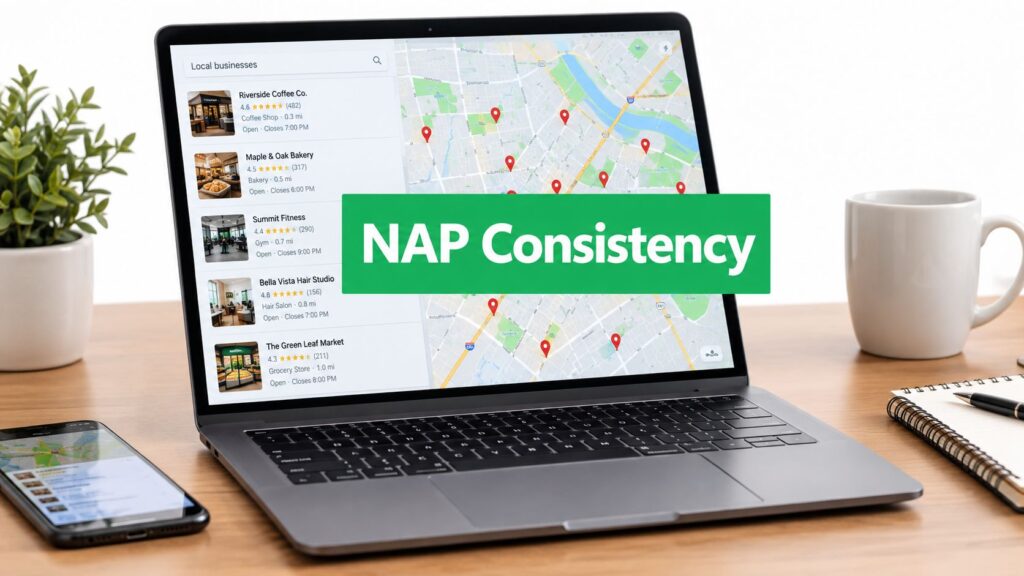
NAP means Name, Address and Phone, and the business name matters because every variation, including DBAs, abbreviations and keyword stuffing, can weaken local search visibility and user trust. A business should choose one accurate, real-world name and use it consistently across its website, Google Business Profile and relevant directories.
A Melbourne service business often discovers the problem after a customer says, “The phone number online doesn't match,” or a directory displays an old suburb, shortened trading name or different suite format. The issue rarely comes from one dramatic error. It usually develops through small edits made over time, each creating another version of the business identity.
NAP consistency is best understood as a canonical data problem, not a cosmetic formatting preference. The business needs one source-of-truth record, then a process for keeping that record aligned wherever customers and search engines find it.
Table of Contents
- What NAP Consistency Actually Means
- Why NAP Consistency Matters for Local Search
- Business Name Variations, DBAs and Keyword Stuffing
- How to Audit Your Current NAP Across the Web
- Step-by-Step Fixes for NAP Inconsistencies
- A Melbourne Service Business Example
- Monitoring NAP and Keeping It Clean Over Time
What NAP Consistency Actually Means
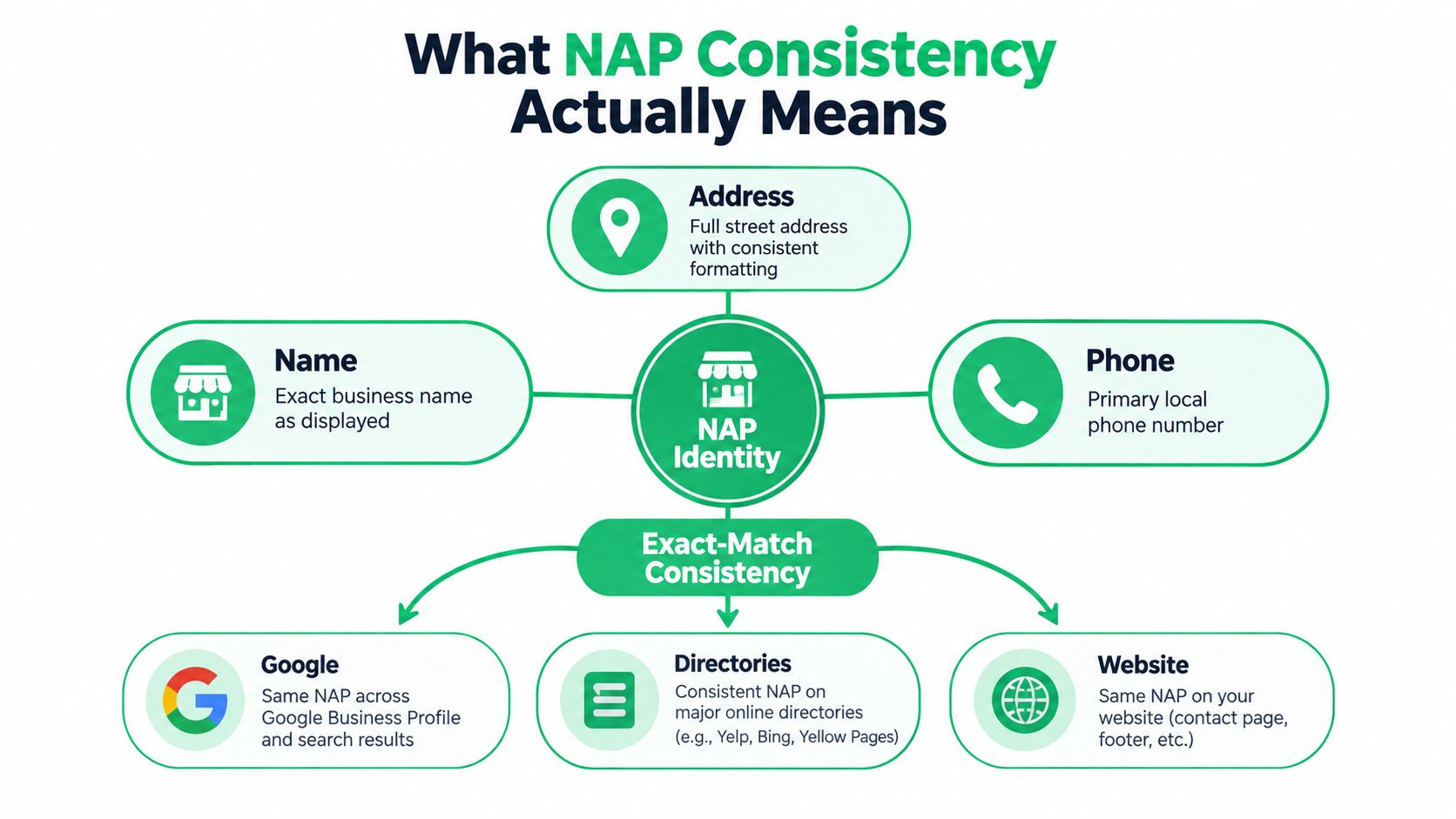
NAP is the combination of the business Name, Address and Phone number. These three fields identify a local business across Google Business Profile, the company website, social profiles, directories and other online mentions. Australian local SEO guidance recommends using one canonical format across platforms, including Australian directories such as True Local and Yellow Pages AU.
Consider a plumbing business that appears online as:
- Coburg Plumbing, 18 Bell Street, Coburg VIC, 03 9000 0000
- Coburg Plumbing Services, 18 Bell St, Coburg, (03) 9000 0000
- Coburg Plumbing Pty Ltd, Level 2, 18 Bell Street, Coburg VIC, +61 3 9000 0000
- Coburg Plumbers Melbourne, Suite 2, 18 Bell Road, Coburg VIC, 03 9000 0000
A person may understand that these listings probably refer to the same company. Search engines still need to reconcile those records before treating them as one business entity. The Australian view of NAP management is therefore operational: document one master version, publish it consistently, and audit listings regularly after changes to the address, phone number or trading name, as explained in this Australian NAP consistency guide.
Exact matching versus sensible normalisation
The practical target is one canonical representation, not panic over every punctuation mark. Businesses should standardise the parts they control, such as the business name, street number, suburb, state, postcode, suite notation and phone digits. A directory might display an address differently because its interface applies its own formatting, but the underlying facts must remain correct.
Practical rule: If a customer could arrive at the wrong place or call the wrong number, treat the variation as urgent. If a platform changes “Street” to “St” while keeping the same location, treat it as a lower-priority formatting issue.
The same principle applies to structured data. A website's visible contact details and its schema markup should describe the same business, rather than presenting another name or phone number in machine-readable code.
NAP consistency is therefore closer to a database control than a branding exercise. A canonical record helps search engines connect citations to one entity, helps customers recognise the business, and gives staff a reliable reference whenever a new profile or directory listing appears.
Why NAP Consistency Matters for Local Search
NAP affects local search in two connected ways. First, it helps search engines verify that the business is legitimate and located where it claims to operate. Australian guidance describes citation consistency and citation volume as part of Google's verification logic, which is why businesses are advised to standardise their details across the website, Google Business Profile and directories, as outlined in this Australian citations and NAP resource.
Second, NAP affects human confidence. A customer searching for a Melbourne electrician may see “Northside Electrical” on Google, “Northside Electrical Services” on a directory and a different phone format on Facebook. Even if every number reaches the same office, the mismatch creates friction. Customers may wonder whether one listing is outdated, duplicated or associated with another company.
The machine-readable signal
Search engines compare business records across sources. Contradictory names, addresses or phone numbers make it harder to determine which record is authoritative. That doesn't mean one abbreviated street suffix automatically removes a business from local results. It means unresolved factual conflicts, duplicate profiles and stale contact details can dilute the confidence attached to the entity.
A clean local presence usually has:
- One business identity: The public-facing name stays stable across profiles.
- One location record: Suite or unit details, street number, suburb, state and postcode describe the same premises.
- One primary phone: The core local number remains consistent wherever permanent business data is published.
A business can have strong service pages and still create local confusion if its citations contradict one another. The wider local SEO framework matters too, including relevance, website quality and location signals, but NAP is a sensible foundation because it confirms what the business is and where customers can find it.
The customer trust signal
Customers cross-check details before calling, visiting or requesting directions. A wrong phone number produces a missed enquiry. An old address sends a visitor to the wrong location. A name that changes from listing to listing makes the company appear less established, even when the underlying business is genuine.
| Factor | Inconsistent NAP | Consistent NAP |
|---|---|---|
| Business name | Several versions split recognition | One real-world identity |
| Address | Conflicting suites, streets or suburbs | One confirmed location format |
| Phone | Old, duplicated or differently assigned numbers | One primary contact number |
| Search interpretation | More records require reconciliation | Clearer entity alignment |
| Customer experience | Doubt, failed calls or wrong directions | Easier verification and contact |
The responsible conclusion is measured. NAP cleanup supports local authority and trust, but it isn't a standalone ranking trick. If core listings are accurate and visibility remains weak, the business may need to examine website accessibility, service relevance, reviews, competition and other local SEO factors.
Business Name Variations, DBAs and Keyword Stuffing
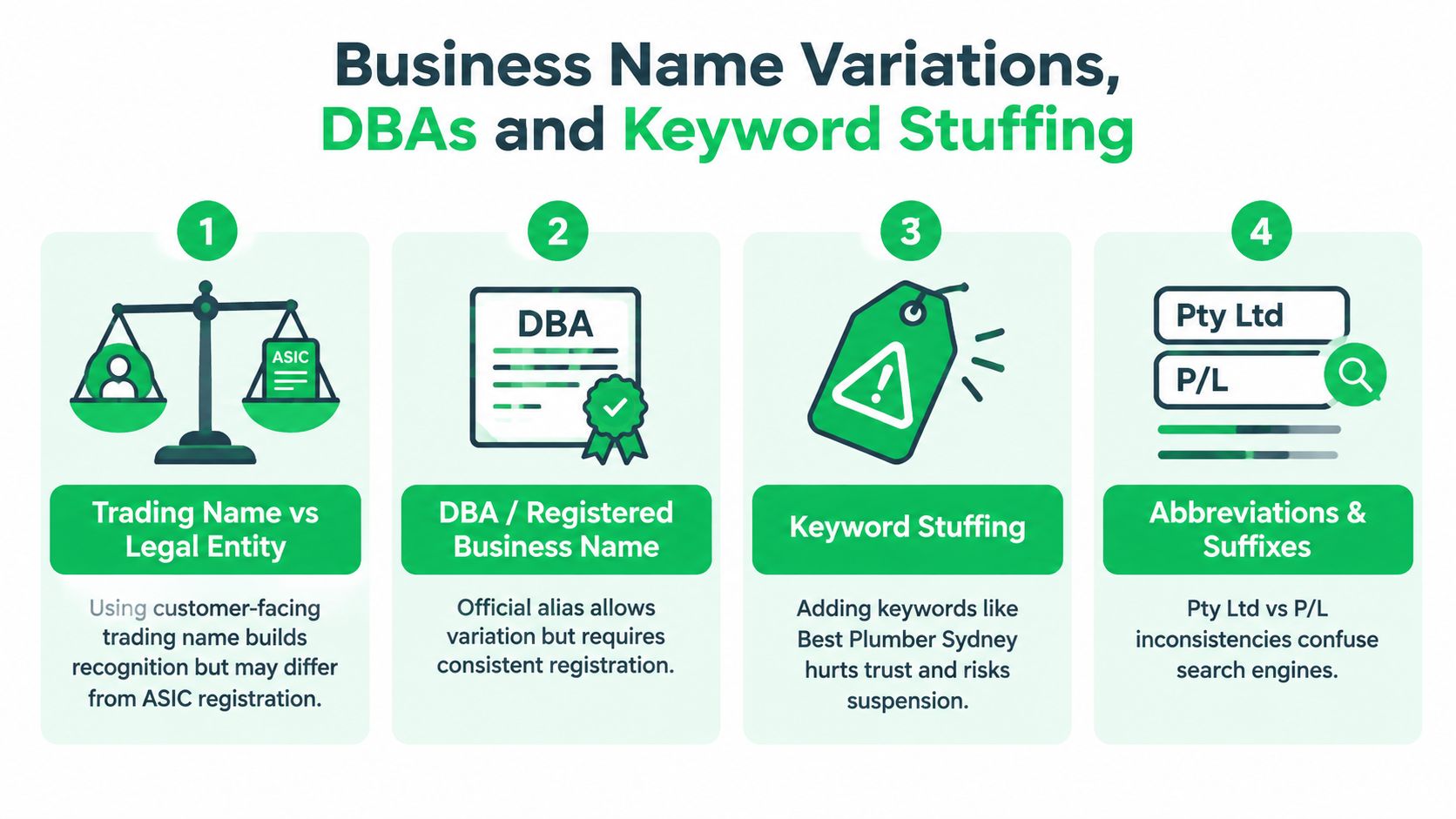
The legal entity name isn't automatically the right public-facing NAP name. Australian businesses often trade under a name customers see on signage, invoices, vehicles and the website, while the registered entity carries a different suffix or structure. Google's guidance says the profile name should reflect the business name used consistently on signage, the website, stationery and with customers. Australian businesses may also need to consider ASIC and ABR records alongside their customer-facing identity, as discussed in this Australian guide to NAP naming.
Trading name versus legal entity
“Coburg Plumbing Pty Ltd” may be the legal entity, while “Coburg Plumbing” is the name displayed on the van and website. If the latter is the genuine customer-facing trading identity, it can be the canonical public NAP name. The legal entity still belongs in places where legal identification is required, such as formal terms, invoices or registration records.
The important point is consistency. Google Business Profile, the website footer and Yelp Australia shouldn't each choose a different version without a real-world reason.
Registered business names and DBAs
A registered business name or DBA can legitimately differ from the legal entity name. That variation should be documented and used consistently where customers encounter it. Registration alone doesn't justify adding extra words to a profile. The public name should remain the name the business presents to customers.
Abbreviations and suffixes
“St” and “Street”, “Pty Ltd” and “P/L”, or “Plumbing & Gas” and “Plumbing and Gas Services” can create avoidable variation. Australian guidance recommends locking the canonical business name and reusing it across citations, with the exact trading name preferred when it differs from the registered entity suffix, as explained by this local citations guide.
A directory may impose its own display rules, but every editable profile should use the chosen version. The same discipline applies to suite notation and phone formatting.
Keyword-stuffed names
“Best Melbourne Plumber, 24/7 Emergency” isn't an acceptable replacement for a real business name merely because it contains useful search terms. Keyword stuffing misrepresents the business identity, reduces customer trust and can breach Google's Business Profile guidelines, creating a suspension risk.
For the Coburg example, Coburg Plumbing should be standardised if that is the name used on signage and customer-facing assets. “Coburg Plumbing Pty Ltd” can remain in legal contexts, while “Best Melbourne Plumber” should not be inserted into the Google Business Profile name unless it is the real-world name.
A careful Google Business Profile optimisation process should protect the business identity rather than turn the name field into an advertisement.
How to Audit Your Current NAP Across the Web
A useful audit starts before any listing gets edited. Changing profiles without first choosing the canonical record can spread a new inconsistency instead of removing the old one.
Step one, create the master record
The business should record:
- Canonical name: The trading name used with customers, including a decision on whether the legal suffix belongs in public listings.
- Canonical address: Street number, street name, suite or unit, suburb, state and postcode.
- Canonical phone: The primary local number, with one preferred Australian display format.
The master record should sit in a shared spreadsheet. It becomes the reference for the website, Google Business Profile, directories and staff-created listings.
Step two, crawl the citation environment
A citation checker or manual search can identify existing profiles, duplicates, old addresses and unclaimed listings. Data sources such as Data.com and Localeze can be investigated where relevant, then the business can review the major platforms and industry directories that matter for its location and service category.
A report should be read by severity, not by visual neatness. An old phone number, incorrect street number or duplicate profile deserves attention before a harmless display change from “Street” to “St”.
Step three, compare fields at string level
A spreadsheet makes hidden differences easier to see. Separate columns for name, address, suite, suburb, postcode and phone digits can expose:
- Name variations: Missing words, extra suffixes or keyword additions.
- Address variations: “Road” versus “Rd”, missing units or incorrect street numbers.
- Phone variations: Different digits, old numbers, country-code differences or spacing changes.
| Field | Common variation | Severity | Recommended form |
|---|---|---|---|
| Name | Trading name versus legal suffix | Medium to high, depending on real-world use | One genuine customer-facing name |
| Address | Suite omitted or formatted differently | Medium | Full address in the chosen canonical format |
| Phone | Old number or different digits | High | Current primary number |
| Street suffix | “St” versus “Street” | Usually lower | Preferred standard where editable |
| Duplicate profile | Two records for one location | High | Claim, merge or remove the duplicate |
Some directories will never display the exact same punctuation or abbreviation because their templates control the output. The aim is factual alignment and clear entity matching, not endless cosmetic editing. A structured SEO audit can help place NAP findings beside technical and on-page issues, so the business fixes the most consequential problems first.
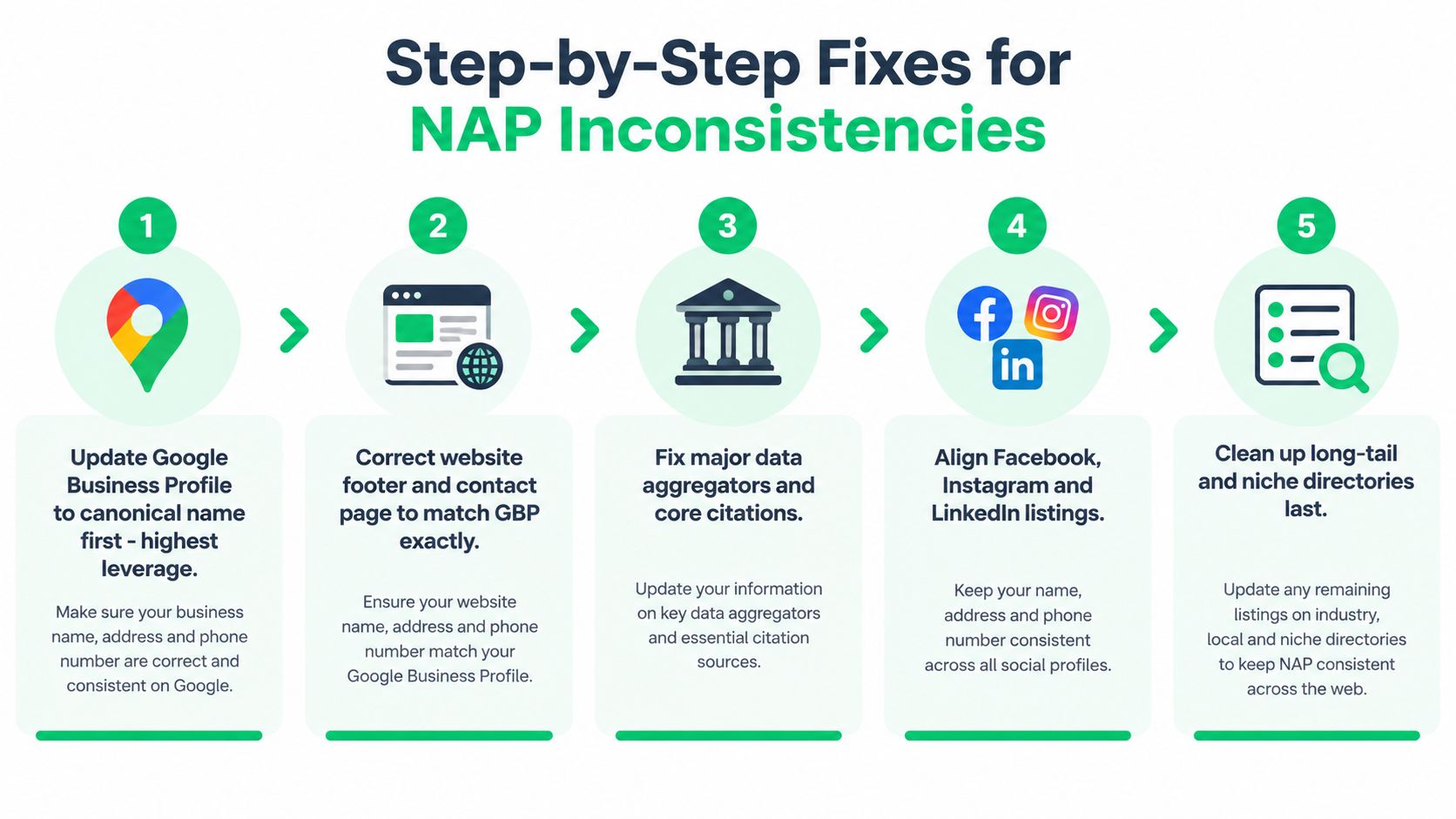
Step-by-Step Fixes for NAP Inconsistencies
Fixes should follow the path of influence, starting with the sources customers and search engines rely on most. A business that edits dozens of minor directories before correcting Google Business Profile has usually started at the wrong end.
1. Correct Google Business Profile
Update the profile to the agreed canonical name, address and primary phone. The name field shouldn't contain suburb modifiers, service keywords or promotional claims that aren't part of the official business name.
2. Align the website
The header, footer and contact page should show the same NAP. LocalBusiness or relevant industry schema should describe the same entity and match the visible content. A mismatch between the page and JSON-LD creates another version of the record for machines to interpret.
3. Repair major data sources
Correct the central data providers that distribute business information to other directories. Fixing a source record can be more durable than editing each downstream profile individually, particularly when an old phone number or address keeps returning.
4. Claim core profiles
Review Apple Maps, Bing Places, Facebook, Yelp and relevant industry platforms. Claiming profiles gives the business greater control over edits, duplicate handling and future changes.
5. Clean up long-tail listings
Work through smaller directories after the core records are stable. Submit direct correction or removal requests where possible, and record the request date, contact method, result and next review date.
What happens after submission
Directory changes may not appear immediately. Platforms can require verification, manual review or ownership checks, while search engines need time to revisit and reconcile updated records. A locked profile should be handled through the platform's official support or verification process, not replaced with a duplicate listing.
The business should log each correction in a spreadsheet containing the source, profile URL, old information, corrected information, date submitted, status and re-check date. For Melbourne businesses that need help coordinating audits, implementation and reporting, SEO2RANK offers local SEO work that includes citation and NAP management alongside related search optimisation.
A Melbourne Service Business Example
A plumbing business serving Melbourne's inner suburbs has a legal entity called Richmond Plumbing Solutions Pty Ltd. Its vans and signage use Richmond Plumbing, while its Google Business Profile has been edited to read Best Richmond Plumber, 24/7 Emergency.
The audit finds three practical problems. One directory lists the premises as a street, another uses the same number with “Road”, and a third omits the suite. The phone appears in Australian local format on the website but with a country code on another profile. Facebook uses the shortened name Richmond Plumbers, which customers recognise, but which doesn't match the chosen canonical identity.
The business chooses Richmond Plumbing because that is the customer-facing trading name used on signage and service materials. The owner records one address format and one primary phone format, then applies the changes in a sensible order:
- Google Business Profile is corrected without the promotional wording.
- The website footer, contact page and structured data are aligned.
- Major data sources and core directories are updated.
- Facebook, Apple Maps, Bing Places and Yelp are reviewed.
- Remaining directory duplicates and stale profiles receive correction or removal requests.
Search engines and directories don't all refresh at the same pace, so visibility changes shouldn't be judged immediately after submission. The business monitors re-crawling and listing status over the following period, then checks whether suburb-specific discovery, calls and direction requests are becoming easier to interpret.
That scenario demonstrates the value of normalisation without promising a guaranteed ranking outcome. If visibility improves, NAP may have removed a source of uncertainty, but service relevance, competition, reviews, website quality and profile completeness can also influence the result.
Monitoring NAP and Keeping It Clean Over Time
NAP cleanup works best as a repeatable maintenance routine. A new employee can create a profile, a directory can import an old record, or a business move can leave stale details behind even after the website has been updated.
A practical monthly check can include:
- Master-string scan: Search the business name, address and phone against the main citation sources.
- Profile review: Check Google Business Profile for unexpected edits, duplicate records or status changes.
- New-source check: Look for newly created listings that repeat outdated information.
A deeper quarterly review can combine a citation tool with manual checks of Yelp, True Local, Yellow Pages, Apple Maps and Bing Places. The shared spreadsheet should record the source, URL, current listing, corrected listing, date fixed and re-check date, so responsibility doesn't disappear between staff members.
Australian guidance also supports regular governance, with some local SEO recommendations calling for audits at least twice a year and ongoing monitoring after business detail changes, as described in this Australian local SEO guide. The exact schedule can depend on how often the business changes locations, phone numbers, trading names or staff responsibilities.
The next task can be simple: open the spreadsheet, choose the most important unresolved listing, and assign its correction before five minutes have passed.
SEO2RANK helps Melbourne service businesses audit and improve local visibility, including Google Business Profile, citations, NAP consistency, location pages, technical SEO and measurement. Businesses can visit SEO2RANK to review the available local SEO support and choose a practical next step for cleaning up their search presence.
Find Out What Is Holding Your
Website Back
Get a practical SEO Snapshot showing the biggest issues and opportunities we can see across your search visibility, website and local presence.
GET YOUR FREE SEO SNAPSHOT