

A power fault late in the evening usually leaves little time to compare contractors. The person searching wants a nearby electrician who handles the problem, answers the phone and can explain what happens next. SEO for electricians works best as an enquiry system: accurate local listings, useful service pages, clear trust evidence and an easy path to call or request a quote.
Table of Contents
- Why Local Search Drives Electrical Enquiries
- Setting Up Google Business Profile for Map Visibility
- Building Suburb and Service Pages That Match Real Searches
- Technical Speed and Mobile Access for Urgent Callers
- Licences, Registration and Reviews That Build Trust
- Measuring Enquiries Instead of Rankings Alone
- Comparing SEO Approaches and How to Choose
- Your Next Step Toward More Local Enquiries
Why Local Search Drives Electrical Enquiries
A search for “electrician” is broad. Someone dealing with a tripped circuit, a safety concern or a planned EV charger installation is more likely to search for a specific service and a nearby suburb. That distinction matters in Melbourne, where an electrician competes for local jobs, not just national website traffic.

The trade has substantial scale. Jobs and Skills Australia reports approximately 197,300 people employed as electricians nationally, with annual employment growth of about 7,200 workers. It also reports median full-time weekly earnings of AUD 2,191 and median hourly earnings of AUD 55, compared with AUD 1,852 and AUD 47 across all occupations. Victoria accounts for approximately 29.9% of Australia's electrician workforce, making Melbourne and its surrounding service areas an important market for location-based visibility (Jobs and Skills Australia's electrician profile).
Local-search behaviour reinforces that focus. An Australian local-business survey reported that 97% of people had searched online specifically to find a local business, 86% used Google Maps to find local businesses, and mobile “near me” searches had increased 136% year over year. These figures cover local businesses generally, not electricians alone, but the pattern fits electrical work, where customers often need a nearby provider for a particular job (Australian local-business search findings).
Practical rule: Build visibility around the services and places the business can genuinely serve, then measure whether that visibility generates calls, quote requests and booked work.
That's why a Melbourne electrician's priorities start with local discovery and a clear contact route. A profile or page that ranks for a broad term has limited value if it attracts people outside the service area or doesn't make the next step obvious.
Setting Up Google Business Profile for Map Visibility
A customer with a tripping circuit may call the electrician whose profile clearly shows the right service and a working phone number. For a switchboard upgrade or EV charger installation, the profile also needs to describe the work accurately and direct people to useful details. Treat it as part of the enquiry process, not a listing to set up once and forget.
Choose one primary category that accurately describes the business. Add secondary categories only for services the business provides. Then check the details customers rely on before calling:
- Service area: List the Melbourne suburbs and nearby areas the business serves. Don't create separate profiles to target individual suburbs.
- Hours and availability: Keep hours current. If emergency call-outs are available only at certain times, state that clearly rather than suggesting 24-hour coverage.
- Phone and website: Test the phone number and make sure the linked page supports the services listed on the profile.
- Services and description: Use plain terms for the jobs handled, such as emergency fault finding, switchboard upgrades and EV charger installation.
Reviews give prospective customers evidence from previous clients. Ask for honest feedback after completed work and respond professionally to praise and complaints. Check that the profile and website agree on the service area, contact details and work offered.
A well-maintained profile can generate calls from people who do not visit the website. For someone weighing up an electrician for a higher-cost job, the site should provide more detail about qualifications, job scope and process. For further setup guidance, see this Google Business Profile optimisation guide.
Building Suburb and Service Pages That Match Real Searches
A useful website doesn't need a separate page for every keyword variation. It needs pages that match real services and service areas, and that help a customer decide whether to call. A page for a switchboard upgrade should explain the work and what a customer may need to know; an emergency page should make the service and contact route clear.
Build around genuine customer intent:
- Service pages: Give important jobs their own clear explanation, such as switchboard upgrades, smoke-alarm installation or EV charger installation.
- Location context: Name suburbs the business serves where that information helps customers understand coverage. A page for a particular area should say something useful about the service offered there, not just repeat the suburb name.
- Decision details: Explain how to enquire, what information to provide and any relevant limits on availability or work scope. Avoid promises the business can't verify or keep.
The weak version is a batch of near-identical pages with a suburb swapped into the heading. Those pages offer little useful information and may make it harder for visitors to tell which location is served. If there isn't enough real local detail to justify a separate page, a well-organised service-area page may be more helpful.
For Melbourne electricians, the page should also make credentials easy to verify. Energy Safe Victoria advises consumers to look for qualifications and areas of expertise in advertising or on a website, and to ask whether an electrical worker is licensed or registered (Energy Safe Victoria's guidance on choosing electrical workers).
There's also a specific advertising requirement: a Registered Electrical Contractor must display its REC number on advertisements, notices and statements indicating that it conducts, or is willing to conduct, electrical contracting work. Include the current number on relevant promotional website pages and check it whenever registration details change (Energy Safe Victoria's REC requirements).
A strong page structure brings those pieces together: the service, the areas covered, the expertise or registration details a customer can check, and a visible way to enquire. This guide to a useful SEO service page offers another checklist for shaping that page around both search intent and customer needs.
Technical Speed and Mobile Access for Urgent Callers
A customer searching on a phone needs to find the service, see the contact option and use it without fighting the page. Technical performance isn't only a developer concern: slow rendering, delayed taps or moving buttons can interrupt the path from search to enquiry.
Google's Core Web Vitals set three practical “good” targets: Largest Contentful Paint (LCP) at 2.5 seconds or less, Interaction to Next Paint (INP) at 200 milliseconds or less, and Cumulative Layout Shift (CLS) at 0.10 or less (Google's Core Web Vitals guidance).
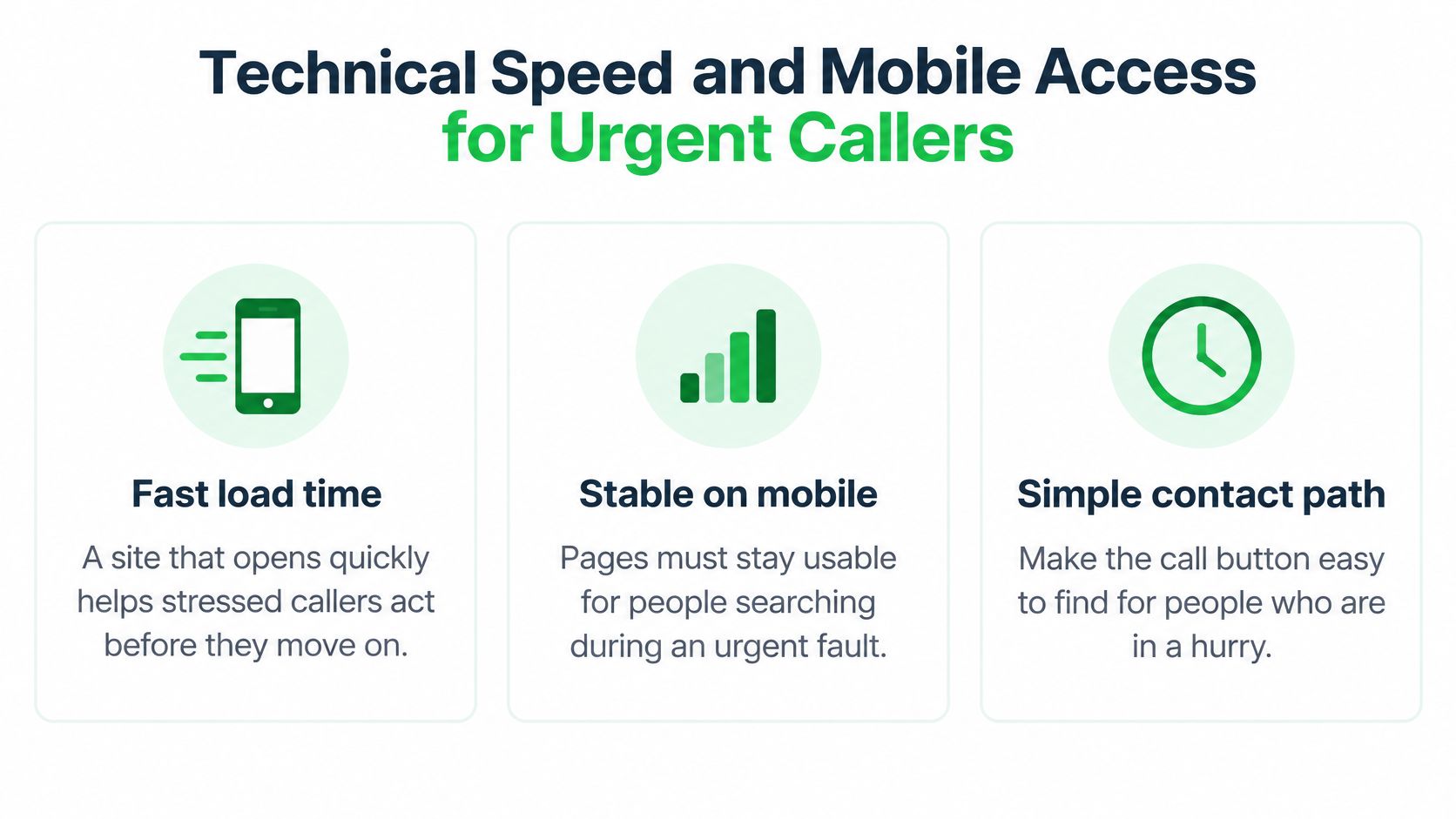
Each measure points to a different friction:
- LCP measures how quickly the main visible content appears. If a large banner image delays the page, the phone number or service details may stay hidden.
- INP measures how quickly the page responds to an interaction. A delayed response can make tap-to-call controls or quote forms feel broken.
- CLS measures unexpected movement while a page loads. If a button shifts just as someone tries to tap it, the contact path becomes harder to use.
Australian web-performance reporting also cites a benchmark that 53% of mobile visitors abandon pages taking more than three seconds to load (Australian web-performance reporting). It's a broad benchmark, not a guarantee about what every electrician's visitors will do, but it's a useful reason to check mobile loading rather than assuming the page is fine.
Start with practical fixes. Compress oversized images, remove third-party scripts that don't serve a clear purpose, reserve space for images and booking widgets, and keep urgent-service pages lightweight. Make sure the phone control is easy to spot and works as expected.
Test pages that support real jobs, not only the homepage. An emergency electrician page, a suburb landing page and a quote form may behave differently. PageSpeed Insights and Search Console can help identify performance problems; review real-user data after changes, since a lab test won't capture every visitor's device or connection. A broader technical SEO checklist for small businesses can help organise the audit.
Licences, Registration and Reviews That Build Trust
A customer who finds an electrician still has to decide whether to trust the business with safety-related work and a potentially significant expense. Specific, verifiable information reduces guesswork. A vague claim such as “qualified electrician” gives a homeowner less to check than clearly stated qualifications, areas of expertise and licensing or registration details.
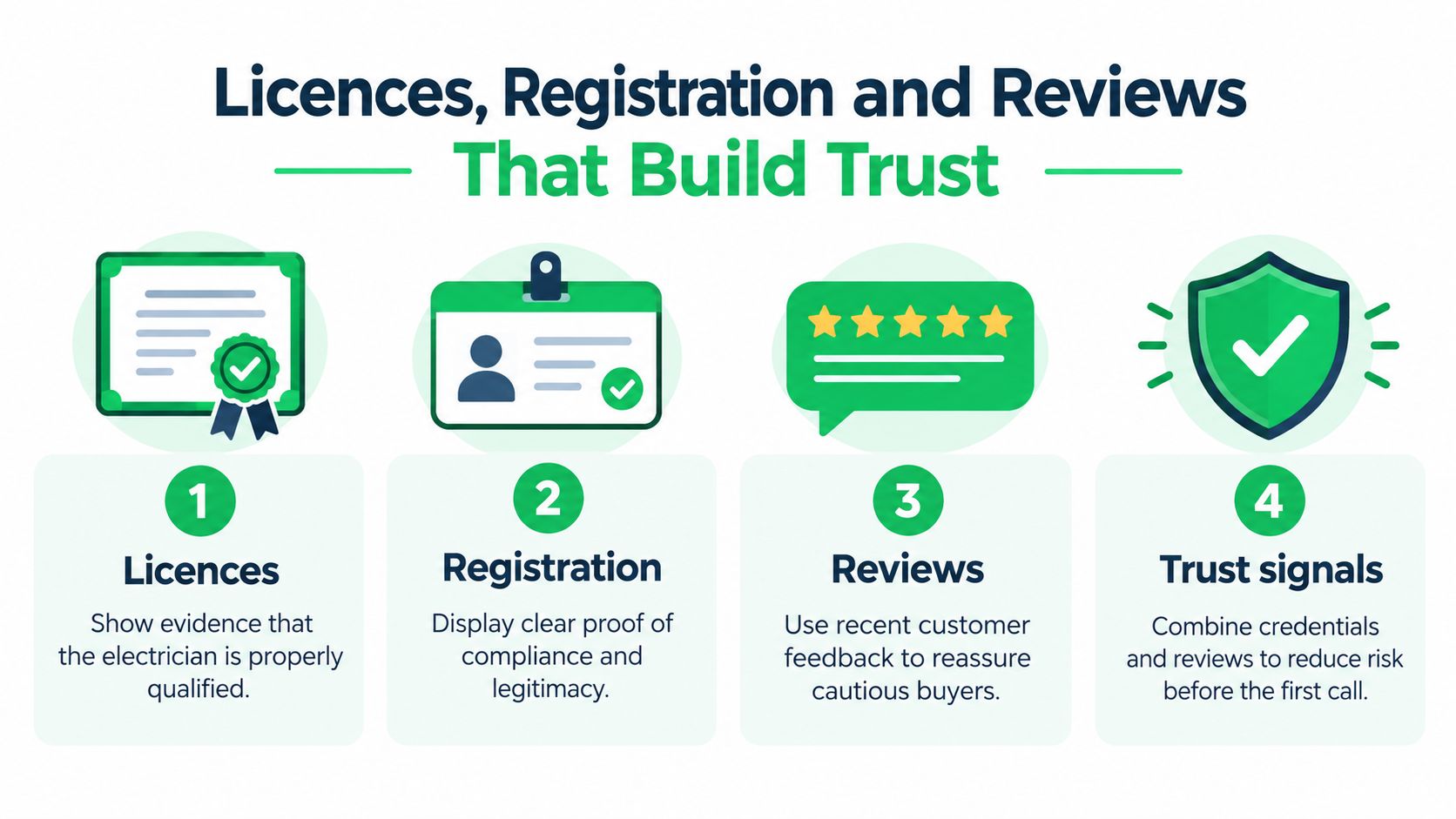
Reviews provide a different kind of evidence. They can help a prospective customer understand how the business communicates and what kind of job it has handled. For that reason, detailed feedback about the service performed, the suburb, response time, safety and communication can tell a reader more than generic praise.
An Australian report citing 2025 consumer research says 83% of consumers use Google to read local-business reviews before deciding (Australian reporting on Google reviews and local-business decisions). The finding is about local businesses broadly, not electricians alone. Still, it supports treating reviews as part of the customer's decision process, not as a box to tick for search visibility.
Review requests must remain honest and compliant. The ACCC says reviews should be independent and reflect the genuine opinion of someone who experienced the service. Fake reviews, reviews from people who didn't use the service, undisclosed employee or paid reviews, and suppressing or editing genuine negative feedback can mislead consumers. If a business offers an incentive, it must apply regardless of whether the review is positive or negative, and the incentive must be disclosed (ACCC guidance on online reviews).
A sound process asks completed customers for honest feedback without screening for likely praise. Don't make public review requests conditional on a customer being happy. A recent, specific set of reviews may help a cautious buyer assess a particular job more than a large collection of vague comments. This guide to how Google reviews relate to local SEO provides more context for handling reviews as part of local visibility.
Measuring Enquiries Instead of Rankings Alone
A ranking report can look encouraging while the phone stays quiet. For an electrical business, measurement should connect search visibility to customer actions and, where possible, to the jobs the business quotes and books. That gives the owner a better basis for deciding what to improve next.
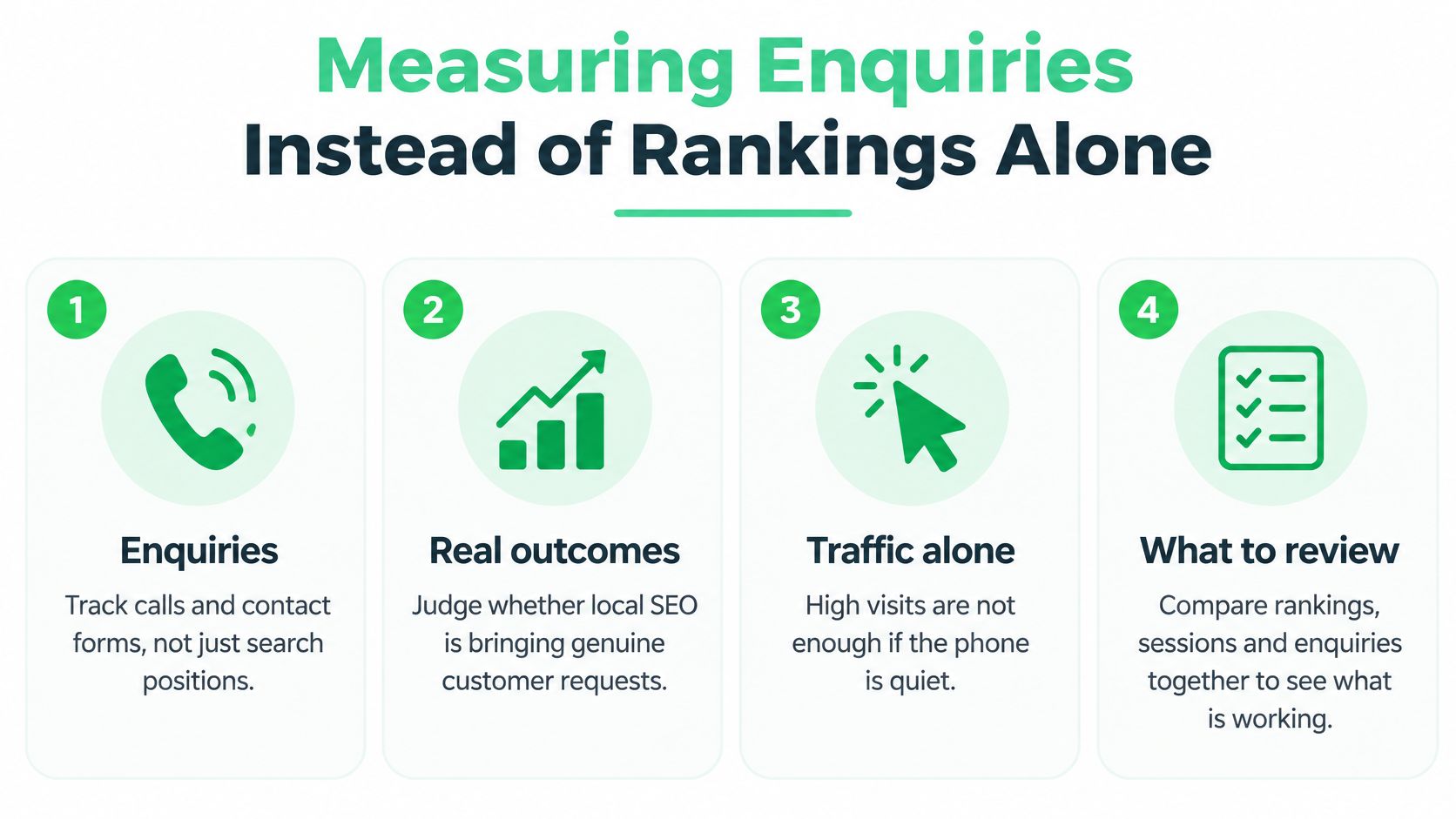
Keep the measures distinct:
- Profile interactions: Track calls, website clicks and direction requests from the Google Business Profile. These actions show how customers use the listing, but they don't all represent a qualified job.
- Website enquiries: Record calls and form submissions from the site. Make sure a quote form identifies the service and location so the business can judge the enquiry's relevance.
- Search visibility: Use Search Console to review which queries bring people to which pages. If a suburb page attracts relevant searches but few enquiries, check whether its service information and contact path are clear.
- Job outcomes: Use CRM or job records to note which enquiries were qualified, quoted and booked. Search tools can show discovery and interaction, but business records show what happened after contact.
Use tracking that fits the way the business receives work. A call-tracking tool can help distinguish calls from different pages or channels, while GA4 can record website actions if it's configured correctly. Keep the setup understandable: if staff can't tell whether a call came from a profile, a service page or another channel, the report may give a false picture.
Measurement principle: Treat rankings and sessions as context. Calls, quote requests and booked jobs are the outcomes that help assess commercial value.
Review a small set of measures consistently rather than building a large dashboard that nobody uses. A regular check of profile actions, organic page and query performance, qualified enquiries and booked work can reveal whether the next task should be improving a page, correcting profile information or fixing a contact route. For a more complete picture, compare these signals instead of treating any one platform's report as the whole story.
Comparing SEO Approaches and How to Choose
Local SEO takes ongoing work, but it doesn't always require the same delivery model. The right choice depends on the business's available time, technical capability, ability to measure enquiries and the value of its typical work. A small operator with a manageable service area may be able to maintain the basics in-house; a busier business may need specialist implementation.
| Approach | Best suited when | Main trade-off |
|---|---|---|
| DIY | The owner or office team can keep profile details current, improve key pages and review enquiries regularly. | Lower direct cost, but the work competes with day-to-day operations and technical tasks may be harder to diagnose. |
| In-house marketer | The business needs regular content and profile management and can support an ongoing marketing role. | More direct control, but specialist technical SEO or measurement work may need outside support. |
| Agency | The business wants coordinated local, technical, on-page and measurement work, with implementation and reporting. | Access to a broader skill set, but scope, fees and responsibilities need to be clear before work begins. |
The trade-off isn't just cost against rankings. A business should ask who will update pages, who will check the Google Business Profile, how calls and forms will be measured, and whether recommendations include implementation or only a list of tasks. If the typical job is high value, the business may justify a more complete program; if the service area is narrow and the website already performs well, a targeted set of fixes may be more sensible.
SEO2RANK is a Melbourne-based agency offering local, technical, on-page and measurement work as an integrated program. Its options include a free high-level SEO Snapshot, a paid Full SEO Audit & Strategy and monthly packages, with setup fees and GST treatment disclosed. That's one route among others; any business considering outside support should check the scope, access requirements and reporting before committing.
The most useful comparison is between the work the business needs and the capacity it has to complete it. A plan that leaves critical changes unimplemented won't help much, whether it was written in-house or by an agency.
Your Next Step Toward More Local Enquiries
Local SEO works when each part supports the same customer journey. A clear Google Business Profile helps a nearby customer discover the business; relevant service pages explain whether it handles the job; mobile performance keeps the contact path usable; and verifiable credentials and genuine reviews help the customer decide whether to call.
A practical review can start with a few checks. Confirm the profile's category, service areas, phone number and hours. Check that key service pages describe the work and locations accurately, and that current REC and licence details appear where required. Then make sure calls, forms and booked jobs can be assessed separately, so the next improvement responds to real enquiries rather than a ranking movement alone.
If the work is manageable in-house, keep the checks organised and revisit them as services, coverage or registration details change. If the priorities are unclear, an outside audit can help identify technical barriers and gaps in local visibility. A free high-level SEO Snapshot from SEO2RANK is one option to review alongside an internal assessment.
The goal isn't to publish the most pages or chase every search term. It's to make it easy for the right customer to find a suitable electrician, verify the business and take the next step.
For a practical review of local visibility, key service pages and enquiry tracking, SEO2RANK offers a free high-level SEO Snapshot as well as audit and ongoing SEO services. Visit SEO2RANK to see whether an external review fits the business's needs.
Find Out What Is Holding Your
Website Back
Get a practical SEO Snapshot showing the biggest issues and opportunities we can see across your search visibility, website and local presence.
GET YOUR FREE SEO SNAPSHOT