

A typical small Melbourne service business should publish one substantial, locally relevant article every two to four weeks. That's the right pace because it covers real search demand without turning the blog into a factory line.
How often should a business publish blog posts for SEO? Not by default every week. For most Melbourne service businesses, the right answer is one strong post every two to four weeks, then a refresh cycle on older content so the site keeps earning enquiries instead of just collecting articles.
Table of Contents
- Why Publishing Frequency Is the Wrong Starting Question
- Five Factors That Decide the Right Cadence for Your Business
- A Practical 90-Day Publishing Plan for Service Businesses
- Recommended Cadences by Business Type
- Quality, Internal Links and Refreshing What You Already Have
- Measuring Results Without Chasing Post Count
- Putting It Together and Your Next Step
Why Publishing Frequency Is the Wrong Starting Question
Frequency gets too much attention because it's easy to count. What matters is whether each post covers a real search need and supports the pages that make money, such as service pages, suburb pages and FAQs.
A business can publish four generic posts a month and still get nowhere if the website is thin, unclear or hard to crawl. The better approach is to treat publishing as a coverage problem, not a volume race. One well-targeted article on something like emergency plumbing in Brunswick can do more for leads than four vague SEO pieces that nobody in Melbourne needed.
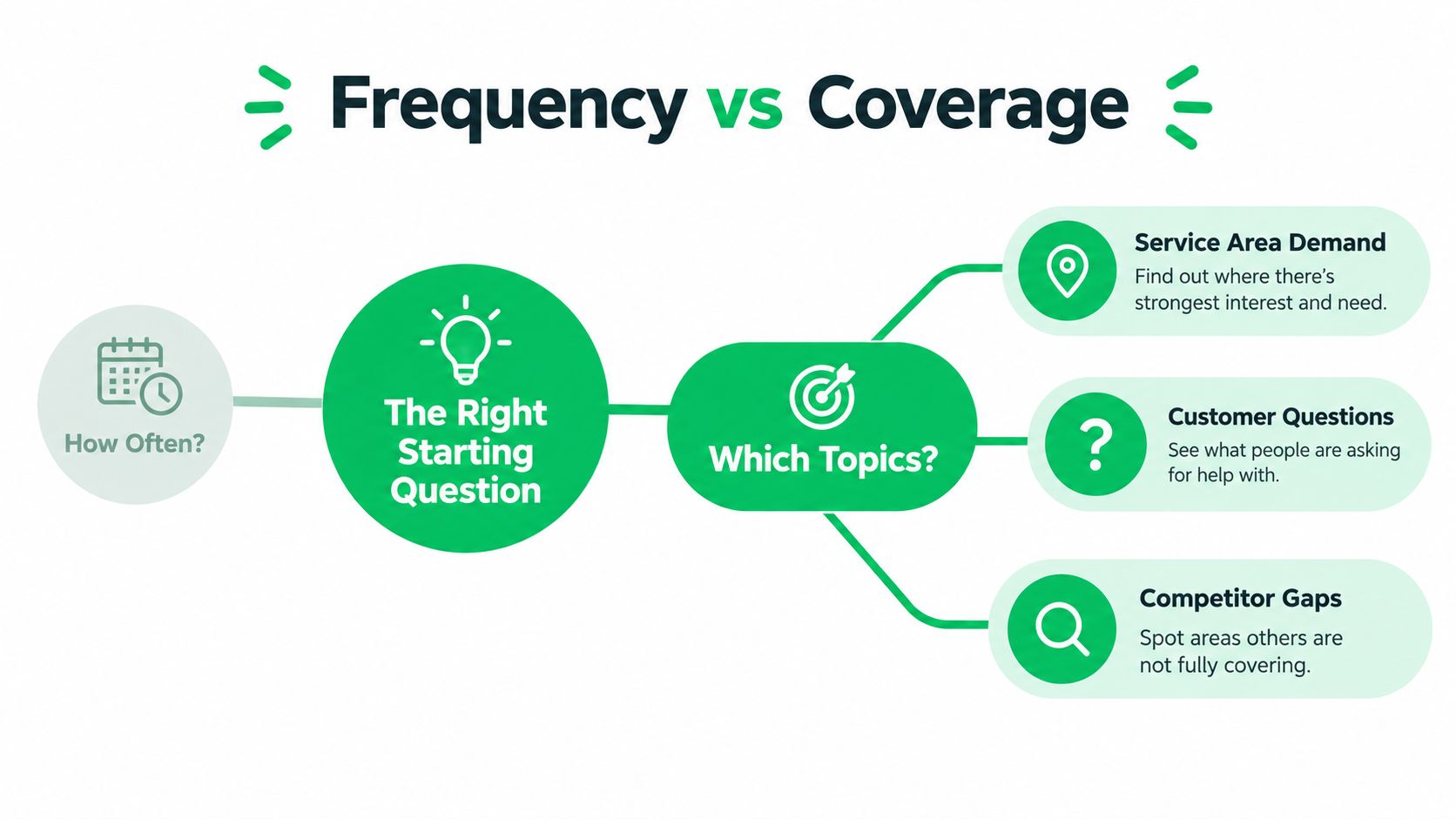
That's why the starting point has to be the site's commercial structure. The Australian Small Business and Family Enterprise Ombudsman found that web presence rose from 44.1% in the smallest cohort to 96.1% in the largest, while social-media presence moved from 38.4% to 87.0% across the same size groups, which shows that publishing only creates value once a crawlable, useful site already exists. That baseline matters for Melbourne businesses because a blog can't rescue weak service pages. ASBFEO Small Business Counts report
Practical rule: fix the money pages first, then publish supporting articles that make those pages easier to find, easier to trust and easier to convert.
There's a reason this framing beats the usual “post more” advice. If the site doesn't already explain what the business does, where it works and why someone should enquire, extra content just spreads effort thinner. A smarter cadence starts with commercial coverage, then adds articles only where they strengthen the path to enquiry. For a deeper look at whether AI-generated content belongs in that mix, see does Google penalise AI content.
Five Factors That Decide the Right Cadence for Your Business
There isn't one right publishing rhythm for every Melbourne business. The right cadence depends on how much genuine search demand exists, how strong the current site already is, and whether the team can keep the content accurate after it goes live.
Search demand and local coverage
Google still dominates Australian search, and the local angle is the important part. Industry summaries put Google at about 93.95% of the Australian search-engine market in July 2024, and roughly 46% of Google searches in Australia have local intent, which means a Melbourne plan should be built around local demand rather than generic blogging habits. Australian search market and local intent data
That means the first question is simple. Which suburbs, services and customer questions deserve dedicated coverage? If the answer is unclear, the business probably doesn't need more posts yet. It needs better topic selection.
Capacity and editorial depth
A business also needs enough time to write, review and connect each article properly. A weekly cadence sounds organised until it starts producing thin posts, duplicate angles and rushed edits. That's how blogs turn into liabilities.
Measurement maturity
The last factor is whether the business can measure the effect cleanly. If Search Console, conversion tracking and enquiry attribution are not in place, there's no point publishing at speed and guessing later.
The right cadence is the one the business can sustain with accurate content, clear internal links and enough local specificity to support a real enquiry.
A sensible starting rule
For most small Melbourne service businesses, one substantial article every two to four weeks is the right starting cadence. That gives enough room to cover service questions, suburb intent and buying objections without starving the team's time for technical fixes and money-page work.
What is search intent and why does it matter for SEO is the missing piece for businesses that keep publishing without improving relevance. Cadence only works when the topic matches what the searcher wants.
A Practical 90-Day Publishing Plan for Service Businesses
A useful 90-day plan starts with one commercial cluster per priority service and suburb. That keeps the content tied to enquiries instead of drifting into general advice that nobody is trying to buy from.
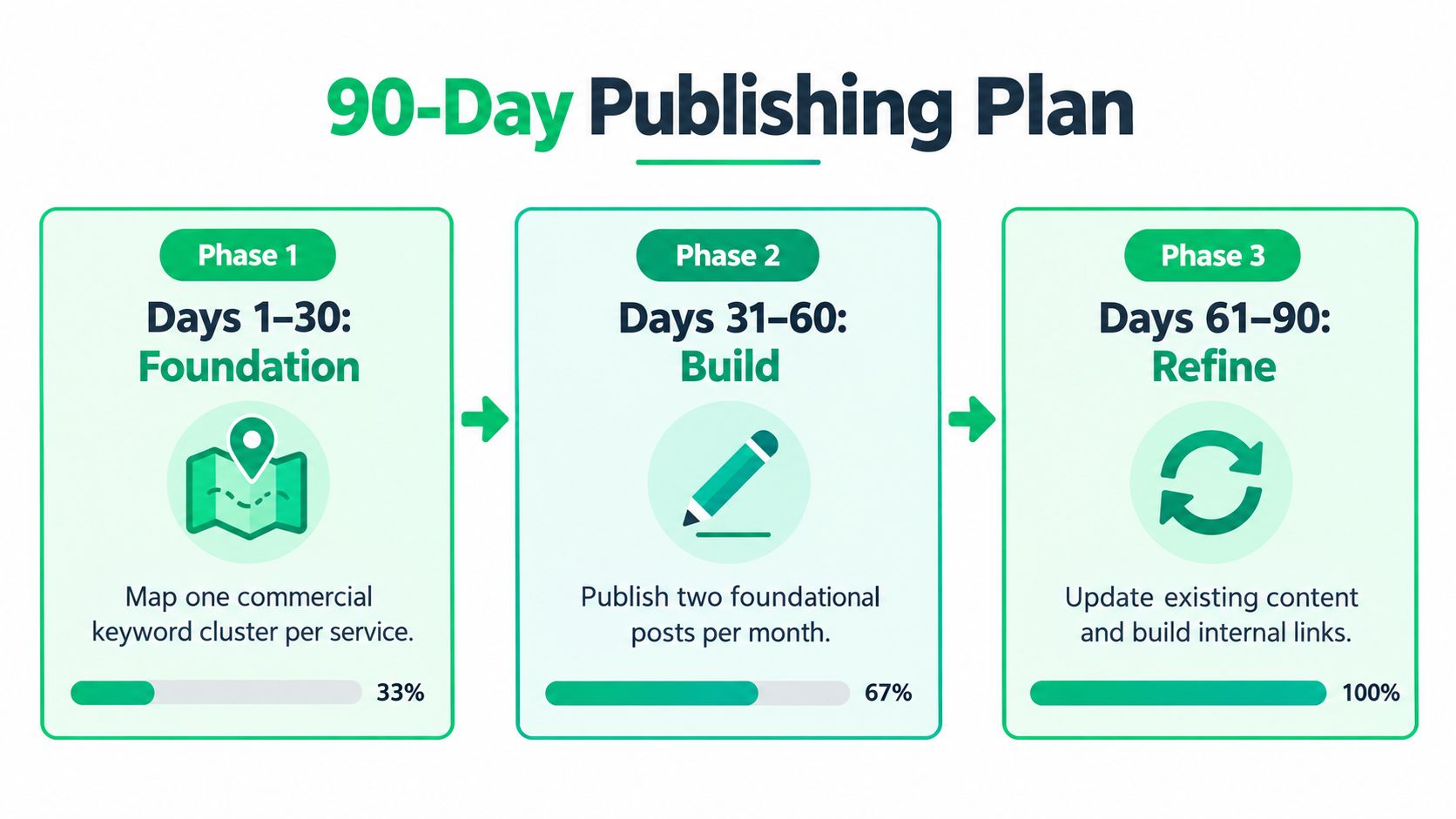
Days 1 to 30, build the map
Start by listing the service pages that matter most, then attach one supporting topic to each. A plumber might map blocked drains, hot water problems and emergency callouts. An accountant might map BAS help, contractor tax questions and year-end planning.
The point is not to brainstorm endlessly. It's to identify the few topics that deserve to exist because they support a clear commercial path.
During this phase, use keyword research your customers are searching for to anchor the topics in actual search demand. If a topic doesn't connect to a service page or suburb page, it probably doesn't belong in the first quarter of work.
Days 31 to 60, publish the support pieces
A workable pace is one solid article every two to four weeks. That's enough to create 3 to 6 useful assets per quarter, while leaving time for the rest of the site.
The content should do three things: answer the question, point to the relevant service page and remove friction before the reader enquires. That means clear internal links, direct calls to action and no filler paragraphs built just to hit a word count.
About 51% of Australian small businesses say they can't operate without the internet, which is why organic discovery has to be treated as core infrastructure, not a side project. Digital Lives of Australians 2025
Days 61 to 90, refine what's already live
After a few weeks, check which pages are getting impressions, which ones are being indexed and which ones are assisting enquiries. Then improve the pages that already show promise before publishing more.
That's where the schedule becomes sustainable. A business with a real SEO system spends part of the quarter creating new assets and part of the quarter improving the ones that are already close to paying off.
Recommended Cadences by Business Type
Different businesses need different publishing rhythms because the content burden isn't the same. A tradie, a dentist and a B2B consultancy do not need the same editorial engine, even if they all want better search visibility.
| Business type | Starting cadence | Annual volume | Priority topics | Editorial load |
|---|---|---|---|---|
| Tradies and home services | 1 to 2 posts per month | 12 to 24 | Emergency jobs, pricing questions, suburb intent, maintenance issues | Moderate, needs local examples and quick approval |
| Dental and healthcare practices | 1 post per month | 12 | Treatment questions, patient concerns, eligibility, aftercare | Higher, needs careful review and accuracy |
| Accountants and financial services | 1 to 2 posts per month | 12 to 24 | Tax deadlines, compliance questions, business structure, contractor issues | Moderate to high, depending on regulation and sign-off |
| B2B professional services | 2 posts per month | 24 | Process comparisons, buyer objections, industry problems, case evidence | Higher, needs deeper expertise and internal linking |
| General retail or technology SMEs | 2 to 4 posts per month | 24 to 48 | Product comparisons, buying guides, feature questions, use cases | Variable, depends on product range and release cycle |
A small business should not copy a competitor's posting pace just because the competitor looks busy. Thin suburb variants, repeated service topics and filler articles can make the site harder to trust, not easier.
Good cadence is visible in coverage, not in churn. If the business can't support accurate local topics and strong service-page links, it should slow down rather than publish more.
The safest starting point for most Melbourne service businesses is still the same. One strong article every two to four weeks is enough to build authority without turning content into a drain on the team.
Quality, Internal Links and Refreshing What You Already Have
Publishing more is wasted effort if the existing pages are stale, orphaned or disconnected. The strongest SEO gains usually come from making each supporting article pull traffic toward a money page with a clear job to do.
The simplest rule is this. Every supporting post should answer one search intent and point to one primary commercial page. That keeps the site organised and stops blog content from floating around as isolated reading material.
Use Search Console to decide what happens next
Classify each URL at around 8 to 12 weeks:
- Impressions and clicks rising: keep it live, expand it with Australian examples and strengthen the call to action.
- Impressions rising, clicks weak: rewrite the title, meta description and opening so they match the search intent better.
- Clicks present, conversions weak: fix the service-page pathway, proof, phone visibility and tracking.
- No impressions: check indexing, canonicalisation, crawl access, topical relevance and internal-link depth before publishing anything else.
That framework stops the business from guessing. It also stops teams from treating every post as permanently finished. Good content gets maintained, not abandoned.
Reuse the strongest ideas across the site
One well-written article can support a FAQ, a suburb-page paragraph, a Google Business Profile update or a short video script. That's not duplication when the formats serve different jobs and the core message stays useful.
The point is to build coverage around the commercial theme, not to produce a pile of near-identical posts. Searchers want a site that helps them move from question to action.
The local path matters because Australian research reports that 76% of smartphone users who perform a local search visit a related business within 24 hours and 28% of those searches lead to a purchase. Australian local SEO statistics That's why supporting posts should reinforce service pages and Google Business Profile signals, not replace them.
If the site already has useful pages, internal linking often delivers more practical value than adding another rushed article. The goal is a connected site, not a larger archive.
Measuring Results Without Chasing Post Count
Post count is a vanity metric. What matters is whether the content is helping the right pages rank, bringing in the right visitors and contributing to enquiries.
Use signals that connect to business outcomes
The basic measurement stack should include:
- Search Console impressions: show whether the topic is being seen for the right queries.
- Non-brand clicks: show whether the content is attracting new demand rather than existing name searches.
- Indexed status: confirm the page is eligible to rank.
- Assisted enquiries: show whether the content helps users reach service pages or contact points.
- Calls and forms tied to topic clusters: show whether the content is moving people closer to action.
That is enough for a small business to judge whether a cadence is working. Raw sessions alone can mislead, especially when branded traffic or general social traffic is mixed in with actual search performance.
Don't mistake visibility changes for traffic changes
Australian search is increasingly answer-driven. Recent reporting says about 58% of searches are now zero-click, up from 51% in 2023, and AI Overviews appeared in around 40.2% of local-business queries in an industry analysis of 60,000 searches. Australian digital marketing statistics That means a business can gain visibility, brand recognition and trust even when clicks don't rise in the same way.
So the question is not just whether the blog got traffic. It's whether the business is showing up in the right places and whether that visibility is helping people enquire later.
A business should slow down publishing when the problem is technical or commercial, not editorial. Poor indexing, slow templates, weak location signals and an unclear conversion path will waste the next ten posts just as easily as the last ten.
Putting It Together and Your Next Step
The clean answer is simple. Most Melbourne service businesses should start with one substantial, locally relevant article every two to four weeks, then refresh older content instead of chasing a fixed weekly quota. That lines up with Google's own guidance, which puts the emphasis on content that is easy to read, well organised, unique, current, helpful, reliable and written for people. Google SEO Starter Guide
The right cadence is the one your team can keep up without cutting corners. If the site is already strong enough to handle that pace, publish steadily and measure the effect on enquiries, not just traffic.
Pick two priority service and suburb combinations, map the supporting topics around them, and commit to a sustainable monthly rhythm with a refresh cycle built in. That gives the business a plan that fits local demand instead of copying a generic blogging rule.
SEO2RANK builds content and SEO programs around search demand, customer questions and the pages that should generate enquiries. For Melbourne businesses that want a publishing rhythm tied to real local demand, SEO2RANK can help map the topics, structure the links and measure what's working.
Find Out What Is Holding Your
Website Back
Get a practical SEO Snapshot showing the biggest issues and opportunities we can see across your search visibility, website and local presence.
GET YOUR FREE SEO SNAPSHOT