
Most businesses don't have a keyword problem, they have a language problem. The fastest way to find the keywords customers are searching for is to listen to how they describe their issue, check the queries already appearing in Google Search Console, then expand those ideas with Google suggestions and competitor pages before prioritising the terms that match real intent and local demand. For Melbourne service businesses, that usually means suburb-plus-problem phrases, service-area terms, and search queries that sound like a customer needing help now, not a marketer building a spreadsheet.
Table of Contents
- How to Find the Keywords Your Customers Are Searching For Without Guessing
- Uncover How Your Customers Actually Describe Their Problems
- Mine Your Own Search Console and Analytics for Hidden Opportunities
- Expand and Validate Ideas With Tools and Competitor Checks
- Prioritise Keywords by Intent Traffic and Effort Before You Write
- Implement Track and Refine Your Keyword Plan Over Time
How to Find the Keywords Your Customers Are Searching For Without Guessing
The cleanest workflow is simple, listen to customers, mine your own search data, expand the list with tools, then choose the terms that match intent and are realistic to win. That process works better than starting with a giant keyword list because customers don't search in neat marketing categories, they search in the words they'd use when they're stressed, comparing options, or ready to call.
For Melbourne tradies and service businesses, this matters because broad head terms often miss the way people search. Australia's search market is also heavily concentrated, with Google holding 87.58% of search engine market share in August 2026 and Bing, Yahoo! and DuckDuckGo far behind, so Google-led demand signals should come first in keyword discovery search market usage in Australia.
Start with customer language, not keyword tool language
A lot of keyword lists fall apart because they're built from internal terms. A plumber might say “blocked waste line”, while a homeowner writes “kitchen sink blocked”, and a patient might search “dentist near me” rather than a practice's formal treatment name. The best seed keywords usually come from the way people speak in the world.
Practical rule: if a customer would say it out loud to the person answering the phone, it usually deserves a place on the keyword list.
Once those raw phrases are collected, they can be grouped into themes such as problem, service, urgency, and location. That gives a practical starting set without forcing the wording into marketing jargon too early.
Treat local intent as a core filter
Search behaviour in Australia leans strongly local and action-oriented. One local SEO source reports that 46% of all Google searches have local intent, and another reports that 78% of mobile local searches lead to a purchase within 24 hours, so suburb terms and service-area modifiers matter more than they do for generic national content local intent and mobile purchase behaviour.
That doesn't mean every page needs a suburb in the title. It does mean the first pass should favour terms that sound like someone who wants a nearby solution, not a general explainer. A Melbourne electrician, for example, usually gets more practical value from “emergency electrician Richmond” than from a vague national head term.
Uncover How Your Customers Actually Describe Their Problems
The most useful keyword ideas are already hiding in the places where customers contact a business. Enquiry forms, call notes, review replies, live chat logs and short post-job feedback often contain the exact phrases people use before they ever touch Google. Those phrases are messy, which is why they're useful.

Pull the words customers already hand over
For a tradie, the language often shows up in the job description field. For a dentist, it's usually in the reason-for-visit note. For a commercial cleaner, it may be in the first email from the office manager. Those phrases are the raw material for seed keywords because they reflect the problem before anyone has optimised anything.
A good habit is to copy the customer's wording exactly, then group similar phrases later. “Roof leaking in Glen Waverley”, “roof repair near me”, and “storm damage roof leak” may sit in different buckets at first, but they can point to the same search theme once the list is cleaned up.
Use support logs and reviews without translating too early
Internal jargon is one of the fastest ways to distort keyword research. A business might label a service as “preventative maintenance”, while customers search for “service”, “check-up”, or “fix”. If the phrase feels polished, it's often less useful than the raw version a customer would type at 10 pm on a phone.
A short, useful exercise is to pull a month of enquiries and note repeated words, places, and urgency cues. The same pattern usually appears across calls, emails and reviews, and it often reveals combinations like suburb plus problem, service plus urgency, or question plus symptom.
For teams that want a plain-English reference while sorting terms, the SEO glossary is a practical companion, especially when the language of the business and the language of search are drifting apart.
Customer language is usually more valuable than polished service language because it shows the exact terms people reach for when they need help.
Mine Your Own Search Console and Analytics for Hidden Opportunities
Google Search Console is the first data source worth checking because it shows the exact queries already bringing impressions, clicks and average position to the site. Google defines clicks as how often someone clicked a link from Google to a site, impressions as how often a site appeared in search results, and average position as the average position of the topmost result across impressions Search Console metrics. That makes it far more useful than a generic brainstorm list.
Filter for Australia and read the query list properly
The practical workflow is to open Performance → Search results, filter by Country: Australia, then sort by impressions to find the themes already visible. Google's Search Console help also shows that performance can be segmented by query and page, which makes it possible to see which exact searches are driving visibility and which pages are capturing them Search Console query and page segmentation.
That split matters. A service page may already appear for a useful query, but the title or snippet may be weak, which means the keyword is already there in plain sight. In that case, the problem isn't discovery, it's alignment.
Focus on striking-distance terms
Search Console is especially useful for terms sitting in the middle of the pack, not the obvious winners. Queries around positions 4 to 16 often respond well to content refreshes, tighter internal linking and better intent match. Those are the keywords where a page already has some relevance, but not enough to earn consistent clicks.
A separate section of the report can show whether one page is trying to do too much or whether several pages are competing for the same theme. That helps avoid the common mistake of creating new content when the site already has a page that just needs sharpening.
Practical rule: if a query already appears in Search Console, it's usually smarter to improve the page that shows up than to start from zero.
If the site is still thin on data, that doesn't block the process. It just means customer language and Google suggestions carry more weight until the site starts earning enough impressions for patterns to emerge. For teams wanting a structured site review before building more content, the SEO audit overview is a useful benchmark reference.
Expand and Validate Ideas With Tools and Competitor Checks
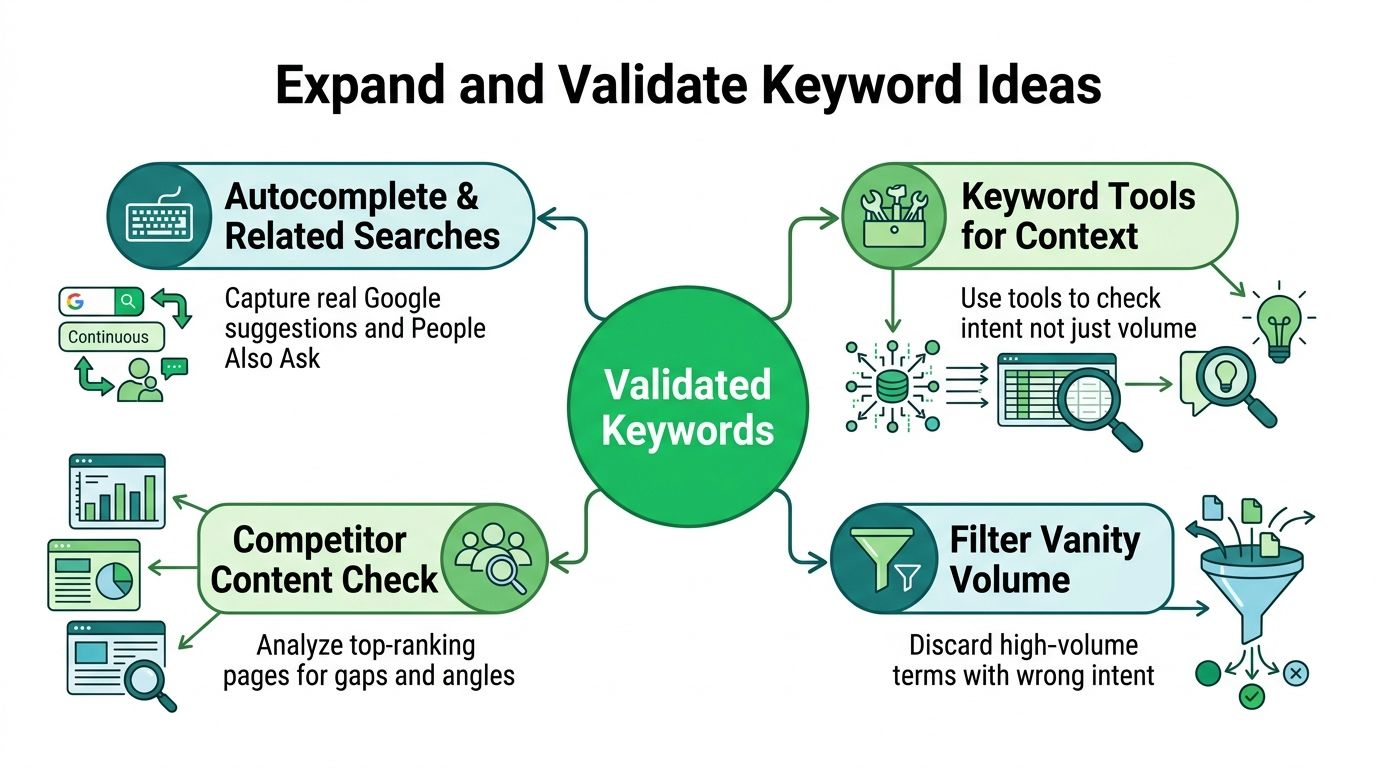
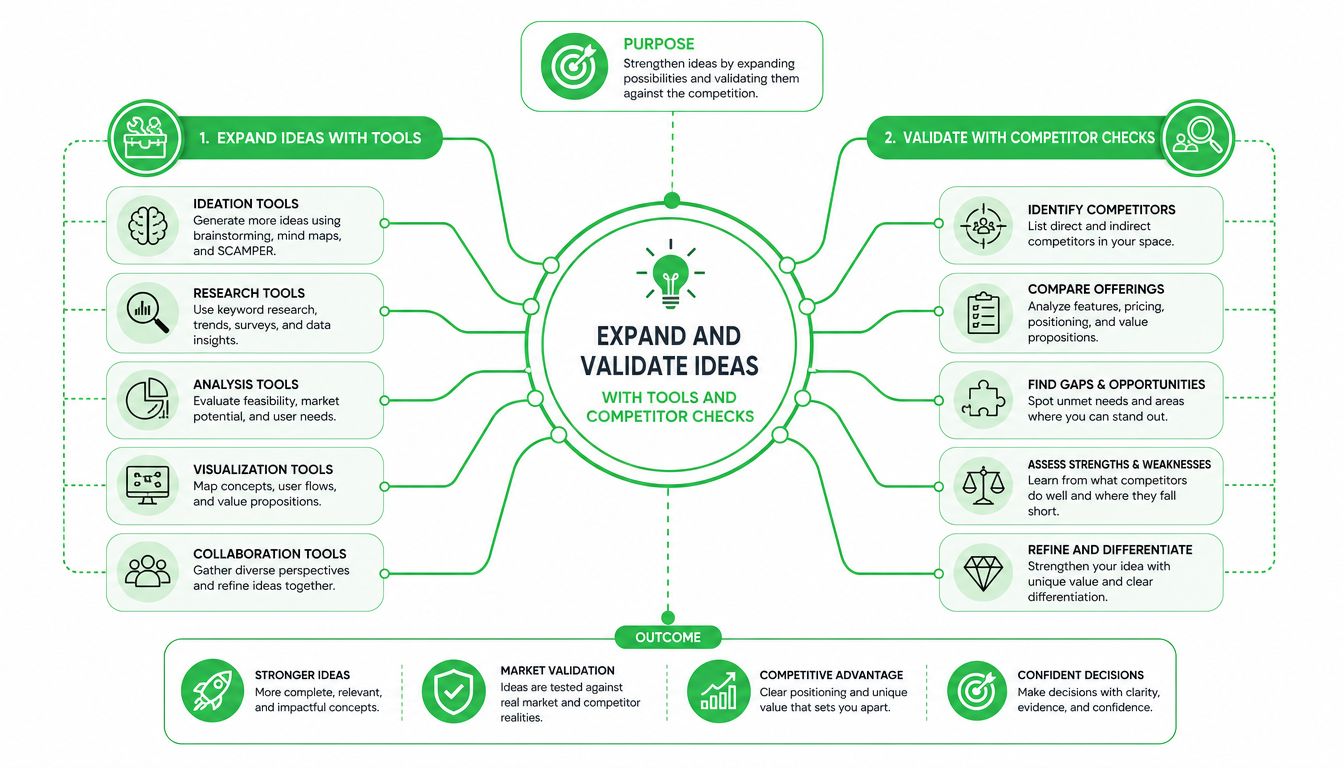
Once the owned data is collected, expansion should be controlled rather than open-ended. Google autocomplete, related searches and People Also Ask can surface real phrasing that customers use, while keyword tools add breadth, context and alternative wording. The point isn't to chase every variant, it's to see which wording matches search intent most closely.
Read the search results before trusting the volume
A keyword with strong volume can still be the wrong target if the results page shows a different intent. A user searching “best hot water system” may be comparing options, while the business wants to rank a service page about installation. Those are different pages, different calls to action and often different search journeys.
Competitor pages reveal this quickly. If the top ranking pages are suburb pages, emergency service pages or detailed guides, the new page should match that pattern unless there's a clear reason to do something else. The aim is to align with the search result shape rather than fight it.
Add Melbourne modifiers where they make sense
For service businesses, local modifiers usually improve usefulness more than they hurt. That can mean suburb names, service areas, near me, or a problem tied to a location. It can also mean building clusters around different forms of urgency, such as maintenance, repair or emergency service, depending on what the business offers.
Google Trends also shows that Australian search attention can swing towards practical, time-sensitive and local topics rather than tidy keyword templates, which is why “messy middle” phrases like suburb-plus-problem and question-based searches deserve attention Google Trends Australia.
For teams that want another option in the planning stack, SEO2RANK's Melbourne work includes keyword research as part of broader search planning, with the emphasis on understanding customer language and competitor visibility. That kind of review is most useful when the site needs a clearer local search map rather than more generic ideas.
Practical rule: keep the keyword pool broad enough to spot patterns, then narrow it to the pages the business can actually serve profitably.
Prioritise Keywords by Intent Traffic and Effort Before You Write
The hard part isn't finding keywords, it's deciding which ones deserve time first. Volume alone is a weak filter because a popular phrase can be wrong for the page, too competitive for the site or too far from buying intent. The better test is whether the keyword matches the business, the page type and the effort required to rank.
The following matrix keeps the decision practical for service businesses.
| Keyword Example | Intent Type | Local Modifier | Priority Score |
|---|---|---|---|
| emergency plumber Richmond | High commercial | Yes | High |
| how to fix a blocked drain | Informational | No | Medium |
| dentist near me | High local | Yes | High |
| roof leak repair Melbourne CBD | High commercial | Yes | High |
| what causes water pressure loss | Informational | No | Medium |
| plumber | Broad commercial | No | Low |
Score by intent before you chase traffic
A suburb-plus-problem phrase usually outranks a broad head term on business value because the searcher is closer to action. That doesn't automatically make it easy to win, but it does make it worth the page slot if the business serves that area. A lower-volume phrase with strong buying intent is often more useful than a higher-volume phrase that brings casual readers.
Many lists go wrong. They overvalue “big traffic” words and underweight the cost of ranking for them. The result is content that looks impressive and produces little.
Split money pages from support content
Service pages, location pages and strong commercial landing pages should usually take the highest-priority intent terms. Supporting content can then answer the questions that sit before the booking decision and internally link back to the commercial pages. That structure helps the site earn relevance without forcing one page to do everything.
For teams comparing options, the how SEO works resource is a useful way to think about the relationship between visibility, intent and site structure. It keeps the planning grounded in how search behaves, not just how keyword tools organise the data.
If a keyword would make a good FAQ paragraph but a poor service-page title, it probably belongs in support content first.
Implement Track and Refine Your Keyword Plan Over Time
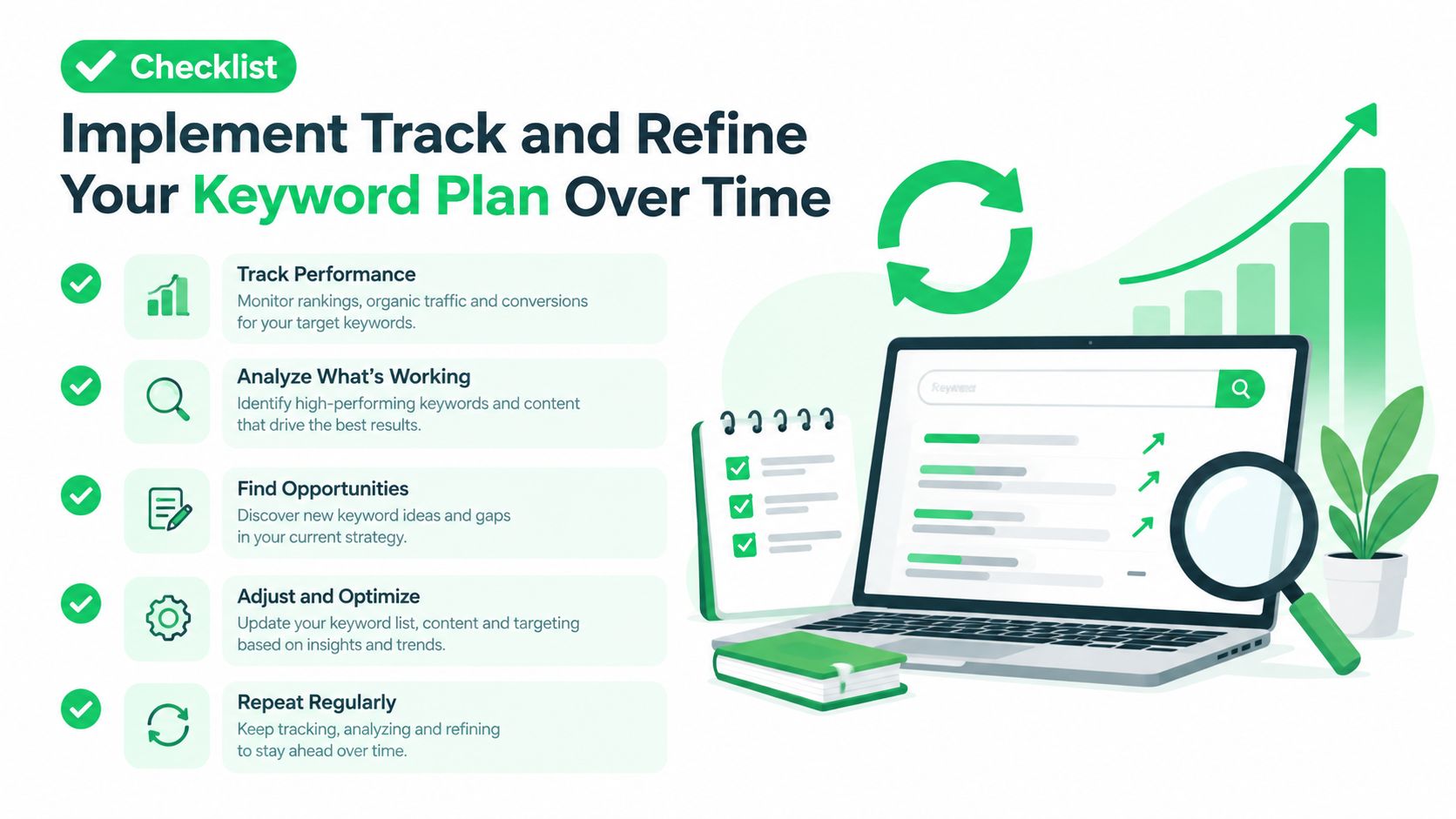
A keyword list only becomes useful when it's mapped to pages, titles and internal links. One page should have one clear primary keyword theme, with related phrases supporting it naturally in the body, heading and supporting copy. That keeps the page focused enough for Google and clear enough for the visitor.
Map each keyword to an existing page or a new page
If a page already exists and it matches the search intent, improve that page first. If there's no page that fits, create one with a clear title, supporting subheadings and internal links from relevant service or location pages. That prevents keyword cannibalisation and keeps the site architecture tidy.
For tracking, Search Console remains the anchor because it shows whether the site is earning impressions and clicks for the terms it was built to target. Analytics can then confirm whether the traffic is turning into enquiries, calls or form submissions, depending on how the site is configured.
Keep a short implementation checklist
- Match the page to the intent: service pages for commercial terms, guides for early-stage questions, and location pages for local demand.
- Align the title and heading: use the customer's wording where possible, not internal jargon.
- Add internal links deliberately: point related pages back to the main service or location page.
- Review Search Console regularly: watch impressions, clicks and average position to spot movement.
- Refresh pages that are close: strengthen pages that already show up but aren't getting enough clicks.
The businesses that keep improving these pages don't treat keyword research as a one-off list. They treat it as a repeatable loop, because customer language shifts, competitor pages change and local demand doesn't stay still.
SEO2RANK helps Melbourne service businesses turn customer language, Search Console data and local intent into a clearer search plan. If the site needs practical keyword research tied to page structure, content and measurement, visit SEO2RANK to see how that work is approached in a local-service context.
Find Out What Is Holding Your
Website Back
Get a practical SEO Snapshot showing the biggest issues and opportunities we can see across your search visibility, website and local presence.
GET YOUR FREE SEO SNAPSHOT