
Search intent is the underlying goal behind a search, to learn, find, compare, or buy, and matching the page type to that goal is what turns rankings into enquiries. In Australia, that matters even more because about 76% of people who do a local “near me” search on a smartphone visit a related business within 24 hours, and about 28% make a purchase, so intent alignment is often the difference between traffic and leads.
A Melbourne business can rank well and still get nothing useful from a page if the page answers the wrong question. A service page that shows up for an informational query may earn visits, but those visitors often leave without calling, booking, or requesting a quote.
Table of Contents
- Search Intent Explained in Plain English
- Why Search Intent Matters So Much in Australia
- The Four Types of Search Intent With Local Examples
- How to Detect Search Intent From the SERP
- Using Keyword Modifiers and Analytics to Confirm Intent
- Why Intent Alignment Drives Rankings and Conversions
- Mapping Intent to Pages for a Melbourne Service Business
- How AI Overviews Are Changing Informational Intent
- Quick-Reference Checklist and Measurement Guidance
Search Intent Explained in Plain English
A plumber in Richmond or a dentist in Glen Waverley can see this problem in real life. A page built to sell services might rank for a question like “how does a hot water system work”, then collect curious readers who are nowhere near a booking.
Search intent is the reason behind the search, the thing the person wants to do. That usually falls into one of four buckets, learn something, go to a specific site, compare options, or take action.
Practical rule: if the page type does not match the searcher's goal, the ranking may still happen, but the enquiry often won't.
The simple way to think about it is this. Informational searches need guides and explainers, navigational searches need branded pages, commercial investigation searches need comparison or proof content, and transactional searches need service, product, or local landing pages.
That sounds basic, but it's where many sites drift off course. Businesses often write what they want to say instead of what the searcher needs to see, then wonder why the page gets impressions but no leads.
The rest of the article works through that gap step by step. It shows how intent works in the Australian market, how to spot it in Google, how to map it to page types, and how to tell whether your current pages are aligned.
Why Search Intent Matters So Much in Australia
A Melbourne homeowner searching “emergency plumber Richmond” is usually trying to solve a problem, not read a general plumbing guide. A page built for that query needs the right suburb, service details, contact options, and a clear next step. Send that visitor to a broad article and the journey becomes harder than it needs to be.
Australia's concentrated search market raises the stakes. Google handles about 92% to 94% of local searches, according to Google's dominance in the Australian search market. That means Google's interpretation of a query strongly influences whether it surfaces a service page, suburb page, map result, comparison page, or explainer.
Search intent therefore works as a routing rule for site architecture. It helps decide which page should target a query, what information that page should contain, and where the visitor should go next. A dental clinic in Glen Waverley might route a “cost of dental implants” search to a pricing or treatment guide, while “dentist Glen Waverley appointment” belongs on a local service page.
Local intent is especially visible on mobile. People search for businesses from the street, the car, or the sofa, often wanting opening hours, directions, availability, or a quick way to call. The page must make those details easy to find, not bury them beneath a long introduction.
Informational searches also deserve careful planning. Google may now answer some straightforward questions through AI Overviews before the searcher visits a website. Useful explainers still support trust and later decisions, but they need a clear path into related services, comparisons, or bookings.
Ranking is only part of the job. Matching the page to the searcher's situation gives Melbourne businesses a clearer route from search result to enquiry.
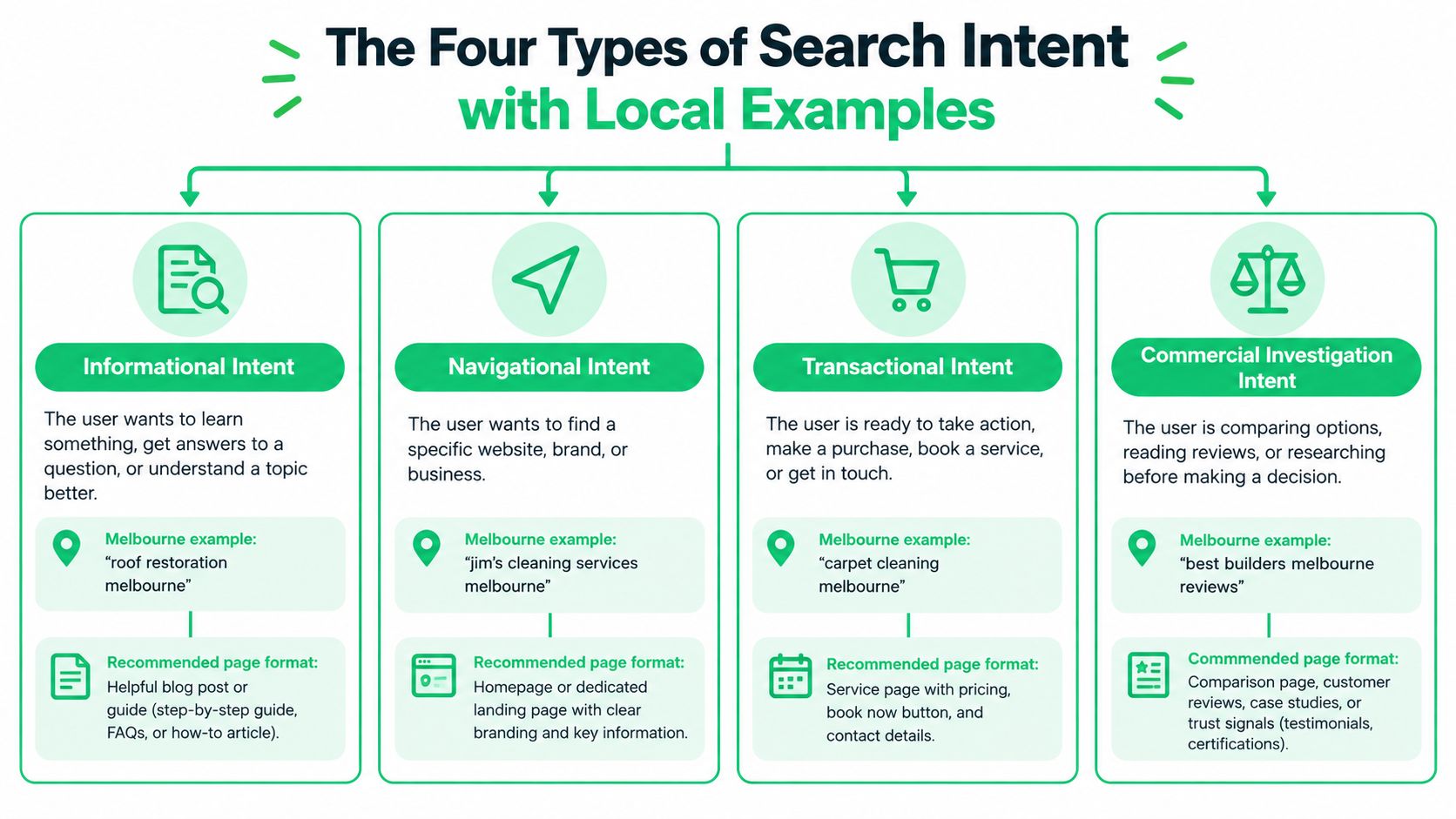
The Four Types of Search Intent With Local Examples
Informational intent
Informational searches happen when someone wants to understand something, not hire right away. A Melbourne roof restorer might search “how much does a roof restoration cost”, which suits a guide or pricing explainer rather than a sales page. Australian guidance on search intent page matching
Navigational intent
Navigational intent means the person already knows where they want to go. A search for a known dental practice name, or a branded login page, belongs on the homepage or a branded landing page, not a generic blog post.
Commercial investigation intent
Commercial investigation sits between learning and buying. A search like “best dentist in Camberwell” or “plumber vs drain specialist” needs comparison content, proof content, or a buying guide, because the person is still weighing options.
Transactional intent
Transactional searches show readiness to act. “Emergency plumber Richmond” is a good example, and it should land on a suburb service page with a clear offer, contact details, and a fast path to enquiry.
The key point is that the page format is the deliverable, not just the wording. A guide, a comparison page, a service page, and a local landing page all solve different problems, and Google tends to reward the one that fits the query best.
How to Detect Search Intent From the SERP
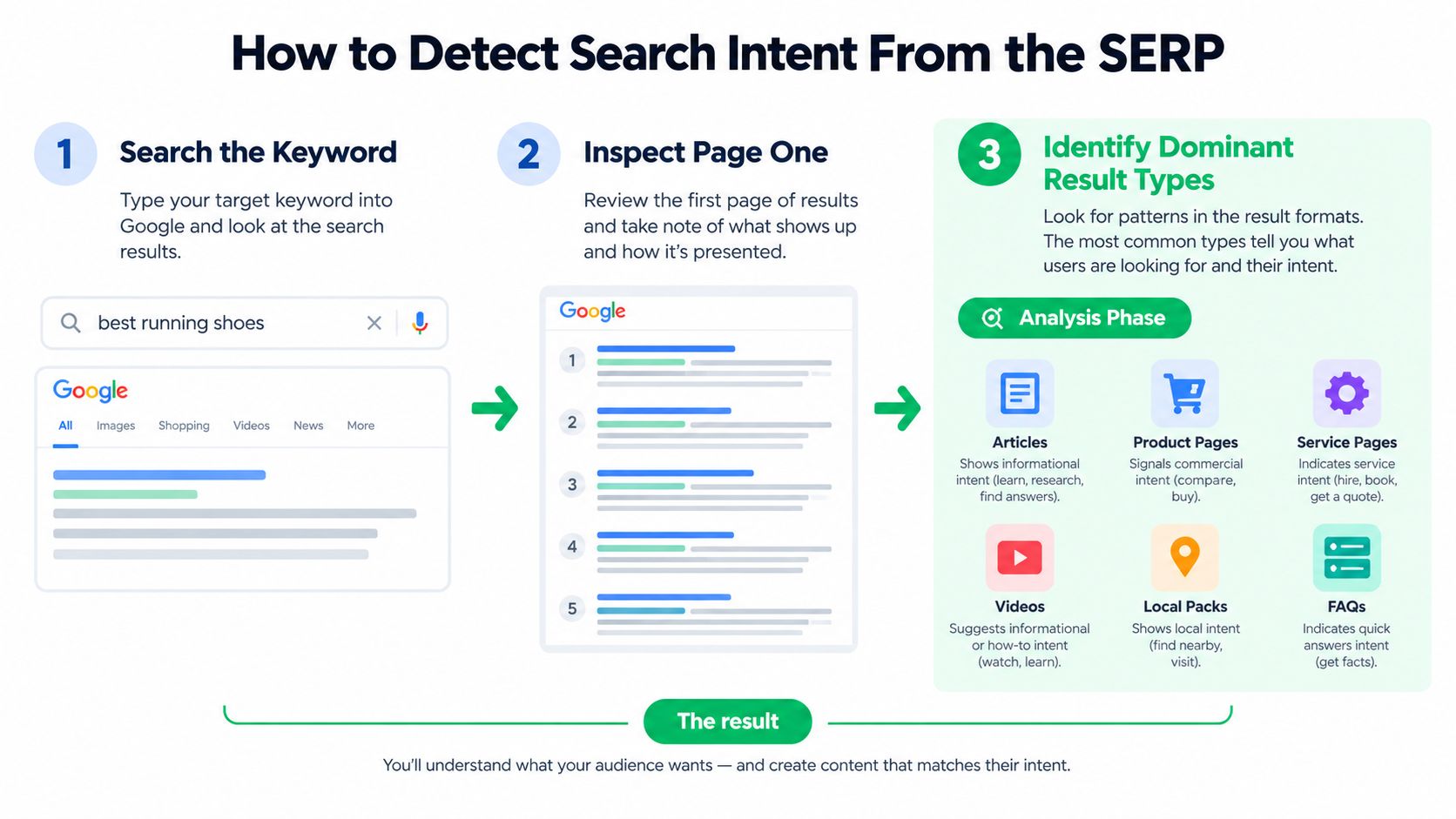
The most reliable check is still simple, search the keyword and read page one. If the results are mostly how-to articles, Google is treating the query as informational. If the results are mostly service pages or brand pages, the intent is probably transactional or navigational. SERP inspection method for Australian search intent
Look at the result titles first, then look at the formats. A mix of guides, comparison pages, map packs, and business profiles tells a different story from a page full of service landing pages. A Google Business Profile map pack often signals strong local intent, especially for service businesses that operate in suburbs rather than nationally.
A practical Melbourne check might compare “hot water system repair Melbourne” with “how does a hot water system work”. The first query points toward a local service page, while the second points toward an educational article. If the same page tries to do both jobs at once, it often ends up satisfying neither properly.
Search results change over time, so intent checks need to be repeated, not treated as a one-time task.
Many teams get tripped up here. A page that matched the SERP six months ago can drift out of step as Google changes what it shows, so the format check should stay part of regular SEO work.
Using Keyword Modifiers and Analytics to Confirm Intent
Words matter because people reveal intent in the modifiers they use. Queries with how, what, or guide usually lean informational, while words like best, reviews, vs, and top often signal commercial investigation. Transactional language often includes near me, book, quote, emergency, or a suburb name.
Google Search Console is the first place to verify that pattern on your own site. It shows the queries already associated with your pages, and Australian SEO guidance recommends filtering queries by city or suburb so local intent becomes visible instead of buried in broad data. Search Console query segmentation for local intent That makes it possible to separate branded, informational, commercial, and transactional queries before deciding which pages need work.
A clean workflow looks like this:
- Check the query wording: look for the modifiers that suggest learning, comparison, or buying.
- Group by intent: split the queries into branded, informational, commercial, and transactional buckets.
- Add location filters: isolate city and suburb terms so local demand is easier to see.
- Match the page type: send the bucket to the page format that solves the query.
For keyword discovery and topic planning, SEO2RANK's keyword research workflow fits neatly into that process because it starts with the searches customers are using, then maps them to the right service or location pages.
The point isn't to overcomplicate things. It's to stop guessing. Once query data and page type are lined up, the business can see which searches belong on money pages and which ones belong in supporting content.
Why Intent Alignment Drives Rankings and Conversions
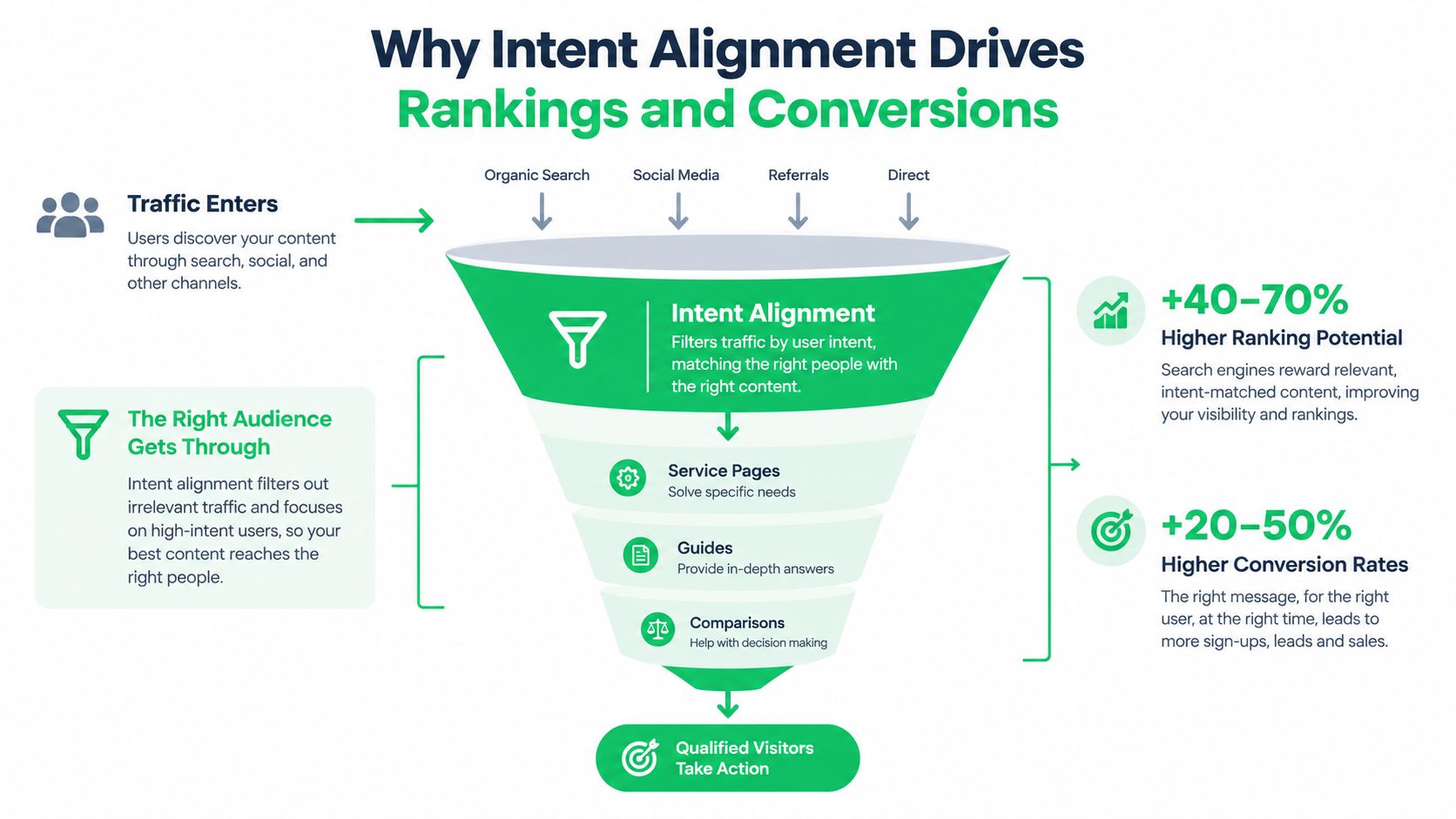
Search intent is not just a label, it's a routing rule. Before any optimisation starts, the intent should decide whether the page needs to be a guide, a service page, a comparison page, a product page, or a local landing page.
That matters because strong writing can still underperform if the page solves the wrong problem. A well-written blog post that attracts people ready to book a plumber will often lose them, while a focused suburb page can turn that same demand into calls. The page type has to do the heavy lifting first.
That's why rankings alone do not pay invoices. A page can attract plenty of traffic and still hide the commercial value if the visitors are in the wrong mindset or the wrong stage of the journey. What a strong SEO service page should include is a different question from whether a query deserves a guide in the first place.
The cleanest SEO wins usually come from pages that match the searcher's stage, not from pages that try to talk to everyone at once.
For a Melbourne service business, the commercial logic is straightforward. Informational content can earn discovery and internal links, while transactional suburb pages can capture local demand and turn it into enquiries. When those two parts work together, traffic becomes more legible, and the business can see where leads come from.
Mapping Intent to Pages for a Melbourne Service Business
A single local business usually needs more than one page type to cover the full search journey. A Melbourne plumber, for example, might need suburb service pages for transactional queries, a well-optimised Google Business Profile for discovery, comparison or proof content for commercial investigation, and educational articles for people who are still learning. SEO2RANK case example on local SEO for a plumber
The structure below gives a simple audit framework.
| Intent type | Example Melbourne query | Best page type | Page goal |
|---|---|---|---|
| Informational | how does a hot water system work | Guide or explainer | Teach and earn discovery |
| Navigational | [business name] login | Branded homepage or landing page | Help users reach a known destination |
| Commercial investigation | best dentist in Camberwell | Comparison or proof page | Build confidence and reduce uncertainty |
| Transactional | emergency plumber Richmond | Suburb service page | Convert demand into a call or quote |
The order matters. Most customers start by learning or comparing before they act, so educational pages should support the pages that earn revenue rather than compete with them. Internal links can move readers from a guide into a service page once they’re ready to take the next step.
This is also where local relevance matters. A suburb page should speak like it belongs to that area, while a comparison page should help the reader decide without sounding like a hard sell. Service businesses that build page architecture around intent tend to get cleaner site structure, better internal linking, and less confusion about which page should rank for what.
How AI Overviews Are Changing Informational Intent
A newer problem sits on top of the old four intent types. Some informational queries are now answered before the click, because AI Overviews increasingly appear on “what is” and “how do I” style searches in Australia. Google Australia’s 2025 year-in-search summary noted that over a third of searches in Australia were reported to trigger an AI summary by the second half of 2025, with those summaries clustering heavily around informational questions.
That changes the work a Melbourne business needs to do. Some informational pages still matter because they earn trust, links, and citations, but not every educational query will drive the same volume of clicks it used to. The practical move is to separate queries that still send visitors from queries that are increasingly satisfied on the results page.
For local service businesses, that often means putting more effort into two areas. First, content that can be cited or surfaced in AI results. Second, the commercial and local queries where the click still has obvious value. SEO2RANK’s note on AI search and website clicks fits this shift because the content plan has to reflect how search behaviour is changing, not how it used to work.
The environment is still shifting, so any fixed claim about exact click loss would age badly. The safer approach is to keep measuring which informational topics still bring visits and which ones mostly serve as brand or authority signals.
Quick-Reference Checklist and Measurement Guidance
A simple audit can catch most intent problems fast.
- Match the page to page one: search each target keyword and confirm the dominant result type matches your page format.
- Segment Search Console queries: separate branded, informational, commercial, and transactional terms, then add suburb or city filters where relevant.
- Check the conversion path: transactional queries should land on money pages, not broad blog posts.
- Link supporting content properly: informational pages should point into service pages, not sit in isolation.
- Track the right outcomes: impressions by intent bucket, click-through differences between page types, and conversion performance all matter.
- Confirm measurement is in place: if enquiry tracking is missing, intent work becomes hard to judge.
Useful test: if a page earns traffic but never contributes to enquiries, the page may be answering the wrong intent.
Professional help is usually worth considering when the site has enough content to make intent messy, or when analytics setup is too thin to show what’s really converting. The main benefit of intent work is clarity, because it tells a business which pages are meant to teach, which pages are meant to persuade, and which pages are meant to convert.
A sensible next step is to pick five target keywords, check the live SERP for each one, and compare those results with the pages already on the site.
SEO2RANK helps Melbourne service businesses map search intent to the right pages, then measure whether those pages bring in enquiries. If the site needs clearer local landing pages, better content structure, or more useful reporting around Search Console and conversion data, visit SEO2RANK to see how that work is approached in practice. designrush verified
Find Out What Is Holding Your
Website Back
Get a practical SEO Snapshot showing the biggest issues and opportunities we can see across your search visibility, website and local presence.
GET YOUR FREE SEO SNAPSHOT