Google does not penalise AI content just because AI helped write it. It does penalise mass-produced, low-value, or manipulative pages, whether a human wrote them or a tool helped draft them.
That's the part Melbourne business owners need to hear, because the wrong lesson from recent Google updates is usually “ban AI”. The right lesson is simpler, publish content that helps a real customer, and don't confuse drafting speed with search quality. For a plumber, electrician, lawyer, dentist, or accountant competing in local search, that difference decides whether a page earns visibility or gets ignored.
Table of Contents
- The Short Answer for Melbourne Businesses
- How Google Enforces Content Quality
- Scaled Content Abuse Versus Helpful AI-Assisted Writing
- Where Melbourne Service Businesses Usually Go Wrong
- Practical Rules for Using AI Without Risking Rankings
- Monitoring Performance After Publishing AI-Assisted Pages
- Why Avoiding AI Entirely Is Also a Mistake
- What to Do Next as a Melbourne Service Business
The Short Answer for Melbourne Businesses
For Melbourne service businesses, the answer is clear: Google does not penalise a page because AI helped produce it. AI-generated content is acceptable when it's high-quality, original, and helpful, while spammy scaled pages remain exposed under Google's Australian Search and AI guidance Google's Australian AI and Search guidance. The tool is not the ranking issue. The page's usefulness is.
A plumber, electrician, lawyer, dentist, or accountant can use AI to shape a draft, improve structure, or clarify a service explanation. The page becomes risky when it is a generic suburb swap, offers no local proof, skips the customer's real question, and gives readers no reason to trust the business. That is the line Melbourne operators need to manage. Safe AI-assisted editing improves a business's own expertise. Scaled content abuse manufactures pages to occupy search results.
Google's AI Overviews on 29 October 2024 rollout in Australia is a useful signal. Google is investing in generative search features, so removing every AI-assisted workflow is the wrong response. Rankings still depend on page quality, not whether a machine appeared in the drafting process.
Practical rule: publish a page only if a customer would find it useful without caring who drafted it.
Keep a person responsible for facts, local details, examples, and the final recommendation. AI can speed up editing, but it cannot supply genuine Melbourne experience or proof. Review every page against the query, then publish only what earns its place.
How Google Enforces Content Quality
Google doesn't use a simple AI yes or no switch. It judges content through ranking systems, spam systems, and, in some cases, manual action. That is why a page can drop without a neat penalty notice. The problem is usually content quality, not the presence of machine-written text.
Helpful content gets treated differently from manipulative content
Google's own guidance says it does not penalise content just because AI or automation helped create it. It aims to rank helpful, reliable, people-first content, including automated, AI-generated, and AI-assisted material, as long as the page was made to help users rather than manipulate rankings Google's AI content guidance. That distinction is the whole point.
The same guidance makes the boundary clear. If automation or AI is used mainly to manipulate ranking, it falls under spam policies. So the question is simple. Does the page answer a searcher's intent, or does it exist to fill a slot in the index?
Google's AI features also use extra guardrails to uphold Search quality standards. That matters in practice, because ranking shifts usually follow quality signals, not authorship labels.
The enforcement target is pattern-based
Google's systems react more strongly to patterns like thin pages, repetitive templates, and mass publishing than to one sentence that sounds AI-written. Local businesses get into trouble when they push out lots of near-identical suburb pages, service pages, or blog posts without new information.
SEO2RANK's coverage of Google's 2026 spam updates is useful background for anyone trying to separate normal ranking movement from quality problems. The key point stays the same. Google is judging the page, the pattern, and the intent, not the drafting tool.
For Australian publishers, the practical takeaway is blunt. Useful beats automated, original beats repetitive, and evidence beats filler. A page that helps a customer make a decision has a far better chance of holding up under Google's quality systems.
Scaled Content Abuse Versus Helpful AI-Assisted Writing
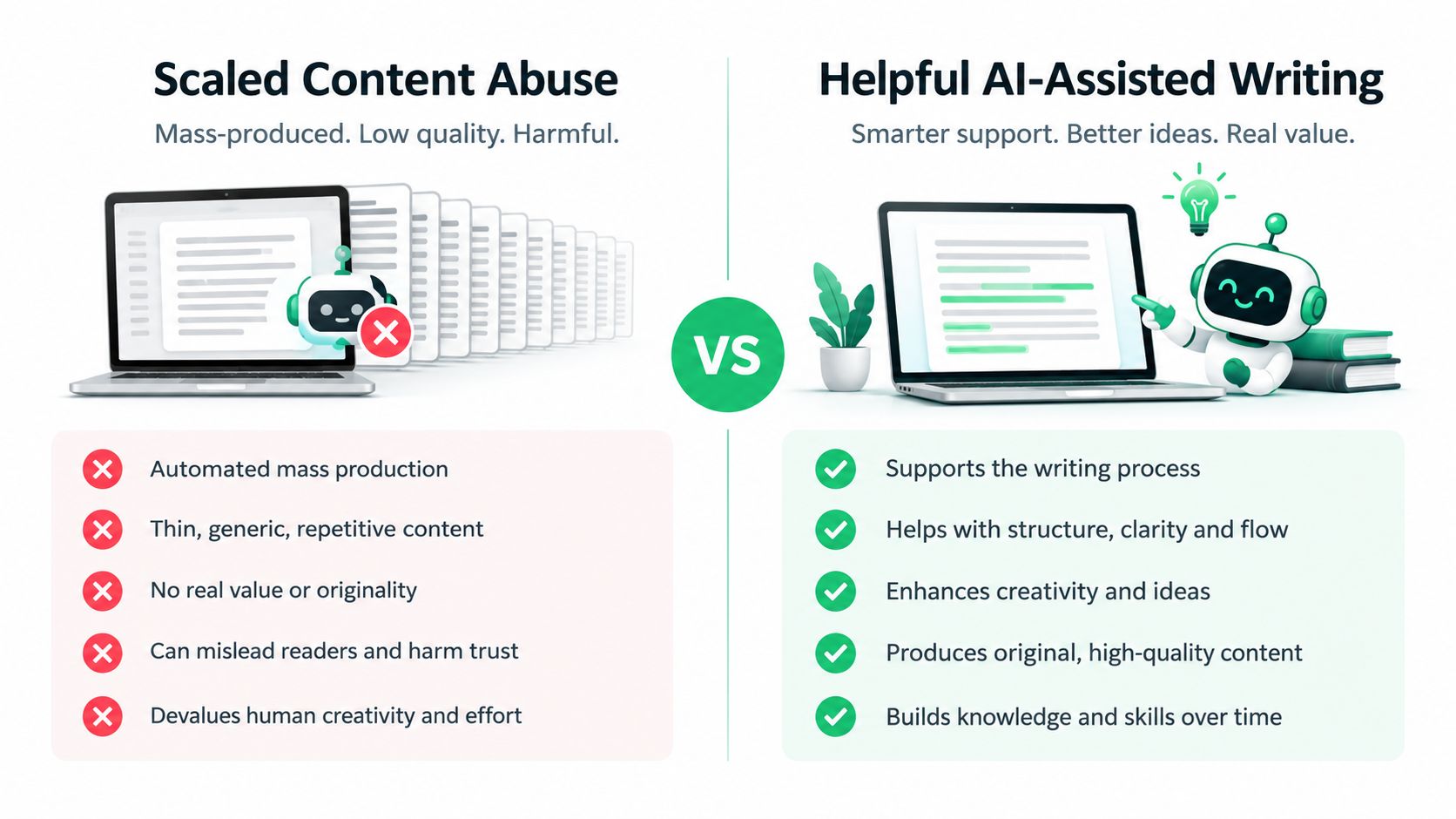
The main risk isn't AI-assisted drafting, it's scaled content abuse. Google clarified in March 2024 that scaled content abuse is when many pages are generated primarily to manipulate Search rankings and not help users, and that this can be enforced whether the pages were produced by automation, human effort, or both Google's March 2024 spam policy update. That's the line Melbourne businesses keep crossing without meaning to.
The safe side looks like editing, not flooding
Helpful AI-assisted writing usually starts with a draft, then gets sharpened by a human who adds local detail, factual checks, pricing context where appropriate, and actual service insight. A tradie using AI to restructure a single service page is playing a different game from a site owner churning out hundreds of near-duplicate suburb pages.
The first approach can be legitimate. The second often looks like an attempt to occupy search results by volume rather than usefulness.
The risky side is easy to recognise
If a business creates pages that only swap suburb names, repeat the same service paragraph, and offer no distinct local proof, Google can read that as low-value scaling. The intent doesn't need to be malicious for the output to look manipulative.
That's why this issue hits service businesses hard. A plumber in Melbourne might think a page for every suburb sounds like good coverage. If each page says nearly the same thing, with no unique project examples, local regulations, team expertise, or service-specific detail, the whole set starts to resemble spam.
Rule of thumb: one genuinely useful page is safer than ten diluted ones.
A useful page answers a specific search need. A scaled page tries to look relevant everywhere without being meaningful anywhere. Google's policy is aimed at the second type.
Where Melbourne Service Businesses Usually Go Wrong

Most local businesses don't get into trouble because they used AI. They get into trouble because they used it as a shortcut for publishing. Google's generative-AI guidance says AI-assisted content still has to meet Search Essentials and spam policies, and it warns that generating many pages without adding value may violate the scaled content abuse policy Google's generative AI content guidance.
The usual mistakes are workflow mistakes
The first mistake is publishing thin AI drafts with no local evidence. A page about roof repairs, accounting, or cosmetic dentistry can't just rephrase the obvious. It needs actual service detail, proof, and a clear answer to the searcher's intent.
The second mistake is duplicating service pages across suburbs with only minor wording changes. That looks efficient on a spreadsheet and weak in search. Google doesn't reward that kind of repetition, because it adds very little value.
The third mistake is assuming automation removes the need for review. It doesn't. AI can help a team move faster, but it also makes it easier to publish generic copy at scale if nobody is checking for duplication, accuracy, or local relevance.
The fix is process, not panic
A Melbourne business does better when it adds a simple editorial gate. That means someone checks whether the page says anything specific, whether the claims are true, and whether the content answers the query. It also means reviewing whether multiple pages are saying the same thing in different words.
15 local SEO tips for Melbourne businesses is a useful reminder that local SEO still depends on location relevance, not just word count. AI can support that work, but it can't replace it.
AI can speed up writing. It can't rescue a weak information architecture or a page that doesn't deserve to rank.
A service business that treats AI as a drafting assistant stays in safer territory. A business that treats it as a publishing machine starts drifting toward the exact pattern Google is trying to clean up.
Practical Rules for Using AI Without Risking Rankings
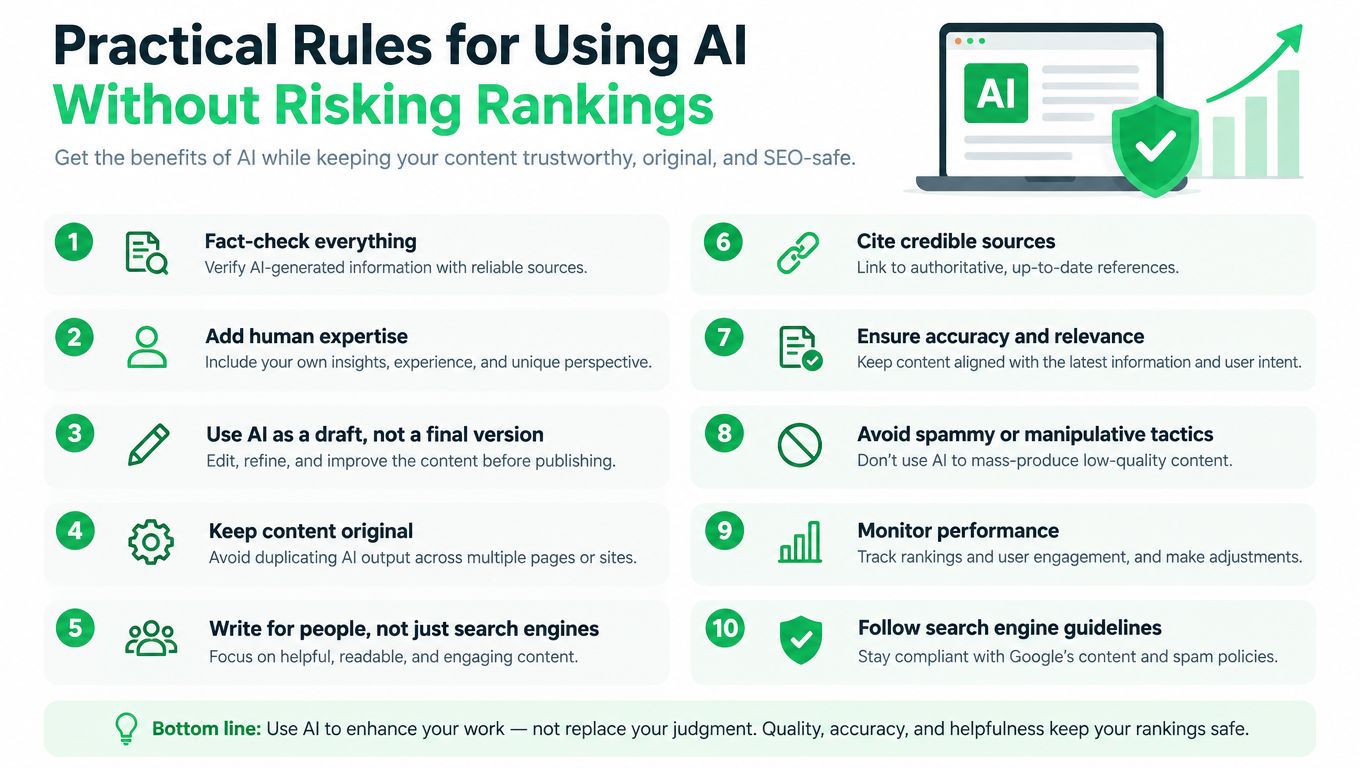
Google's official stance is simple, it does not penalise content just because AI or automation helped create it. The test is whether the page was made to help users or to manipulate rankings, and Google says any automation role should be self-evident when it substantially shaped the page Google's AI content audit guidance. That means the safe path is not secrecy, it's editorial discipline.
Use AI as a drafting aid, not a publishing endpoint
A page should go through human review before it goes live. That review should check facts, tone, local relevance, and duplication. If the content only works because someone else will “fix it later”, it isn't ready.
For a dental practice updating treatment pages or a tradie refreshing service-area content, the human pass is where the page becomes credible. AI can structure the draft. A person has to make it believable.
Keep each page tied to one real search need
One page should answer one job. If the query is about emergency plumbing in Melbourne's inner suburbs, the page should talk about that job, not wander across unrelated services. If the query is about accounting for sole traders, the page should focus on that audience.
SEO2RANK's AI SEO service fits into this kind of workflow when the aim is to improve structure, entity signals, and topical coverage rather than flood the site with more pages.
Make disclosure part of the process when needed
If automation substantially generated a page, readers should be able to tell. That doesn't mean every sentence needs a disclaimer. It does mean the site shouldn't pretend a mass-produced draft is a handcrafted expert piece if it isn't.
A practical checklist helps here:
- Check for originality: if the page could be swapped with a competitor's page, it's too generic.
- Check for local proof: if there's no Melbourne-specific evidence, the page is probably too thin.
- Check for duplication: if several pages say the same thing, collapse or rewrite them.
- Check for intent match: if the page doesn't directly answer the searcher's question, it needs work.
- Check for trust signals: if the page makes claims, back them up with clear facts and context.
Those rules keep AI in the useful category. They also make it much harder for a business to drift into scaled content abuse by accident.
Monitoring Performance After Publishing AI-Assisted Pages
After a page goes live, the first move is to check whether it is earning the right kind of visibility. Search Console gives you the full picture. Look at impressions, clicks, indexing status, and the queries bringing traffic. Then check whether that traffic turns into calls, form fills, or booked jobs.
Watch the right signals, not vanity noise
Impressions show whether Google is surfacing the page. Clicks show whether searchers care. Indexing status tells you whether the page is in play. If performance drops after an edit, check whether the page got thinner, more duplicated, or less aligned with the search intent.
Analytics matters just as much. A page can pull in visits and still miss the mark if it does not produce enquiries. For a Melbourne plumber, electrician, or accountant, traffic without leads is wasted effort.
Practical rule: if a page gets traffic but no enquiries, it is probably attracting the wrong searchers or solving the wrong problem.
Diagnose before you rewrite
Compare the live page with the version before the change, then compare both against the pages ranking above you for the same query. If your page now reads like a template, lacks local detail, or answers the query too loosely, that is a warning sign. If the page still covers the job clearly and the numbers only move a little, you may be seeing normal search movement.
As noted earlier, Google cares about usefulness, originality, and people-first quality. Use that lens here. Do not blame AI just because rankings wobble. Look at the page quality first, then fix the parts that make it thin, generic, or hard to trust.
Why Avoiding AI Entirely Is Also a Mistake
Some businesses overcorrect and ban AI from the workflow completely. That sounds cautious, but it often wastes time and leaves less room for the work that really matters, like local expertise, original examples, and careful editing. A blanket ban doesn't create quality by itself.
AI is just one part of the process. It can help a team draft faster, organise research, and shape rough notes into a usable page. It can also create junk at speed if nobody is watching.
AI search clicks and website traffic is worth understanding because search is already changing around AI-driven surfaces. The answer isn't to pretend the workflow can stay frozen. The better move is measured use with stronger editorial controls.
For Melbourne service businesses, that middle ground is usually the smartest one. Use AI where it saves time, but keep humans in charge of facts, local relevance, and final approval. That combination is far safer than either blind automation or total avoidance.
What to Do Next as a Melbourne Service Business
The clean answer is this. Google doesn't penalise AI content for being AI-made. It penalises weak, repetitive, manipulative, or mass-produced content that fails users. That's true for tradies, dentists, accountants, and other service businesses trying to rank in Melbourne and across Australia.
The next step is a content audit, not a panic swap. Check whether existing pages are thin, duplicated, or too generic to deserve their current targets. Then tighten the review process so every AI-assisted draft gets human fact-checking, local proof, and a clear reason to exist.
A page that helps a real customer will usually survive. A page built mainly to fill space won't. That's the line.
SEO2RANK helps Melbourne service businesses clean up content structure, local relevance, and measurement so pages are built to answer real search intent instead of chasing volume. If this topic is affecting your rankings or your publishing workflow, visit SEO2RANK and review how its SEO and AI SEO services fit into a more controlled content process.
Find Out What Is Holding Your
Website Back
Get a practical SEO Snapshot showing the biggest issues and opportunities we can see across your search visibility, website and local presence.
GET YOUR FREE SEO SNAPSHOT