

Typical 2026 Melbourne SEO retainers for small businesses commonly sit between about AUD 1,500 and AUD 5,000 per month plus GST, with separate setup fees and audit costs. The right figure depends on scope, suburbs, implementation depth and the value of a qualified lead.
A business owner comparing proposals can easily see three different prices for what appears to be the same service. One provider may supply a monthly ranking report and recommendations. Another may fix technical issues, improve commercial pages, manage local search assets and track phone enquiries. The invoices differ because the work differs.
Table of Contents
- What Melbourne Businesses Typically Pay for SEO in 2026
- Why SEO Prices Vary So Much
- Typical Pricing by Business Type and Scope
- Setup Fees, GST and Contract Terms to Watch
- Audits Versus Monthly Retainers and One-Off Projects
- Calculating ROI and a Realistic SEO Budget
- How to Choose a Melbourne SEO Agency Without Overpaying
- Sample Budgets and a Sensible Way to Decide
What Melbourne Businesses Typically Pay for SEO in 2026
For most Melbourne small businesses, a defensible planning range is AUD 1,500 to AUD 5,000 per month plus GST, with narrower local campaigns near the lower end and technically demanding, multi-suburb or multi-service programs nearer the upper end. Australian market estimates place broader SME retainers in this range, while small-business SEO investment is also reported at approximately AUD 1,200 per month in narrower engagements, as summarised by Australian local SEO pricing estimates.
A setup fee or paid audit usually sits outside the retainer. It pays for initial crawling, indexation checks, technical diagnosis, keyword and page mapping, local search review, conversion measurement and prioritisation. A monthly fee then funds the continuing work required to implement and validate those priorities.
The range becomes wider when the campaign covers several suburbs, service lines, websites or stakeholders. A single-location practice with a healthy website has a different workload from a tradie serving many Melbourne suburbs, or a professional firm targeting several commercial services.
Practical rule: A monthly SEO fee should buy defined work, not merely access to a dashboard.
SEO is better treated as an ongoing investment in organic visibility than as a one-off website expense. The program may include technical remediation, Google Business Profile optimisation, commercial landing pages, internal linking, content, conversion tracking and reporting. The appropriate fee should be judged against the qualified enquiries those activities can support, not against a generic market average.
Australian search advertising alone accounted for AUD 8.0 billion in 2025, within total internet advertising expenditure of AUD 18.4 billion, according to the IAB Australia Internet Advertising Revenue Report. That scale doesn't prescribe an agency fee, but it shows why Melbourne businesses compete seriously for search visibility and why SEO deserves a proper investment case.
Why SEO Prices Vary So Much
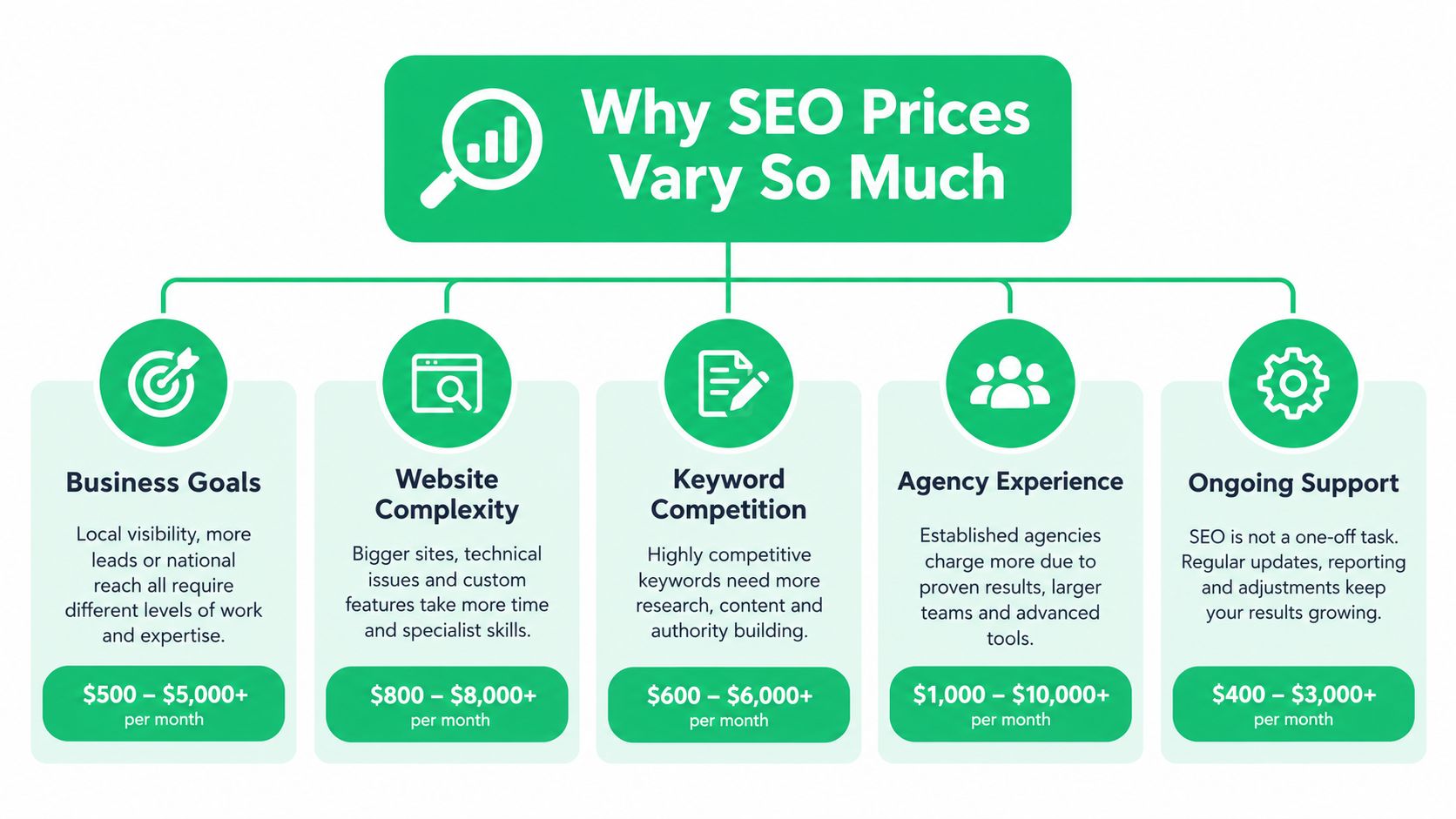
SEO pricing reflects labour, complexity and accountability. Automated tools can identify possible errors, but they don't decide which issue affects revenue, who should fix it, whether the fix is safe or whether a page now converts better.
Australian market data places the median advertised SEO salary at approximately AUD 95,000 excluding superannuation, while freelance SEO specialists are reported at roughly AUD 600 to AUD 1,500 per day, according to the Australian SEO salary survey. An agency retainer must fund specialist analysis, implementation, quality assurance, reporting and account overhead, not just software subscriptions.
The work behind the quote
A technically credible program may need to resolve crawl and indexation barriers, improve Core Web Vitals, repair redirects, strengthen site architecture and validate structured data. Those tasks often require access to the content management system, developer coordination and testing after deployment.
Content also changes the workload. One service page may need search-intent research, commercial copy, proof points, internal links, metadata, structured data and editorial review. Several suburb pages require a useful geographic strategy, not duplicated text with suburb names swapped in.
The same applies to measurement. Conversion-event QA must distinguish a genuine enquiry from a page view or accidental click. Reports should explain what changed, what remains blocked and which action takes priority next.
Why low retainers can mislead
A low monthly price may be entirely appropriate for a narrowly defined project. It becomes risky when the proposal promises technical SEO, content, local search, link development and conversion tracking without stating how much labour each receives.
Fair Work records a National Minimum Wage of A$26.44 per hour or A$1,004.90 per week from 1 July 2026, and a 4.75% increase to minimum award wages, according to Fair Work's minimum wage information. These figures aren't SEO quotations, but they illustrate why legitimate labour carries cost. A very low fee often means fewer hours, templated activity or recommendations that the client must implement separately.
Typical Pricing by Business Type and Scope
The most useful comparison isn't “cheap versus expensive”. It's narrow scope versus broad scope. The following bands are practical planning ranges for Melbourne small businesses, not guaranteed agency menus.
| Business profile | Typical monthly range | Typical setup / audit | Main scope drivers |
|---|---|---|---|
| Single-location local service business | AUD 1,500 to AUD 2,500 plus GST | AUD 750 to AUD 1,500 plus GST | Google Business Profile, core service pages, technical baseline, tracking |
| Tradie covering several Melbourne suburbs | AUD 2,000 to AUD 4,000 plus GST | AUD 1,000 to AUD 2,000 plus GST | Service-area pages, local relevance, internal links, calls and form attribution |
| Single dental or healthcare practice | AUD 2,000 to AUD 3,500 plus GST | AUD 1,000 to AUD 2,000 plus GST | Treatment pages, trust signals, local profile, technical and conversion work |
| Accounting or professional services firm | AUD 2,000 to AUD 4,000 plus GST | AUD 1,000 to AUD 2,500 plus GST | Multiple service intents, commercial content, authority development, lead quality |
| Multi-service B2B operation | AUD 3,000 to AUD 5,000 plus GST | AUD 1,500 to AUD 3,000 plus GST | Topic depth, stakeholders, technical complexity, long sales-cycle measurement |
| Multi-location business or larger service brand | AUD 4,000 to AUD 5,000 plus GST and potentially higher | AUD 2,000 to AUD 3,000 plus GST and potentially higher | Multiple profiles, locations, templates, governance and reporting |
A single-location practice may need only one Google Business Profile, a focused set of service pages and a clean conversion path. A multi-suburb tradie needs stronger geographic coverage without creating thin or duplicated pages. A group with several sites or locations adds approval processes, profile governance and reporting complexity.
The SEO packages comparison is useful as a reference point when assessing how a provider separates setup charges, monthly scope and GST treatment. The important question isn't whether a package fits a label. It's whether the listed work matches the business's actual search footprint.
Higher pricing is justified when the provider is doing more than supplying recommendations. Buyers should look for implementation of agreed technical fixes, commercial-page improvements, Google Business Profile work, internal-link architecture, content production and conversion-event validation. If those items remain with an internal developer or staff member, the apparent saving may just transfer the cost elsewhere.
Setup Fees, GST and Contract Terms to Watch
A credible proposal separates setup or audit fees from the recurring retainer. The initial work should examine the website, search demand, local coverage, conversion paths and technical constraints, then turn those findings into priorities. Do not accept an undefined audit buried inside the first few months of delivery. Ask what you receive for the setup fee, who implements the recommendations and how much work remains for your team.
GST can distort comparisons. The Australian Taxation Office states that GST is generally 10% on most goods and services, as explained in its guide to how Australian GST works. A quote of A$1,000 before GST becomes A$1,100 including GST, while an advertised A$1,000 GST-inclusive price contains A$90.91 in GST. Compare like with like, then judge the effective cost per delivered outcome, not just the monthly headline.
Read the proposal line by line
Before signing, confirm:
- GST basis: Each fee must say plus GST or GST-inclusive.
- Setup scope: Identify whether the initial fee covers an audit, strategy, configuration, implementation, or only a report.
- Included delivery: Confirm content quantities, technical hours, local-profile work, measurement setup and reporting frequency. Recommendations without implementation can leave you paying twice.
- Access and ownership: Retain access to Google Analytics, Search Console, Google Business Profile and the website. The agency should not control the assets that generate your enquiries.
- Minimum term: Check the commitment period, notice requirements and what happens to unfinished work on exit. Our guide to what happens when you stop paying for SEO explains the practical exit questions to raise.
- Renewal terms: Look for annual review clauses and require notice before pricing or scope changes.
The 2026 wage update gives businesses a useful reason to examine annual price reviews, as outlined in Fair Work's 2026 Annual Wage Review. It does not automatically justify a higher retainer. Ask whether a proposed increase reflects labour costs, additional pages, new suburbs, implementation, or a changed service level.
A longer agreement should buy clearer delivery, not lock in a fee. Tie spend to qualified enquiries, defined work and measurable reporting, then negotiate terms that let you leave when the agency stops delivering.
Audits Versus Monthly Retainers and One-Off Projects
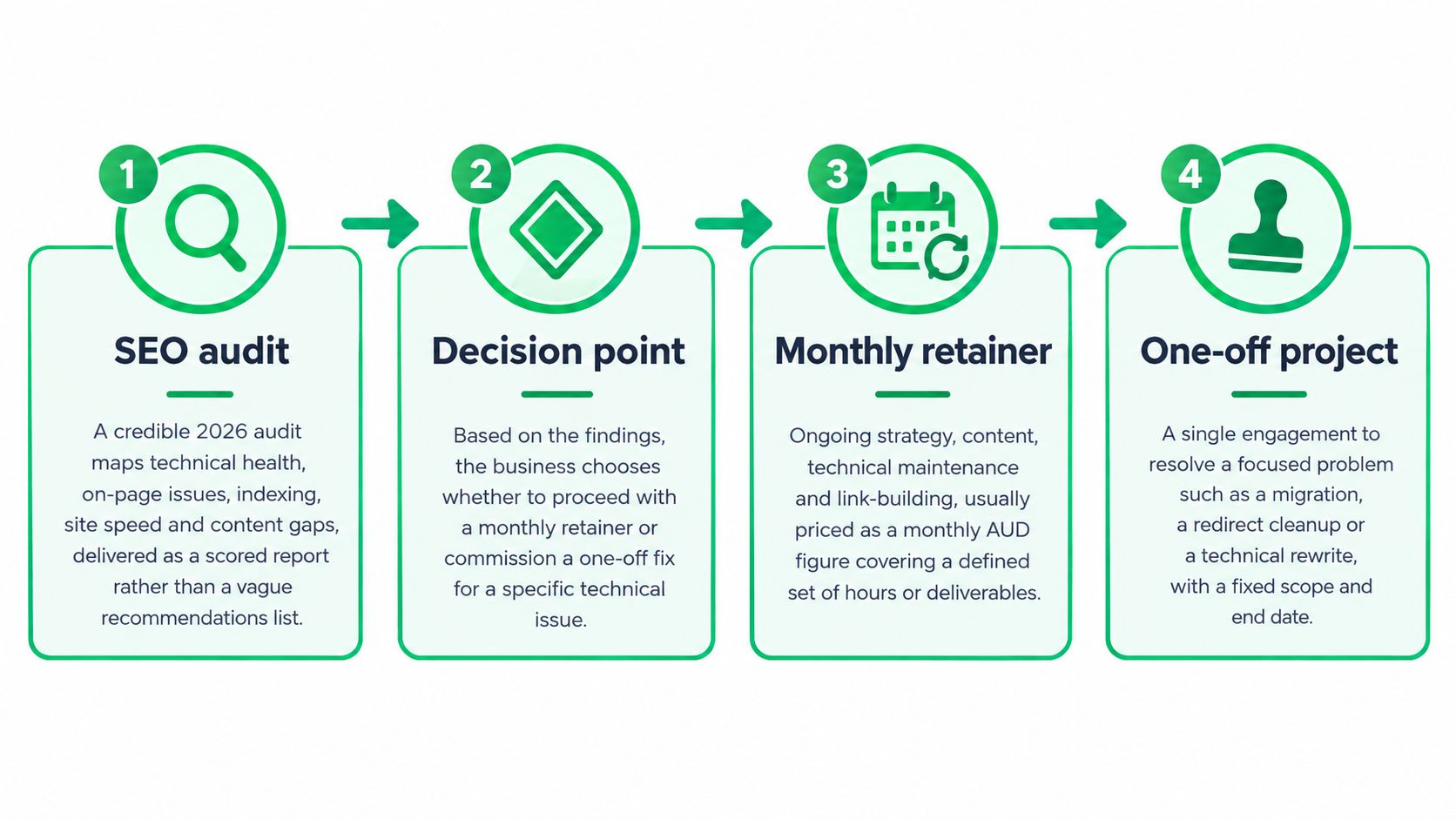
An audit makes sense when a business needs diagnosis before committing to ongoing work. A credible audit should inspect the website rather than produce a generic checklist.
What a useful audit should contain
A full engagement commonly covers:
- Crawl and indexation checks, including pages search engines can discover, access and index.
- Core Web Vitals and technical review, with prioritised issues rather than an unranked export from a tool.
- Money-page analysis, examining whether important service or product pages match search intent and support enquiries.
- Google Business Profile review, including categories, services, location information and discovery assets.
- Internal-link and site-architecture assessment, so authority and context reach important pages.
- Backlink and authority review, focused on relevance and risk rather than bulk link counts.
- Conversion measurement checks, confirming that calls, forms and other enquiry actions record accurately.
- A prioritised roadmap, showing what should happen first, who needs to act and why it matters.
A free high-level snapshot can help a business identify obvious issues. It isn't a substitute for a paid audit when the website is complex, traffic has fallen, a migration is planned or several stakeholders need an implementation roadmap.
A one-off project suits a focused problem, such as redirect cleanup, a migration, a structured-data rewrite or a technical rebuild. A monthly retainer suits businesses that need continuing prioritisation, content, local work, technical maintenance and measurement.
The wrong purchase is an audit that never reaches implementation. A detailed report can sit unused if nobody has access, time or responsibility for applying the fixes. Before approving the audit, the business should ask whether the provider can implement the agreed work and whether that implementation is included or separately quoted.
Calculating ROI and a Realistic SEO Budget
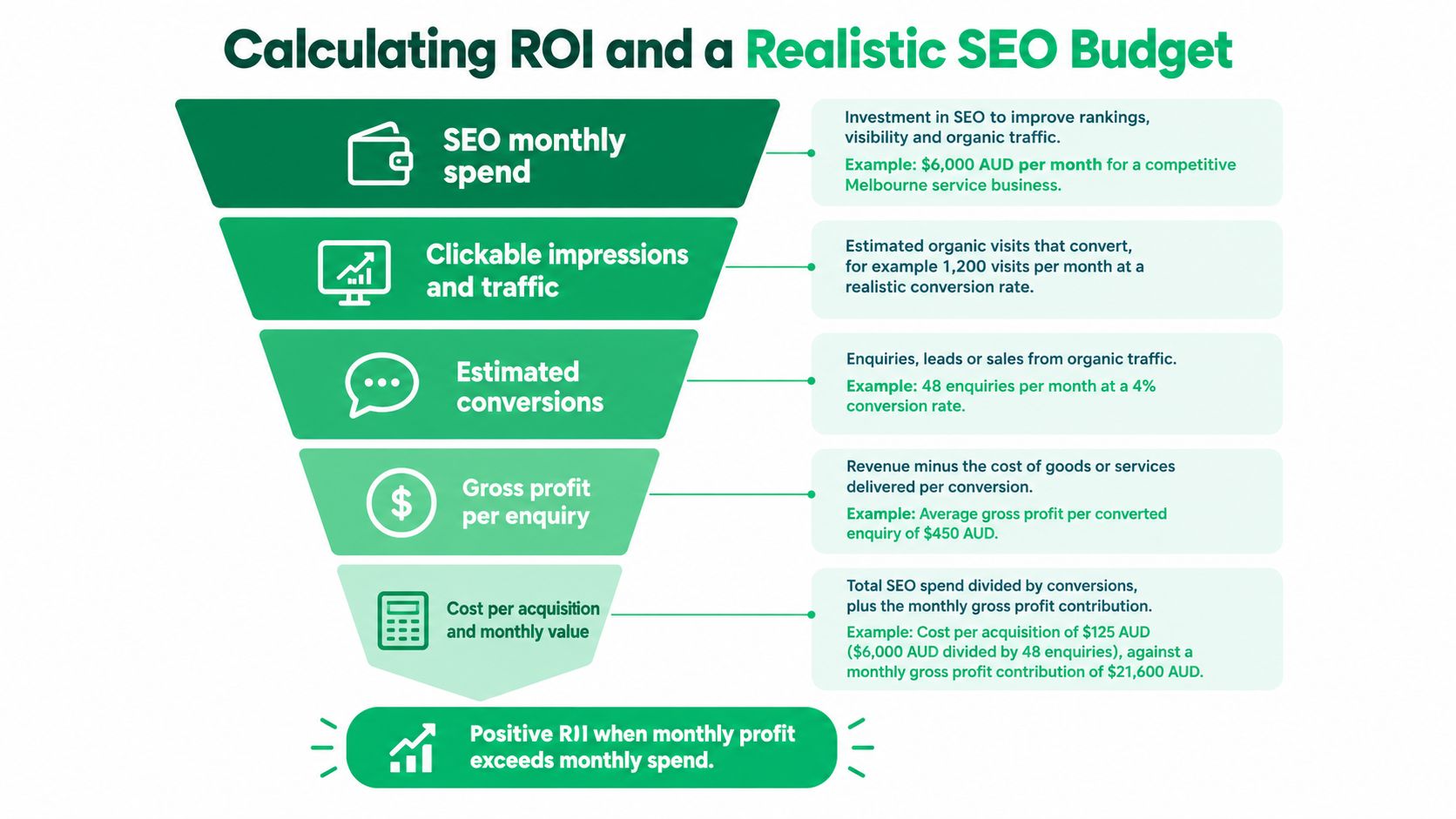
SEO budgets should start with qualified-enquiry economics, not with a provider's preferred package. A business can estimate the commercial ceiling for acquisition by combining gross profit per customer with the proportion of qualified enquiries that become customers.
For example, the Australian 2026 marketing benchmark gives a worked scenario where a new customer produces AUD 1,500 in average gross profit and 25% of qualified organic enquiries close. Each enquiry therefore carries an expected gross-profit value of AUD 375 before delivery costs, as outlined in the Australian marketing benchmarks for 2026.
That figure isn't a promise that SEO will produce enquiries at that cost. It provides a rational reference point. A business can compare the expected value of an enquiry with the cost of producing and handling it, then decide how much room exists for SEO, paid search, sales follow-up and other acquisition activity.
Measure the right local signals
Melbourne local SEO also operates beyond traditional organic rankings. Available Australian market summaries report that Google accounts for more than 93% of Australian search usage, while a separate summary states that 83% of Australians check Google reviews before buying, according to Australian Google review behaviour reporting.
That means a credible program should measure more than keyword positions. It should separate branded discovery, map actions, organic clicks, phone calls, form submissions and qualified leads. Google Business Profile optimisation, review processes, location relevance, service pages and conversion tracking work together because customers often assess a provider before contacting them.
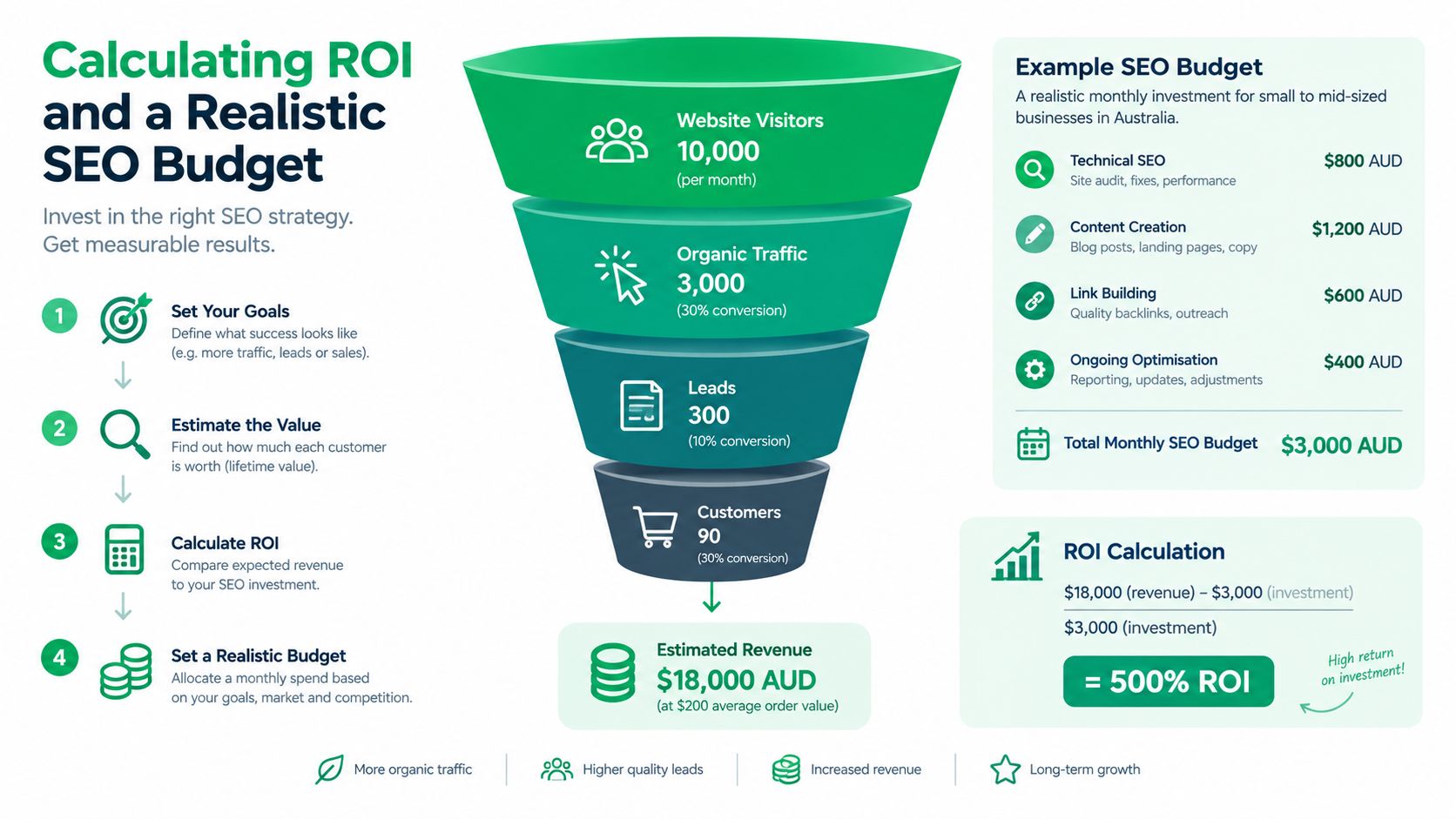
Budget allocation also needs discipline. Established businesses commonly allocate 6% to 8% of revenue to total marketing, while early-stage or acquisition-focused businesses may allocate 10% to 15%, according to the Australian benchmark cited above. Businesses spending under AUD 5,000 per month generally benefit from concentrating on no more than two primary channels, rather than spreading a limited budget thinly.
SEO timing should also be treated as a planning issue, not a sales promise. Site condition, competition, authority, implementation speed and search demand all affect the runway. Businesses assessing the difference between a diagnostic project and a continuing program can use this practical guide to how long SEO takes as one planning reference.
How to Choose a Melbourne SEO Agency Without Overpaying
A credible proposal should make the work visible. It should state what happens, who does it, what access is required and how the business will judge progress.
Questions worth asking
- What happens in the first 90 days? The answer should identify discovery, priorities, implementation and validation.
- Who performs the work? A senior strategist, specialist technician, writer and account manager may contribute different parts of the program.
- What is implemented? Separate recommendations from completed changes, developer tickets and client responsibilities.
- What gets measured? Reports should connect search visibility with calls, forms, qualified enquiries and commercial pages.
- What does local work include? Ask specifically about Google Business Profile, reviews, location pages, citations and map actions.
- How is content produced? The proposal should explain research, editorial review, subject-matter input and internal linking.
- What happens after cancellation? Clarify access, content, links, unfinished tasks and reporting history.
The provider should also explain how technical work is tested after deployment. A recommendation to improve indexation has little commercial value if nobody confirms that important pages can now be crawled and indexed.
Warning signs
Guaranteed first positions, vague “optimisation” language, bulk link promises and reports containing only rankings should trigger caution. So should a proposal that assigns every task to the client while presenting the monthly fee as a complete SEO program.
The questions to ask an SEO agency can help a non-specialist structure a sales conversation. SEO2RANK is one Melbourne-based option that combines audits, implementation, local work, technical SEO and measurement, with packages that disclose setup fees and GST treatment. No provider should be selected solely because its proposal is polished. Access, scope, accountability and commercial fit matter more.
Sample Budgets and a Sensible Way to Decide
Once Melbourne SEO pricing is clear, match the scope to the commercial outcome you need. The useful comparison is the cost per qualified enquiry delivered, not the monthly invoice alone.
A single-location service business with one core service, a sound website and a modest local catchment can usually start with a focused retainer near the lower end of the market. Its budget should buy work on the Google Business Profile, the main service page, technical checks, conversion tracking and a short list of priority improvements. Paying for broad content production would be wasteful if those fundamentals remain unfinished.
A multi-suburb tradie has a different cost profile. Service-area structure, useful suburb pages, internal links, call tracking, review processes and technical work across several templates create more implementation time. Compare that quote with another multi-suburb program, not with a single-location practice.
A competitive professional services firm may need several service pages, deeper content, authority development, stakeholder approvals and closer tracking of qualified leads. A higher retainer earns its place when it includes the people and implementation capacity to complete that work.
Use a simple worksheet before approving the spend:
- Estimate the gross value of one qualified enquiry.
- Record the monthly SEO fee, setup fee and GST separately.
- Estimate how many additional qualified enquiries would cover that cost.
- Check whether the provider is responsible for implementation or only recommendations.
- Review the result after the agreed term using enquiries, booked work and revenue, not rankings alone.
For example, a business can reject a cheaper quote if it leaves technical fixes, content publishing or tracking with an already busy team. A higher fee may produce the lower effective cost when the provider completes the work, measures the enquiries and keeps commercial pages improving.
Choose a free snapshot when the problem is still unclear. Pay for an audit when the site is complex and the business needs a prioritised implementation plan. Select a retainer after access, scope, measurement, responsibilities, minimum terms and exit conditions are written down.
SEO2RANK offers Melbourne-focused local, technical, on-page and measurement work, including audits, implementation and ongoing reporting for small businesses. Businesses comparing SEO costs can visit SEO2RANK to review its approach and request a practical starting point.
Find Out What Is Holding Your
Website Back
Get a practical SEO Snapshot showing the biggest issues and opportunities we can see across your search visibility, website and local presence.
GET YOUR FREE SEO SNAPSHOT