
Meta descriptions don't directly affect Google rankings. Google's own guidance says the description tag isn't used to determine ranking position, while Australian government guidance confirms that it's often used to populate search result listings and should help users decide whether to click.
That distinction challenges one of the most repeated pieces of SEO advice. A meta description isn't a hidden lever that moves a Melbourne business from page two to page one, but it can shape the wording a potential customer sees beside the result. That makes it a snippet and click-through asset, not a direct ranking signal.
Table of Contents
- The Short Answer on Meta Descriptions and Rankings
- What Google Has Said Over Time
- How Meta Descriptions Influence SEO Indirectly
- Why Google Rewrites So Many Descriptions
- Writing Meta Descriptions That Earn Clicks
- Measuring Snippet Impact in Search Console
- Common Misconceptions Worth Clearing Up
- A Practical Wrap-Up for Melbourne Businesses
The Short Answer on Meta Descriptions and Rankings
A meta description is a short summary in a web page's HTML, usually inside the <head> section. Google may show it beneath the page title, but it can replace the supplied text with wording from the page when that better matches the search query. The Australian Government Style Manual recommends user-focused descriptions with relevant keywords and a limit of 160 characters (Australian Government Style Manual guidance).
For a Melbourne business owner, separate the outcomes:
- Ranking position: The meta description does not directly raise or lower a page's position.
- Search snippet: It may influence the summary shown to searchers.
- Click behaviour: Clear, relevant wording can make the result more appealing.
- Business outcome: More qualified visits may create opportunities for enquiries, bookings or calls.
Google stated in its 2009 documentation that it does not use the description meta tag for web search ranking, although it may still use the tag for search snippets (Google's 2009 explanation of meta tags). A ranking system chooses where a page can appear. Snippet presentation helps shape what a searcher sees after that decision.
The supplied description is not guaranteed to appear. Google rewrites snippets often enough that a business should treat its text as guidance, not a fixed label. Search Console can then compare impressions, clicks and click-through rate for local service pages before and after description changes, while keeping ranking position as a separate measure.
A description also differs from a social media preview. Facebook, LinkedIn and other platforms may use Open Graph fields such as og:description, while Google handles the search snippet separately. A business may need both search-focused and social sharing metadata.
Practical rule: Treat the meta description as sales copy for the search result, not as a ranking instruction for Google.
A well-written description supports the wider explanation of how SEO works, but it cannot compensate for weak content, unclear service information or technical inaccessibility. The useful test is whether the wording attracts qualified clicks, not whether it claims to move a page up Google.
What Google Has Said Over Time
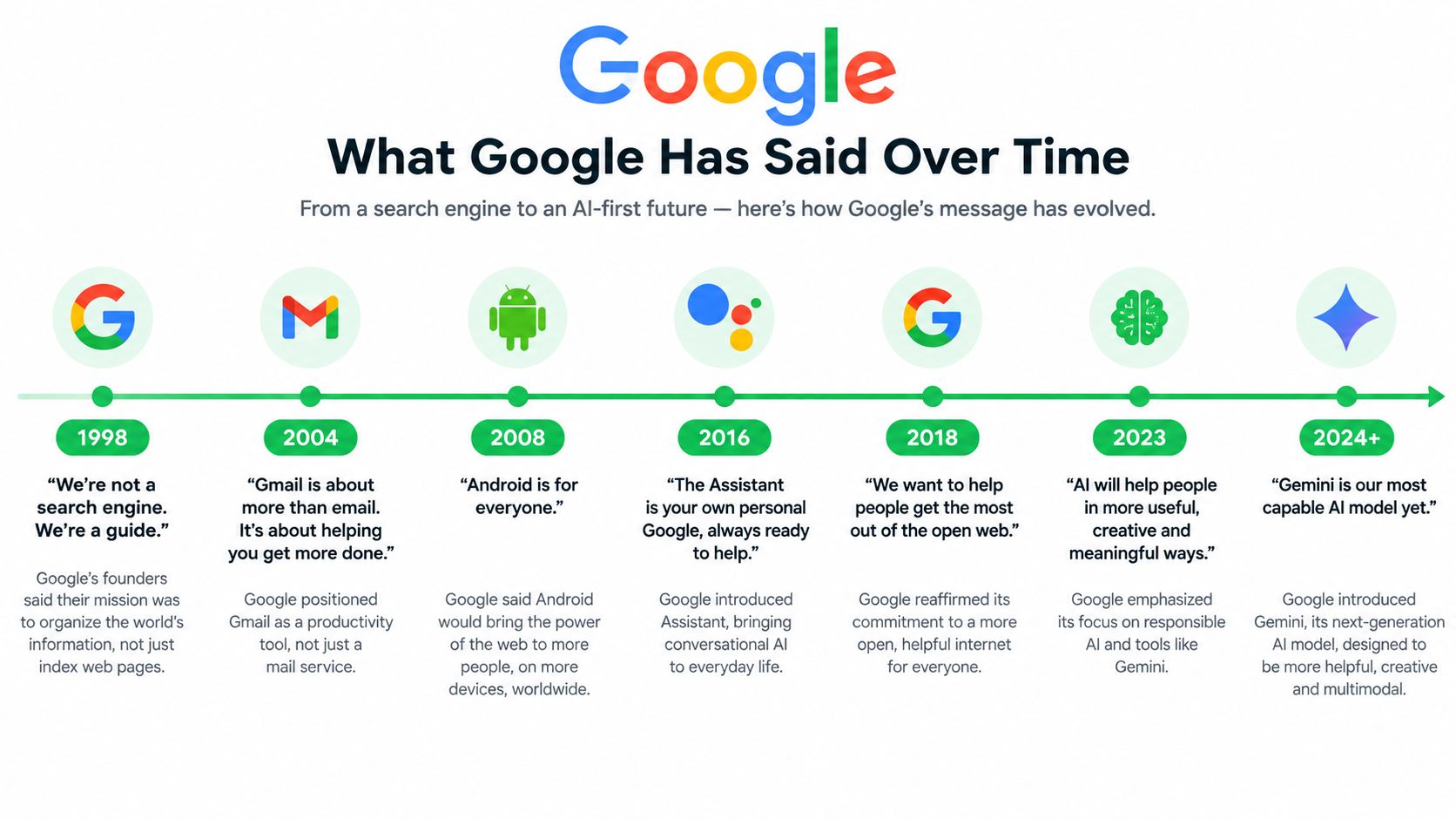
Google's position has remained consistent as search results have changed: the description meta tag is not used to determine web search rankings, but it may help provide text for a result snippet. That distinction separates the system that orders pages from the system that selects the summary a searcher sees.
Current Google Search Central guidance describes the tag as a short, page-level description. It recommends accurate wording, while explaining that Google may instead select relevant text from the page when that better matches the query (Google's snippet documentation).
What has changed
Google now selects page content more freely when it considers that wording more useful for a particular search. A supplied description is therefore a suggestion, not a guaranteed script. The same Melbourne service page can show different snippet text for different queries. For example, a page about emergency plumbing may display wording about burst pipes for one search, then draw text about hot-water repairs for another, if those phrases appear more relevant on the page.
That creates a practical limit on snippet control. You can write a clear description for the page's main service, but you cannot ensure that every searcher sees those exact sentences. A strong on-page introduction and clearly stated services give Google better source material when it rewrites the snippet.
Search results also include richer formats and AI-generated features. These may change how much attention a standard organic listing receives, while leaving the distinction between ranking input and snippet input intact.
For Australian content teams, Digital NSW offers a similar practical recommendation: give each page a meta description that summarises its purpose and helps readers decide whether to click, with descriptions kept to 150 characters including spaces (Digital NSW metadata guidance).
The useful conclusion is narrower than “descriptions improve rankings.” They help frame a result and may influence whether a qualified searcher chooses it. Their wording belongs to snippet presentation, not Google's ranking order.
How Meta Descriptions Influence SEO Indirectly
Saying that meta descriptions aren't a ranking factor doesn't mean they have no commercial or SEO value. Their realistic influence begins after the page appears in search results.
A searcher sees a title, a URL or breadcrumb, and often a short description. If the wording matches the problem behind the query, the result may look more useful than a competing listing. If it sounds generic, repetitive or unrelated, the searcher may choose another result even when the page ranks higher.
That behaviour is measured as click-through rate, or CTR. CTR is calculated as clicks divided by impressions multiplied by 100, a definition reflected in Australian SEO commentary (Australian commentary on meta tags and rankings). Google doesn't present the meta description as a direct ranking control, so any relationship between a better description and future visibility needs careful interpretation.
Correlation isn't proof of causation
A page that attracts more clicks may also have a stronger title, better brand recognition, better content, more relevant links or a more prominent ranking position. Those factors can affect both visibility and clicks. A higher CTR alongside improved rankings therefore doesn't prove that the description caused the ranking change.
User behaviour after the click matters commercially, too. A misleading snippet may attract an unqualified visitor who leaves quickly. An accurate snippet sets expectations before the visit, which can produce a better match between the searcher and the page. Google doesn't confirm that a specific meta description directly controls ranking through dwell time or bounce behaviour, so those pathways should be treated as plausible SEO considerations, not guaranteed mechanisms.
Consider two Melbourne plumbing pages appearing near one another for a local service query. If one listing explains its emergency response area and the other uses vague wording, the clearer result may attract more qualified clicks from the same search visibility. Over time, that difference can affect leads and competitive pressure, but it doesn't mean the description itself pushed the URL into a higher position.
| Effect Type | What Changes | Google Confirmation | Evidence Strength |
|---|---|---|---|
| Direct | The description directly changes ranking position | Google says the tag isn't used for web search ranking | Strong official guidance |
| Snippet | Google may display or rewrite the supplied summary | Google documents snippet selection and rewriting | Strong official guidance |
| CTR | Searchers may be more likely to click relevant copy | CTR can be measured in Search Console, but the description isn't confirmed as a ranking signal | Useful operational evidence |
| Leads | Better expectation-setting may improve visitor quality | Depends on page experience, offer and tracking | Business-specific |
Structured data can support how services and page details are understood, but it has a different purpose from a meta description. A business considering what schema markup is should treat it as part of a broader on-page system, not as a replacement for clear snippet copy.
Why Google Rewrites So Many Descriptions
The core SEO question isn't only, "Does Google use the description?" It's also, "How much control does the business have over the snippet?"
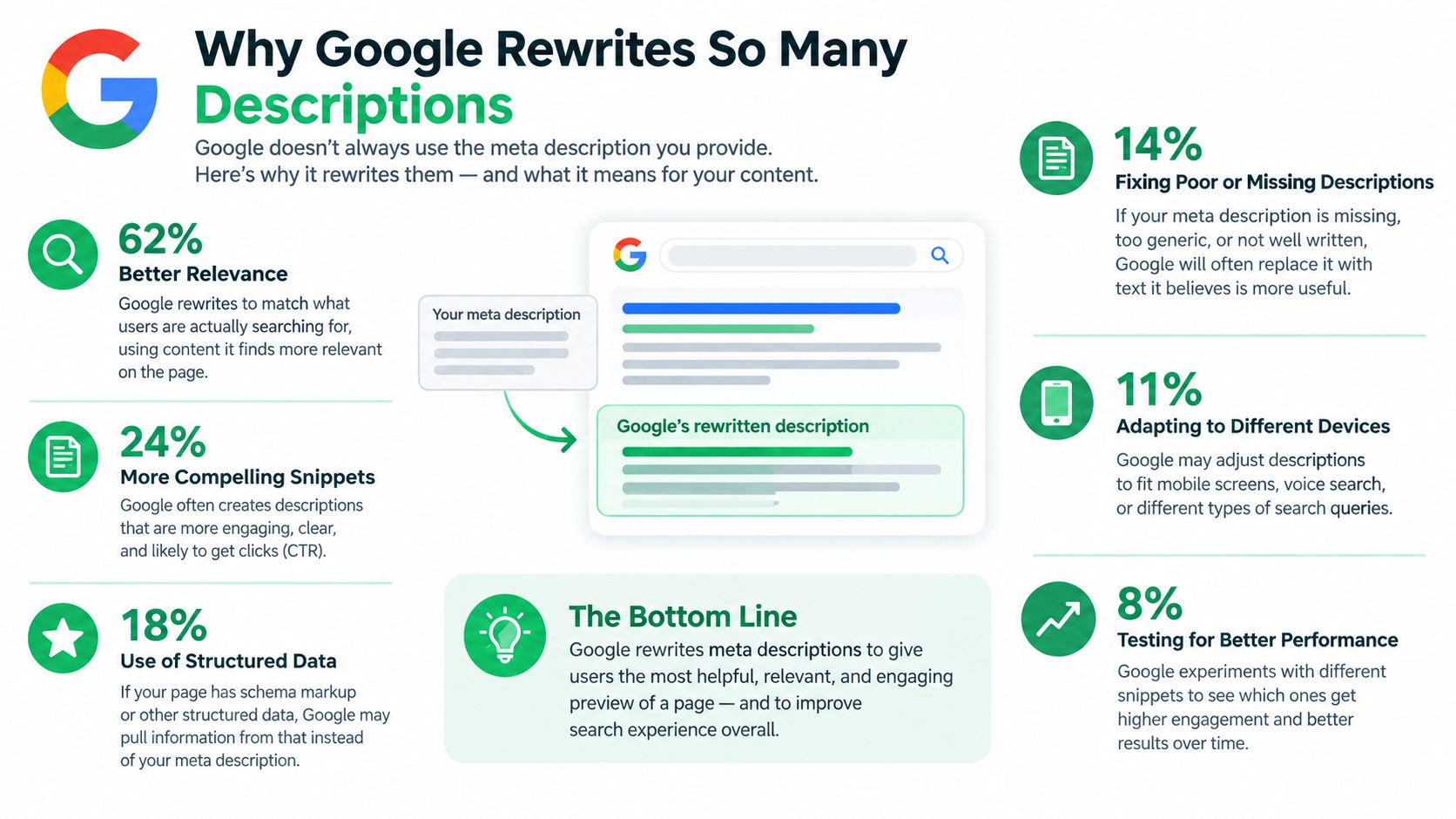
Australian SEO coverage reports that Google rewrites meta descriptions in search results about 63% of the time, and that 25% of top-ranking pages have no specified meta description (Safari Digital's Australian discussion of rewrite rates). Those figures point away from ranking manipulation and towards snippet control. A page can rank well without a supplied description, while a carefully written description can still be replaced.
Google may select different text when the supplied summary doesn't match the searcher's wording or the page's visible content. A service page describing “general plumbing solutions” may not provide the best snippet for a query about blocked drains, even if blocked drains appear somewhere on the page. Google may extract the more relevant sentence instead.
Common reasons for replacement
- Intent mismatch: The description doesn't answer the purpose behind the query.
- Content mismatch: The summary promises information or services that the page doesn't clearly provide.
- Outdated wording: The description includes details that are no longer current.
- Query variation: The same page serves several related searches, and on-page text may fit one query better.
- Display constraints: Search results vary by device and layout, so Google may shorten or select another passage.
The rewrite rate doesn't make manual optimisation pointless. It changes the objective. A description that accurately reflects the page gives Google a useful candidate and gives the business a better chance of presenting a persuasive message when the tag is used.
An absent or weak description doesn't automatically cause a ranking problem. It does, however, remove one opportunity to shape how the result is understood. For local commercial pages, that opportunity can be valuable because searchers often compare several similar providers quickly.
Writing Meta Descriptions That Earn Clicks
A description earns attention by matching the searcher's purpose, not by cramming in keywords. State what the page offers, who it helps and, for a local business, where the service is available. Treat the description like a shopfront sign: it should help the right person recognise the business before entering.
Australian publishing guidance gives useful boundaries, although neither sets a guaranteed Google display length. The Australian Government Style Manual recommends staying within 160 characters (Style Manual metadata guidance). Digital NSW recommends no more than 150 characters including spaces (Digital NSW content guidance). Google may still shorten the text or select wording from the page.
A reliable writing process
- Match the main query: A South Melbourne blocked-drain page should mention blocked drains, rather than hiding the service under “complete plumbing services”.
- Lead with value: Put the clearest reason to choose the page near the beginning.
- Add a local signal where it helps: Use South Melbourne, Bayside or Melbourne CBD when the page serves that area.
- Offer a next step: Invite the reader to call, request a quote, compare options or book an appointment.
- Keep the promise accurate: The landing page must provide what the snippet suggests.
- Write uniquely: Suburb pages need more than the same description with a location swapped.
Start with the page's H1 as an alignment check. If it says “Emergency Plumber in South Melbourne”, a description about routine bathroom renovations creates doubt. Research can help a business find keywords customers are searching for, but the finished copy should still sound natural and fit the page.
| Service Page | Weak Description | Strong Description |
|---|---|---|
| South Melbourne plumber | Plumbing services for all your needs. Contact us today. | Blocked drains and emergency plumbing in South Melbourne. Call for practical help or request a quote from a local team. |
| Bayside dental clinic | Welcome to our dental clinic. We offer many treatments. | Family and cosmetic dentistry for Bayside patients, including check-ups, fillings and smile consultations. Book an appointment. |
| CBD tax accountant | Tax accountant Melbourne. Tax services and accounting. | Tax accounting for Melbourne CBD businesses and professionals. Get clear advice on returns, planning and ongoing obligations. |
The stronger examples identify the service, audience or location, then give the searcher a sensible action. They avoid claims the page cannot support. Good copy improves the chance of earning a click when Google uses it, while still allowing for replacement text in the result.
Structured data can reinforce details such as business type, service or location, but it cannot guarantee a particular snippet. The description must work independently because Google may choose other page text.
Measuring Snippet Impact in Search Console
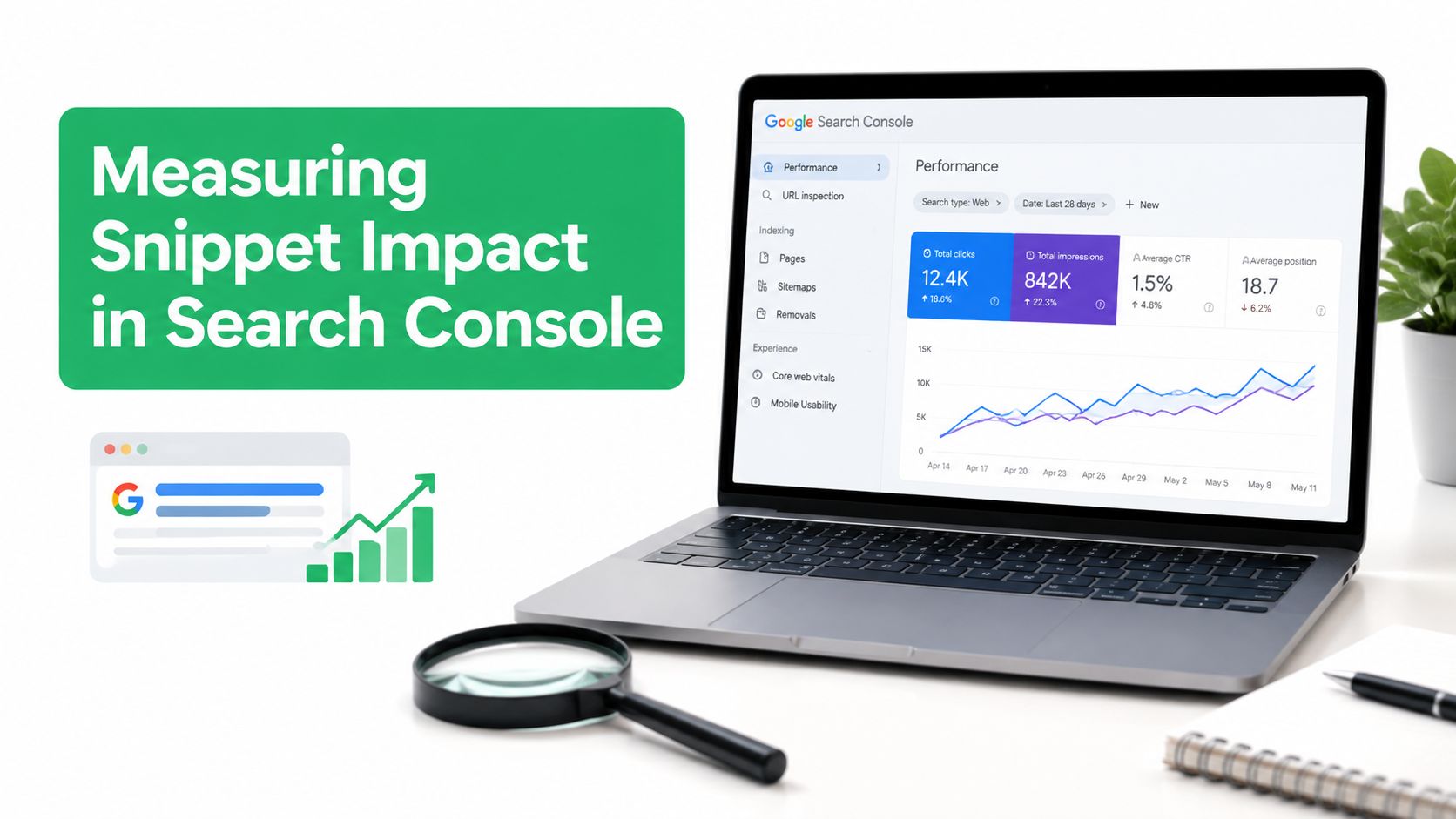
Search Console can show whether a description change coincided with different click behaviour. It can't prove that the meta description caused every change, so the test needs a controlled comparison.
A practical workflow
- Open the Performance report in Google Search Console.
- Filter by the specific URL, or create a group of comparable local service pages.
- Record the current impressions, clicks, average CTR and average position.
- Change the description, keeping the page content and title stable where possible.
- Compare a period before the change with a matching period afterwards.
- Export the data so the figures can be reviewed alongside leads and enquiries.
Average position is the main control variable. If a page moves substantially in the results at the same time as the description changes, a click increase may reflect greater visibility rather than stronger snippet copy. A useful review looks for improved CTR while average position remains broadly similar.
Small local pages may need a longer observation period before the pattern becomes meaningful. A 28-day test window is a practical minimum for low-traffic local pages, but seasonality can affect Melbourne retail, home services and other query types. A tradie may see different demand during weather events, while a retailer may experience changes around promotions or holidays.
Connect clicks with business outcomes
Search Console measures search visibility and clicks. Google Analytics 4 can then help assess what happened after the organic landing-page visit, including engaged sessions and assisted conversions where tracking is configured correctly.
A description test should therefore ask more than whether CTR increased. The better question is whether the new snippet attracted the right visitors and contributed to useful actions, such as calls, form submissions or bookings.
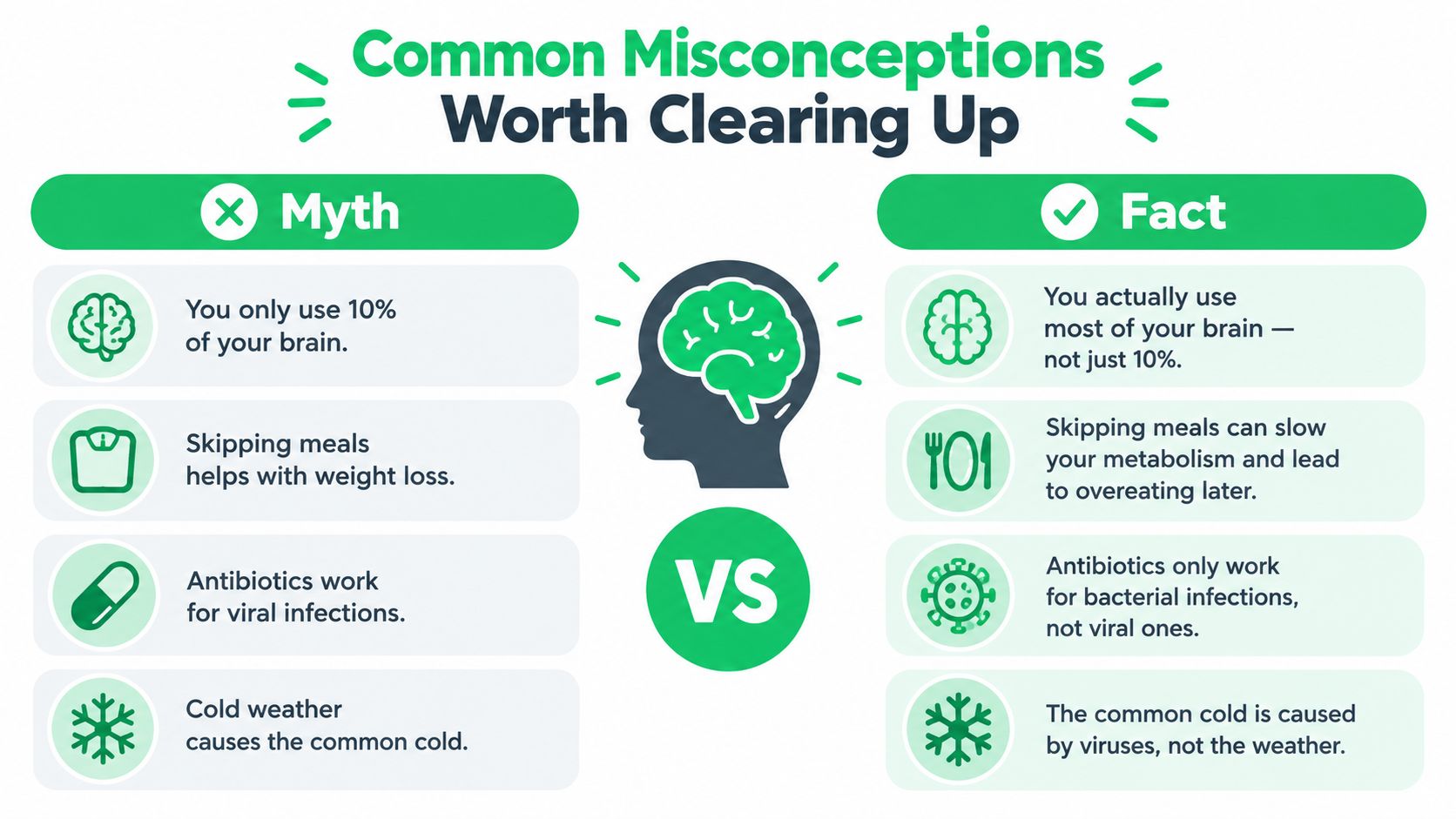
Common Misconceptions Worth Clearing Up
A meta description is not an editable ranking field. It is better understood as search-result copy that may influence the decision to click, while Google decides whether to display it or rewrite it.
Myth one, keyword stuffing improves position
Repeating a service phrase does not turn the description into a ranking instruction. A naturally used keyword can help the summary match the page and may appear in bold when it matches a search, but awkward repetition reduces clarity and trust.
Takeaway: Use the main topic once where it helps the reader understand the page.
Myth two, longer descriptions are automatically better
Extra words do not guarantee a stronger result. The visible snippet can change with the query, device and layout, so the service, benefit and location should appear early. Australian guidance recommends concise descriptions, with the Style Manual advising 160 characters and Digital NSW advising 150 characters including spaces, as noted earlier.
Takeaway: Put the reason to click near the beginning instead of padding the copy.
Myth three, repeated rewrites will move the page upwards
Editing a description does not directly change ranking position. A rewrite can still help when the existing copy is inaccurate, duplicated or poorly matched to intent. Frequent changes make results harder to measure and cannot replace improvements to content, internal linking, technical accessibility or local relevance.
Google also rewrites descriptions frequently, so the text you publish is not always the text a searcher sees. Character counts provide a practical editing guide, while display-width advice for desktop and mobile remains approximate because layouts change. Neither approach guarantees the exact snippet.
A Melbourne business owner comparing a page title with its H1 should remember that they have related but different jobs. The guide to SEO titles versus H1 headings explains that distinction. The meta description serves another purpose, adding context in the search results and helping the listing make a clearer case for the click.
A Practical Wrap-Up for Melbourne Businesses
The answer to Do Meta Descriptions Affect Google Rankings? is no, not directly. Google treats the description as a possible snippet source, and the snippet can influence whether a searcher chooses the result. That makes it commercially useful without making it a ranking factor.
A Melbourne service business can apply a simple checklist:
- Write one accurate description per page: Reflect the actual service and page content.
- Put the value proposition first: Don't bury the reason to click at the end.
- Use a genuine local signal: Mention a suburb, Melbourne area or service location when relevant.
- Stay concise: Work within the Australian guidance range, while accepting that Google may rewrite the result.
- Avoid duplication: Give each suburb, service and audience page its own useful summary.
- Measure the change: Review impressions, clicks, CTR and average position in Search Console.
- Check lead quality: Compare organic landing-page behaviour with enquiries, calls and bookings.
The description can't rescue a page that doesn't meet search intent. It can, however, help a well-built local page communicate its relevance before the visitor arrives. That is the right level of influence to expect.
SEO2RANK helps Melbourne businesses review on-page SEO, local search visibility, snippet wording and Google Business Profile alignment through practical audits and hands-on implementation. Visit SEO2RANK for a plain-English second set of eyes on whether key service pages are earning the clicks their rankings deserve.
Find Out What Is Holding Your
Website Back
Get a practical SEO Snapshot showing the biggest issues and opportunities we can see across your search visibility, website and local presence.
GET YOUR FREE SEO SNAPSHOT