

A Melbourne tradie, dentist or accountant can offer several services, but Google Business Profile categories aren't a menu of every task the business performs. The right setup is one primary category that best describes the core business, supported by relevant additional categories. Google doesn't allow custom categories, so the practical job is to match the business to the closest, most specific option available, rather than choose a broad label that sounds convenient.
Table of Contents
- How Google Business Profile Categories Work and Why They Matter
- Understanding Primary and Additional Categories
- How to Choose the Right Categories for Your Business
- Industry Examples That Show Category Mapping in Practice
- Common Mistakes to Avoid When Selecting Categories
- Implementation Checklist and How to Measure Results
How Google Business Profile Categories Work and Why They Matter
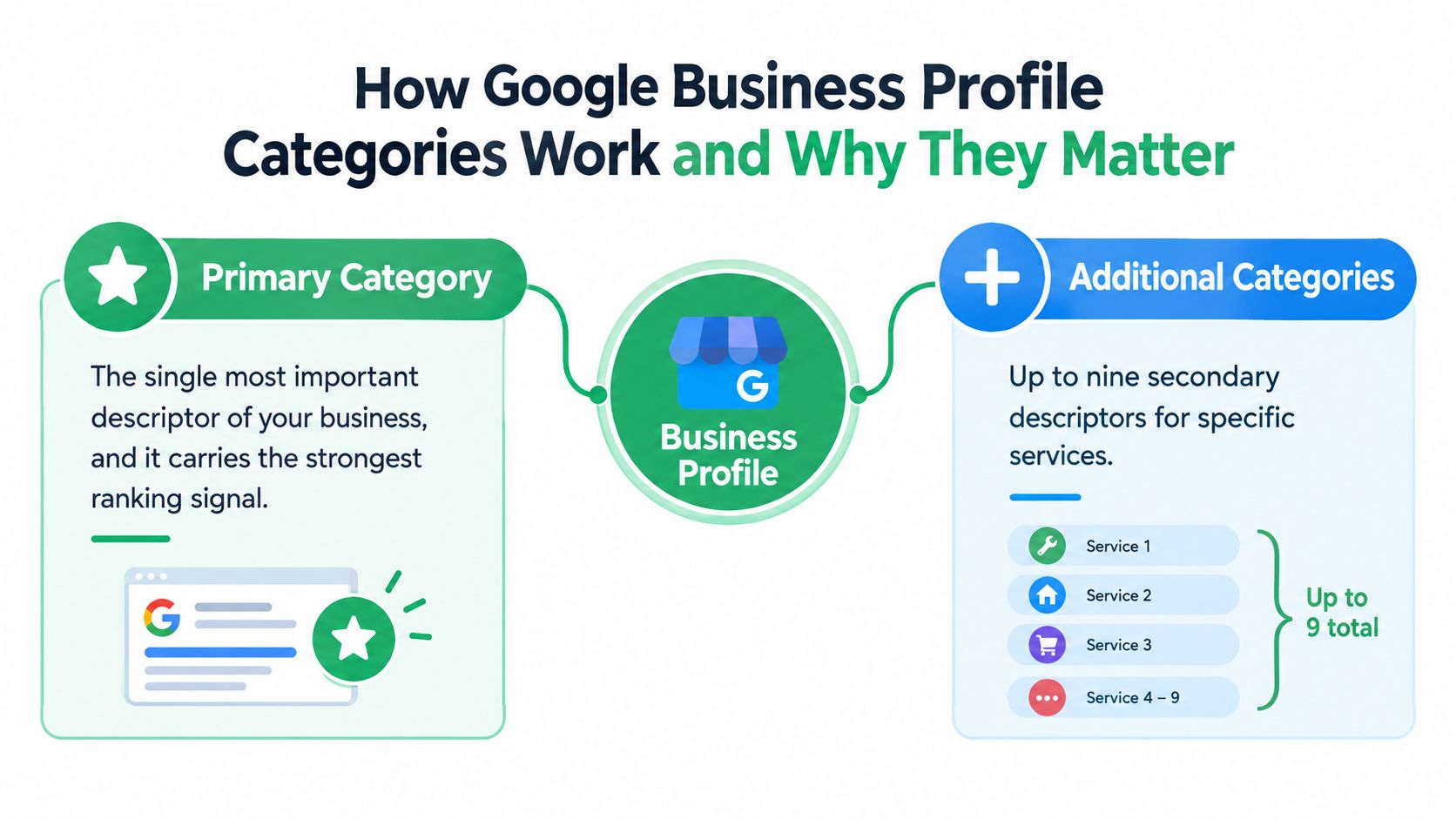
Google Business Profile categories tell Google what type of business a listing represents. A business selects one primary category and can add supporting categories, but it can't create a custom label. Google's guidance recommends choosing the most specific available category, such as “Nail salon” rather than “Salon”, because categories help Google confirm business information and show relevant profile details in Search and Maps. This classification approach is explained in Australian guidance on Google Business Profile categories.
That distinction matters for local SEO. A category isn't a slogan, a marketing theme or a list of target keywords. It's part of Google's product structure, carried forward from the former Google My Business interface into Google Business Profile. When someone searches for a plumber in a particular Melbourne suburb, Google needs to understand whether a profile represents a plumber, a general contractor, a hardware shop or another type of business.
Primary category and local relevance
The primary category gives Google the clearest description of the business's main identity. It can affect whether the profile is considered relevant for local-intent searches across suburbs and service areas, although category selection isn't the only factor in local visibility. A precise category helps establish a cleaner connection between the business, the service it provides and the searcher's likely intent.
For example, a dental practice shouldn't select a broad health-related category just because it sounds safe. A plumbing business shouldn't use a general contractor category when a more accurate plumbing option exists. A precise classification makes the listing easier for Google and customers to interpret.
Categories aren't the same as services
Categories describe what a business is. Services describe what it does. A plumber may provide blocked drain work, hot water repairs and gas-related services, but those offerings don't automatically need to become separate categories. They can be represented through the profile's services and business information, provided the business offers them.
Practical rule: Choose the category that best describes the business customers are primarily hiring, not every task an employee might complete.
For Melbourne businesses, category choice should therefore begin with the actual service model. Consider the main enquiries the business wants, the work it performs at the stated location and the category wording Google makes available. A category that doesn't reflect those realities may create weaker relevance or confuse customers, even if it appears to cover more search terms.
Understanding Primary and Additional Categories
The primary category carries the central classification responsibility. It should represent the business's main service line, the service that best explains why the profile exists and the type of customer the business most wants to attract. Additional categories provide context for supporting services, but they shouldn't turn the profile into an unstructured list of capabilities.
Google's category system is highly granular. Australian local SEO guidance describes 4,102 available categories and also refers to more than 4,000 categories in total, showing why near-synonyms and close industry distinctions matter. The same guidance describes a structure of one primary category plus up to nine secondary categories. Those figures are documented in the Google Business Profile category guidance.
Why specificity usually wins
A specific category gives Google a more useful description than a generic one. Google's own example shows that a business with “Pizza restaurant” as its primary category may also be surfaced for broader searches such as “Restaurants”, “Italian Restaurants” or “Pizza”. That example is discussed in this guide to setting up Google Business Profile categories.
The lesson isn't that every business should choose the narrowest phrase available regardless of context. The category must still be accurate. A business should select the most specific option that describes its main operation, then use additional categories only where they represent genuine, meaningful parts of the business.
When an additional category earns its place
A secondary category can make sense when it represents a distinct supporting service that customers actively seek from the same business. A dental clinic might need a category connected to a clearly offered treatment, while an accounting firm may support its main classification with a relevant tax service category if that option accurately reflects the practice.
A category should usually be left out when it represents an occasional task, an aspirational service, or a keyword the business wants to capture without delivering the service. Adding every available option isn't a sign of completeness. It can make the business identity less clear and create a mismatch between the profile and the customer experience.
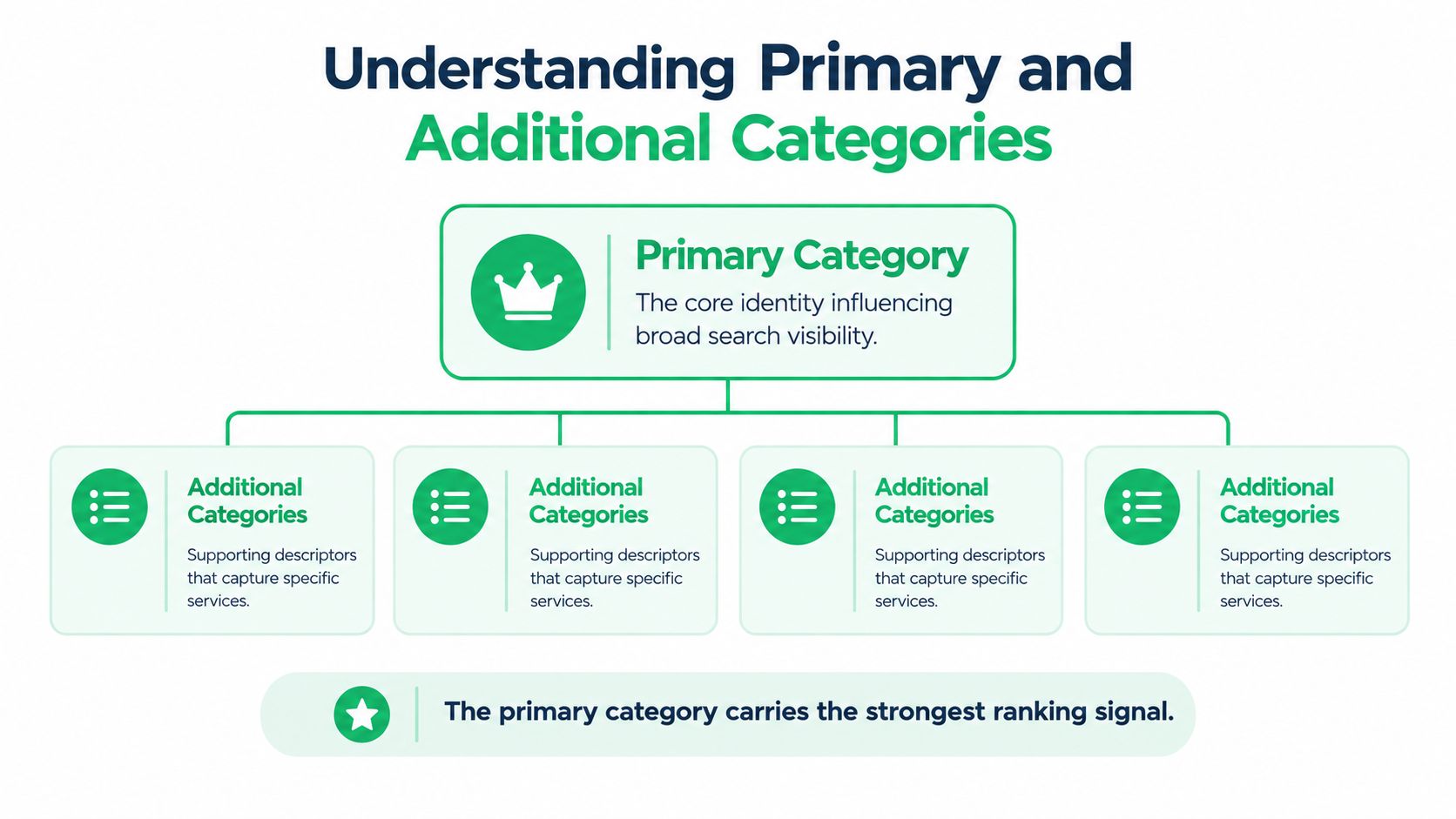
The strongest working principle is simple: the primary category should carry the business's core identity, while additional categories should clarify, not compete with, that identity. A profile with one accurate primary category and a small number of closely related supporting categories is often easier to manage and explain than one built around every possible business label.
How to Choose the Right Categories for Your Business
Category selection works best as a service-mapping exercise. The business owner or marketing team should first understand what the business sells, then match those services to Google's available taxonomy. Guessing from a competitor's profile or choosing the first familiar phrase often produces a category that's technically related but strategically weak.
Start with the service audit
List the services that define the business, separating core work from occasional extras. A Melbourne plumber may focus on residential plumbing, emergency call-outs and hot water repairs. A dentist may prioritise general dentistry while also providing specific treatments. An accountant may mainly serve small businesses with compliance, bookkeeping and tax work.
The primary category should normally reflect the service that best answers, “What type of business is this?” It shouldn't be selected solely because a service sounds lucrative or because a broad word attracts more imagined searches. The service must be delivered and central enough to represent the business.
Match the wording available in Google
Search the category field inside the Business Profile manager and compare the available options. Don't type a label that Google doesn't offer, and don't treat a website keyword as proof that an equivalent category exists. Google controls the category list, so the final choice has to come from its predefined options.
Look for the closest accurate match, then test whether a more specific variation is available. A trade business should investigate options tied to its actual trade rather than settle immediately on “Contractor”. A healthcare practice should distinguish the professional service from a general medical label where Google provides that distinction.
Use local competitors as context
Competitor research can reveal how similar businesses are classified in Melbourne's local results. It shouldn't become a copying exercise, because competitors may have outdated, inaccurate or poorly chosen categories. The useful question is whether a recurring category pattern reflects a genuine service distinction that also applies to the business being audited.
The business can record the category options considered, the reason for choosing the primary category and the supporting categories retained. That record helps future staff understand the decision and prevents random changes whenever a new marketing idea appears.
For a broader profile review, the Google Business Profile optimisation guide can sit alongside the category audit. Categories work within a wider profile, so the business description, services, contact details and landing pages should tell a consistent story.
Choose specificity over breadth. A smaller, accurate category set is more useful than a longer list built around unrelated search terms.
A final selection checklist should confirm:
- Core identity: The primary category describes the business customers primarily hire.
- Specific wording: A narrower accurate option hasn't been overlooked.
- Service support: Each additional category represents a real, meaningful service.
- Location fit: The business provides the represented service at the listed location or service area.
- Customer clarity: A customer seeing the category wouldn't reasonably expect something the business doesn't provide.
- Documentation: The reason for each choice has been recorded for later review.
Industry Examples That Show Category Mapping in Practice
Category mapping becomes clearer when the business's actual service model is placed beside the available classification. The same broad label can be tempting across industries, but it often hides the distinction that matters most to a local customer.
| Business Type | Too Broad or Incorrect | More Specific and Effective |
|---|---|---|
| Plumbing business | Contractor | Plumber |
| Nail-focused beauty business | Salon | Nail salon |
| Dental practice | General health label | Dentist |
| Accounting practice | Business service | Accountant |
| Tax-focused accounting practice | Generic consultant | Accountant, supported by a relevant tax category where available |
The first example is common among tradies. A business that mainly handles plumbing work should lead with Plumber, not a broad contractor label. If emergency plumbing is a substantial and genuine part of the operation, an appropriate supporting category may be considered if Google offers one and the profile accurately represents the service. The category should never promise emergency availability when the business doesn't provide it.
Dental practices need treatment accuracy
Dentists often provide several treatments, but the primary category still needs to identify the practice's central professional function. A treatment such as teeth whitening may be important to customers, but it shouldn't replace the main dental classification unless the business is structured around that service and Google provides an accurate category for the business type.
Additional categories can support distinct services, but a practice should avoid selecting medical or cosmetic labels that imply qualifications, facilities or treatments it doesn't offer. The profile, website and patient-facing information need to agree.
Accountants should separate identity from specialisation
An accounting firm may provide tax preparation, bookkeeping, business advice and compliance work. Accountant is often a clearer primary identity than a vague professional services label, while a supporting tax-related category can be considered when it accurately describes a genuine part of the practice.
This approach keeps the profile anchored to the profession while allowing related services to be represented. It also helps the business align its category choice with the pages and enquiry paths it uses for local search. Businesses working on Melbourne map visibility can review broader local considerations in this guide to ranking on Google Maps in Melbourne.
A category isn't a substitute for a service page, a clear offer or a credible business profile. It provides classification context. The strongest mapping connects the category to the service, then connects that service to the website content and the customer journey.
Common Mistakes to Avoid When Selecting Categories
The most damaging category decisions usually come from trying to make a profile say too much. A business adds broad and loosely related labels to capture more searches, but the profile becomes harder to interpret. The correction is usually less dramatic than the original mistake, a careful return to the business's actual core.
Choosing a broad primary by default
“Contractor”, “Consultant” or another general label may feel flexible, especially when a business offers several services. Flexibility isn't always useful in local search. If the business is a plumber, dentist or accountant and a more accurate category exists, the broad label hides the most important information.
The fix is to review the primary category against the main service line and the way customers describe the business. Google's guidance favours the most specific available option, provided it accurately represents the operation.
Adding irrelevant secondary categories
A secondary category shouldn't be added because its wording resembles a valuable keyword. It belongs on the profile only when the business provides that type of service and wants to be understood that way. A lawn care professional shouldn't add pest control or pool construction categories just because customers occasionally ask about those jobs.
If a service is real but secondary, it may be better represented in the Services section, on the website and in relevant supporting content. That gives customers useful detail without changing the business's core classification.
Changing categories without a clear reason
Category updates can be appropriate when the business changes its service model, location arrangement or commercial priority. Random, frequent changes make measurement difficult and can leave staff unsure which version reflects the business. A planned review is more useful than reacting to every competitor movement.
Ignoring location and delivery reality
A category should match the services the business delivers. A mobile tradie can describe a service area accurately, but the profile shouldn't imply a shopfront, clinic or office service that customers can't access. Businesses should also keep their name, address and phone details aligned across listings, as explained in this NAP consistency resource.

Treating categories as a guaranteed ranking fix
The correct category improves classification, but it doesn't guarantee a top local position. Google also evaluates broader relevance, location and prominence signals, and customers still need accurate information before contacting the business.
When a profile isn't appearing as expected, category alignment should be audited alongside the business location, website pages, reviews, profile completeness and local competition. The guide to a business not showing on Google Maps can help frame that wider diagnosis.
Implementation Checklist and How to Measure Results
Before changing a category, record the current primary and additional categories, the services they represent, and the searches or enquiries you want to assess. A category change should be a documented local SEO test that is tracked and reviewed over time.
Use this implementation checklist:
- Open the profile controls: Edit the category in the Google Business Profile management area.
- Confirm the primary: Select the category that best represents the core business, rather than an occasional service.
- Review additional categories: Keep categories connected to genuine supporting services. A handyman should not add pest control or pool construction categories because customers sometimes request those jobs.
- Align profile details: Check the business name, address, phone number, opening hours and service information against the website and other listings. The business name, address and phone details should remain consistent across listings, as explained in this NAP consistency resource.
- Update related pages: Ensure relevant service and location pages describe the same offer as the profile.
- Record the change: Note what changed, when it changed and why, so later reviews have useful context.
- Review after meaningful changes: Revisit categories when the business adds, removes or substantially changes a service line.
Measurement needs patience and clean attribution. Google Business Profile insights can show profile interactions, while Google Search Console can indicate how relevant website pages appear for local service searches. Enquiry tracking, call records and form submissions add commercial context that visibility data cannot provide.
Review category performance alongside the wider profile situation. Local results vary by searcher location, competition, profile signals and the query itself, so short-term movement does not prove that a category caused the change. Compare profile discovery, relevant page impressions, qualified enquiries and lead quality over a suitable observation period.
One precise primary category plus a few relevant supporting categories is usually easier to validate than a long, unfocused list.
SEO2RANK can review Google Business Profile categories within a Melbourne local SEO program, alongside profile optimisation, local landing pages, citation work and measurement. Businesses seeking a specialist review can visit SEO2RANK to assess whether their categories match the services they want customers to find.
Find Out What Is Holding Your
Website Back
Get a practical SEO Snapshot showing the biggest issues and opportunities we can see across your search visibility, website and local presence.
GET YOUR FREE SEO SNAPSHOT