Google AI Overviews are changing how Australians search, but traditional SEO is still worth it. The harder truth is that many searches now end without a click, especially when Google shows an AI summary, so businesses in Melbourne need to care about more than rank position alone. The practical answer is to keep investing in SEO, but judge it by enquiries, qualified traffic, and whether pages are useful enough to be cited by Google's AI layer.
Table of Contents
- What the Click Data Actually Shows for Australian Businesses
- What Google AI Overviews Actually Do to Search Results
- Which Searches Are Most Affected and Which Traffic Survives
- Traditional SEO Goals Versus AI-Aware SEO Goals
- Why Traditional SEO Foundations Remain Essential
- Practical SEO Actions for Melbourne Small Businesses
- Common Mistakes and Real Risks When Adapting to AI Search
- How to Decide Your Next SEO Priorities
What the Click Data Actually Shows for Australian Businesses
In Australia, the click problem is already big enough to change how SEO is measured. Independent benchmark data cited for Australia shows a 65% baseline zero-click rate, rising to 83% when an AI Overview appears, while other industry references report organic click-through falling by around 61% on affected queries (The Conversation). That means a larger share of searches now ends on the results page, even when the business still appears in search.
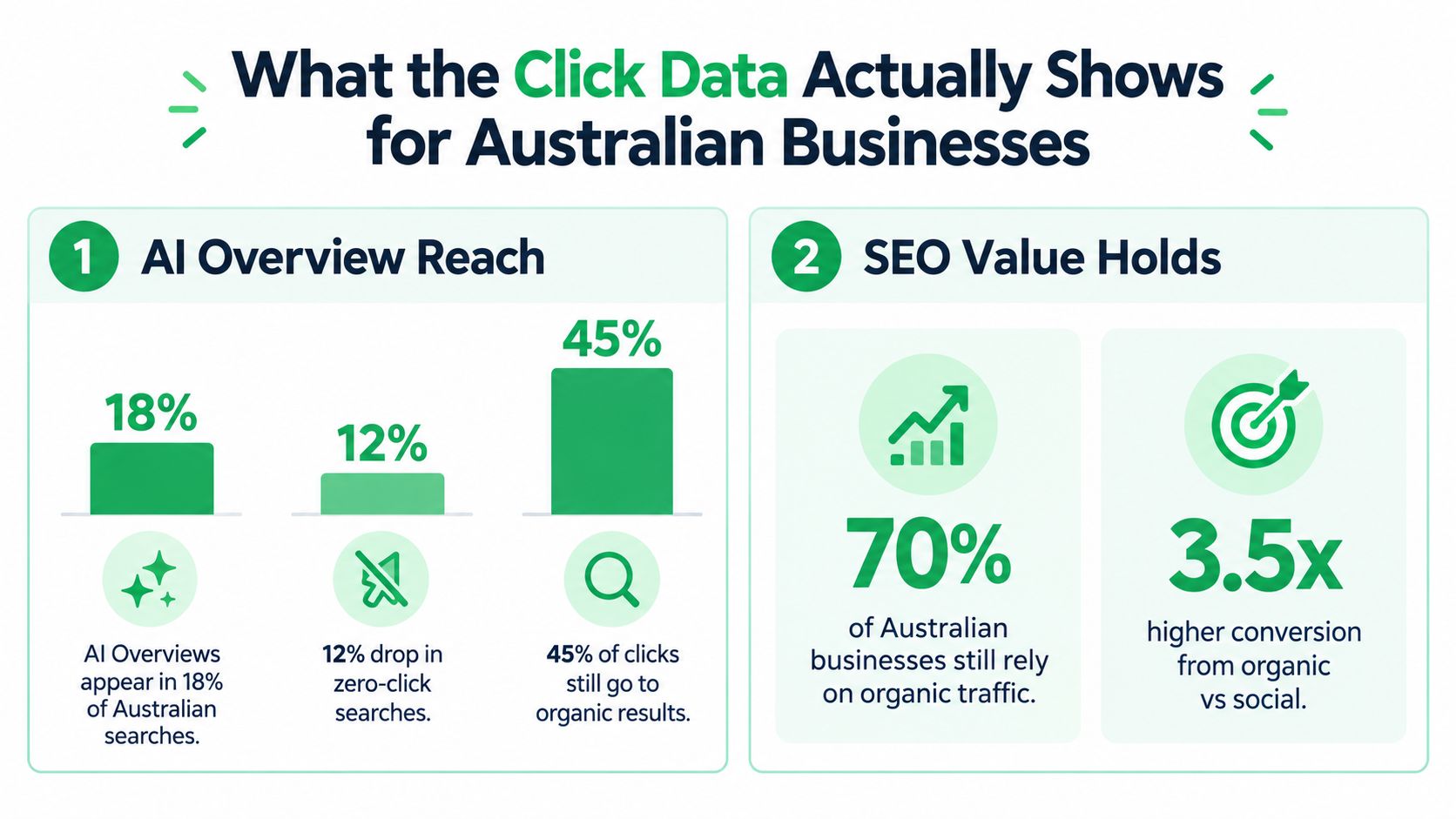
For Melbourne businesses, the pressure is highest on informational searches like “how to fix”, “what is”, or “best way to”. Those queries are more likely to be answered directly in the results, so the old pattern of ranking and waiting for the visit is weaker. Local service searches still bring traffic, because someone looking for a plumber, dentist, accountant, or B2B provider usually has clearer intent to act.
Practical rule: treat clicks as one signal, not the whole scorecard.
That does not mean search traffic has vanished. It means you need to read it beside enquiries, call volume, and lead quality, as detailed in our analysis of AI search may be reducing website clicks.
Google still shapes discovery in Australia. The ACCC reported nearly 94% share in August 2024, so SEO remains tied to the platform most Australians use to search. For businesses that want actual enquiries, that level of dominance still matters.
Searchscope's Australian usage data points in the same direction. Google remains the main place people start, but AI features are changing how often they leave the results page (Searchscope).
For Melbourne tradies, dentists, accountants, and B2B firms, the key question is which searches still produce visits that turn into leads. AI Overviews have made some clicks harder to win, but they have not replaced Google as the main discovery layer.
What Google AI Overviews Actually Do to Search Results
Google rolled out AI Overviews nationwide in Australia on 29 October 2024, and the feature is built to show an AI-generated snapshot with links to deeper sources (Google Australia). For a business owner, that means the results page now does two jobs at once. It answers the question quickly, then points to supporting pages if the system thinks they're credible enough.
The practical change is that your page no longer competes only for a blue link. It can also be used as source material inside the summary itself. That's why clarity matters so much, because Google needs pages it can understand, trust, and quote in a compact way.
What this looks like on the page
A normal search result page used to ask a simple question, which link gets the click. AI Overviews add a second layer, which source gets selected into the answer. That shifts SEO from a single target to two related targets, visibility in the standard results and inclusion in the summary layer.
For Melbourne service businesses, the confusion often starts here. A page can do well without getting the click every time, if it helps Google answer a question accurately and still supports the brand. That doesn't make clicks irrelevant. It just means being seen inside the answer can matter even when the visit happens later.
The pages most likely to help are usually the ones that make the answer obvious. Clear headings, plain language, and visible evidence help Google extract the useful parts faster than vague sales copy does. Pages that bury the answer tend to lose in both layers.
Which Searches Are Most Affected and Which Traffic Survives
Not every query behaves the same way, and that's the part most generic SEO commentary misses. Newer tracking suggests that informational queries are far more likely to trigger AI Overviews than navigational ones, and AI Overview prevalence rose sharply through 2025 before partially stabilising in late 2025 (Rocking Web). That makes the exposure uneven across business types, because a person searching for “how to choose a tax structure” behaves differently from someone searching for a specific accountant in Richmond.
The traffic that tends to hold up better
Branded, local, and transactional searches still have a stronger chance of driving useful visits. Someone searching for a clinic, a suburb, a pricing page, or a service provider usually has clearer intent than someone asking a general information question. That's why tradies, dentists, accountants, and B2B firms shouldn't panic in the same way, even if they all see click pressure.
The traffic that gets squeezed first
Informational content is the first place to feel the squeeze. Educational articles, simple definitions, and broad advice pages are the most likely to be summarised by Google before a visit happens. If a site depends too heavily on that sort of traffic, the decline can look worse than the actual commercial impact.
For teams trying to understand what survives, the right internal question is whether the page drives an enquiry or just attracts a session. That's why measuring lead quality matters more than counting visits alone, and why resources such as Do Meta Descriptions Affect Google Rankings? are more useful when they're tied to real search intent instead of cosmetic optimisation.
Pages that answer a question well can still help the business even when the click is delayed or skipped.
The split is practical. If a Melbourne business sells expertise, service, or local availability, SEO still works best where intent is high. If the content is purely informational, it now needs a stronger reason to earn the click.
Traditional SEO Goals Versus AI-Aware SEO Goals
Traditional SEO hasn't disappeared, it's expanded. Google's Australia-facing guidance still emphasises crawlability, indexability, and unique useful content rather than telling businesses to abandon SEO (Searchscope). The job now is to earn visibility in both the organic results and the AI layer above them.
| Traditional SEO goal | AI-aware SEO goal |
|---|---|
| Rank well for relevant keywords | Be easy for Google to understand, cite, and summarise |
| Drive clicks from blue links | Earn visibility in AI Overviews and standard results |
| Publish content for search volume | Publish content that matches intent and answers clearly |
| Optimise pages individually | Build topical coverage that supports the whole service offer |
| Track rankings and traffic | Track enquiries, assisted conversions, and branded demand |
The biggest change is that ranking alone is no longer the finish line. A page can rank and still lose clicks if the summary answers the question first. It can also be cited without becoming a high-click page, which means the business value may show up later in the journey.
What stayed the same
The foundations are still the same. Search engines need pages they can crawl, understand, and trust. Strong structure, sensible internal linking, clean indexation, and clear intent have not stopped mattering just because AI is sitting on top of the results.
For Melbourne businesses, that means the shift is mental, not mechanical. The target is broader, but the building blocks are familiar. Better structure and better content still do the heavy lifting.
Why Traditional SEO Foundations Remain Essential
If Google cannot crawl, trust, or understand a page, that page loses visibility in both the organic results and the AI layer above them. For Melbourne tradies, dentists, accountants, and B2B services, that still means weak site structure, poor indexation, and thin content can cut off enquiries before they start.
Technical health still sets the floor
Pages need to load properly, make sense to crawlers, and present content in a way Google can parse. Broken indexation, weak internal links, duplicate pages, and messy site structure make both traditional rankings and AI inclusion harder.
Structured data helps too, especially for businesses with clear services, locations, FAQs, or team details. A plain-language guide to schema markup is useful because schema helps describe the page to search systems, but it only works when the visible content already matches.
Local SEO still carries commercial weight
For a tradie in the eastern suburbs, a dentist in the inner north, or an accountant serving Melbourne SMEs, local relevance still drives enquiries. Google Business Profile signals, suburb-level landing pages, and clear service-area language help buyers find the right business at the right time. That work is less flashy than AI headlines, but it is often the layer that produces calls.
A page can also look fine to a human and still fail technically. If the right page is not indexed, or if Google cannot connect it to the right service and location, the business misses demand that was already there.
Practical rule: AI visibility starts with pages that are already worth ranking.
Traditional SEO still matters because it gives the AI layer something solid to work from. Strong pages can be found, understood, and reused. Weak pages usually do none of those things well.
Practical SEO Actions for Melbourne Small Businesses
The smartest response is not to rewrite the whole strategy around AI. It's to tighten the parts that influence enquiries. Tradies, dentists, accountants, B2B service firms, and retailers all need the same core basics, but they apply them differently.
Start with the pages that make money
Service pages, location pages, and pricing or quote pages usually matter more than blog content. Those pages should explain what the business does, who it serves, where it works, and what happens next. For a Melbourne plumber or electrician, that means clear suburb coverage and emergency or same-day service details. For an accountant, it means showing the types of clients and compliance work handled. For a retailer, it means product and category pages that are easy to browse and compare.
Make the page useful to both people and search systems
A good money page usually has:
- A clear service statement at the top, so the offer is obvious fast.
- Simple FAQs that answer the questions buyers really ask.
- Internal links to related services, locations, or supporting guides.
- Visible trust signals such as reviews, accreditations, or team details.
- Structured data where it fits the page and matches the content.
Measure what leads, not just what ranks
If a page gets impressions but no enquiries, the issue may be intent match, not traffic volume. Search Console query groups, call tracking, form submissions, and assisted conversions give a better view of what's working. That matters even more now, because some useful visibility won't show up as a click in the way older SEO reports expect.
Melbourne businesses wanting a tighter, practical program can also look at SEO2RANK, which combines local, technical, on-page, and measurement work for service businesses. The point isn't to chase every AI feature, it's to keep the pages that generate leads strong enough to compete in both search layers.
Common Mistakes and Real Risks When Adapting to AI Search
The biggest mistake is treating AI Overviews as a reason to abandon the basics. Businesses that chase the latest feature often end up with prettier content and weaker commercial performance. If the site isn't crawlable, the pages aren't clear, or the local signals are thin, AI-focused tweaks won't save it.

The most common traps
- Chasing summaries instead of enquiries. Being quoted in an AI answer sounds good, but it only matters if it supports lead flow.
- Ignoring measurement. Without clean reporting, a business can't tell whether AI-era changes are helping or hiding traffic loss.
- Overloading the site with thin content. More pages won't fix weak intent or poor structure.
- Neglecting local signals. A local business that downplays suburb relevance often gives away its easiest conversions.
There's also a reporting risk. AI-driven search can make traffic look weaker even when the business is still getting decent commercial value from branded and local queries. That's why checking rankings alone is not enough. For a practical reset, 10 Things to Check When Google Rankings Drop is the kind of diagnostic mindset that still pays off.
The commercial risk is decision-making based on hype. If a business cuts its core SEO because AI sounds newer, it can lose the very foundation that helps it appear in AI-driven results at all. The safer move is to adapt the content and measurement without breaking the base.
How to Decide Your Next SEO Priorities
The next move depends on where the business gets value. If most enquiries come from local intent, local SEO deserves priority. If the site is technically messy, fix crawlability and structure first. If content is broad and informational but doesn't convert, tighten the money pages before producing more articles.
A simple decision rule works well for Melbourne service businesses. Protect the pages that already bring enquiries, improve the pages that should convert but don't, and trim work that only adds traffic without moving lead quality. That keeps effort tied to commercial reality rather than search feature noise.
For businesses with strong informational content, the goal is to make those pages clearer, more authoritative, and easier to quote. For businesses with local demand, the priority is making sure Google Business Profile, service pages, and location signals are strong enough to win the searches that still matter most. For B2B firms, the emphasis usually belongs on trust, proof, and intent alignment.
Traditional SEO is still worth it because it remains the base layer of discoverability in Australia. AI Overviews have changed the shape of the click, but they haven't removed the need for pages that rank, get cited, and lead to enquiries.
If a Melbourne business wants to sort out which pages deserve more attention in the AI era, SEO2RANK works on local, technical, on-page, and measurement improvements as one programme. Visit SEO2RANK if a clearer SEO plan, tied to enquiries rather than vanity metrics, would help the next round of decisions.
Find Out What Is Holding Your
Website Back
Get a practical SEO Snapshot showing the biggest issues and opportunities we can see across your search visibility, website and local presence.
GET YOUR FREE SEO SNAPSHOT