
SEO is worth it for a small business in Melbourne when the gross profit from the new customers it can realistically attract covers the monthly spend, and it isn't when it can't. On the widely reported Australian budget of about AUD 1,200 a month and a gross profit of AUD 600 per customer, break-even is two new customers a month, which at a 25 per cent close rate means roughly eight qualified enquiries.
That framing cuts against the advice most owners hear. The common pitch is that SEO compounds over time, so the only real mistake is starting late. The common rebuttal is that AI answers and paid ads have made the whole thing pointless. Both skip the question that decides the matter: how many extra customers does the campaign need to produce before it covers its own cost, and can the business service them?
For a dentist in Carlton, a plumber in Preston or an accountant in the CBD, the answer usually comes down to margin, close rate and proven demand across a handful of suburbs. The sections below work through that calculation, the state of the local market, real cost drivers, how to measure progress, and the situations where the honest answer is to spend the money somewhere else first.
Table of Contents
- How to Test Whether SEO Pays Off for Your Business
- Melbourne Search Demand, Competition and Lead Value
- How Long SEO Takes and What Changes First
- SEO Compared With Google Ads and Other Channels
- What SEO Costs and What Drives the Price
- Measuring SEO Results Beyond Rankings
- When SEO Is Not the Right Priority
- Deciding Whether SEO Is Worth It for Your Business
How to Test Whether SEO Pays Off for Your Business
SEO earns its keep when the value of the customers it can realistically attract covers the monthly cost inside a timeframe the business can fund. It fails that test when demand is thin, margins are small, or the team can't answer the enquiries it already receives, and no amount of campaign polish repairs those conditions.
The test fits into one sentence. Monthly SEO spend divided by gross profit per new customer gives the number of new customers the campaign must produce each month to break even. Divide that figure by the close rate and you have the number of qualified enquiries required.
Australian coverage of small business marketing budgets commonly puts SEO at about AUD 1,200 a month, with measurable results often reported across a 6 to 18 month window (Andava's Australian digital marketing statistics). Treat both as planning benchmarks rather than a quote or a promise from any particular provider.
At a gross profit of AUD 600 per new customer, AUD 1,200 a month means two new customers. At a 25 per cent close rate, that's about eight qualified enquiries a month. Eight enquiries is a problem most established Melbourne service businesses can solve. Thirty-two is a different conversation.
The break-even rule: monthly spend divided by gross profit per customer gives the customers needed each month. Divide again by the close rate for the enquiries, then check that volume against what the business currently sees.
Where revenue and profit part company
Take a Melbourne service business spending AUD 1,000 a month on SEO, with an average new customer worth AUD 2,500 in gross revenue. It doesn't need dozens of new customers for the spend to make sense. Two customers a month covers the fee in revenue terms, which sounds easy.
Gross revenue isn't what pays the invoice, though. If materials, subcontractors and travel consume 60 per cent of that AUD 2,500, gross profit is AUD 1,000 per customer and the campaign needs one customer a month. At 85 per cent, gross profit is AUD 375 and it needs closer to three. The same spend, the same website, three very different verdicts.
Repeat business shifts it again. A missed Google enquiry isn't necessarily worth one transaction: the customer may return, buy additional services or refer someone. If being difficult to find costs a business just two potential customers a month, that's 24 missed opportunities a year, multiplied by the average value of a new customer including repeat and referral revenue.
The table shows how the same budget moves as gross profit per customer changes, and how quickly the required enquiry volume becomes unrealistic.
| Gross profit per new customer | New customers needed each month | Qualified enquiries needed at 25% close rate |
|---|---|---|
| AUD 150 | 8 | 32 |
| AUD 300 | 4 | 16 |
| AUD 600 | 2 | 8 |
| AUD 1,200 | 1 | 4 |
Before any provider conversation, an owner should be able to state four figures without checking: gross profit per job after materials and labour, the share of qualified enquiries that become customers, repeat and referral rate, and current monthly enquiry volume. A business at AUD 150 gross profit needs eight customers a month to cover a modest fee, which is a far harder assignment than needs one.
Melbourne Search Demand, Competition and Lead Value
Search demand can be checked before a dollar is committed. Type the service into Google the way a customer in a specific suburb would: "emergency plumber Preston", "dentist Carlton", "tax agent Melbourne CBD". Read the results page for three signals: how many paid ads sit above the organic listings, whether a map pack of three local businesses appears, and whether page one is made up of genuine competitors or directories and national aggregators.
Building that list properly, around phrases customers type rather than industry jargon, is the first job of any keyword research for customer searches. A handful of service and suburb combinations tells an owner more about commercial potential than a spreadsheet of a thousand broad terms.
Local search behaviour explains why suburb-level queries carry so much weight. Australian local-marketing coverage citing BrightLocal research reports that 52 per cent of consumers began their most recent local-business search on Google Search and 9 per cent on Google Maps, that 73 per cent of local searches started on a mobile phone, and that 72 per cent of consumers considered three or fewer businesses before deciding (Goop local search coverage).

Those percentages come from commercial research rather than an official dataset, so they're directional evidence, not a Melbourne forecast. They do explain a mechanic that holds regardless: visibility must work on a phone, profile information must be accurate, and the page a searcher lands on has to make its case before a competitor gets a look.
Where competition actually bites
Density varies enormously by category and postcode. A trades category in an inner suburb such as Richmond or Brunswick may have a dozen well-established operators competing for the same map pack, while an outer-fringe suburb or a specialist B2B service may have three credible providers across the whole state. Niche B2B services often need Melbourne-wide or statewide targeting, which changes both the cost and the realistic timeline.
Competition is patchier than it looks, too. business.gov.au reports ABS data indicating that only 50 per cent of Australian businesses have a web presence (Small Business Digital Champions fact sheet), so plenty of categories contain operators with no technical foundation at all. That doesn't make them easy to outrank, but it does mean the bar in some suburbs sits lower than the ad spend suggests.
Lead value closes the loop. An enquiry is worth what the business earns from the customers it converts, not what a keyword tool claims a click costs. A $2,500 emergency plumbing job and a $400 one-off repair produce completely different tolerances for cost per lead, and that difference should decide which services get attention first.
If demand looks thin or three competitors own every relevant result, SEO may still work but needs a longer runway and a bigger budget. A short paid campaign or a properly built Google Business Profile may answer the same question faster.
How Long SEO Takes and What Changes First
SEO is a medium to long-term marketing activity, and meaningful search growth usually depends on competition, the current condition of the website, the strength of competitors and how much work is required. An owner should plan for a window rather than a date, and judge progress against milestones instead of a promised month.
The work tends to follow a sequence, even when the calendar refuses to cooperate.
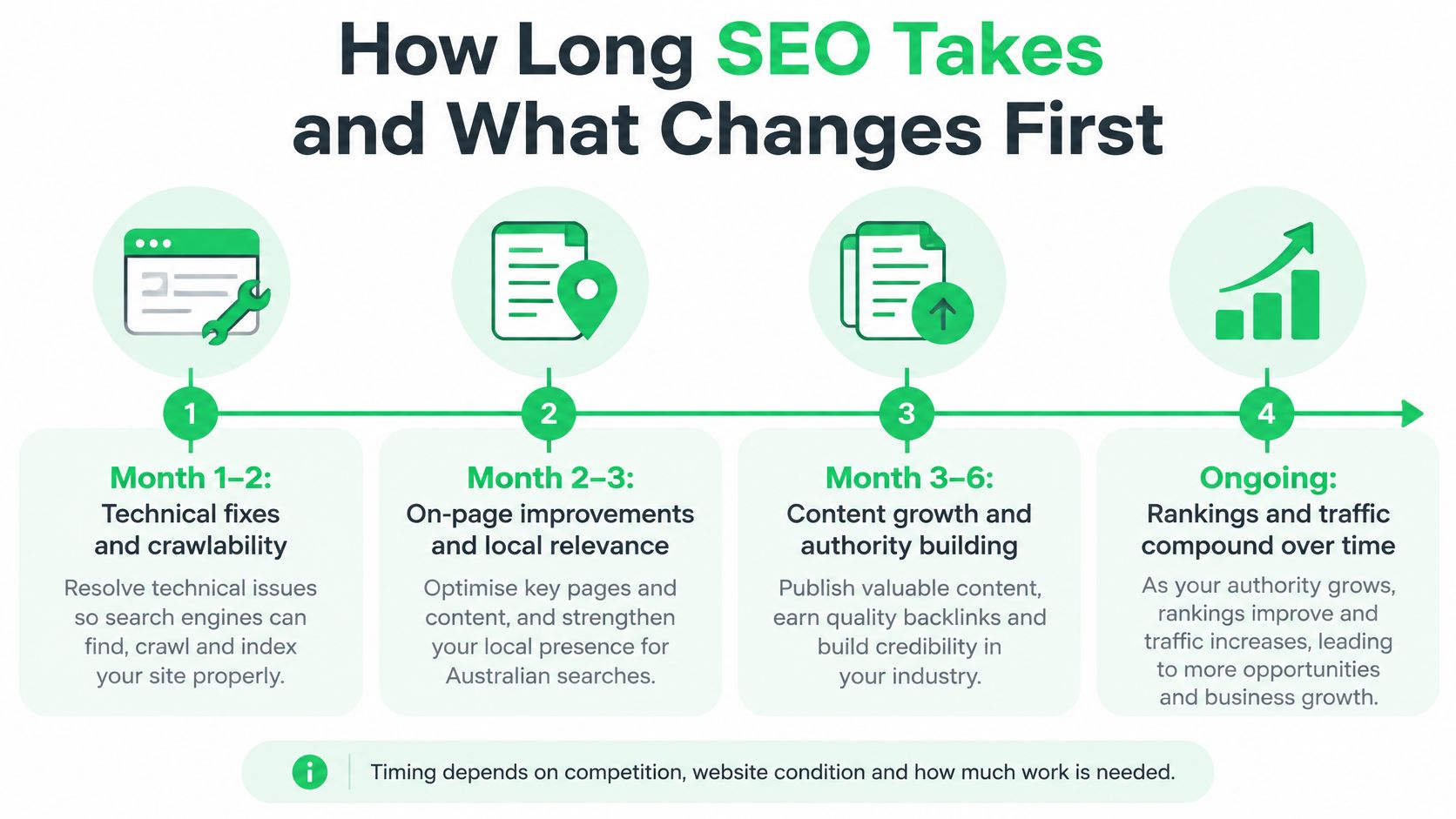
- Months one and two, foundations. Crawl and index problems, canonical URLs, mobile page speed, sitemap submission, conversion tracking, and an accurate Google Business Profile with the right categories, services, hours and photos. None of this produces leads on its own, and skipping it wastes everything that follows.
- Months two and three, on-page relevance. Service pages rebuilt around the language customers use, internal links from supporting pages, descriptive titles and metadata, and structured business information. A Melbourne page starts reading like it belongs to a Melbourne business.
- Months three to six, content and authority. Additional service and suburb pages where genuine demand exists, genuine reviews, consistent citations, and links earned through useful local content or community involvement.
- Ongoing, compounding. Rankings on harder commercial terms tend to move last, because competitors are actively defending them.
What actually changes first
Rankings and impressions typically move before anything else. A Melbourne service business that watched this play out saw local keyword positions lift first, then wider organic visibility, then more opportunities for potential customers to find the business. Clicks and enquiries followed as stronger commercial terms climbed closer to the top of the results.
That order matters when judging a provider. If impressions and non-branded clicks are flat after a reasonable period of implementation, adding a second content retainer won't fix it. If positions are climbing on the terms that matter and enquiries are trailing, the constraint is usually the page or the offer, not the ranking itself.
The full breakdown of phases and dependencies sits in this guide to how long SEO takes to show results, which is worth reading before signing a minimum term. Anything shorter than several months rarely produces enough data to judge.
SEO Compared With Google Ads and Other Channels
Google Ads buys visibility that stops the moment the budget stops. SEO builds visibility that can keep working after the work is done, but it depends on ongoing effort and never guarantees a position.
| Factor | SEO | Google Ads |
|---|---|---|
| Time to first visible results | Usually months, depending on competition and website condition | Often fast once campaigns are approved and live |
| Cost pattern | Ongoing fees plus content and technical work | Charged per click within a set budget |
| Traffic when spending stops | Can continue, but rankings may slip over time | Stops as soon as the budget stops |
| Control over position | Limited, and dependent on search engine systems | Direct control through bids, budgets and targeting |
| How results are labelled | Organic results, not marked as ads | Clearly labelled as ads |
| Best use | Steady, high-intent demand over a longer horizon | Testing offers, seasonal peaks and urgent demand |
The comparison isn't really about which channel is better. It's about what each one is good at.
A campaign can be live by the afternoon and produce calls the same week, which makes paid search the right tool when a business needs enquiries this month. The trade-off is that costs recur indefinitely and typically rise in competitive categories as more advertisers bid. Organic visibility costs less per click over time but can slip when a competitor publishes a better page or search systems change how results are assembled.
The sequence that works for most small budgets
A practical combination is to run paid search first on a small set of service and suburb combinations, and let it reveal which ones convert and what an enquiry costs. The proven terms then become the priority list for SEO, where the same intent can eventually be captured without paying per click.
That order protects the budget. It's common to see an owner commission an eighteen-month organic program for services nobody was searching for, when four weeks of modest ad spend would have shown which services carry demand.
- Urgent demand: paid search or a well-managed Google Business Profile, both able to generate contact quickly.
- Steady high-intent demand over a longer horizon: SEO, particularly where several suburbs and services can share one set of foundations.
- Both, sequenced: paid to test and prove, organic to reduce the ongoing cost per enquiry on the winners.
A closer look at the mechanics of each channel sits in this comparison of SEO and Google Ads for small business.
What SEO Costs and What Drives the Price
SEO isn't a product with a shelf price. The fee reflects the work: how many services and suburbs are in scope, how far behind the site is, how hard competitors are pushing, and how much content has to be written and maintained each month.
Most quotes bundle some combination of these components.
- A one-off audit and remediation: crawl and index issues, redirect chains, broken internal links, duplicate location pages, mobile speed, structured data, and analytics or conversion tracking that may not exist yet.
- Google Business Profile work: categories, services, hours, photos, review responses and service-area settings.
- Service and suburb page development: writing that answers what a customer needs before they call, including inclusions, coverage areas and how pricing works.
- Ongoing content and technical maintenance: new pages where demand justifies them, internal linking, and fixes as the site changes.
- Reporting and review: connecting the work to impressions, clicks, calls, forms and booked jobs.
Price drivers are mostly scope and competition. Ten services across six suburbs is a different assignment from one service across two. A site with a clean structure and good tracking needs less foundational work than one built on five years of plugin upgrades and orphaned pages. Whether the business does the writing in-house also changes the number considerably.
The value test remains the same regardless of the quote: divide the monthly fee by gross profit per new customer and see how many customers a month the program must produce. A cheap plan that generates no enquiries costs more than it appears, because it consumes months of goodwill as well as money. A higher fee is only justified when it builds visibility for services that effectively convert.
Contract terms deserve as much scrutiny as the fee. Check the minimum term and notice period, confirm who owns the domain, the Google Business Profile and the analytics account, and establish in writing whether content produced during the engagement stays with the business if the relationship ends. Ownership problems are far more expensive to fix than they are to prevent.
Questions worth putting in writing before signing: what exactly is included each month, how progress is reported and against which metrics, what access to accounts is required and who holds it, and what results the provider will and won't commit to. Rates and market conditions change, so request current written quotes rather than relying on figures in older articles. This breakdown of what SEO costs and why covers typical inclusions in more detail.
Measuring SEO Results Beyond Rankings
A ranking is a leading indicator, not a result. The measurement chain runs in order: impressions, clicks, enquiry actions, then revenue. Each stage answers a different question, and each requires its own record.
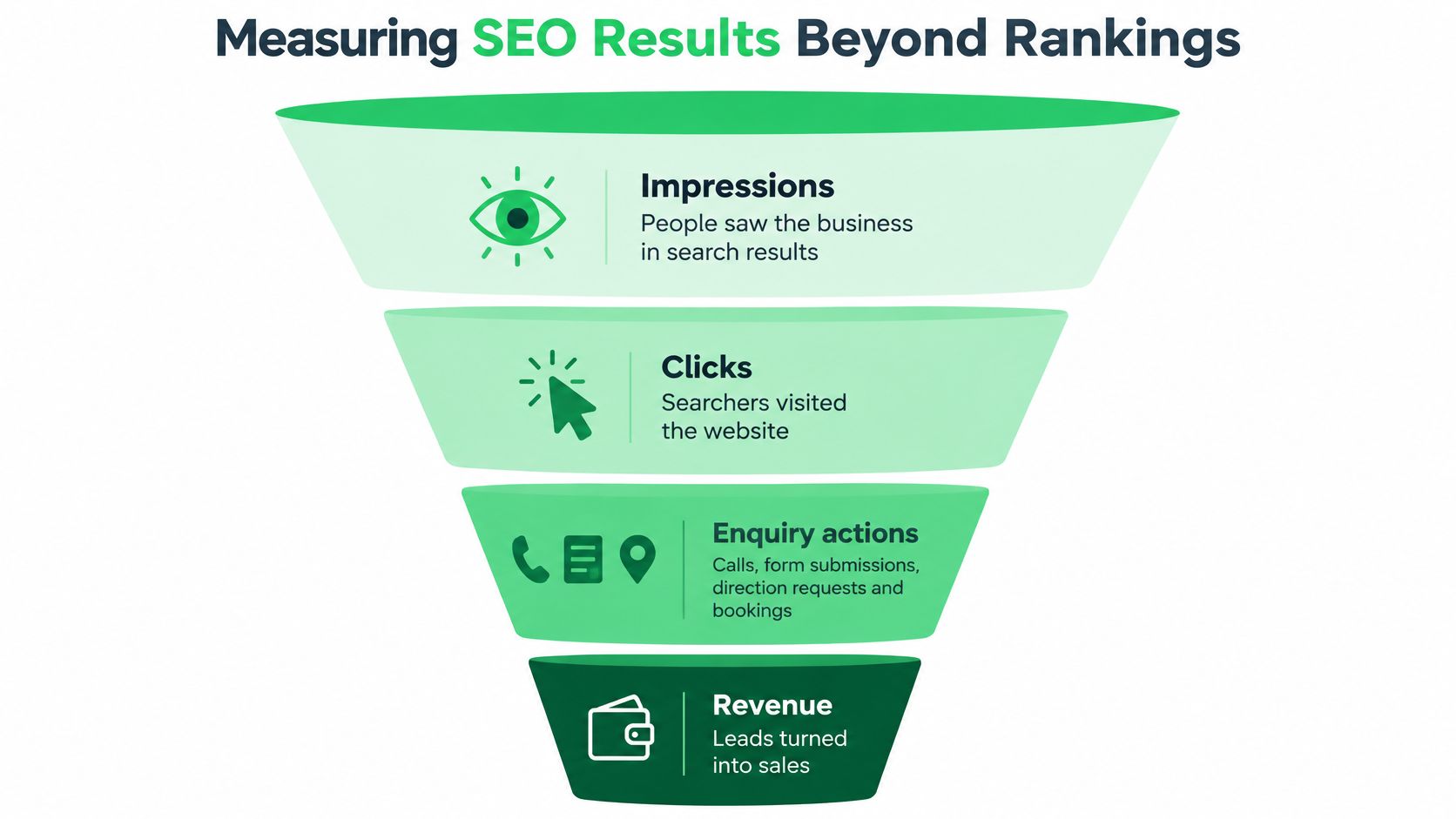
- Impressions: Search Console shows whether the business is appearing at all, and for which queries. Rising impressions on non-branded service terms means the content is being considered.
- Clicks: the step from appearing to being chosen. Track non-branded clicks separately from branded ones, because branded traffic mostly reflects people who already knew the name.
- Enquiry actions: calls, form submissions, direction requests and online bookings. These need call tracking numbers, form event tracking and Google Business Profile actions, not guesswork.
- Revenue: the only stage that proves the investment. It requires a CRM or an intake field that records where each new customer came from.
Where attribution quietly falls apart
A customer can call after seeing a map result, reading an AI-generated recommendation, or hearing the business named on the radio, and none of those appear as an organic session. Australian industry research notes that Google's share of local discovery is easing while AI tools increasingly shape local recommendations, which means a growing share of first contact happens where a session report can't see it (Search Scope industry research).
The practical response is redundancy. Run Search Console alongside analytics, add a call tracking number on the main service pages, give the person answering the phone a required field for "how did you find us", and review Google Business Profile actions monthly. Record the answer even when it doesn't fit a dropdown, because "found you on Google Maps" and "asked ChatGPT" both tell an owner something a rankings report never will.
Start with a baseline, too. Capture at least three months of enquiry volume, call counts and non-branded click data before the work begins, otherwise there's nothing to compare later improvement against. Without that baseline, a good month looks like luck and a bad one looks like failure.
A report that earns its place is short: what was done, what moved in visibility, how many enquiries arrived and how many became customers. The question worth asking each month is whether the enquiries are the kind that convert, not whether the line went up.
When SEO Is Not the Right Priority
Some Melbourne businesses should not buy SEO this quarter. That is an uncomfortable sentence from an SEO provider, but an honest call on timing is worth more than a retainer sold to a business that cannot use it yet.
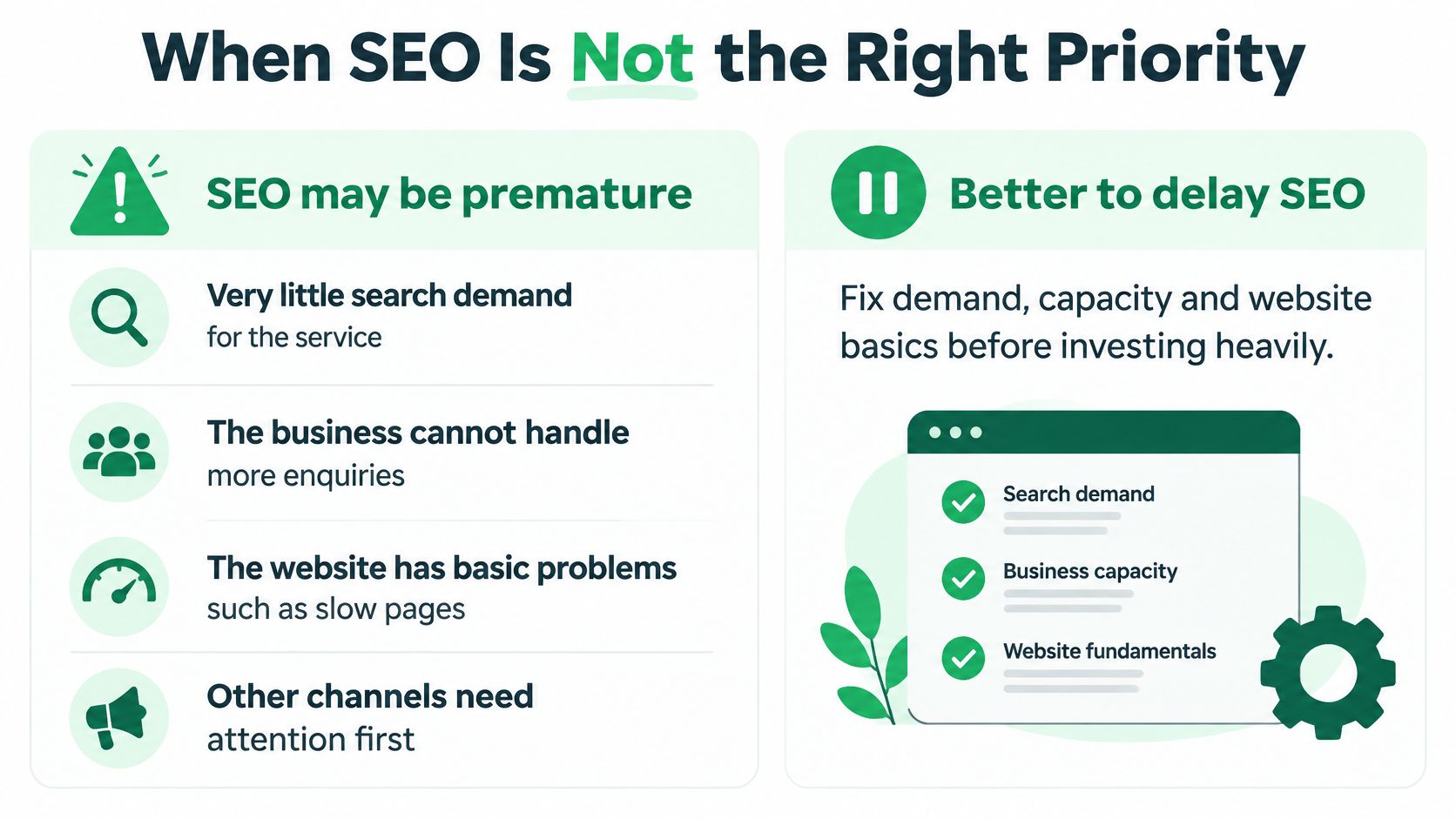
The payback test fails in a handful of recurring situations.
- Very little search demand. A service new to the market, or one serving a tiny catchment, may not generate enough searches in its target suburbs to cover a monthly fee at any realistic close rate.
- No capacity to handle enquiries. A clinic with a three week wait or a tradie already turning work away does not need more leads. It needs a second van or a better booking system.
- The website has basic problems. Slow pages, broken forms, unclear service descriptions and no pricing guidance waste whatever visibility a campaign earns.
- The owner needs leads this month. SEO is a medium to long-term activity, and organic growth cannot fix a cash-flow emergency.
- Margins are thin or demand is heavily seasonal. A business earning $40 gross profit per transaction needs enquiry volume SEO rarely delivers quickly, and a seasonal peak has usually passed before rankings settle.
- Referrals already do the job. Where most work arrives through builders, solicitors or word of mouth, search is not the constraint worth paying to fix.
Access is the other blocker nobody raises in a pitch. Plenty of owners are cautious about granting online access because of security concerns, and that caution is reasonable. The concern sits on top of a real requirement, though: SEO work needs controlled permissions to the website, analytics, Search Console data and business listings. A business unwilling to grant those permissions cannot run the work properly, and no provider can compensate for that from the outside.
A business that won't give controlled access to its own website, analytics and business profile can't run SEO well, and shouldn't be sold it.
The workable version is least-privilege access. Named users rather than shared passwords, multi-factor authentication where available, and a written record of who holds which login. Security concerns and SEO are compatible once permissions are scoped properly.
Before spending on organic work, an owner can test cheaper alternatives: complete and verify the Google Business Profile, ask every satisfied customer for a review, fix the contact and booking path, answer the phone within three rings, and run a short paid campaign on the urgent services. If none of that moves enquiries, SEO probably will not either. These conditions are a verdict on timing, not on the business.
Deciding Whether SEO Is Worth It for Your Business
The decision comes down to a handful of conditions being true at once. Proven search demand for the service, a customer worth enough to justify the work, capacity to handle more enquiries, a website and offer in reasonable shape, and a time horizon measured in months rather than weeks. Where those hold, the payback maths usually works; where one is missing, fix that first.
The order matters more than the checklist itself.
- Run the break-even calculation with real figures: monthly fee divided by gross profit per customer, then divided by the close rate.
- Check demand and competition across the five most important service and suburb searches before committing to scope.
- Confirm the basics: Google Business Profile accuracy, mobile speed, working forms and conversion tracking.
- Set up measurement first, with a baseline on record, so the first three months produce evidence rather than opinion.
When engaging a provider, ask how the engagement starts, how progress is reported, what access is required and what results won't be promised. Confirm in writing that the business keeps ownership of its domain, its Google Business Profile and its analytics. SEO 2 RANK's Small Business SEO Melbourne service begins by identifying the biggest visibility gaps and highest-value opportunities, then directs effort where it can have the strongest commercial impact.
For many businesses, the honest answer is not yet, and hearing that from a provider is a useful signal in itself.
SEO 2 RANK works with established Melbourne service businesses, including sole traders and small teams, where better search visibility can produce meaningful commercial value. The work is sized around the numbers above: direct specialist access, plain-English reporting that ties activity to enquiries, and hands-on implementation rather than a list of recommendations. If the break-even calculation looks workable for a service and suburb worth targeting, start a conversation at SEO 2 RANK.
Find Out What Is Holding Your
Website Back
Get a practical SEO Snapshot showing the biggest issues and opportunities we can see across your search visibility, website and local presence.
Get Your Free SEO Snapshot→