

Ask five providers what a small business needs and you'll get five different lists, each starting somewhere different. One opens with a blog publishing schedule. Another leads with a technical cleanup. A third wants to talk about links. The owner is left holding quotes that can't be compared and no sense of which order the work should happen in.
The useful question isn't which SEO services exist. It's which work has to happen before the next piece can pay for itself. For most established Melbourne service businesses, that sequence is short: make the site reachable and readable, fix the pages that earn money, be visible in the area you serve, then measure before scaling anything.
Everything else is growth work that earns its place afterwards. What follows is where the lines fall, how the mix changes by business type, and how to tell when a service isn't worth buying yet.
Table of Contents
- The Short Answer for Most Service Businesses
- Which SEO Services Are Foundations and Which Are Growth Work
- How Your Business Model Changes the Mix
- Technical and Service-Page Work to Do First
- Local SEO and Google Business Profile for Your Service Area
- Measuring Enquiries Before Spending on Growth
- When Content and Link Building Are Worth Paying For
- Deciding What to Fund and What Comes Next
The Short Answer for Most Service Businesses
Most established service businesses don't need every SEO service on the market. They need technical foundations so Google can crawl, index and understand the site, the service pages that generate revenue rebuilt around what customers search for, and local visibility with basic enquiry measurement where the business serves a defined geographic area.
Three terms carry most of the conversation. Crawling is how search engines find pages by following links. Indexing is where eligible pages get stored and organised so they can be retrieved for a query. Ranking is the order results appear in once a page is eligible.
Order matters because each layer sits on the one beneath it. A well-written article can't rescue a site Google can't read. A page one position that produces no calls isn't a commercial result either.
What SEO Services a Small Business Actually Needs First
- Technical foundations. Crawl access, indexation, redirect control and load speed on a mid-range phone.
- Core service pages. One page per service worth selling, written to match how customers phrase the search.
- Local visibility and measurement. A Google Business Profile where a catchment exists, plus call and form tracking so the results can be judged.
SEO is generally a medium to long-term marketing activity, and meaningful search growth usually depends on competition, the current condition of the website, the strength of competitors and how much work is required. Nobody can promise a timeline before seeing the site.
The ordering rule: fund the layer that currently blocks the next one. A content calendar can't compensate for a service page nobody can find.
Size explains why sequencing beats a full menu. The ABS estimated roughly 632,000 micro businesses (employing 0 to 4 people) and 286,000 small businesses (5 to 19 people) in 2024-25, according to its business characteristics methodology. Most of those operators cannot fund every service at once, so priorities have to be ranked by commercial impact rather than by what a package includes.
Which SEO Services Are Foundations and Which Are Growth Work
A dependency sort keeps the buying decision simple. The table below groups the common services by tier and by the condition that triggers them.
| Service | Tier | Needed when | Can usually wait when |
|---|---|---|---|
| Technical SEO foundations | Must-have | Pages aren't indexed, the site was recently redesigned or migrated, or pages load slowly on mobile | A basic check confirms key pages are indexed, load acceptably and are reachable |
| Keyword and search-intent research | Must-have | Before changing or writing any service page | A quick check is enough when a single narrow service has clear demand |
| Service-page optimisation | Must-have | Core revenue pages are thin, unclear, or outranked by competitors with clearer pages | Core pages already convert visitors into enquiries at a reasonable rate |
| Google Business Profile and local SEO | Must-have where a defined area is served | Customers find the business through Maps or near-me searches | Online-only or national businesses with no local catchment |
| Measurement and conversion tracking | Must-have | Before any growth spending, so results can be judged | Scale the setup down, but don't skip it |
| Internal linking | Foundation, low cost | Service or location pages are hard to reach from the rest of the site | The site has only a few pages and every page is already linked |
| Supporting content | Growth | Customers ask questions the current pages don't answer | Core pages are weak or tracking is missing |
| Authority and link building | Growth | Foundations are working and competitors have clearly stronger profiles in the niche | Most early-stage small sites, or sites with foundation problems |
| SEO audit | Diagnostic, one-off | Before choosing the mix, or after a migration or change of provider | Current, reliable data and a clear priority list already exist |
Foundations are the work that stops other spending from being wasted. If important pages can't be indexed, or a service page doesn't match buyer intent, money spent on articles or links lands on top of a problem instead of fixing it. Growth activities add reach once those conditions are met, and they produce far better returns when they aren't carrying a broken site.
The audit row is different from the rest. An SEO audit isn't the same as ongoing implementation; its job is to identify the problems and opportunities and show where specialist work will have the strongest commercial value. A business that already has clean data and a clear priority list is paying for a document it won't use.
Three tests for sorting a service
- Does the problem block other work? If yes, it's a foundation regardless of how unglamorous it is.
- Does it touch pages that produce enquiries? Work on a commercial page outranks work on a low-value blog URL.
- Can the result be measured? If the outcome can't be tied to calls, forms or bookings, the spend can't be defended.
Treat the table as a starting point, not a universal checklist. A site that already crawls and indexes cleanly may skip remediation entirely, and a firm with strong existing rankings often needs less foundation work than it's being sold. Australian business data shows why the gap between having an online presence and having a measured system matters: 32% of businesses reported receiving orders online in 2024-25, while 51% used social media as part of their online presence, according to the ABS business characteristics release. A business can hold a website or a Facebook page for years without a reliable way of attracting and converting search demand.
The factors that reshape the mix are business model, service area, website condition, competition, search demand, existing rankings, customer value and growth goals. Change any one of them and the order of spending changes with it.
How Your Business Model Changes the Mix
The foundations don't change between industries. What changes is where the first dollar goes, because the way customers search and choose differs.
A tradie sells urgency
A plumber or electrician usually faces short, high-intent searches that combine a service and a suburb, often typed on a phone in a driveway with a problem that can't wait. Google Business Profile, one page per core job, reviews gathered within platform policy and phone call tracking tend to come first. A monthly blog program and national link building are rarely the opening spend, because neither fixes a missing suburb page for the job that pays the bills.
A dentist sells treatment confidence
A dental practice also depends on local visibility, but patients search by treatment and suburb and read before they book. Individual treatment pages with specific, accurate information, visible proof and a clear booking path carry more weight than a high-volume content schedule. Health advertising rules apply, so claims need to be accurate and a practice should check its regulator's current advertising guidance before publishing anything that promises an outcome.
A B2B firm sells evidence
An accountant, consultant or technology provider usually runs a longer buying cycle, serves a wider catchment and wins fewer, larger clients. Specialised service pages, sector-specific proof of expertise, case studies and enquiry tracking matter more here, while a network of suburb pages matters much less. The content matters too, but as a research aid for a buyer comparing three providers, not as a traffic play.
A quick test: list the last ten good customers and where they came from. That list is a better budget guide than any keyword volume chart.
The same logic explains why a single-location business needs far less structural work than a multi-site operator. Structure should follow genuine locations, not ambition.
Technical and Service-Page Work to Do First
Technical SEO is a prerequisite for content and local optimisation, because search engines must crawl, render and index important pages before relevance signals can produce any visibility. Run the checks in this order.
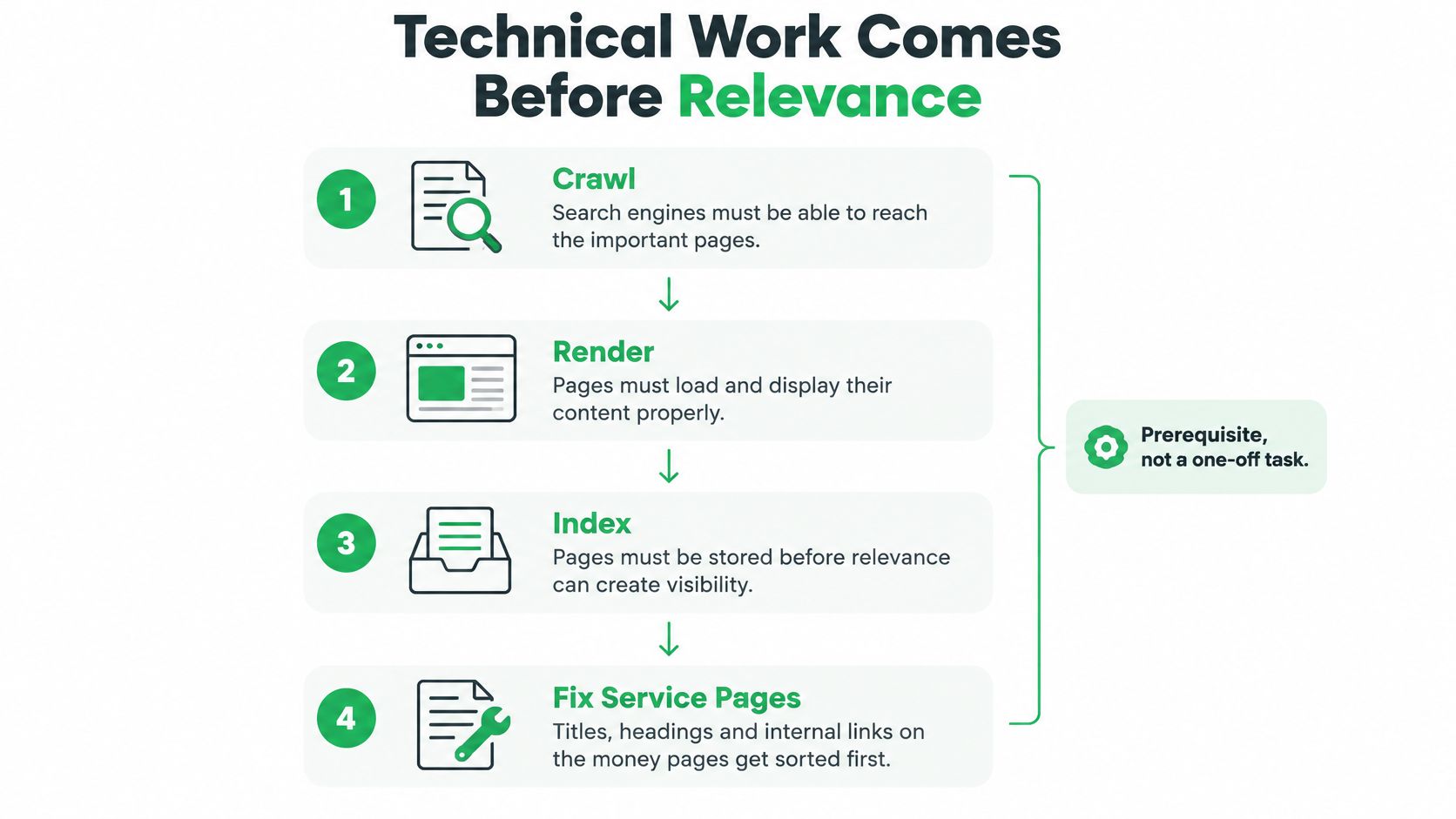
- Confirm the money pages are indexed. Open the Pages report in Google Search Console and filter to the service and location URLs. If a page isn't indexed, nothing else about it matters yet.
- Check robots.txt and the XML sitemap. A stray disallow line or a sitemap that omits commercial pages can hide exactly the pages being promoted.
- Fix broken links, redirect chains and duplicate URLs. Chains slow crawling and split signals, and a canonical tag is the fallback when a duplicate can't be removed outright.
- Test mobile rendering on a mid-range phone. Tap the phone link, submit the enquiry form, and confirm the enquiry email arrives.
- Read the field data in Search Console, split by mobile and desktop. Devices, networks and templates differ enough that a blended score hides the problem.
The performance thresholds are concrete. Good results mean Largest Contentful Paint at or below 2.5 seconds, Interaction to Next Paint at or below 200 milliseconds and Cumulative Layout Shift at or below 0.1, measured at the 75th percentile of real visits, as the guide to Core Web Vitals sets out. Field data matters more than a lab score, and passing isn't automatic: an Australian performance report cited in that guide found 84% of sampled ecommerce websites failed at least one Core Web Vitals measurement.
Common fixes, in the order they usually pay:
- Compress oversized hero images. They're the most common cause of a slow largest element.
- Remove render-blocking scripts from the critical path so text appears sooner.
- Reserve width and height on every image to stop content jumping as the page loads.
- Defer non-essential third-party tags, from chat widgets to tracking pixels, until after the main content renders.
Service pages, one per job
On the page side, build one page per core service rather than a single page covering everything. Each one needs a title and main heading that match how customers search, answers to the questions that stall a booking, one obvious next step, and internal links from related pages. For a detailed breakdown of what belongs on those pages, see what a good SEO service page should include.
In SEO 2 RANK's technical work, the crawling and indexation review covers robots, sitemaps and indexation patterns, which is where these checks usually start.
Prioritise commercial pages over blog URLs, and after any change compare 28 days of Search Console data with enquiry numbers. A complex platform, a replatform or a domain migration is the point to bring in a specialist rather than experiment.
Local SEO and Google Business Profile for Your Service Area
For a Melbourne service business, local work starts with the Google Business Profile and location relevance. Broad content production comes later. Google's local results are shaped mainly by relevance, distance and prominence, which makes the profile itself the first surface to fix.

The order matters. An incomplete profile with the wrong primary category limits every suburb page built on top of it, so get the basics right before anything clever: accurate categories, a full service list, real opening hours, genuine service areas, current photos and a steady review process that follows platform policy. Then connect the profile to suburb and service landing pages so the two reinforce each other. A practical set of checks is in these Google Business Profile optimisation tips.
A maintained profile produces measurable actions, not just impressions. Rocking Web's Google Business Profile statistics reported a median of 67 monthly actions per listing, made up of 36 website clicks and 18 phone calls, across Australian listings. Calls and clicks from a profile sit close to real enquiries, which is part of why local work often pays back before broader content spending does.
Consistency is the unglamorous half. The business name, address and phone details should match across the profile, the website and the directories customers use. A changed mobile number updated in four listings and left stale in six others costs enquiries, because both customers and local results read conflicting details as a weak signal.
The suburb page decision
Location pages are a separate decision from the profile. Create one only where the business serves an area, and make each explain real coverage, the services offered there, proof, availability and how to enquire.
The most common local mistake: publishing forty suburb pages that repeat the same paragraphs with a different place name. Google treats them as near-duplicates, and customers notice before the algorithm does.
Distance also sets a ceiling. Local ranking includes proximity, so a Melbourne business can't realistically dominate every suburb through domain authority alone. Fund the suburbs where service capacity and lead value are highest, get the profile and pages converting enquiries there, then expand. A single-location operator and a multi-location franchise need different structures, because the right priorities depend on the business, its competition and its genuine target locations.
Measuring Enquiries Before Spending on Growth
Before funding a single article or link, an owner should be able to answer one question: which searches produced last month's calls, forms and booked jobs? If that can't be answered, the first spend isn't content, it's the tracking that makes every later decision reversible.
The setup is smaller than most owners expect.
- Call tracking on the main number, so phone enquiries are attributed rather than guessed.
- Form submission tracking on the contact and quote forms, including which page the visitor came from.
- Booking or quote tracking where a booking tool or CRM is already in place.
- Google Business Profile actions. Calls, website clicks and direction requests recorded separately from ordinary organic visits, so profile performance isn't blended into site traffic.
That measurement gap is widespread. Only 7% of businesses measured the contribution of digital activities to overall business performance in 2024-25, according to the Australian Bureau of Statistics. The figure has more than doubled from 3% in 2021-22, which suggests measurement is becoming normal rather than optional.
Online visibility is also a weak proxy for commercial impact on its own. In the 2025-26 CPA Australia survey, 44% of Australian small businesses reported generating more than 10% of revenue through online channels, against 63% across the surveyed Asia-Pacific markets, as set out in the Australian Government's small business factsheet. That doesn't prove SEO fails. It shows that rankings and sessions can't stand in for lead quality.
Good reporting connects three things: visibility, traffic quality and measurable enquiries, with local rankings and profile activity alongside where available. The sequence that works is repair tracking and high-intent service pages first, then expand content once the numbers can be trusted.
There's a limit worth stating plainly. A form submission isn't a paying customer, so someone still has to record lead quality manually, and privacy and consent requirements apply to visitor tracking. For a Melbourne service business, whether SEO is worth the spend usually comes down to lead value and close rate rather than traffic volume.
When Content and Link Building Are Worth Paying For
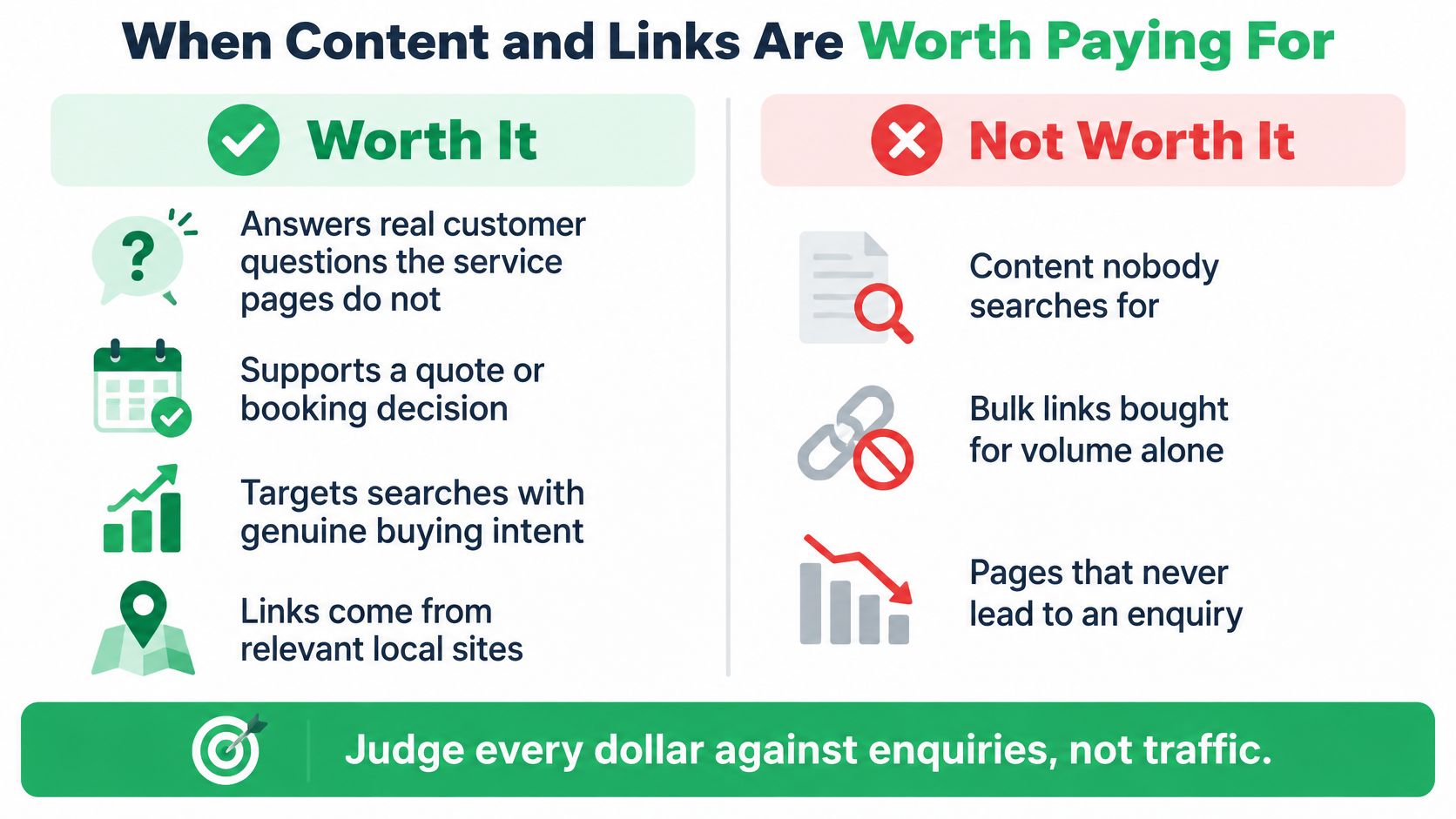
Content is worth funding when it answers a real customer question the service pages don't cover, supports a decision such as a quote or a booking, and targets searches with genuine commercial value. A handful of well-chosen pieces usually beats a weekly quota.
The volume myth
Publishing several articles a week won't compensate for weak service pages, technical problems, weak local visibility, or a site that doesn't turn visitors into enquiries. Content sold by word count tends to be written for a calendar rather than a customer, and it usually stalls at a few hundred sessions a month.
The same instinct drives a lot of rushed AI content. In separate 2025 Australian SME research cited in a Treasury small business consultation paper, 39% believed AI had made it harder to stand out, while 21% cited inaccurate AI-generated information as a concern. Adding more machine-written pages doesn't solve a differentiation problem. Accurate business information, first-hand expertise, clear organisation signals and honest reviews do more for visibility in AI-assisted answers than volume does. It's worth checking periodically how those tools describe the business and correcting the source information when they get it wrong.
When authority work earns its place
Link building becomes worth paying for once the foundations work and competitors in the niche hold clearly stronger profiles. Prefer relevant sources: industry associations, suppliers, local partnerships, sponsorships and genuine press. Paid link schemes that breach Google's spam policies put the whole domain at risk, and a sudden block of directory links does nothing for a business whose service pages still don't convert.
If a business is publishing out of obligation rather than purpose, how often a business should publish blog posts is a more useful starting point than a monthly quota.
Hold off on both content and links when any of these apply:
- Pages aren't indexed reliably, so new content starts invisible.
- Service pages don't convert, so extra traffic wastes the visit.
- Tracking is missing, so nobody can tell whether the work helped.
- The budget can't sustain a few months of consistent effort, because stop-start publishing rarely compounds.
Deciding What to Fund and What Comes Next
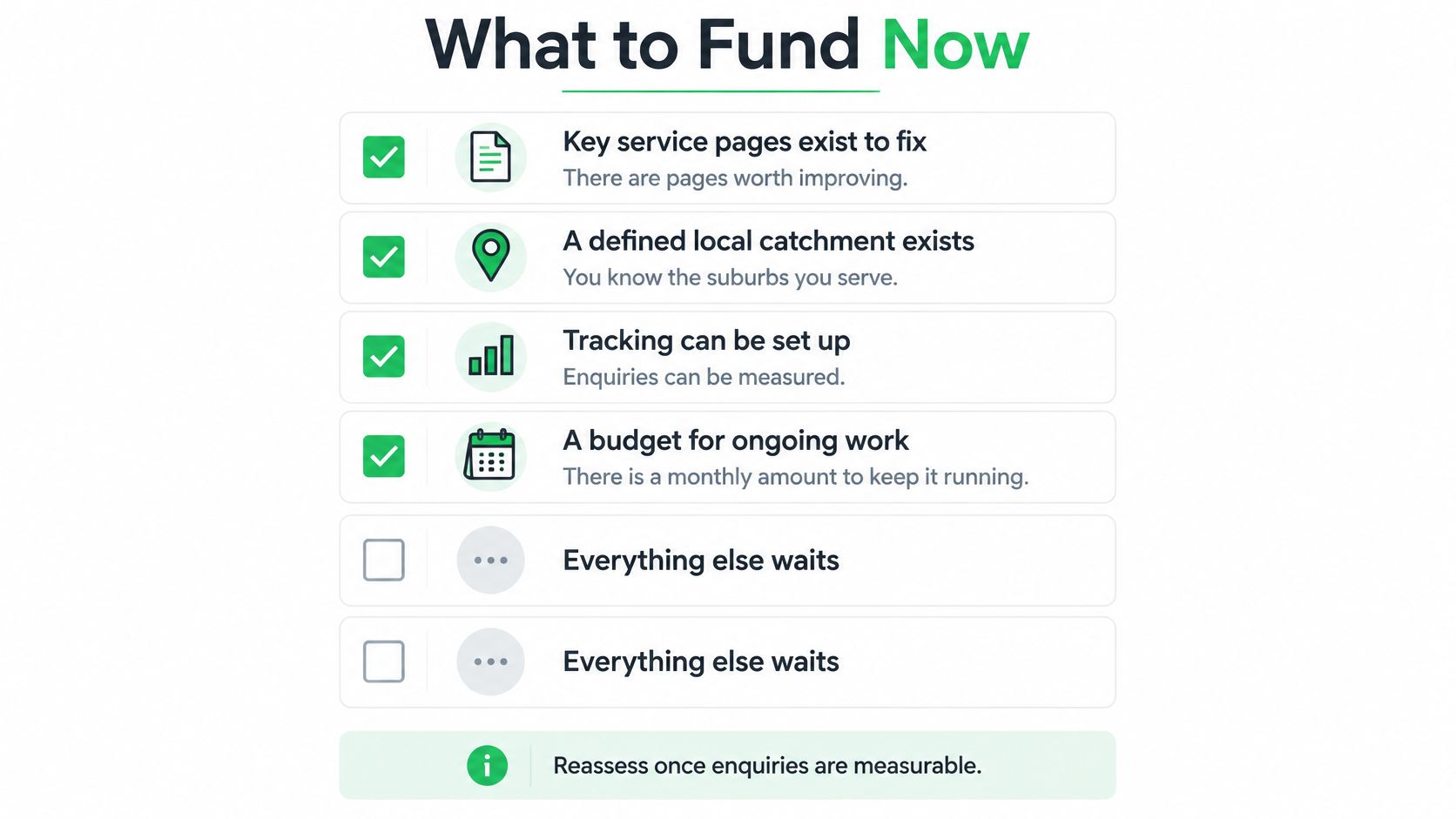
The decision comes down to conditions, not preferences. Fund now when there are key service pages worth fixing, a defined local catchment to rank in, and tracking that can judge the result. Wait, or fix something smaller first, when there's no commercial page to optimise, no local area being served, or no way to measure an enquiry. In that last case, measurement comes first because it protects every later dollar.
Cost depends on the number of pages, the state of the technical foundations, competition in each suburb or niche, whether a migration or rebuild sits in the middle of it, whether the work is one-off or ongoing, and how much time the owner can put in. Comparing scope beats comparing price, so ask what each deliverable includes: how many pages are rewritten, who implements, what reporting shows, and whether implementation is included or quoted separately.
Headroom is a real constraint. 91.6% of Australian businesses had annual turnover below $2 million at the point the ABS compiled its counts of Australian businesses, so an audit that identifies where the money goes is often worth more than a year of unfocused activity.
Professional help is worth considering for complex platforms, migrations, established sites with stagnant growth, or a change of provider. SEO 2 RANK's paid Full SEO Audit and Strategy is built for exactly those cases, while its free SEO Snapshot is a high-level opportunity review and isn't a substitute for it. For smaller campaigns, Search Foundation suits a narrower scope, and the Small Business SEO Melbourne service sets out how the ongoing work fits together.
A sensible next step is to open the website and the Google Business Profile, work through the checks above, and note which of the three priorities is currently weakest. That answer decides where the money goes first.
If you'd rather have a specialist read the site than work through it alone, SEO 2 RANK reviews the technical foundations, service pages and local visibility that decide whether SEO spending lands. The free SEO Snapshot gives a high-level view of the opportunities, and the paid audit and ongoing Small Business SEO work cover implementation and enquiry reporting when the foundations justify it. Start with the SEO 2 RANK site and book the review that matches how far along the site already is.
Find Out What Is Holding Your
Website Back
Get a practical SEO Snapshot showing the biggest issues and opportunities we can see across your search visibility, website and local presence.
Get Your Free SEO Snapshot→