
Falling leads rarely mean the rankings fell. In most Melbourne service businesses the drop sits in one layer of a short funnel: the page stopped appearing in results, it appeared but stopped earning clicks, it earned clicks but stopped converting, or the enquiry arrived and the tracking never recorded it. Working out what Melbourne business should do if rankings and website leads are dropping starts with naming which of those numbers moved, on which pages, in which suburbs, and from what date.
Rewrite the homepage in week one and a month disappears without anything being learned. The cheaper path is a four-step triage: separate visibility from clicks from enquiries, rebuild a segmented baseline, check access and local profile health, then repair the commercial pages that used to produce work. New content earns a place in the plan only after those four steps.
The channel justifies the attention. auDA's Digital Lives of Australians 2024 study found that 99% of Australian consumers and small businesses said the internet added at least some value to their lives, while 78% of small businesses said they would struggle to function without it.
Table of Contents
- Find Which Number Is Falling Before You Change Anything
- Build a Baseline That Counts Real Enquiries
- Check Access, Indexing and Local Profile Health
- Repair Your Money Pages and the Enquiry Path First
- Sequence the Fixes and Track Recovery Over Eight Weeks
- What Recovery Costs and What Changes the Price
- Decide Whether to Run the Triage Yourself or Bring In Help
Find Which Number Is Falling Before You Change Anything
The reflex advice after a lead drop is to publish more content and refresh the titles. That advice assumes a ranking problem. Plenty of Melbourne service businesses lose enquiries while their positions barely move, and some gain visibility while the phone goes quiet. Before touching a page, name the number that fell.
Think in a chain. Impressions are how often a page appeared in search results. Clicks are the visits those results delivered. Enquiries are the calls, forms, bookings, emails and direction requests that follow. Conversion rate divides enquiries by clicks. One link in that chain is usually broken, and the fix for one link rarely fixes another.
The funnel below shows which layer to check at each stage.
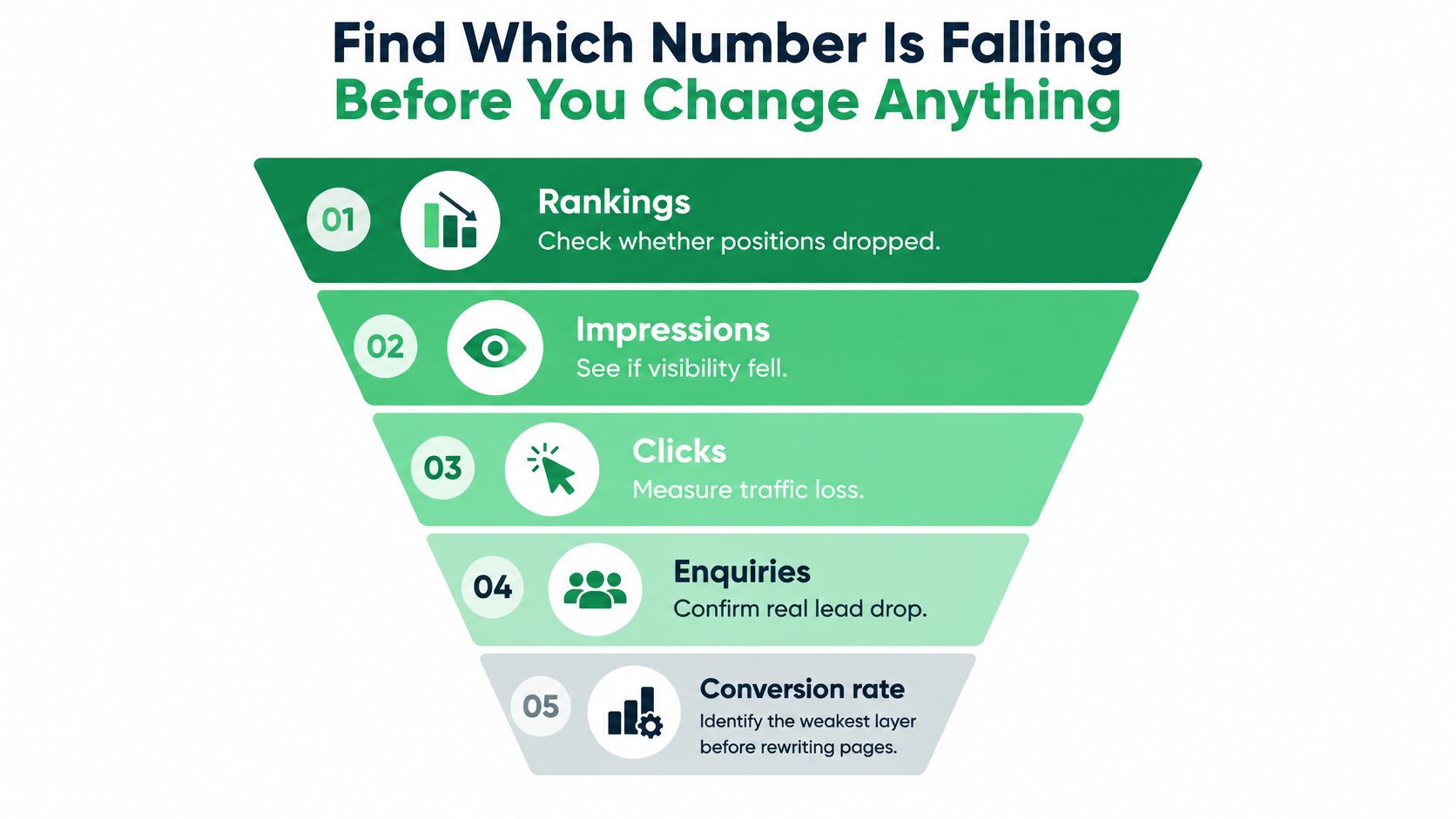
The pattern points to the layer that broke
| Symptom pattern | Likely cause | First check |
|---|---|---|
| Impressions and clicks falling together | Lost positions, demand change or indexing loss | Non-brand queries by page in Search Console and index status of key URLs |
| Impressions steady, clicks falling | Weaker titles and snippets, or AI answers absorbing informational clicks | Click-through rate by query and whether the affected pages are informational or commercial |
| Clicks steady, enquiries falling | Conversion friction on forms, phones or mobile pages, or tracking failure | Test calls and forms on a phone and check form delivery and event logs |
| Drop limited to one suburb or service | Weak local relevance, Business Profile issues or competitor displacement | Map results for suburb searches, recent profile edits and review activity |
| Sudden cliff on one date | Site migration, redesign, robots or noindex change, or a broken analytics tag | Release notes, redirect map, robots.txt and analytics tag firing |
| Gradual decline over several months | Seasonal demand, shifting market or stronger competitors | Year-on-year comparison and the pages of competitors ranking for lost queries |
Two rows deserve special care. A cliff on a single date almost always follows a release: a migration, a theme update, a robots.txt edit or an analytics tag that stopped firing. A gradual slide is a different animal, and seasonality is the first thing to rule out for trades with summer peaks and quiet winters.
One more hypothesis is worth testing rather than assuming. Google's guidance on AI Mode for Australian marketers reports that clicks from pages shown with AI Overviews can be higher quality, and that 60% of potential lead-generation customers surveyed by Google said an AI Overview made decision-making faster, easier or less overwhelming. AI summaries cluster heavily on informational queries, while buying and booking searches are less consistently affected.
Australian evidence on the small-business side is thinner than the commentary implies. ABC News reporting on businesses adapting to Google's AI pivot notes that AI Overviews have been available across Australia since October 2024 and that AI Mode began rolling out here in October 2025, alongside reports of sharply lower search traffic to business websites in the second quarter of 2025 and one accounting firm's 25% year-on-year decline in organic traffic. The same coverage cites an independent review finding that many widely quoted AI-search click studies used US or unspecified-country samples rather than Australian small-business websites. Treat click loss to AI answers as a live possibility, not a verdict.
A business can hold its visibility and lose its leads. The reverse happens too. Only the segmented numbers separate the two.
Three things go in writing before any change is made. The date the decline started, because it lines up against releases, algorithm updates and staff changes. The pages and queries affected, so the fix has a target. The device and suburb mix, because a mobile-only or suburb-only drop points somewhere quite different from a site-wide one.
Build a Baseline That Counts Real Enquiries
A single traffic line can't tell you whether a suburb page lost its rankings or a form stopped sending mail. The baseline that answers the question is segmented by query, URL, device and suburb, and it counts enquiries as events rather than sessions.
Australian consumers reach for search and maps to pick a nearby provider. A compilation of Australian digital marketing statistics reports that 46% of Google searches have local intent, and cites 42% of local searchers clicking a Map Pack result before other page results. That's why the numbers get built at suburb-and-service level, not site level.
The sequence below keeps the report honest from the first week.
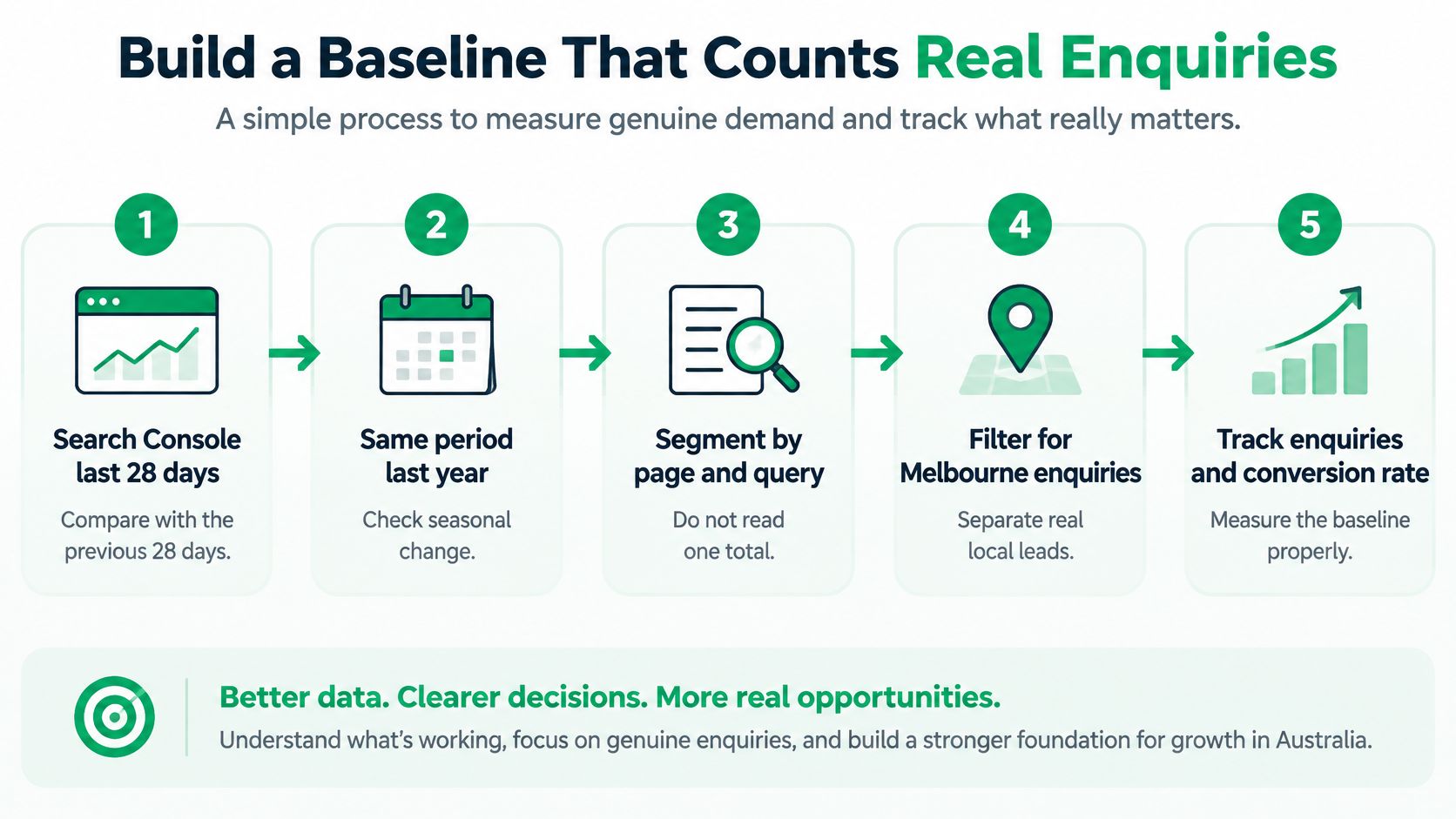
Four steps to a baseline you can defend
- Fix the comparison windows first. Open the Search Console Performance report on the last 28 days, then compare with the preceding 28 days and the same period a year earlier. Two comparable windows are the entire basis for calling a fall real.
- Split branded from non-branded queries. Business-name searches flatter a site total and hide losses in generic service queries, which is where new customers come from.
- Read per page, per device, per suburb. Pull impressions, clicks and average position for every service URL, filtered to suburb-plus-service queries. Average position can improve while clicks fall, and daily rank movement is noise rather than signal.
- Reconcile clicks against outcomes. Search Console clicks against GA4 engaged sessions, calls, form submissions and booked jobs. If those four don't line up, one of them is wrong.
What counts as an enquiry
An enquiry is a call from the website or the Business Profile, a form submission, a booking, an email or a direction request. Each one needs its own test, because a business that only counts form fills will misread a phone-led trade as a collapse.
| Source | How to test it | Where to reconcile |
|---|---|---|
| Website calls | Click-to-call on a phone and check the GA4 event | Phone logs and CRM |
| Business Profile calls | Call the profile number from a mobile and log the call | Phone logs and CRM |
| Form submissions | Submit a test form and confirm inbox receipt | Inbox and CRM |
| Booking completions | Complete a test booking | Booking system and job records |
| Direction requests | Check profile insights and UTM-tagged link clicks | Profile insights and GA4 |
| Emails | Send a test email to the listed address | Inbox |
Reconcile monthly against phone logs, the inbox and job records. Profile calls and direction requests don't appear as website leads, and a business that ignores them will undercount demand precisely on the days it matters.
Test the plumbing before you trust the graph
Name the events in GA4 rather than relying on whatever the theme shipped with: click_to_call, form_submit and booking_complete. Then submit a live test form and place a test call, and confirm the notification lands in the right inbox. Tag Business Profile links with UTM parameters so profile traffic stops arriving as direct.
Every analytics platform undercounts. The ACCC's own cookies and website analytics notice lists the fields its analytics record, including IP address, top-level domain such as .au, browser type, operating system, visit date and time, pages accessed, documents downloaded and the referring internet address. It notes the clickstream data is anonymised, and that visitors can opt out of Google Analytics cookies. Blocked cookies, declined consent and ad blockers all remove real people from the count, so the reported figure sits below the true one. Check call records, form-delivery logs and job records before concluding a lead source has died.
The bigger gap is commercial. The Australian Bureau of Statistics characteristics of Australian business release shows 32% of Australian businesses received orders online in the 2024–25 financial year, while only 7% measured the contribution of digital activities to overall business performance. Without that link, a recovered ranking can't be valued and a lost enquiry can't be priced.
Action threshold: a sustained fall of at least 20% in non-brand impressions or qualified enquiries across two comparable four-week periods justifies a full diagnosis, once seasonality and analytics changes are ruled out.
Check Access, Indexing and Local Profile Health
Technical faults suppress good content, which is why these checks run before any rewrite. A service page can rank for years and then lose access overnight to a robots.txt edit, a staging noindex that shipped to production, or a canonical tag pointing elsewhere.
| Check | Where to look | Problem sign |
|---|---|---|
| Crawlability and robots.txt | robots.txt file and Search Console crawl stats | Service pages blocked by a disallow rule |
| Indexation | Search Console page indexing report | Key pages marked noindex, excluded or treated as duplicates |
| Canonical tags | Page source or site audit crawler | Service pages canonicalised to a different URL |
| Redirects and status codes | Site audit tool and server logs | Redirect chains, or 404 errors on URLs that used to rank |
| XML sitemap | Sitemap file and Search Console Sitemaps report | Sitemap listing old, redirected or non-indexable URLs |
| Mobile usability and speed | PageSpeed Insights and Search Console Core Web Vitals | Layout shifts or slow loading on service templates |
| Google Business Profile | Profile dashboard and map searches for key suburbs | Suspension, wrong primary category or wrong service area |
| Reviews and citations | Google reviews and key Australian directories | Mismatched name, address or phone number, or an unexplained drop in review activity |
Reviews and citations belong in the diagnosis
The ACCC's internet sweep of online reviews and testimonials examined 137 businesses across 10 sectors and found 37% raised concerns about their online reviews or testimonials, while 63% did not. The sweep identified failing to disclose incentivised reviews, encouraging inflated reviews, misrepresenting ratings or review volumes, and using third-party services to create or remove reviews. The commission noted that small businesses can be particularly affected by negative reviews from competitors, professional reviewers or other third parties, because many rely on online ratings to attract customers when they lack an established base.
Mobile local research is the other half of profile health. Google's Australian Consumer Barometer reported that 39% of Australians used a smartphone to find local business information in the previous month, and that 58% used the internet during recent purchase journeys. Test tap-to-call from the profile, confirm the service-area setting matches the suburbs served, and check that the landing page a profile link points to names those suburbs.
Access problems are the easiest fix to recognise and the hardest to spot without looking. A short guide on why Google isn't indexing a website is worth working through before a developer is booked, since a fair share of cases end at a single stray tag.
Some of these fixes need a developer, and a recent rebuild should be checked against a redirect map rather than repaired page by page as 404s surface. Inconsistent name, address and phone details across the website and the main Australian directories weaken local trust in a way no amount of new content repairs.
Repair Your Money Pages and the Enquiry Path First
New content is the most expensive way to solve a conversion problem. The pages that produced enquiries for years already hold whatever authority the domain has earned, and they're the fastest place to recover ground.
The two views below are the pair that matters: what search sent, and what the page did with it.

Work the pages in this order
- Identify the five to ten money pages that historically generated qualified Melbourne enquiries, using analytics and job records rather than memory.
- Map each page to one service, one location intent and one primary action, such as calling, booking or requesting a quote. Pages trying to serve three intents usually serve none.
- Compare the lost queries with each page's title, H1, service proof, pricing or eligibility boundaries, FAQs, internal links and structured data, then rewrite to match the intent the query actually carries. Add suburbs served, qualifications and verifiable testimonials.
- Merge pages competing for the same query instead of adding another one to the pile. Two half-relevant pages lose to one thorough page, every time.
- Improve the enquiry path with visible click-to-call controls, short forms, a stated response time and tap targets that work on a thumb.
Why the mobile path decides the outcome
Australian traffic is mobile-led. An Australia-focused compilation of mobile traffic figures puts mobile's share of traffic between about 49.55% and 67% depending on measurement method, and cites benchmark conversion rates of 1.8% on mobile against 3.2% on desktop. Those are rough benchmarks rather than targets, but the direction is consistent: the smaller screen converts worse, and a small form or a buried phone number makes it worse again.
Test on real phones, compress oversized images, defer non-blocking scripts, remove layout shift and check Core Web Vitals by template rather than only on the homepage. If the service page template is slow, every suburb page built on it is slow.
Every additional required field on a mobile form costs enquiries. Ask for a name and a number, then earn the rest on the call.
The measurement side has its own failure mode. Adding tracking or extra form fields to explain a lead drop can collect personal information the business has no lawful need for, and the ACCC's privacy policy sets out the principle clearly: personal information may be collected only for a lawful purpose reasonably necessary for, or directly related to, the organisation's functions or activities, and by lawful and fair means. Fix the measurement without widening what each form collects.
If the pages rank and enquiries still don't arrive, the constraints sit closer to the offer and the form than the keyword, which is the territory covered in why a website isn't converting.
Avoid thin suburb pages that repeat a template with the name swapped, bought links, URL changes without redirects, and judging the recovery by rank position alone. None of them answer what the searcher wanted.
Sequence the Fixes and Track Recovery Over Eight Weeks
Order matters more than volume. An urgent fix that restores a broken form beats a rewrite of a page nobody can reach, and lost redirects on last year's highest-earning service page come before anything new gets written.
The plan below front-loads the faults that block recovery entirely.
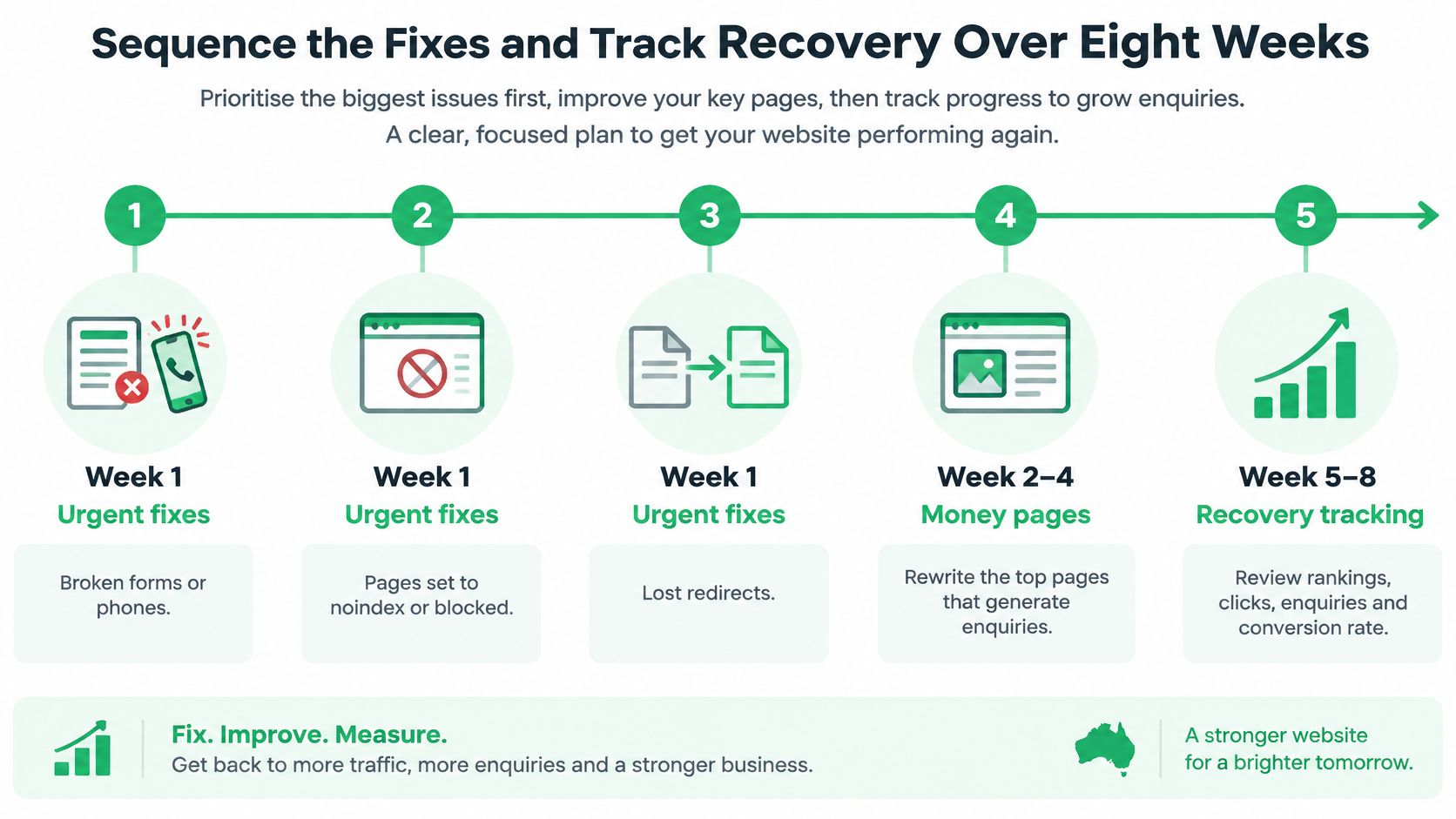
| Window | Focus | Measure |
|---|---|---|
| Weeks 0 to 2 | Fix broken forms, phone faults, blocked or noindex money pages and lost redirects | Form delivery, call connection and indexed status of key pages |
| Weeks 2 to 4 | Rewrite the top five to ten money pages and clean up the Business Profile | Non-brand impressions, clicks and map actions |
| Weeks 4 to 8 | Adjust titles, internal links and merged pages based on what moved | Qualified enquiries by landing page and form completion rate |
| Ongoing | Monthly review with an annotated change log | Trends across three to six months and cost per qualified lead |
Annotate every change in the baseline spreadsheet with its date, the page and the reason. SEO is staged testing, not an instant recovery, and a note from three weeks ago is often the only thing that explains a movement.
Stop rule: if the agreed fixes have been applied and the key measures haven't moved after about eight weeks, go back to the diagnosis. Adding more content to an unresolved problem spends money on the wrong layer.
Single-week movements are noise. Trends across three to six months are the dependable signal, which is the realistic frame for how long SEO takes. The monthly routine is short: non-brand impressions, qualified enquiries by landing page, map actions, call connection rate and cost per qualified lead, plus one line on what changed and what gets tested next.
What Recovery Costs and What Changes the Price
There's no standard package price, because recovery cost tracks the work rather than a menu. A site with admin access and ten sensible pages is a different job from a custom build where every change waits on one developer.
The variables that move the number most:
- Platform and access. WordPress with admin rights is quicker to change than a bespoke build with a release process.
- Page count and overlap. Ten pages to rewrite is one thing, ten pages plus a merge-and-redirect exercise is another.
- Technical depth. Migration repairs, redirect mapping and Core Web Vitals work pull in a developer, and that's billed differently to content.
- Tracking setup. GA4 events, call tracking and form routing all take configuration and testing time.
- Local work. Profile optimisation, citation clean-up and a review process that keeps running after the project ends.
- Reporting and reconciliation. Monthly data matching against CRM or job records adds hours that basic rank reporting doesn't.
- Internal time. Someone has to approve copy, supply proof and answer questions. That's a real cost even when no invoice arrives.
Ask for an itemised quote that separates diagnosis, implementation, content and ongoing reporting, and ask what happens if the agreed measures haven't moved after eight weeks. The breakdown of SEO costs is a useful sanity check on how those components are usually priced before any proposal is compared.
Decide Whether to Run the Triage Yourself or Bring In Help
A business with a capable internal person and admin access to its own Search Console and analytics can run the baseline and technical checks without outside help. A business without that capacity, or one sitting on a rebuild that needs development work, gets further by bringing someone in.
If a provider is engaged, ask for a diagnosis that names the pages and queries that lost visibility, a prioritised plan separating urgent fixes from longer-term work, written deliverables, realistic timeframes, examples from comparable Melbourne businesses, and clear ownership of approvals and implementation.
SEO 2 RANK is one Melbourne option, and its stated model is worth testing against those questions. It describes direct specialist access, plain-English reporting and hands-on implementation within scope where platform access permits, a benchmark step that reviews the website, rankings, Search Console, local visibility, competitors and current lead pathways, and a focus on established service businesses, including sole traders and small teams. Weigh those claims against the quality of the diagnosis rather than any promise about rankings.
Start the baseline this week, even if it's three columns in a spreadsheet. It's the document that tells a provider what to fix, and the test of whether they've understood the problem.
SEO 2 RANK works with established Melbourne service businesses on this exact sequence, starting with a benchmark that reads the website, rankings, Search Console, local visibility, competitors and current lead pathways, then moving into hands-on fixes to the pages and profile that lost ground. If the triage above has stalled, or nobody internal owns it, SEO 2 RANK can run the diagnosis and the implementation with plain-English reporting tied to enquiries rather than rankings alone.
Find Out What Is Holding Your
Website Back
Get a practical SEO Snapshot showing the biggest issues and opportunities we can see across your search visibility, website and local presence.
Get Your Free SEO Snapshot→