
Most Melbourne service businesses see early Google Maps movement in 4–8 weeks, with stable top-three visibility often taking 3–6 months in average competition. In dense inner-Melbourne and CBD markets, a realistic timeframe for stable top-three visibility is 9–12 months.
A Preston plumber may have launched a Google Business Profile six weeks ago and still be missing from the Map Pack. A South Yarra dentist may have a polished profile, good photos and strong services listed, yet remain below competitors that have been building local prominence for years. That doesn't automatically mean the work has failed. It usually means one of Google's local ranking signals is still weaker than the nearby competition.
The useful question isn't just, “How long does it take to rank in Google Maps?” It's which of relevance, distance or prominence is currently blocking the business in its target suburb?
Table of Contents
- The Honest Melbourne Answer Up Front
- How Google Decides Who Shows on the Map
- The Six Levers That Actually Speed Up Maps Ranking
- Realistic Timelines by Competition Level in Melbourne
- Two Melbourne Examples and How They Progressed
- Your 90-Day Plan to Rank Faster in Google Maps
- Common Mistakes and What to Do Next
The Honest Melbourne Answer Up Front
A Melbourne service business can see early improvement in map impressions, calls or profile visibility within 4–8 weeks after meaningful optimisation. Further progress often appears over 8–12 weeks when profile updates, citation work and review activity continue consistently, according to Australian local SEO guidance and Australia-focused Google Maps advice.
That movement does not mean the business owns the top three positions. Average-competition suburbs commonly require 3–6 months for stable top-three visibility. Dense inner-Melbourne and CBD markets can take 9–12 months, because established competitors have stronger review profiles and deeper local authority. Melbourne-focused local SEO guidance distinguishes early placement from sustained top-three performance.
The timeline starts with a diagnosis, not a calendar.
- Relevance: Does the profile clearly match the service customers search for? If not, correct the category, services and business information first. This is usually the quickest signal to improve.
- Distance: Is the business close enough to the searcher and the suburb being targeted? A strong profile cannot fully overcome a location disadvantage, especially for location-sensitive searches.
- Prominence: Does Google see enough evidence that the business is established and trusted locally? Reviews, mentions, links and consistent business details build this signal, but they take longer to strengthen.
Google has no fixed waiting period. Its local system weighs relevance, distance and prominence, so the applicable timeline band depends on which signal is weakest against nearby competitors. Google Maps SEO guidance for Australian businesses explains this model in practical terms.
Practical rule: Use the first two months to measure movement, not to promise a top-three result.
Track profile impressions, calls, direction requests and visibility across the target suburbs. Then fix the weakest signal. A neglected profile may move quickly after basic corrections, while a polished business in a saturated category can still need months to overcome established competitors.
How Google Decides Who Shows on the Map
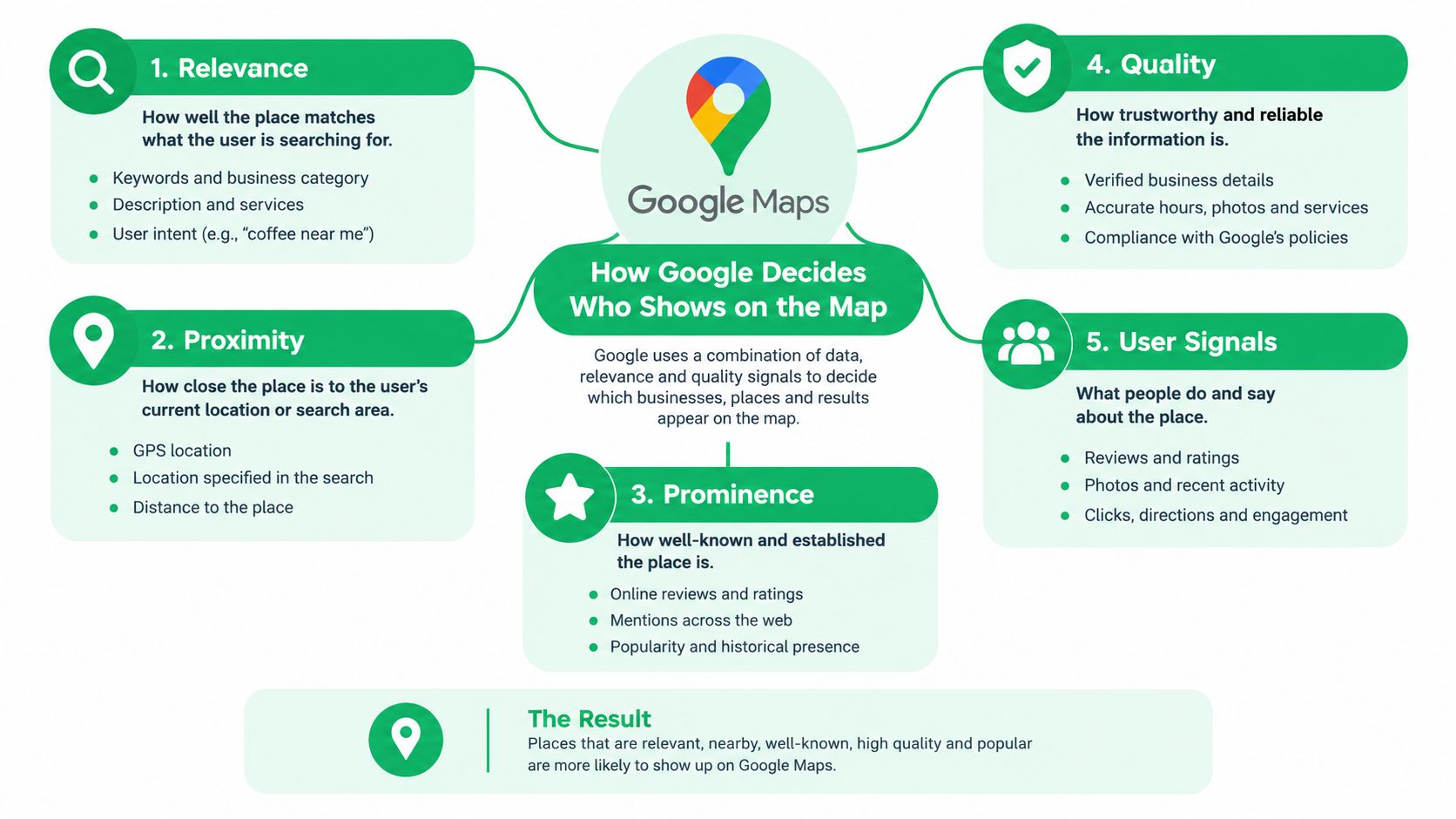
Google's public local ranking model uses three core factors: relevance, distance and prominence. These factors explain why a business can rank well for one suburb, disappear in another and change position as the searcher's location changes. Google Business Profile guidance cited in Australian SEO advice connects practical optimisation work to these three signals.
Relevance tells Google what the business does
Relevance is the match between the search and the business profile. A Carlton cafe that clearly lists coffee, breakfast and dine-in service gives Google more context than a profile with only a business name and phone number. The primary category, services, description, website content and locally relevant information all help clarify that match.
This is usually the fastest signal to improve because the business can correct it directly. Selecting an accurate primary category, completing service fields and aligning the website with the profile can produce early movement within weeks, although the exact response depends on competition and the starting condition of the listing.
Distance limits the realistic service area
Distance refers to how close the business is to the searcher or the location implied by the search. An electrician in Bayswater may be highly relevant for an electrical repair query, but a searcher in another part of Melbourne may see closer competitors instead.
Distance is the least flexible factor. A business can't move its premises to win every search, and a service-area setting won't turn a distant location into a nearby one. Accurate address information and appropriate service-area settings help Google understand the actual operating footprint, as outlined in Australian local SEO advice about location data.
Prominence compounds over time
Prominence reflects how established and trusted a business appears in its local market. Reviews, consistent directory information, local links, web mentions and the wider strength of the business's website contribute to that picture.
This is the slowest pillar to build because competitors already have a head start. Relevance can improve after profile edits, but prominence usually develops through repeated activity and independent confirmation. A business that acquires genuine reviews, earns relevant local links and maintains consistent citations gives Google more evidence over time.
Businesses should also understand that NAP consistency and local business data don't create an instant ranking switch. They reduce ambiguity and support trust, which matters most when Google compares similar businesses in the same suburb.
The Six Levers That Actually Speed Up Maps Ranking
Six operational levers influence how quickly a service business improves its map visibility. They don't carry equal weight, and they don't work on the same schedule.
| Lever | Typical Time to Movement | Melbourne Realistic Impact |
|---|---|---|
| Google Business Profile optimisation | 2–4 weeks | Fastest opportunity when categories, services or key fields are incomplete |
| Citation and NAP consistency | 4–8 weeks | Helps Google confirm the business location and identity |
| Review velocity and quality | 8–12 weeks | Builds prominence steadily when genuine reviews arrive consistently |
| Local on-page signals | 3–6 months | Supports relevance for services and suburbs |
| Technical SEO health | 3–6 months | Removes access and usability barriers that weaken the wider local presence |
| Proximity and competitive density | Ongoing constraint | Sets the ceiling because location and competitor strength can't be edited away |
Google Business Profile optimisation comes first. The profile needs a verified location, accurate primary category, complete services, correct hours, useful description, photos and appropriate service areas. This Google Business Profile optimisation guide covers the profile elements that should be reviewed before building authority.
Citation cleanup follows closely. Australian directories and niche listings should display the same business name, address and phone number. Conflicting details make it harder for Google to reconcile the business across the web.
Reviews need a repeatable process rather than an occasional request. A review request after each completed job is more dependable than asking only when rankings decline. The business should seek honest feedback, respond professionally and never manufacture reviews.
Local on-page work connects the profile to the website. Service pages should describe what the business does, where it operates and how customers can make contact. Two strong suburb-and-service pages are more useful than a collection of thin pages that repeat the same wording.
Technical SEO supports discovery and usability. Mobile problems, slow pages, broken internal links and unclear indexing can prevent important local pages from helping the profile.
The two levers Melbourne businesses underuse are review process design and local partner links. Tradies often finish the job and move on without asking for feedback. Professional firms may have strong referral relationships with suppliers, associations or complementary businesses but never earn a relevant local mention.
Proximity and density remain the hard boundary. A business in a quieter outer-suburban market can move with fewer authority signals than a business competing in a crowded CBD category.
Realistic Timelines by Competition Level in Melbourne
A Melbourne Map Pack campaign does not have one universal deadline. First identify the factor holding the listing back: relevance, distance or prominence. Relevance problems can improve after profile and website corrections. Distance sets a limit that optimisation cannot remove. Prominence takes longer when nearby competitors have stronger reviews, citations and local authority.
| Competition Tier | Example Melbourne Areas | First Movement | Stable Top-3 | Realistic Ceiling |
|---|---|---|---|---|
| Low | Pakenham, Cranbourne, Werribee | 4–8 weeks | 3–4 months | 3–4 months |
| Medium | Brighton, Glen Waverley, Doncaster | 6–10 weeks | 3–6 months | 6 months |
| High | CBD, South Yarra, Docklands | 60–90 days | 9–12 months | 9–12 months |
These bands reflect Australian guidance on local search timelines and competition-based Melbourne ranking expectations. They are planning ranges, not guarantees. The useful question is which row matches your suburb and category, then which ranking factor is currently weakest.
Low competition
Pakenham, Cranbourne and Werribee can produce early movement when competing profiles are incomplete or poorly categorised. The main blocker is usually relevance or inaccurate business data. Correct the category, services, contact details and service-area signals first. A low-density market may show progress within 4–8 weeks, but stable top-three visibility still requires consistent activity.
Medium competition
Brighton, Glen Waverley and Doncaster demand a stronger prominence profile. Competitors commonly have complete listings, established review histories and more relevant local mentions. If relevance is already sound, review velocity becomes the practical constraint. Expect initial movement in 6–10 weeks, then maintain review requests, local content and citation consistency through the 3–6 month period.
High competition
CBD, South Yarra and Docklands contain established agencies, law firms, accountants and clinics with deep local prominence. A profile can be relevant and still lose because competitors have stronger accumulated signals. Distance also matters more, especially near the CBD, where small changes in the searcher's location can change the Map Pack. Plan for 60–90 days before judging early progress and 9–12 months for a serious top-three campaign.
Use the table as a planning tool, not a promise. Compare the target suburb, service category, searcher's likely location, competitor review strength and profile completeness before choosing a deadline. If distance is the blocker, target a nearer service area or accept a lower ceiling. If relevance is weak, fix the profile before investing heavily in prominence.
Two Melbourne Examples and How They Progressed
Consider a representative Cranbourne plumbing business entering a relatively low-density map pack. Its starting position is weak: the profile isn't fully optimised, the business has twelve reviews, and citations use inconsistent versions of the name, address and phone number.
During weeks one to two, the owner verifies the profile, corrects the primary category, adds services and repairs the most important directory inconsistencies. By week three, early movement becomes possible because relevance and business identity are clearer. That doesn't guarantee a top position, but it gives Google a cleaner profile to assess.
A suburban trade business
By week six, a structured review process can start strengthening prominence. The owner asks genuine customers for feedback after completed work, responds to reviews and uploads useful photographs of vehicles, staff and completed jobs. With the profile and citations already corrected, the new review activity has a clearer foundation.
By week ten, stable top-three visibility becomes a realistic target in this type of market, with week twelve serving as a useful checkpoint. The result still depends on the exact search location, category and competing listings. The pattern is representative, not a promise.
A CBD professional service
Now consider an accounting firm near the CBD competing against ten established firms. Its baseline is much stronger: an optimised profile, forty reviews and clean citations. Yet it remains on page two because competitors have greater accumulated prominence and the local market is crowded.
Citation cleanup during weeks one to four may produce little visible movement. That work is still necessary, but it removes uncertainty rather than instantly overcoming entrenched competitors. A sustained review programme involving clients and appropriate referral relationships may move the firm into the top five by week twenty.
A stable top-three position may take month eight to month ten in this setting. The longer arc reflects competitive density and established prominence, not a lack of activity.
Two businesses can complete similar tasks with similar care and see completely different timelines because Google compares each listing with the businesses around it.
These examples shouldn't be treated as case studies or guarantees. They show the practical difference between improving a weak profile in a lower-density suburb and displacing established businesses in a high-authority CBD market.
Your 90-Day Plan to Rank Faster in Google Maps
A business owner can complete much of the first three months without an agency. The work needs to be sequenced, because building citations before fixing the core profile creates avoidable rework.
Weeks one to two
Start with the foundation:
- Claim and verify the profile: Confirm ownership and make sure the listed business is eligible for a Google Business Profile.
- Complete every field: Add the correct category, services, hours, website, service areas and business description.
- Fix NAP conflicts: Search existing listings and align the business name, address and phone number.
- Add credible photos: Upload images of the team, vehicles, premises and completed work, with permission where people or customers appear.
The checkpoint is simple. The owner should be able to explain exactly what the business does, where it operates and which searches the profile should match.
Weeks three to six
Build supporting signals:
- Create consistent citations: Review Yellow Pages, True Local, Hotfrog, Yelp, StartLocal and relevant industry directories.
- Request genuine reviews: Ask each completed-job customer through a repeatable process, without incentives or scripted praise.
- Publish local service pages: Add two useful pages that connect specific services with the Melbourne suburbs served.
- Review competitors: Record their categories, services, review patterns and local relevance, without copying their wording.
The relationship between reviews and local rankings is explained in this guide to Google reviews and local SEO. The key is consistency and authenticity, not a sudden burst of questionable activity.
Weeks seven to twelve
Strengthen local authority and usability:
- Answer profile questions: Add useful, accurate Q&A content that reflects real customer concerns.
- Publish weekly Google Posts: Tie updates to genuine services, availability or suburb coverage.
- Earn local links: Approach suppliers, associations, sponsors and complementary businesses where a relevant mention makes sense.
- Audit the website: Check page speed, mobile usability, internal links and structured data.
At the end of each phase, check the map-pack position weekly using an incognito search from the target suburb. Also record calls, form enquiries and direction requests, because rankings without enquiries don't show commercial progress.
The business owner can usually handle review requests, photos and basic profile updates. Citation reconciliation, technical diagnosis and competitor research are sensible tasks to delegate when time is limited. An agency becomes more appropriate when several suburbs, multiple practitioners, service-area complexity or persistent ranking volatility make manual tracking difficult. SEO2RANK is one Melbourne-based option that combines local, technical, on-page and measurement work for service businesses.
Common Mistakes and What to Do Next
Five mistakes routinely extend the timeline for Melbourne service businesses.
- Buying cheap citations: Spammy directory packages add low-value listings and can create more inconsistent data to clean up. Build only relevant, credible citations.
- Keyword-stuffing the business name: Adding suburbs or services that aren't part of the actual business name damages profile accuracy. Use the actual trading name.
- Incentivising reviews: Rewards for positive reviews undermine trust and can breach Google's policies. Ask for honest feedback from real customers instead.
- Ignoring the primary category: A broad or inaccurate category can block relevance before any link or review work begins. Choose the most accurate category for the core service.
- Tracking rankings without conversions: A position report alone can't show whether the profile generates calls or enquiries. Track visibility alongside actions that matter to the business.
A business that isn't appearing at all should first check whether the profile is verified, accurate and eligible. This guide to businesses not showing on Google Maps can help identify the common visibility problems before more authority work begins.
The next practical step is a suburb-specific Maps audit. A useful audit should review profile completeness, category fit, review velocity, citation health and the businesses already visible for the target service. The result should identify whether relevance, distance or prominence is the weakest link, rather than offering another generic promise about ranking speed.
A free 20-minute Maps audit is a reasonable starting point for a Melbourne service business that has already completed the basics but still can't see consistent progress. It should clarify the main blocker and the next actions, not pressure the owner into a long engagement.
SEO2RANK offers local, technical and on-page SEO support for Melbourne service businesses, including Google Business Profile work, citation cleanup, local landing pages and competitor analysis. Businesses that need a clearer view of what is holding back Google Maps visibility can visit SEO2RANK to request a practical starting assessment.
Find Out What Is Holding Your
Website Back
Get a practical SEO Snapshot showing the biggest issues and opportunities we can see across your search visibility, website and local presence.
GET YOUR FREE SEO SNAPSHOT