
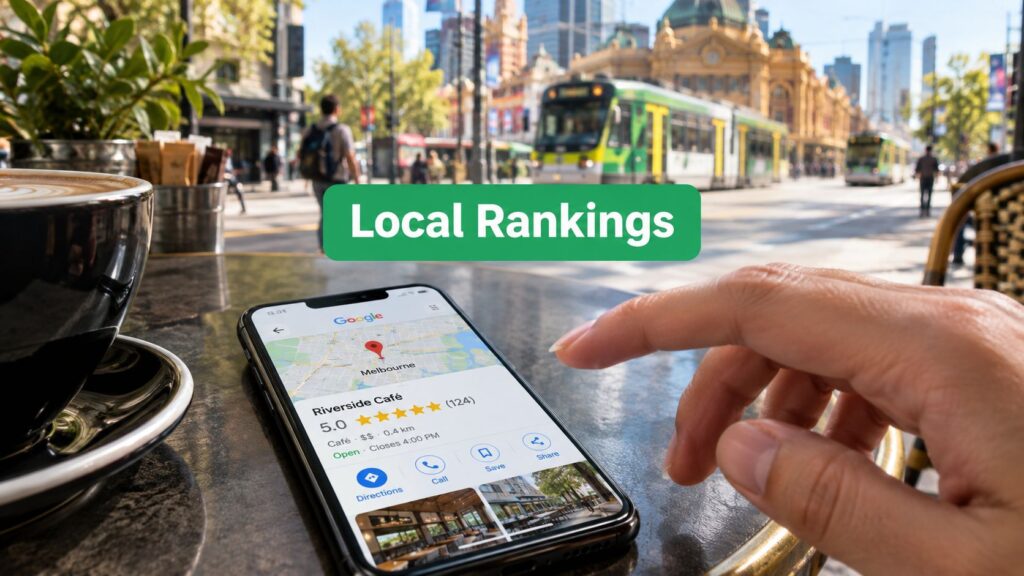
A Melbourne customer searching for a plumber, accountant or dentist usually sees a map, business names, star ratings and review counts before choosing a website. If two nearby businesses appear relevant, the one with a stronger, fresher review profile often earns more attention, even when both offer similar services. Google Reviews do help SEO and local rankings, mainly because they contribute to the prominence of a Google Business Profile, while also shaping whether searchers click, call or move on.
Reviews aren't a replacement for relevance, distance, accurate business information or a useful website. They're one part of the local search system, but they're unusually important because they connect an algorithmic signal with a human decision. For Melbourne service businesses, review management should therefore be treated as ongoing local SEO work, not as a request sent once after a business opens.
Table of Contents
- Do Google Reviews Actually Move the Needle for Local SEO
- How Google Uses Reviews in Local Ranking Signals
- The Australian Consumer Thresholds That Drive Click-Through
- Best Practices for Soliciting Authentic Google Reviews
- Managing Reviews and Handling Negative Feedback
- Comparing Active Review Strategies vs Passive Wait-and-See
- Integrating Reviews into Your Overall Local SEO Strategy
Do Google Reviews Actually Move the Needle for Local SEO
A customer comparing two nearby electricians may see one profile with a steady stream of recent feedback and another with an older collection of reviews. Both may have the right category and service area, but the active profile communicates stronger current market presence. That difference can affect both Local Pack visibility and the likelihood that a searcher chooses the listing.
Google's local ranking system uses relevance, distance and prominence. Reviews mainly support prominence, which is Google's way of assessing how well-known or established a business appears. Google doesn't treat a review as a magic keyword that automatically moves a listing upwards. Instead, review activity contributes to the broader reputation and popularity picture around the business.
The distinction matters. A business can't overcome an incorrect category, an unsuitable service area or excessive distance just by collecting testimonials. Reviews also won't make a poorly maintained profile competitive if the business name, phone number, hours and services are inaccurate.
Practical rule: Reviews strengthen a sound local foundation. They don't repair an irrelevant or misleading Google Business Profile.
For a Melbourne business competing across suburbs, the useful question isn't only whether the business has reviews. It's whether the profile shows a credible pattern of quality, volume, rating, recency and engagement compared with nearby alternatives. A profile that remains dormant can look less active than one receiving genuine customer feedback over time.
Reviews also create a trust layer around the search result. Google may use them as part of prominence, while customers use the visible rating and written experiences to judge risk. That makes review work a dual-purpose activity. It supports local discovery and helps convert the visibility the profile already earns.
How Google Uses Reviews in Local Ranking Signals
Google's own explanation of local search says results are mainly based on relevance, distance and popularity. Reviews matter through the popularity or prominence component, rather than replacing the other two factors, as outlined in Google's local ranking guidance.
Relevance asks whether the profile matches the search. A Melbourne dentist should clearly represent dental services, with accurate categories, services and supporting website content. Distance reflects the relationship between the searcher, the location and the area served. A business may be relevant but still less competitive for a searcher located far away.
Prominence is where review signals become particularly useful. Google can assess the apparent reputation of a business through indicators such as:
- Review quantity: A larger body of genuine feedback gives the profile more evidence of customer activity.
- Rating quality: The average rating influences how reputable the business appears to both Google and prospective customers.
- Review recency: Fresh feedback suggests that the business is still operating and serving customers.
- Response activity: Thoughtful replies show that the business maintains its profile and engages with customer feedback.
The effect isn't a guaranteed ranking formula. Google doesn't publish a fixed number of reviews that every business needs, and local results vary by query, suburb, competition and searcher location. Industry guidance sometimes estimates review signals at about 15–20% of Local Pack weighting, but that estimate comes from industry studies rather than Google's public formula, so it should be treated as directional rather than exact. The Australian Google Business Profile guide from RevGenX presents review quantity, rating, recency and responses as practical prominence signals.
Why steady activity matters
A profile with many old reviews may still have authority, but steady, authentic activity gives customers and Google more current context. For a business operating in a dense Melbourne market, that freshness can help distinguish an active provider from a profile that hasn't been maintained.
A useful operational approach is to monitor review movement alongside other profile signals. Businesses can use Google Business Profile notifications, a customer relationship management system or a spreadsheet to track new reviews, response status, recurring service language and unresolved complaints. The Google Business Profile optimisation guide can support a wider profile review, but reviews should be assessed as one part of the listing rather than isolated from category, location and website relevance.
The Australian Consumer Thresholds That Drive Click-Through
A high Local Pack position doesn't guarantee a lead. Searchers still compare the rating, review count and freshness of feedback before deciding whether a business feels safe to contact.
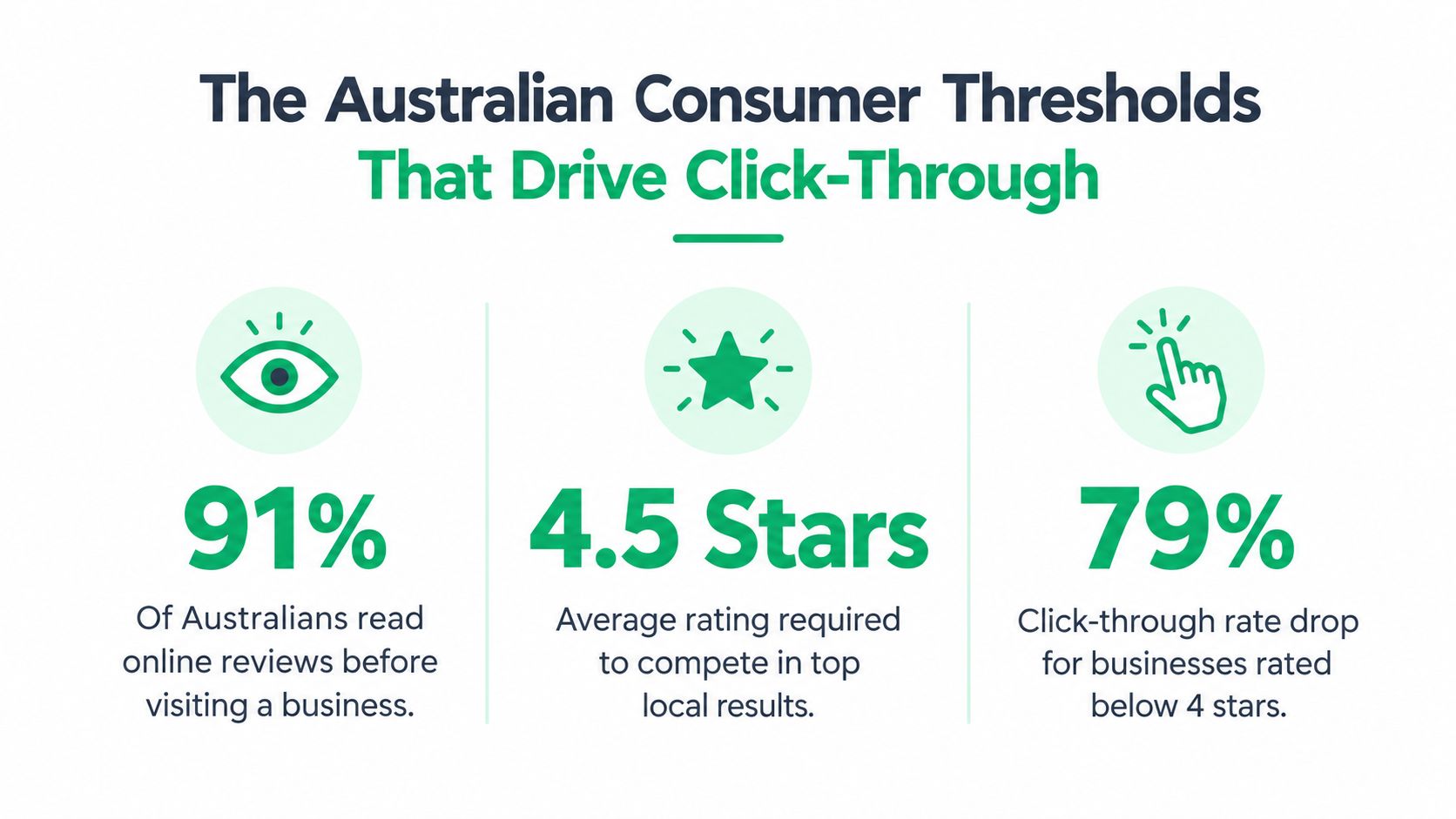
Australian-focused data illustrates the size of that filter. About 68% of consumers will only consider a business rated 4 stars or higher, and about 71% use Google to evaluate local businesses, according to Australian SEO statistics from Loudachris. The same source reports that customers are around 2.7 times more likely to consider a business reputable when it has a complete Google Business Profile.
The review profile itself can also exclude a business before a visitor reaches the website. The source reports that 87% of Australian consumers read Google reviews before choosing a local business, 73% won't consider a business with fewer than 10 reviews, and 68% won't consider a business rated below 4.0 stars. These figures don't mean every searcher behaves identically, but they show why review management affects conversion as well as visibility.
A business can therefore lose at two different points:
- Discovery: The profile may be less competitive because its prominence signals are weak.
- Selection: The profile may appear, but the rating, review volume or outdated feedback discourages the click.
The second problem is easy to miss in reporting. A business owner may see impressions in Google Business Profile and assume the strategy works, while calls and website visits remain limited. Review data helps explain that gap. Searchers don't evaluate rankings in isolation. They assess whether the business appears established, credible and relevant to the job.
The hierarchy of effort
For most service businesses, review work should follow a clear order:
- First, protect the rating: Fix recurring service problems instead of trying to bury poor experiences with requests.
- Next, build genuine volume: Make it easy for satisfied customers to leave feedback after completed work.
- Then, maintain recency: Avoid long periods in which no new feedback appears.
- Finally, manage responses: Reply in a way that helps future readers understand the business's standards.
A business that ranks slightly lower but meets these trust thresholds can attract more qualified attention than a business with a stronger position and a less convincing profile. Rankings create opportunity. Reviews help determine whether the opportunity becomes an enquiry.
Best Practices for Soliciting Authentic Google Reviews
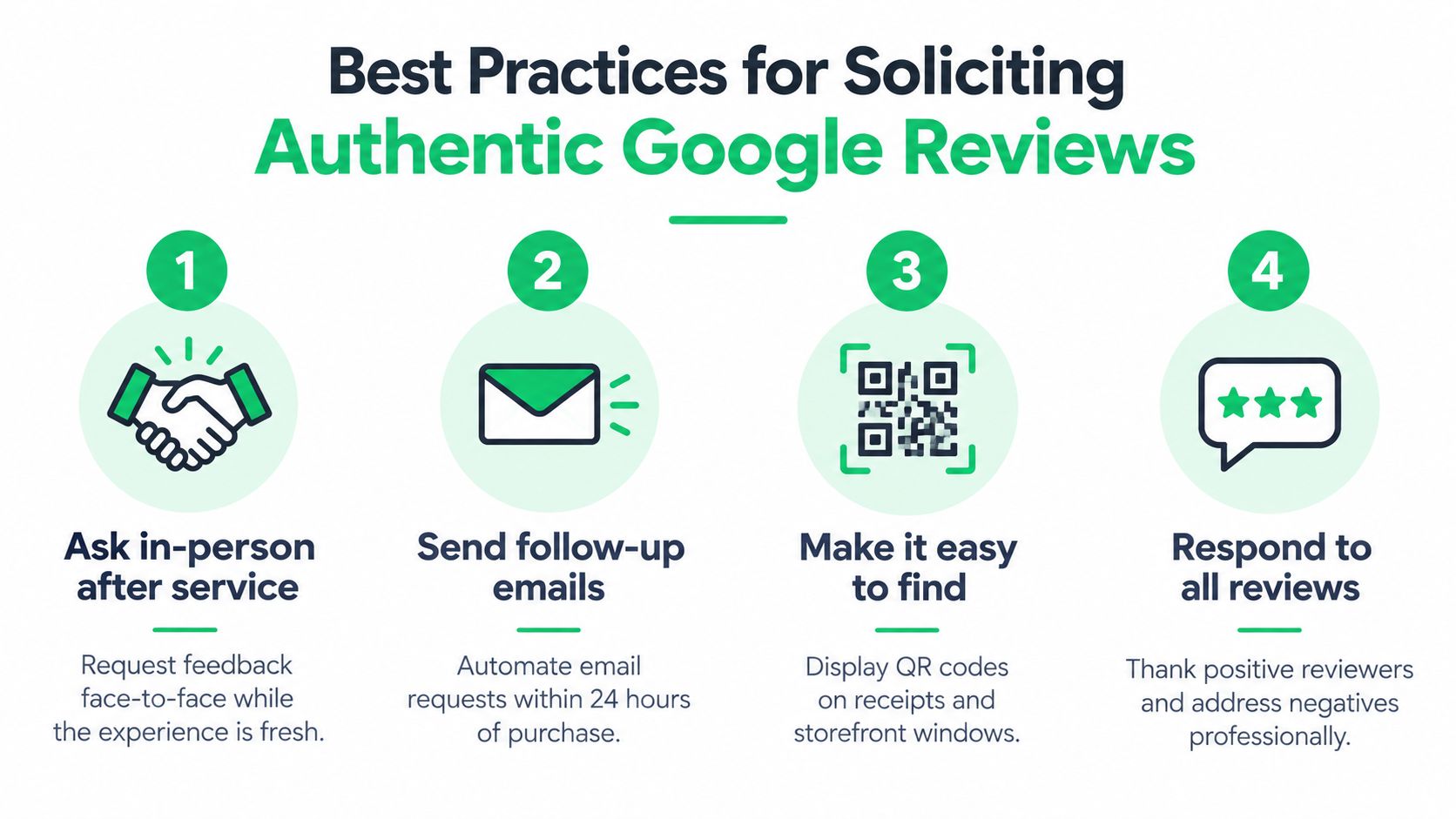
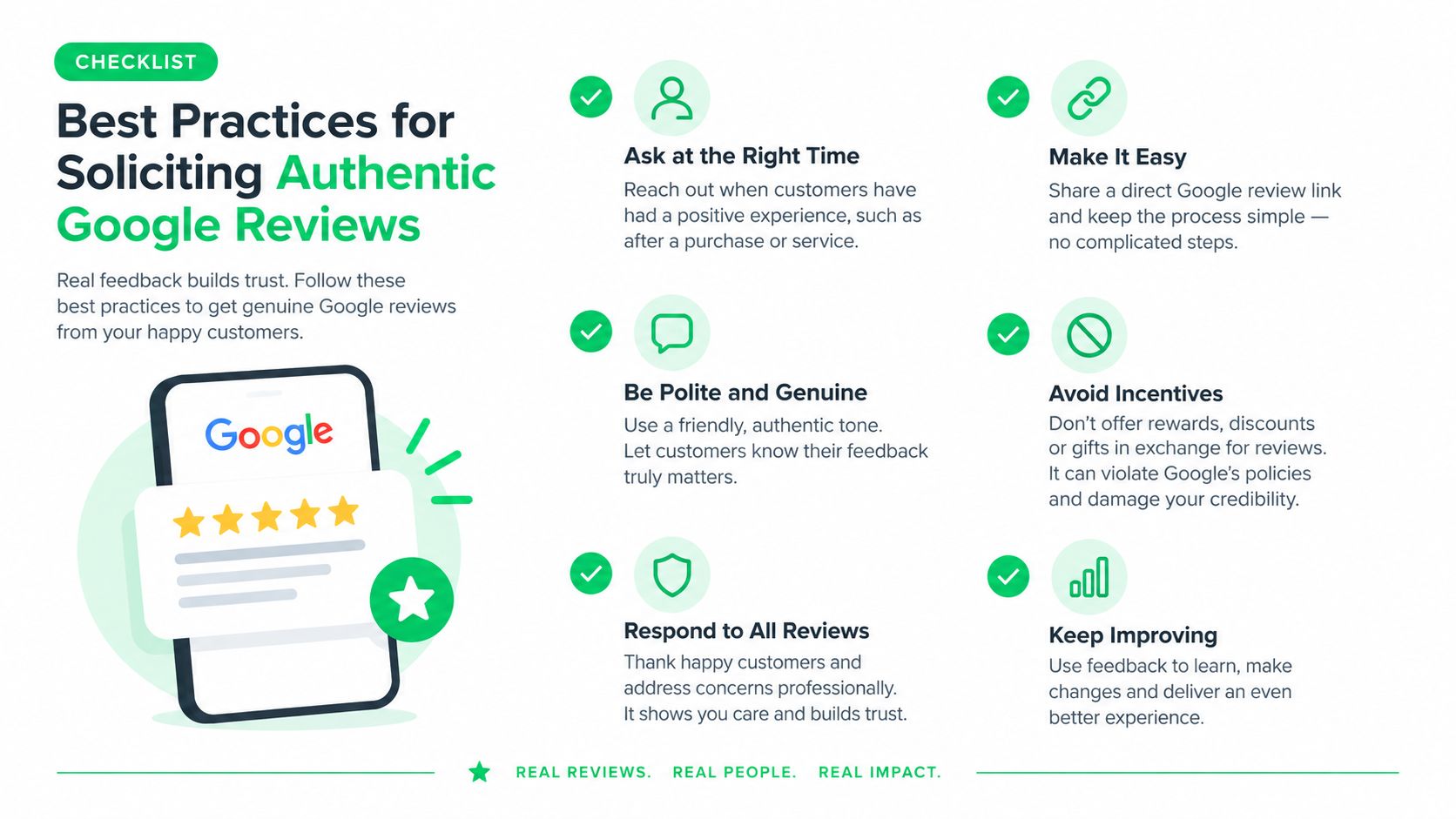
The safest review strategy is simple: ask real customers for honest feedback at a natural point in the service journey. A completed plumbing repair, a finished tax consultation or a post-treatment follow-up can provide an appropriate moment, because the customer has enough context to describe the experience accurately.
The request should never imply that only positive feedback is welcome. Businesses shouldn't offer rewards for favourable reviews, write reviews on behalf of customers or ask staff, friends and suppliers to create artificial activity. Those tactics may inflate the profile temporarily, but they weaken trust and can create platform or compliance risks.
A practical workflow looks like this:
- Confirm the service is complete. Resolve obvious issues before asking for feedback.
- Use a direct review link. Send the customer to the relevant Google review screen rather than making them search for the business.
- Keep the message neutral. Ask for an honest review and explain that feedback helps the business improve.
- Send one sensible follow-up. A reminder can help, but repeated requests can feel intrusive.
- Record the process. Note when requests are sent and whether unresolved service issues need attention.
A useful test: If the request would feel inappropriate after a mediocre experience, the process probably needs a service-recovery step before review collection.
The channel can match the customer journey. An SMS may suit a tradie who finishes a job at a home, while an email may fit an accountant or healthcare practice with a formal follow-up process. A QR code can help at a reception desk, but it should lead to an honest review request rather than a page that filters unhappy customers away from Google.
Businesses reviewing the wider profile workflow can use Google Business Profile optimisation tips alongside their review process. The central principle remains authenticity. The objective isn't to manufacture a perfect rating. It's to make genuine customer feedback easy to provide and useful to future customers.
Managing Reviews and Handling Negative Feedback
Review collection without review management creates an incomplete process. Every new review becomes part of the public customer experience, and an unanswered complaint can influence a future customer even when the underlying problem has been resolved privately.
Positive reviews deserve a specific, human response. A short acknowledgement can mention the service provided without forcing keywords into the text. Generic copy pasted replies make the profile look automated, while a response that refers naturally to the customer's feedback demonstrates attention.
Negative reviews need a slower and more disciplined workflow:
- Check the record: Confirm the date, service and internal facts before responding publicly.
- Acknowledge the concern: Avoid arguing about the customer's character or motives.
- Protect privacy: Don't publish personal information or discuss sensitive details in the review thread.
- Offer a private channel: Invite the customer to contact the business so the matter can be investigated.
- Follow through offline: A polished public reply has limited value if the business doesn't address the cause.
A response doesn't need to admit fault before the facts are known. It should show that the business has taken the feedback seriously and has a reasonable process for resolving concerns. Future readers often judge the response as much as the original complaint.
When a review may need removal
Not every negative review violates Google's policies. A poor opinion about a genuine customer experience usually calls for a professional response, not a removal request. Suspected spam, impersonation, conflicts of interest or false claims should be documented carefully before action is taken.
The ACCC guidance on online reviews says businesses concerned about false or misleading reviews should contact the review platform and request removal. That provides a concrete first step for Australian businesses dealing with manipulation or inaccuracies. A business should keep records of relevant bookings, messages and interactions, but shouldn't pressure a reviewer to change feedback or publish private correspondence as retaliation.
Profile accuracy also matters while reviews are being managed. Inconsistent business names, addresses or phone details can create confusion for customers and local systems, so businesses can review NAP consistency as part of reputation maintenance. Reviews won't compensate for basic listing errors.
Comparing Active Review Strategies vs Passive Wait-and-See
A passive approach depends on customers remembering to leave feedback without a clear request or follow-up. That can produce occasional reviews, but it rarely gives a business a reliable view of its reputation or a consistent stream of recent activity.
An active approach doesn't mean asking aggressively. It means building a repeatable process around completed services, responding to feedback and using complaints to improve operations. The difference is less about sending more messages and more about making review management accountable.
| Strategy | Review Velocity | Local Pack Visibility | Consumer Trust Signal |
|---|---|---|---|
| Proactive review management | Genuine feedback is requested at suitable customer touchpoints and monitored over time | The profile can present stronger, fresher prominence signals when other local factors are comparable | Customers see current activity, visible engagement and clearer evidence of service quality |
| Passive wait-and-see | Reviews arrive irregularly, often after unusually positive or negative experiences | The profile may become less competitive when nearby businesses maintain more active feedback | Customers may see an older or thinner evidence base and choose an alternative |
The table isn't a promise of a specific ranking outcome. Google still weighs relevance and distance, and competitors may have stronger websites, categories or local authority. It does show why review work belongs in a local SEO operating rhythm rather than in a one-off launch checklist.
The practical distinction: Passive businesses hope their review profile stays competitive. Proactive businesses inspect the signal and improve the process that creates it.
Integrating Reviews into Your Overall Local SEO Strategy
Reviews are a core local SEO asset, but they work best inside a complete system. A Melbourne service business still needs an accurate Google Business Profile, consistent business details, relevant service and suburb pages, a technically accessible website and clear conversion paths.
The order of work should reflect the customer journey. First, ensure the business can appear for the right searches. Next, strengthen prominence through genuine review activity and complete profile information. Finally, measure whether visibility produces useful actions such as calls, direction requests, form submissions or booked consultations.
A practical review dashboard can include:
- Profile health: Categories, services, hours, phone details and service areas.
- Review condition: Rating, volume, recent activity and unanswered feedback.
- Customer language: Repeated descriptions of services, locations and experience.
- Commercial outcomes: Calls, enquiries and completed actions from local traffic.
- Operational follow-up: Complaints, recurring issues and response ownership.
This broader framework prevents a common mistake, treating reviews as a substitute for service quality or website work. A strong profile may attract the click, but the landing page, phone experience and actual service determine what happens next. Businesses can use local SEO tips for Melbourne businesses to connect review management with the rest of the local search programme.
So, do Google Reviews help SEO and local rankings? Yes, conditionally. They support prominence, reinforce trust and influence click-through, but they don't override relevance, distance, accurate information or a credible customer experience. For Melbourne businesses, the durable advantage comes from earning authentic feedback, responding professionally and improving the service behind the profile.
SEO2RANK helps Melbourne service businesses manage Google Business Profile optimisation, local landing pages, technical SEO, content and measurement as an integrated programme. Businesses can visit SEO2RANK to discuss a review and local search process built around visibility and qualified enquiries.
Find Out What Is Holding Your
Website Back
Get a practical SEO Snapshot showing the biggest issues and opportunities we can see across your search visibility, website and local presence.
GET YOUR FREE SEO SNAPSHOT