

There's no universal monthly SEO budget for a Melbourne small business, but the most an owner can rationally justify is roughly the gross profit from the extra customers that spend is reasonably expected to produce. Published Australian pricing material puts monthly SEO somewhere around AUD 1,000 to 5,000 or more, but that range describes what the market charges, not what your business should pay. The gap between those two numbers is the entire decision.
A reasonable scenario: a Reservoir plumber with a tidy site, five core services, and job records showing about $900 of gross profit on a typical callout. One proposal quotes $1,200 a month, another $3,400, and neither explains what changes on the site. Either could be right. Without a break-even number, there is no way to tell which, and that is the position most owners face when they start comparing Melbourne SEO packages.
The way out is arithmetic, not negotiation. Work out what a customer is worth, how many extra customers a candidate budget needs, and whether the market and the website can plausibly deliver them. Everything else in this guide hangs off those three answers.
Table of Contents
- Working Backwards From What a Customer Is Worth
- How Margin and Close Rate Change the Number
- Affordable Spend Versus Required Spend
- What Each Budget Level Can Realistically Buy
- Comparing SEO With Paid Search Before You Commit
- Measuring Whether the Spend Is Paying Off
- Cheap SEO Packages and the Warning Signs
- Set Your Budget Against Your Own Numbers
Working Backwards From What a Customer Is Worth
Two inputs drive the calculation, and both come from your own records rather than any industry average. Gross profit per new customer is what's left from a typical job after the direct cost of delivering it: materials, subcontractor time, lab work, the clinician's or installer's time. Close rate is the share of genuine enquiries that turn into paying customers. With those two numbers, every proposed budget reduces to one question: how many extra customers does it have to produce?
The arithmetic runs in two steps.
- Customers needed: divide the monthly SEO spend by gross profit per new customer.
- Enquiries needed: divide those customers by your close rate.
Apply it to a hypothetical service business: A$2,000 in gross profit on each new customer and a 20 per cent close rate, so one in five qualified enquiries becomes a paying job. Each enquiry is then worth A$400 in expected gross profit before any repeat business. A $2,000 monthly budget needs one new customer, or five enquiries, to cover itself. Every enquiry past five is margin the spend has already paid for.
The break-even ladder
| Monthly SEO spend (hypothetical) | New customers needed | Enquiries needed at 25% close rate | Enquiries needed at 10% close rate |
|---|---|---|---|
| $1,000 | 0.5 | 2 | 5 |
| $2,000 | 1 | 4 | 10 |
| $3,000 | 1.5 | 6 | 15 |
| $4,000 | 2 | 8 | 20 |
Read the top row carefully. Half a customer means half a customer on average across months, not half a sale due in any given week. Over a quarter it means one and a half customers, which is a far more useful frame for a small monthly spend than expecting a steady tally.
The test to apply: ask how many extra customers a candidate budget needs each month, then ask whether that number is plausible for the suburbs and services being targeted. If it isn't, either the budget is too high for the current opportunity, or the targeting is wrong.
The ladder is a break-even check, not a forecast. It says nothing about whether your site, your competitors and the search demand in your target suburbs can produce five extra enquiries a month. That is a market question rather than a maths one, and whether SEO is worth it for small businesses in Melbourne examines it in detail. Affordable spend and required spend are different numbers, and this calculation only settles the first.
How Margin and Close Rate Change the Number
Every figure in that ladder moves when the inputs move, which is why copying someone else's example is dangerous. Start with margin. A $2,000 job delivered at a 40 per cent gross margin produces $800 of gross profit, not $2,000, so the affordable monthly budget shrinks by the same proportion. A ladder built on turnover rather than profit overstates what the business can carry by two and a half times.
Close rate matters just as much, and it's usually the input owners are least sure about. Pull it from somewhere real: CRM stages, quote logs, booking software, call notes across the last six to twelve months. A guessed close rate is a weak basis for committing money.
Three customer values, one budget
Run the same $2,000 monthly budget against three different customer values and the picture changes sharply.
At $2,000 gross profit per customer, one customer covers it. At $500, four customers are needed, which at a 20 per cent close rate means about 20 enquiries a month. At $5,000, only 0.4 of a customer is required, roughly two enquiries at the same close rate.
That's the practical lesson: high-value jobs can justify a materially larger SEO investment because a single win pays for months, while low-value jobs need enquiry volumes a single suburb may not supply. A mobile dog groomer and a cosmetic dentist in the same postcode are not playing the same game.
Lifetime value belongs in the calculation only where past customers prove it exists. Count repeat purchases, follow-up work and referred family members when the records show them happening, and treat that revenue as upside rather than the base case. If the first job breaks even, retention is what makes the investment comfortable.
When the numbers aren't there yet: if a business tracks fewer than a handful of enquiries a month, the honest first step is measurement, not a large retainer. Set up call tracking, form records and a running tally of quotes sent and won for 60 days.
National data can't settle this for you either. A 2025 survey of 500 Australian small and medium business owners was designed to be nationally representative by age, gender and location, which makes it a useful directional input, but it doesn't establish a Melbourne-only average or tell any individual business what to spend (Vistaprint 2025 Small Business Report).
Affordable Spend Versus Required Spend
Two budgets sit behind every SEO quote, and confusing them is how owners end up either underfunded or overcommitted.
Affordable spend is what cash flow, margin and tolerance for risk will carry through a quiet quarter. Required spend is what the competitive situation demands before anything meaningful moves. They are rarely the same number, and the gap between them is where most campaigns either stall or pay off.
Melbourne's business base makes that gap common. Most Melbourne businesses are small, so competitors typically have limited staff and budgets, and they are all chasing the same suburb searches. Affordable stays modest because few operators in a local category are writing enormous cheques. Required stays real because dozens of similar businesses want the same map positions and the same page-one slots.
At the top of the market, search absorbs serious money: Australian internet advertising expenditure reached A$16.4 billion in 2024, up 11.1%, with search and directories accounting for A$7.2 billion, roughly 43.9% of all internet advertising spend (B&T's digital advertising market report). Search is where commercial attention sits. A five-person accounting firm in Brighton still should not budget like a national retailer; the point is that the channel is proven, and the question is what a given category's share of it demands.
Where the two budgets drift apart
| Factor | Why it adds workload | Hypothetical example |
|---|---|---|
| Competitive search category | More pages, authority and content are needed to compete for the same searches | A plumber competing with many established local brands |
| Large website with many service pages | More pages to audit, optimise and keep current | A site with 40 service pages across six trades rather than eight pages for one |
| Several suburbs or locations | Separate local pages, profile setup and citations for each area | Targeting five suburbs rather than one |
| Technical problems | Crawling, indexing or speed issues must be fixed before content can gain traction | A site blocking key pages from search engines |
| Aggressive growth target | More work is compressed into a shorter period | Aiming to double enquiries within six months |
| Limited existing authority | More time is needed to build trust signals across the web | A newer business with few reviews and mentions |
| Strong existing site | Less remediation, so work can focus on targeted gains | A well-structured site with clean technical health |
When required spend exceeds what cash flow allows, the fix is sequencing, not shrinking the scope until the fee looks comfortable. Fund the highest-value service pages and the suburbs that already send jobs first, and schedule the rest later. A focused campaign on the strongest revenue pages can still clear its break-even customer count; a diluted one that touches everything lightly usually clears nothing.
Two identical businesses, two very different quotes: the same trade can need different budgets in Armadale and in Cranbourne, on a clean site and on one that's been patched for eight years. A quote should reflect the work and opportunity, not the size of the business.
Exact local priorities depend on the business, its competition and its target locations. SEO is generally a medium to long-term marketing activity, and meaningful search growth usually depends on competition, the current condition of the website, the strength of competitors and how much work is required.
What Each Budget Level Can Realistically Buy
Australian pricing material reports monthly ranges from about AUD 1,000 to 5,000 or more, with single-location local work usually at the lower end and competitive sectors such as finance, legal and trades at the higher end. Other published estimates place small-business SEO at AUD 1,200 to 2,500 a month, with local campaigns reaching higher again (Mad Sun Media's Australian digital marketing cost guide). Those figures are context, not quotes, and no single average can describe what a Preston dental clinic, an emergency plumber and a B2B consultancy need.
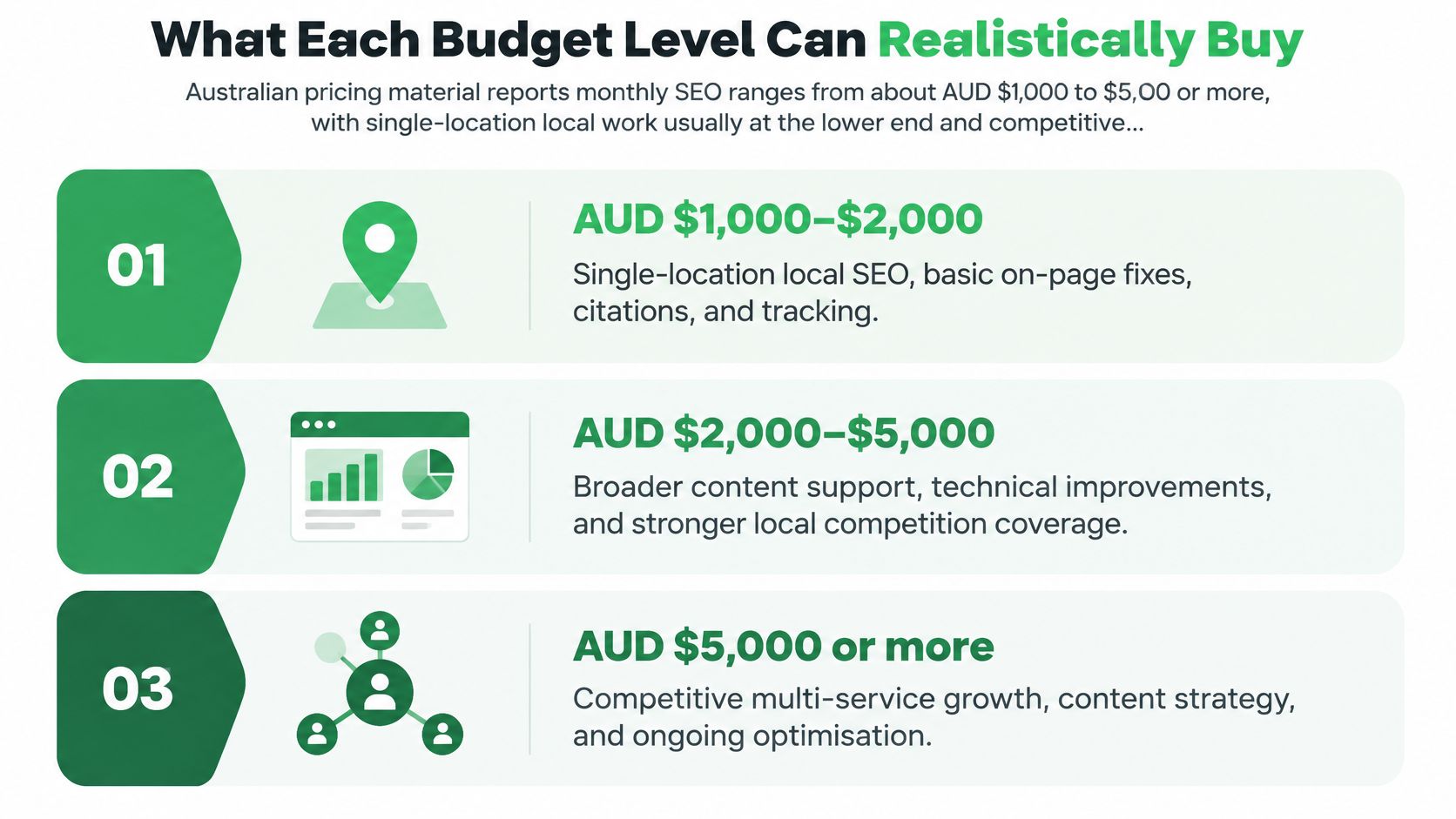
A monthly fee buys skilled time and a defined scope. It doesn't buy a ranking, a traffic level or a lead count, and any provider framing it that way is selling something they can't control.
| Budget tier (indicative) | Work it can usually cover | What it cannot promise |
|---|---|---|
| Lower tier | Priority service page work, Google Business Profile accuracy, critical technical fixes, measurement set-up and monthly reporting | A specific ranking, traffic level or lead count |
| Middle tier | Lower-tier work plus suburb-specific pages, internal linking, content for priority questions and citation clean-up | Results on a fixed timeline or a set number of enquiries |
| Higher tier | Middle-tier work across several locations or a larger site, broader content, authority building and more frequent testing | First-page placement or a fixed revenue outcome |
Why a smaller budget isn't automatically worse
A tighter budget mostly means tighter prioritisation and slower execution. Fewer pages get built each month, testing happens in bigger batches, and the work is sequenced rather than parallel. That's a legitimate way to run a campaign, and often the right one for a business with a handful of services in one or two suburbs.
The uneconomic case is the cheap package that skips implementation, measurement or conversion work altogether, because nothing in it can prove or improve a result. A higher fee is rational when one additional customer covers the investment.
Ask for the monthly task list in plain English, with a reason attached to each item, then check it against your break-even figure. If the list can't be justified line by line, the price isn't the problem.
What sits inside each tier varies by provider, so it's worth understanding what SEO services a small business actually needs before comparing proposals. The tiers here are indicative scope categories built from published ranges, not price bands from any one provider.
Comparing SEO With Paid Search Before You Commit
Paid search turns on quickly and generally stops when the spending stops. SEO builds more slowly, and its visibility may persist after the work pauses, though no timing or persistence is guaranteed either way.
The channel isn't a default. Search advertising remains Australia's largest online advertising category, accounting for 44% of online ad spend in one published 2026 market compilation, while Australian guidance commonly places SEO at AUD 1,000 to 5,000+ monthly and broader multi-channel activity at AUD 2,500 to 7,000 monthly (Andava's Australian digital marketing statistics). The central question is which channel suits your cash flow and urgency.
Which way the signals point
- Urgent demand: if the calendar is empty next month, ads buy speed that SEO can't deliver in the same window.
- Margin per job: thin margins give paid clicks less room to pay back, while strong margins can absorb them.
- Repeat and referral work: businesses that get most work from repeat customers and referrals have less reason to rent attention.
- Tracking quality: without call tracking and form records, a paid test teaches you nothing and an SEO program can't be judged.
- Page readiness: if service pages are thin or the site is slow on mobile, fix that before either channel gets more budget.
A staged approach usually beats choosing sides. Fund the technical and conversion foundations first, use a tightly controlled paid test to find out which queries convert, then put money into local pages and authority work where measured enquiries support it.
Both channels need the same maths. A paid campaign that costs $150 a click and converts one in ten enquiries still has to clear the gross profit test, so run the same break-even check before either budget is approved.
Many businesses end up running both, with ads carrying the load while organic visibility grows. SEO versus Google Ads sets out the trade-offs in more detail, including where paid spend is better wound down.
Measuring Whether the Spend Is Paying Off
Australian government guidance recommends using website analytics to measure how many people visit a site, where visitors live, how they found the site and which pages interest them most (business.gov.au guidance on measuring digital performance). Those mechanics are what let an owner judge SEO on business outcomes rather than rankings.
| Metric | What it tells you | Where to check |
|---|---|---|
| Organic visits from target suburbs | Whether the right areas are finding the site | Analytics location and traffic reports |
| Visits to service pages | Whether commercial pages are being reached | Analytics landing page reports |
| Calls and form enquiries | Whether visits are turning into contact | Call tracking and website form records |
| Qualified enquiries and won customers | Whether enquiries are worth the spend | CRM, booking system or job records |
| Business Profile actions | Calls, direction requests and website clicks from the listing | Google Business Profile performance data |
| Search impressions and clicks | Early signs of visibility for target searches | Google Search Console |
Local listings generate commercial actions without a website click at all. An Australian benchmark drawn from 45,264 business listings across 36 industries reported a median of 67 monthly actions per listing, including 36 website clicks and 18 phone calls (Rocking Web's Google Business Profile statistics). That dataset is historical, so treat it as a planning benchmark rather than a Melbourne forecast.
Where attribution gets fuzzy
Customers often search, see a listing, then call two days later from a number saved in their phone. Nobody can attribute that perfectly. Call tracking plus one simple question at enquiry, asked consistently, closes most of the gap.
Timing matters too. Technical fixes and Business Profile corrections often show movement sooner than new content, while new suburb pages and authority work need considerably longer. One quiet month shouldn't trigger a budget change on its own, which is why the metrics and the reporting format are worth agreeing on before the campaign starts, and why what happens when you stop paying for SEO is worth reading before cutting spend on the strength of a slow month.
Cheap SEO Packages and the Warning Signs
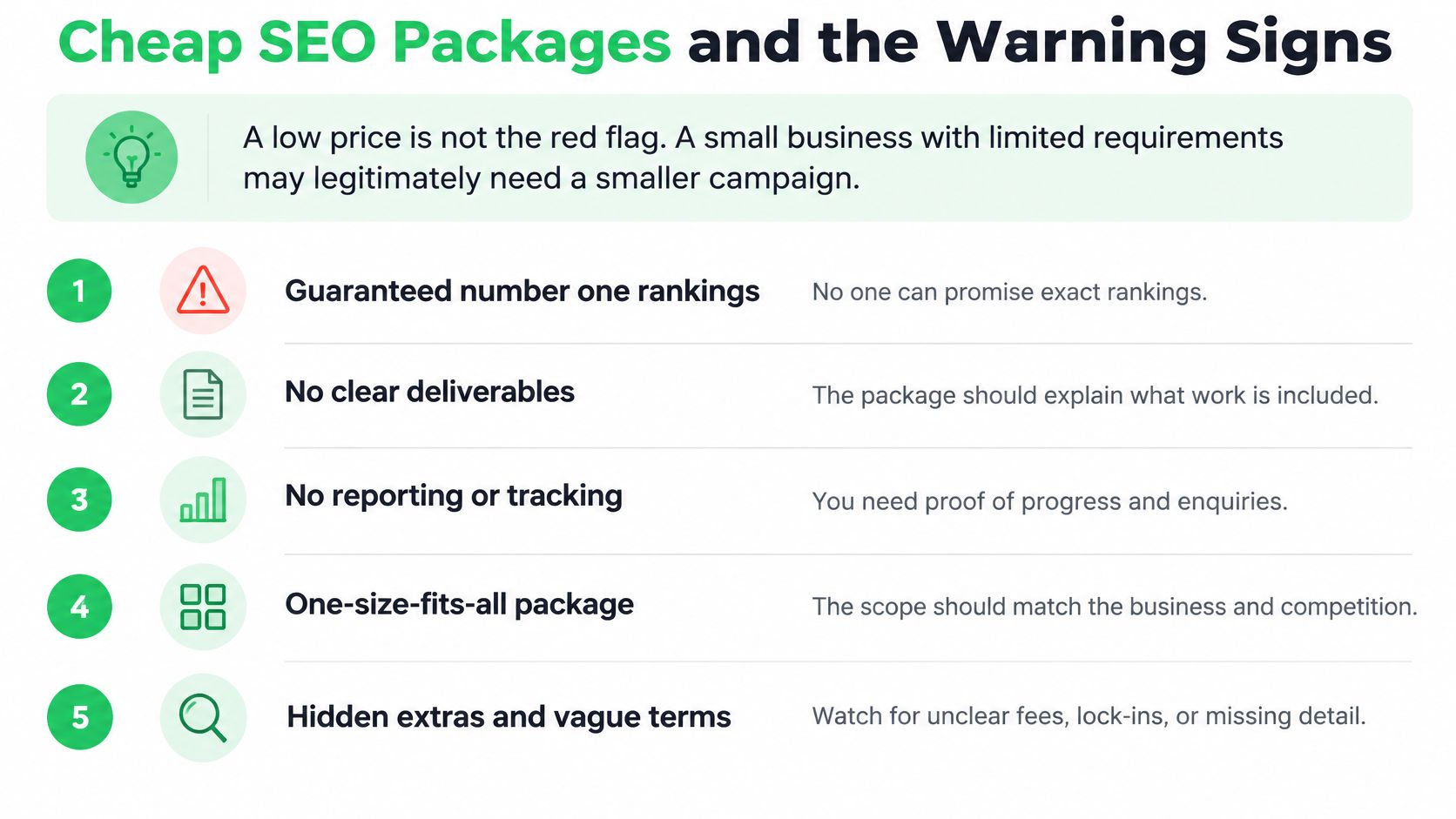
A low price isn't the red flag. A one-van business with five services, a clean site and one suburb to win can run a small campaign and get real value from it. Plenty of Melbourne SEO packages are priced sensibly for exactly that business.
Self-assessment is the unreliable part. In a 2025 Australian small-business and consumer report, 72% of businesses believed they had a strong online presence compared with 49% of consumers (Small Business Answers report on small business conditions). That gap is why a package should be judged on what it changes, not what it asserts.
Red flags worth walking away from
- Guaranteed number one rankings: no provider controls Google's results, and the claim tells you how the rest of the contract will go.
- Bulk backlinks with no detail: a monthly quota of links from unnamed sites is a production target, not a strategy.
- Deliverables you can't inspect: "optimisation" without pages, suburbs or changes named is not a scope.
- Mass-produced content: twenty suburb pages with the suburb name swapped waste crawl budget and convince no one.
- No access to reporting or data: if analytics, Search Console or the ad account sit only in the provider's login, you can't verify progress or leave cleanly.
- No explanation of strategy: a provider who can't say why this work matters for your enquiries is guessing.
- Work disconnected from business goals: rankings for terms nobody buys from don't pay wages.
- Packages defined by arbitrary task counts: thirty vague line items can be worth less than five targeted ones.
- Reluctance to explain what's being changed: basic transparency shouldn't need chasing.
Questions that separate a small package from a bad one
Ask which pages and suburbs are included and why each was prioritised. Ask what will physically change on the site this month, who holds the accounts and data, and how progress will be measured against enquiries rather than rankings.
Then get the commercial terms in writing: setup fees, GST treatment, contract length, minimum term, cancellation notice, and what happens to reporting access and account ownership if the engagement ends. A provider confident in their work answers all of it without flinching.
Judge a package by fit, not size. The right one addresses your diagnosed problems, moves the pages that produce enquiries, and lets you see the evidence each month.
Set Your Budget Against Your Own Numbers
The sequence that works is short, and it can be run in an afternoon with a laptop and last year's job records.
- Gross profit per new customer for your main service, after direct delivery costs.
- Close rate from tracked enquiries, quote logs or bookings, or start tracking now if the data doesn't exist.
- Customers and enquiries needed to cover a candidate monthly budget, using the two-step calculation.
- The work your market and website require, assessed against the factors that raise or lower workload.
- A staged scope that fits the gap, with review points set on measured enquiries rather than calendar dates.

Where scope is unclear, a paid audit usually costs less than a quarter of the committed retainer. SEO 2 RANK, a Melbourne-based SEO business, offers a Full SEO Audit and Strategy from $1,990 excluding GST, covering a detailed review, an issue register, prioritised recommendations and a 90-day roadmap, with final pricing depending on the size and complexity of the website. The team can be reached on 03 7074 8800 or hello@seo2rank.com.au.
An audit may well conclude that a smaller or quite different budget is the right answer, which is a useful outcome in itself. For general pricing context rather than a spend decision, the How Much Does SEO Cost? guide covers how providers structure their fees.
SEO 2 RANK works with established Melbourne service businesses on local, technical and on-page SEO sized to the enquiries a business can profitably handle. If you'd rather settle scope before committing to a monthly figure, visit SEO 2 RANK to see how the audit and ongoing packages are structured. A short conversation about your suburbs, services and customer value will tell you more than any published average.
Find Out What Is Holding Your
Website Back
Get a practical SEO Snapshot showing the biggest issues and opportunities we can see across your search visibility, website and local presence.
Get Your Free SEO Snapshot→