
A business can pay for SEO or advertising, see visitors arriving and still receive very few enquiries. A website isn't converting when the people arriving, the page they reach or the action they're asked to take doesn't match the job they came to do. Attracting visitors is only half the challenge: prospective customers also need to understand the offer, trust the business and complete a useful next step without getting stuck.
Table of Contents
- Ten Reasons Your Website Is Not Converting
- What a Website Conversion Actually Means
- How to Find Where Enquiries Are Lost
- Choosing Better Enquiries Over More Traffic
- Contact Options That Match Buyer Intent
- Get a Clear Read on Your Enquiries
- Common Questions About Website Conversions
- Start With the Enquiry Path You Already Have
Ten Reasons Your Website Is Not Converting
For an owner asking “Why is my website not converting?”, the most useful starting point isn't a redesign. It's identifying where a prospective customer loses interest, encounters uncertainty or cannot finish the enquiry.
Several problems can exist together. A relevant visitor might tolerate an ordinary-looking page, but leave when the service area is unclear and the contact form fails.
Ten conversion problems and the first fix
| Problem | What you notice | First fix |
|---|---|---|
| Wrong visitors | Rankings or ads bring people who want a different service, price or location | Compare Search Console queries with the services the business actually sells |
| Unclear messaging | A new visitor cannot quickly tell what the business does | State the service, customer and area in the first screen |
| Weak call to action | The page explains the work but never asks for a call, form or booking | Put a clear next step on each key service page |
| Poor mobile experience | Buttons, menus or text are awkward on a phone | Open the main pages on a phone and complete the enquiry path |
| Slow loading | Pages hesitate before the offer or phone number appears | Compress large images and remove unnecessary scripts |
| Missing trust signals | There are no reviews, business details, credentials or work examples | Add relevant proof near the enquiry action, including service coverage |
| Complicated contact form | Excessive fields, errors or unclear privacy wording prevent submission | Request only information needed to respond and explain what happens next |
| Poor landing page match | The page doesn't answer the search that brought the click | Align the heading and offer with that search |
| Unclear pricing or value | Visitors cannot judge fit, inclusions or reasons to choose the business | Explain inclusions and pricing factors, even without a fixed fee |
| Broken tracking or enquiry path | Reports miss genuine enquiries, or the contact process fails | Send a test enquiry and confirm delivery and the analytics event |
What these problems look like in practice
Wrong visitors can make healthy traffic figures misleading. A plumber ranking for DIY repair instructions may attract readers who never intended to hire anyone. Commercial service pages should answer hiring questions, while educational content should provide a relevant route to professional help.
Unclear messaging leaves visitors guessing. A clinic might describe its caring approach without naming its treatments or Melbourne suburbs. Its opening screen should establish the service, intended patient and location before introducing broader brand language.
Weak calls to action force interested visitors to hunt. An accountant whose phone number sits below a lengthy essay should place an obvious enquiry option near the service explanation, using wording that describes the action.
Poor mobile usability makes ordinary tasks frustrating. A booking button hidden behind a pop-up or a menu that covers the page needs testing on an actual phone, not just a resized desktop browser.
Slow loading can prevent visitors from reaching the useful content. Oversized project photos and unnecessary third-party scripts deserve attention before decorative effects. The technical SEO checklist for small businesses provides a practical starting point for technical checks.
Missing trust signals leave important questions unanswered. A home-services page can show genuine work examples, relevant credentials and independently verifiable reviews beside its enquiry option. Evidence should relate to the service being considered.
Complicated forms ask for commitment too early. A quote form shouldn't demand detailed project specifications when a suburb, brief description and contact method would let the business begin a conversation.
A poor landing page match sends visitors somewhere too broad. Someone searching for commercial lease advice needs that service explained, not a general legal homepage requiring another search.
Unclear pricing or value makes comparison difficult. Where a fixed price isn't practical, the page can explain scope, inclusions, assessment requirements and what changes the fee.
Broken enquiry systems can resemble a marketing problem. A successful-looking submission means little if the notification never reaches the inbox.
Practical rule: Treat the table as a diagnosis, not a promise that changing a button will increase revenue.
The owner can mark the pair of rows that most closely match the website, then test those suspected problems before commissioning broader changes.
What a Website Conversion Actually Means
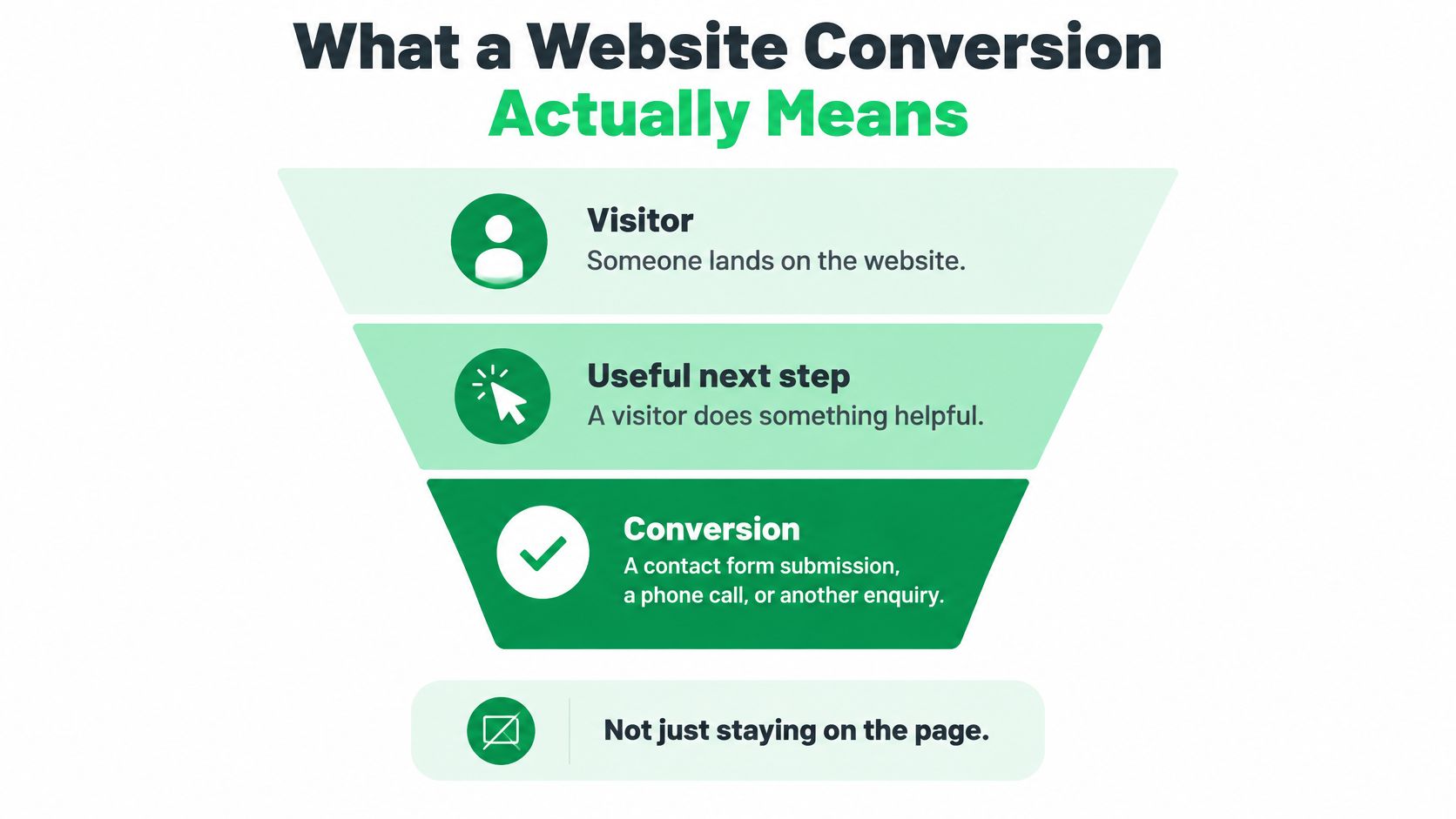
A website conversion happens when a visitor takes a useful action connected to the business's goals. For a Melbourne service business, that might be a contact-form submission, phone call, appointment booking or quote request. For a retailer, it might be an online purchase.
Consider a visitor searching for a routine physiotherapy appointment. Reading a treatment page is useful progress, but completing a booking is the action the practice ultimately needs.
A recorded action isn't always a qualified enquiry
Analytics can record a contact click without proving that a conversation happened. Likewise, a completed form might contain spam, request an unavailable service or come from outside the service area.
The distinction matters:
- Recorded action: The visitor tapped a phone number or submitted a form.
- Genuine enquiry: A real prospective customer made contact.
- Qualified enquiry: The business can reasonably serve that person's needs, location and circumstances.
An unanswered call belongs in the contact record, but it shouldn't automatically be treated as a successful sales opportunity.
Match the conversion to the buying process
An urgent plumbing job usually needs a direct calling option. A routine clinic appointment may suit online booking, while an accountant's prospective client may need an introductory enquiry before choosing a service.
The useful path is visit, relevant page, understood offer, trusted next step, enquiry. A website can support several actions, but reporting should distinguish the main commercial outcome from supporting activity such as downloading a guide.
Counting page views as the main success measure can make a quiet website appear productive. Before inspecting traffic reports, the owner should write down exactly what qualifies as an enquiry and which supporting actions deserve separate measurement.
How to Find Where Enquiries Are Lost
Tracking should be checked before performance is interpreted. Otherwise, a report showing no enquiries could describe a measurement fault rather than customer behaviour.
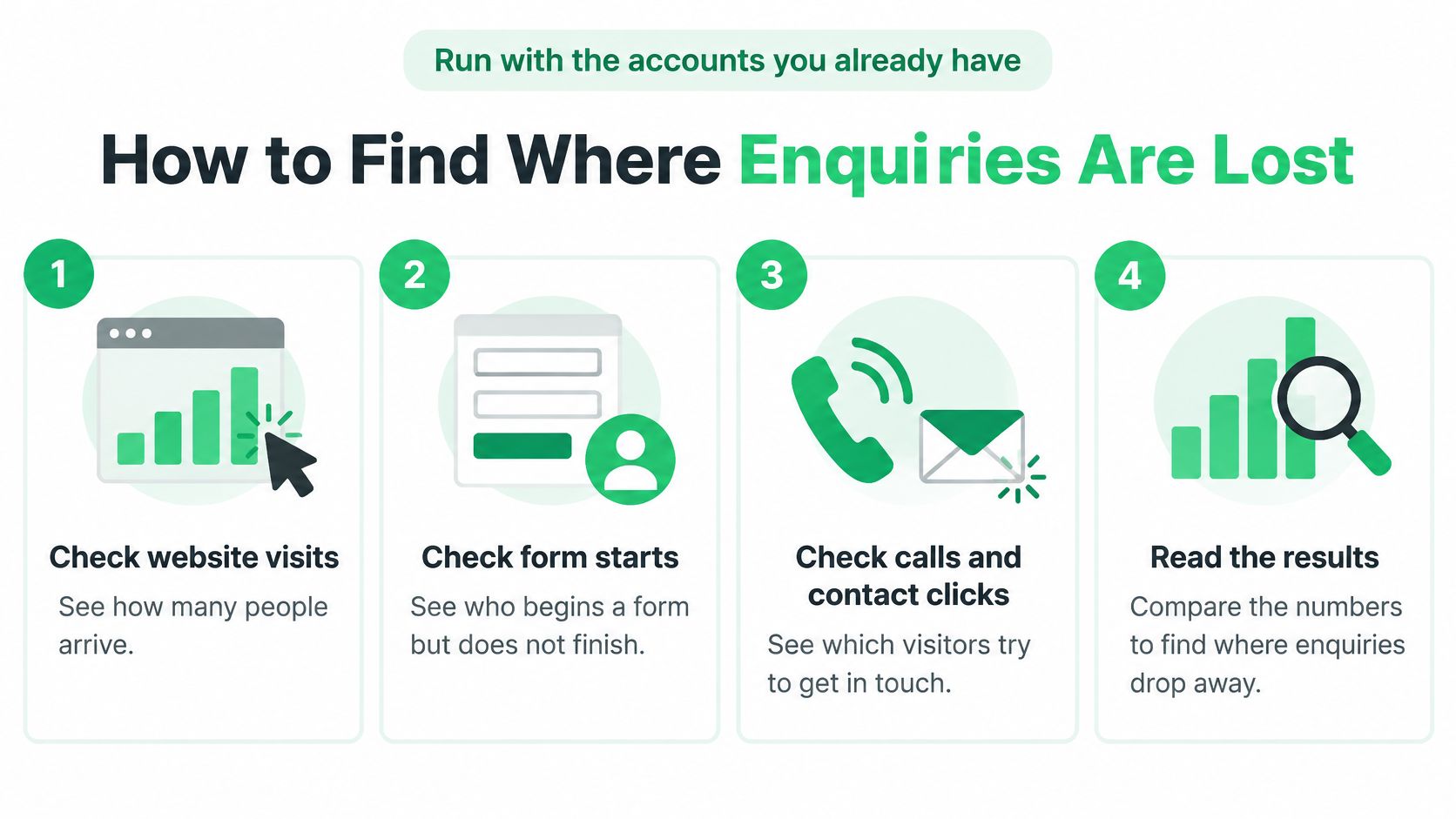
The following checks connect search activity with what happens on the website and inside the business.
Run the checks in a sensible order
Inspect Search Console queries and pages. Compare the searches bringing clicks with actual services and coverage. Mark irrelevant informational searches, unavailable services and suburbs outside the business's operating area.
Validate Google Analytics 4, then compare landing pages. Confirm that a successful enquiry produces the intended event. Compare mobile and desktop sessions, form activity and recorded outcomes on the pages where visitors first arrive.
Complete the contact journey on a phone. Tap the phone number, open the menu and submit the form. Note obstructive pop-ups, difficult fields and confirmation messages that don't appear.
Read the main service page as a new customer. Check whether it establishes suitability and makes the next action obvious. A search snippet's promise also needs to match the destination; the explanation of meta descriptions and Google rankings helps distinguish search presentation from the page experience.
Confirm delivery beyond the website. Check the inbox, booking platform or customer-management system. A submission event doesn't prove that staff received a usable enquiry.
Read the pattern rather than an isolated score
Many form starts with few successful submissions suggest completion friction. Few starts despite relevant visits suggest that the offer, reassurance or next action needs examination.
RockingWeb's Australian mobile-versus-desktop shopping overview reports mobile conversion around 1.8%, compared with 3.2% on desktop. Those shopping figures aren't targets for a service business, but they support investigating device differences rather than treating all visits alike.
Where mobile results lag, compare browsers and landing pages, then inspect Core Web Vitals and real-user loading behaviour. Google Search Central, Google Analytics Help and web.dev are the appropriate official references for checking tool definitions and performance guidance.
A laboratory speed score is a diagnostic clue. A qualified enquiry is the business outcome.
SEO 2 RANK measures results in enquiries and commercial outcomes using real Search Console and conversion data. The immediate priority should be the broken step that can be demonstrated, not changes to every page at once.
Choosing Better Enquiries Over More Traffic
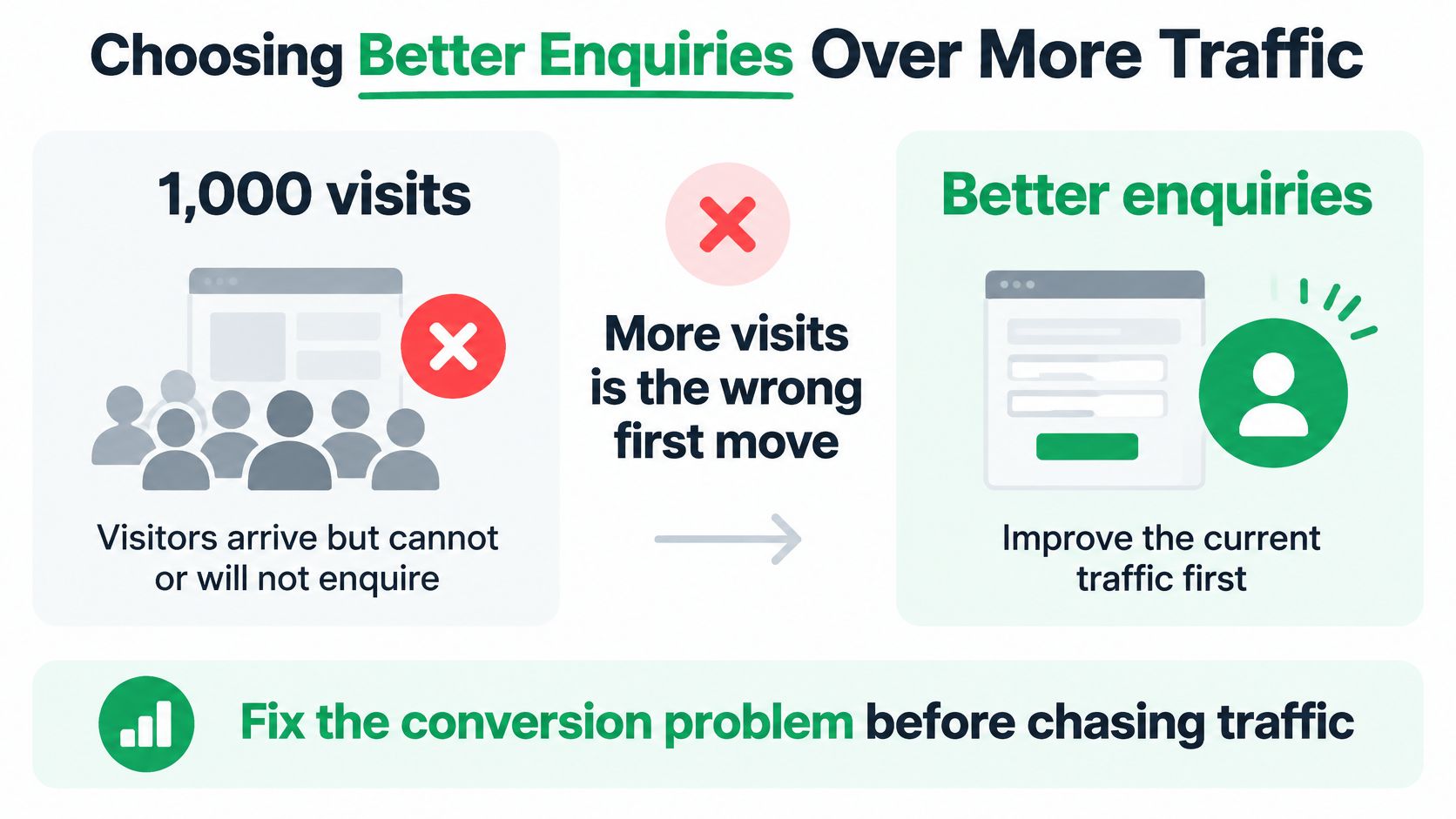
A local service business can receive plenty of visits and still miss its goals. The problem may be that searchers want a service the business doesn't offer, the page hides the next step, or contact is difficult after the click.
Consider a hypothetical comparison: 1,000 visits and 5 enquiries produce a 0.5% conversion rate. With 500 visits and 15 enquiries, the rate is 3%, and the second site receives three times as many enquiries from half the traffic.
These figures illustrate the arithmetic, not an industry benchmark or a promised result. Enquiry quality matters too: a smaller number of suitable requests may be more useful than a larger number the business cannot serve.
Choose the right constraint to address
Start with the point where a suitable potential customer gets stuck. The right priority depends on what is stopping a useful business conversation.
| Current situation | More useful priority |
|---|---|
| Relevant visitors arrive but cannot complete an enquiry | Repair the contact journey |
| Visitors mainly want something the business doesn't offer | Improve search targeting and page relevance |
| Suitable enquiries arrive but staff cannot respond reliably | Address response capacity |
| The page works, enquiries are recorded and relevant visits are scarce | Build qualified visibility |
A dental practice needs appointment requests for treatments it provides. A trades business needs work within its service area. In both cases, more visits from people looking for something else won't solve the problem.
Understanding search intent and why it matters for SEO helps explain why a page should match what searchers are trying to find.
When more traffic makes sense
Online buying is widespread in Australia, but broad demand does not show whether a particular local service is being searched for. More traffic is a sensible priority when the offer matches relevant searches and the page gives visitors a clear path to enquire.
Check that the site works on mobile and that enquiry recording is dependable. If suitable visitors already arrive, improve their route to an enquiry before spending more to attract them.
Contact Options That Match Buyer Intent
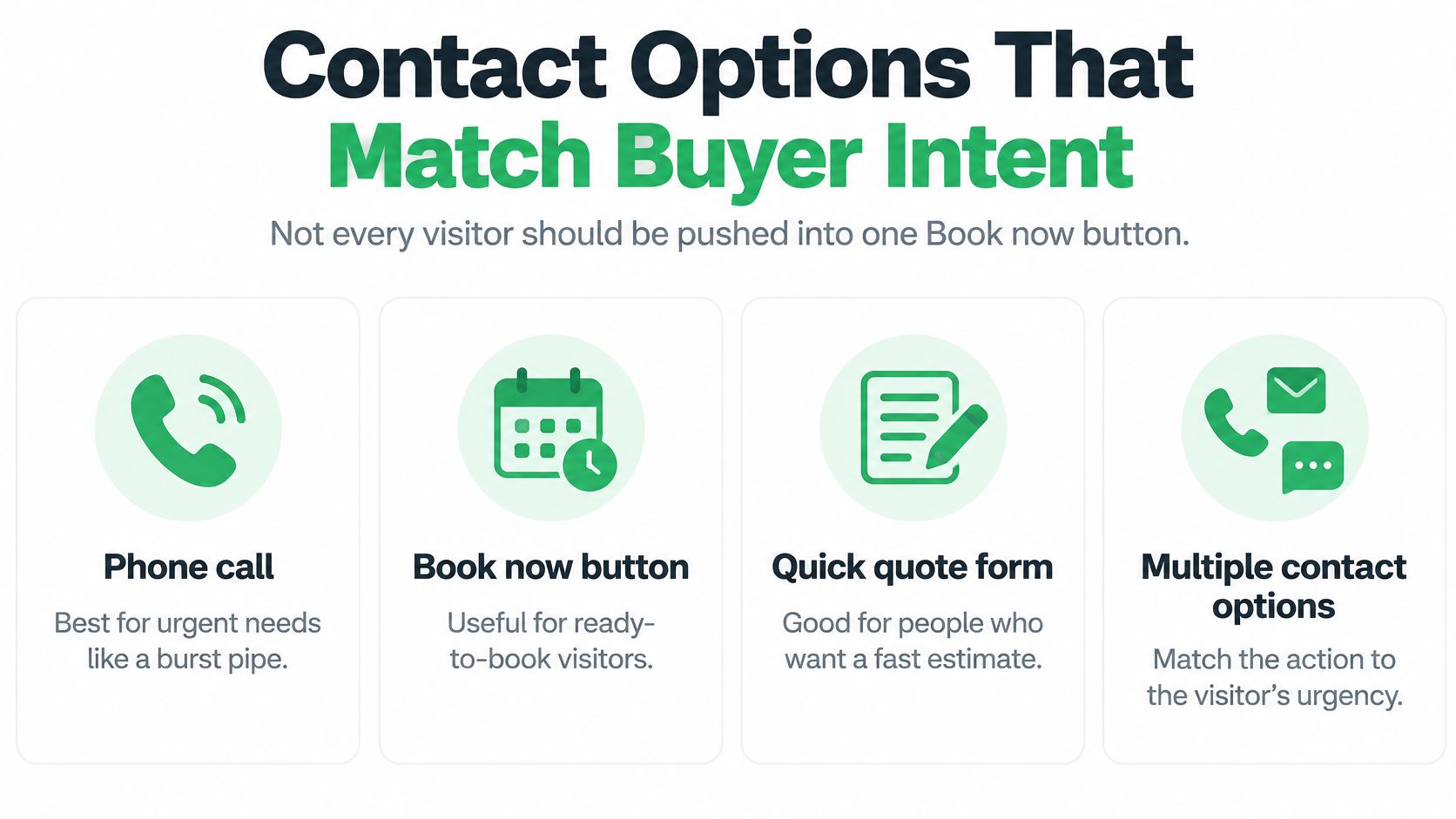
A burst pipe, a routine appointment and an early-stage quote request don't call for the same contact method. Pushing every visitor towards a booking button can create friction when the person needs a different kind of help.
ServiceNow's Australian customer-experience recap identifies preferences for self-service before calling, demand for after-hours contact options and customers turning away from businesses that are difficult to contact. A small team doesn't need to pretend it operates around the clock, but it does need to explain its available pathways plainly.
Offer a manageable choice
Contact options should reflect what staff can support:
- Urgent needs: A prominent phone number, with accurate hours and emergency availability.
- Quick estimates: SMS or a concise quote form, where the business monitors those channels.
- Routine appointments: Online booking with clear service descriptions and availability.
- Pre-enquiry questions: Useful FAQs covering service areas, eligibility, preparation and pricing factors.
More options aren't automatically better. An unmonitored chat box or abandoned SMS inbox creates another failed contact route.
The guide to a useful SEO service page provides a framework for making service information and next steps work together. The same principle applies to other service industries: the page should support a decision, not merely display contact buttons.
Make sharing details feel reasonable
Privacy belongs in the enquiry experience. A UNSW report on Australians' control over personal data found that 70% of Australians felt they had little or no control over how their data was disclosed between companies.
That finding doesn't measure form abandonment. It does justify explaining why information is needed, who will receive it and what follow-up to expect, particularly where health or financial details are involved.
Forms should avoid collecting information that staff won't use. Sensitive documents may be better requested through an appropriate secure process after initial contact.
Test whether the task is accessible
Keyboard access, visible focus, readable contrast, labelled fields and meaningful error messages help people complete the same task in different ways. A phone number should be tappable on mobile, and an error shouldn't erase everything already entered.
The Australian Government Style Manual's accessibility guidance uses WCAG for government content. A private website's legal obligations depend on its circumstances, but an unusable form can still exclude prospective customers.
Contact test: A new customer should be able to identify the service, confirm coverage, choose a contact method and recover from a mistake.
Comparing form starts with completions, calls during and outside opening hours, and time to first response helps reveal whether the obstacle occurs before or after submission.
Get a Clear Read on Your Enquiries
Professional help is worth considering when relevant searchers arrive but enquiries remain weak, or when the owner cannot establish whether the problem is visibility, usability or measurement. An independent assessment can also help before a redesign or change of SEO provider.
Other useful triggers include declining organic traffic, important pages failing to rank, suspected technical faults and competitors consistently appearing ahead. The purpose is to establish priorities, not to produce a long document that nobody implements.
What a useful assessment should examine
A sensible review connects the website with the business's operating reality:
- Visibility: Which services and locations appear in search, and which important pages are missing?
- Search intent: Do visitors arrive with needs the business can fulfil?
- Technical access: Can search engines and customers reach important content reliably?
- Lead pathways: Do contact actions work, reach staff and produce trustworthy records?
- Commercial fit: Are the enquiries suitable for the business's capacity and service offering?
SEO can support conversions by addressing these issues. It can't make an unsuitable offer attractive to everyone or replace staff answering the phone.
What implementation should involve
SEO 2 RANK is a Melbourne option for established service businesses seeking plain-English explanations of visibility, qualified traffic and enquiries. Its approach considers the website, Search Console, local visibility, competitors and existing lead pathways before agreeing on changes.
For WordPress websites, agreed on-page optimisation, internal linking, metadata, structure, schema and certain technical improvements can be implemented within campaign scope. Reporting explains what changed, what improved and what happens next.
SEO 2 RANK's SEO packages don't include full website redesigns or new website builds; major development is separately scoped. Work can begin with a Free SEO Snapshot or a conversation, with the snapshot serving as a high-level assessment rather than a guarantee.
An owner whose checks reveal relevant visits without a dependable enquiry path can request an initial conversation about the evidence and priorities.
Common Questions About Website Conversions
Why is a website getting visitors but no enquiries?
The visitors may want services the business doesn't provide, the page may leave the next step unclear, or the contact journey may fail. Incorrect measurement can also hide genuine calls and submissions.
The most useful distinction is whether customers won't enquire, can't enquire or do enquire without being recorded. Those situations need different fixes.
What is a good website conversion rate?
There's no universal target that suits a plumber, clinic and accountant equally. Service complexity, urgency, traffic source and the action being measured all affect the result.
A phone-number click shouldn't be compared directly with a completed appointment. A more useful benchmark is the business's own qualified-enquiry performance over comparable periods, with consistent definitions and allowance for seasonal changes.
Can SEO help improve website conversions?
Yes, when SEO aligns commercial pages with relevant searches and addresses technical barriers affecting access or usability. Reliable enquiry measurement also helps identify which work deserves priority.
However, rankings alone don't establish customer fit. Service quality, availability, pricing and the handling of enquiries remain business responsibilities.
Why are people leaving without contacting the business?
Some visitors are still researching, comparing providers or checking suitability, so not every departure indicates a fault. Others may leave because essential information is missing, the page is difficult to use or sharing details feels risky.
An exit rate alone cannot explain motivation. Search-query review, task testing and contact records provide a more reliable diagnosis than assuming every departure requires stronger sales copy.
How can conversions improve without more advertising spend?
The starting point is the pages that already receive suitable visitors. Clearer service information, relevant proof and a usable contact journey can remove avoidable obstacles without buying additional clicks.
Changes should be recorded and reviewed against genuine enquiries, not just button activity. Where traffic is limited, results may remain uncertain for a while, so a short-term fluctuation shouldn't be presented as proof that a change worked.
Start With the Enquiry Path You Already Have
Website traffic but no enquiries usually points to a mismatch between the visitor's needs, the page's offer, the contact process or the way results are recorded. A complete redesign isn't automatically the answer.
A practical review follows the customer's task while checking the business's records:
- Review search queries for service and location fit.
- Verify tracking before relying on conversion reports.
- Test phone and form actions on a real mobile device.
- Check the service page for a clear, suitable next step.
- Confirm delivery into the inbox or booking system.
Priority: Repair a demonstrated obstacle before funding another source of visitors.
Problems can overlap, so resolving a failed form may still leave unclear service coverage or weak reassurance. Progress means removing those barriers in a sensible order and checking whether more suitable customers successfully make contact.
The owner's next step is to mark the pair of matching problems in the table and run the checks during the coming week. If qualified searchers still don't enquire, a focused assessment can help separate website faults from offer, capacity or response problems.
SEO 2 RANK helps Melbourne service businesses assess search visibility, technical performance and the pathways from a visit to a qualified enquiry. For a clear starting point, visit SEO 2 RANK to request a Free SEO Snapshot or discuss where the website's enquiry process needs closer attention.
Find Out What Is Holding Your
Website Back
Get a practical SEO Snapshot showing the biggest issues and opportunities we can see across your search visibility, website and local presence.
Get Your Free SEO Snapshot→