

An IT MSP can improve SEO by concentrating on the pages and local signals that support buying decisions, then removing technical barriers that stop those pages being found and used. In this Melbourne engagement, the biggest gains came from rebuilding the Managed IT Services page, strengthening local SEO around Melbourne suburbs, improving internal linking, and cleaning up a slow WordPress site. Organic enquiries rose from roughly 2 per month to between 8 and 12 per month within six months, although the result depended on the client's existing domain history, service area and ability to respond to leads.
Table of Contents
- The Client and the Headline Result
- What the SEO Audit Found
- Technical SEO Fixes on a Slow WordPress Site
- Rebuilding the Managed IT Services Page
- Local SEO for Melbourne and the Suburbs
- Measurement Setup and Before and After Results
- What Other IT MSPs Can Take From This
- Practical Checklist and Frequently Asked Questions
The Client and the Headline Result
The client was a Melbourne-based managed IT services provider with a team of roughly 20 to 40 staff, serving small and medium-sized businesses across Melbourne and its inner suburbs. The website was live and credible enough for existing referrals, but it had almost no meaningful organic visibility for commercial searches. A blog had been published without a clear keyword or conversion strategy, Google Ads had generated some activity, and no sustained SEO programme had addressed the site's underlying problems.
The engagement focused on one commercial question: could the website attract people actively looking for managed IT support and turn that demand into qualified enquiries? The answer came from three connected changes:
- Service-page optimisation: The Managed IT Services page was rebuilt around commercial intent, clearer service detail, stronger trust signals and more direct calls to action.
- Local SEO: Google Business Profile, citations, Melbourne relevance and suburb landing pages were improved together.
- Technical cleanup: Slow WordPress delivery, unnecessary assets, indexing errors and weak internal architecture were addressed.
The headline result was clear. Organic enquiries moved from roughly 2 per month to between 8 and 12 per month by month six. This wasn't a claim that every SEO project will produce the same outcome. It was the result of matching an established local service business with searches that already reflected a need for IT support.
The engagement is documented alongside other practical examples in the SEO case studies collection, but the useful lesson is less about a single result than about the decisions behind it. The sections below examine what the audit uncovered, why some fixes took priority, and how the team separated useful search activity from enquiries that sales could progress.
What the SEO Audit Found
The audit didn't treat every warning as equally important. A missing metadata field can matter, but it shouldn't outrank a service page that loads slowly, has no clear conversion path and isn't well connected to the rest of the site. The findings were therefore grouped by their likely impact on discoverability, relevance and lead generation.
Technical issues came first because they affected access to the whole site. Mobile pages loaded slowly, the WordPress plugin stack was bloated, structured data was missing or inconsistent, and the XML sitemap included URLs marked noindex. Internal links between service pages were also thin, which made important commercial URLs harder for users and search engines to reach.
The Managed IT Services page had the clearest commercial weakness. It used one H1, offered no FAQ content, had a weak meta description, relied on generic stock photography and placed the enquiry form too far down the page. The copy described the business rather than answering the questions a buyer has before contacting an MSP.
Content and local signals were the next priority. The site had no dedicated pages for the Melbourne suburbs the sales team served, and its supporting articles didn't reflect common IT support conversations. The Google Business Profile was unclaimed or inconsistent, citations were sparse, and the website lacked clear Melbourne location signals.
| Pillar | Key findings | Priority |
|---|---|---|
| Technical | Slow mobile delivery, excessive plugins, inconsistent schema, sitemap URLs marked noindex, weak internal architecture | Immediate |
| On-page | Unfocused Managed IT Services page, weak metadata, no FAQs, buried form, generic imagery | Immediate |
| Content | No suburb-specific landing pages, limited support for commercial service terms, weak alignment with sales questions | High |
| Local | Inconsistent Google Business Profile, sparse citations, limited Melbourne relevance | High |
| Measurement | Organic activity wasn't tied cleanly to forms, calls, GBP actions or qualified leads | Immediate |
Practical rule: Prioritise the change that can improve both search visibility and the next action a buyer takes. For an MSP, that usually means a service page, a local profile or the technical delivery of both.
The audit also avoided a common trap. Publishing more blog posts would have added activity, but it wouldn't have solved the main problem while the money page and local presence remained weak. The work therefore moved towards pages with commercial value before expanding informational content.
Technical SEO Fixes on a Slow WordPress Site
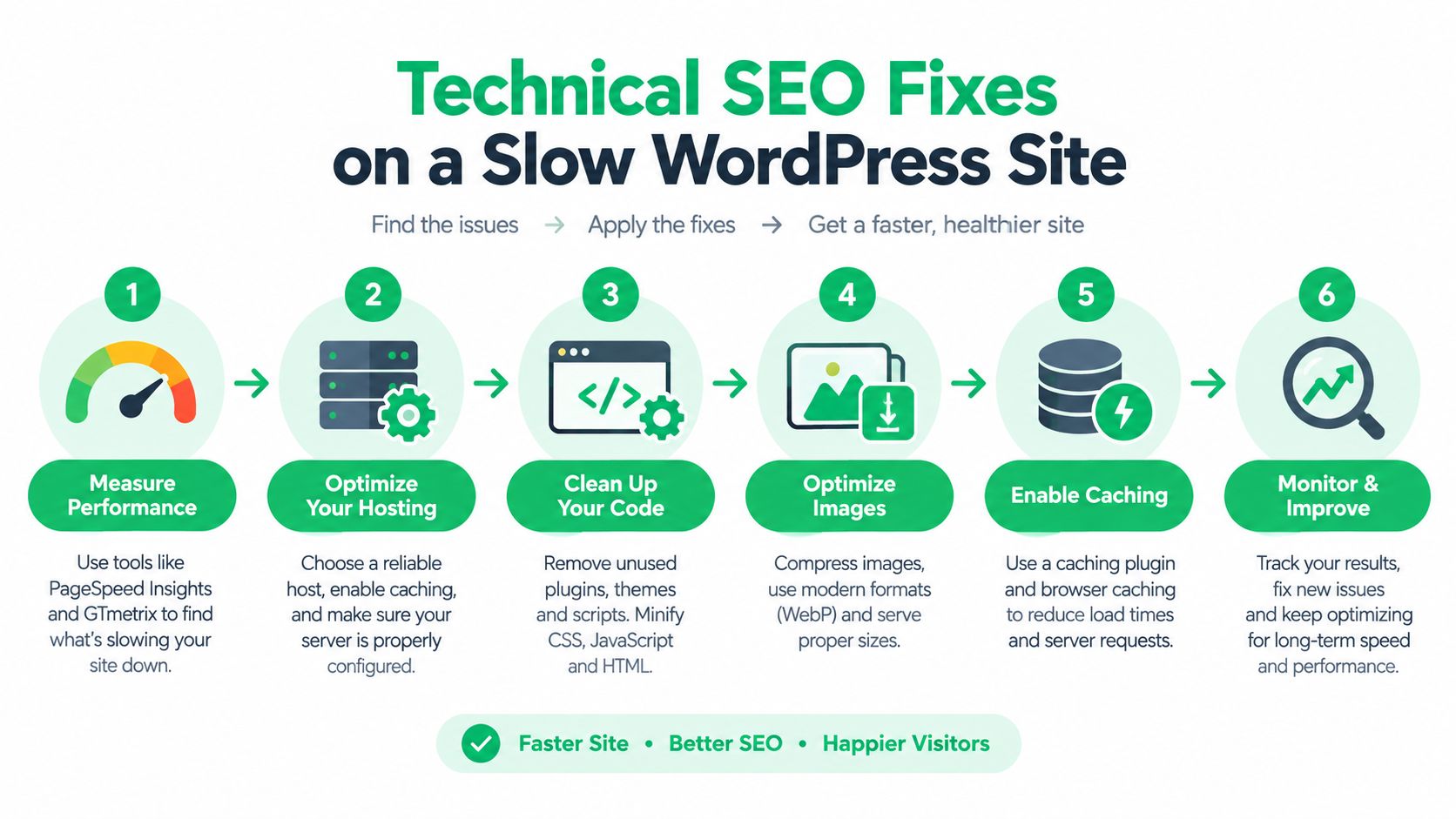
The audit showed that page delivery, rather than a lack of content, was holding back the site. A managed host and large plugin stack loaded unnecessary assets, while render-blocking resources delayed the first useful mobile view. Hosting and theme changes had to come before detailed page-level tuning could produce a reliable improvement.
The site moved away from its heavy managed hosting arrangement. The plugin count fell from around 30 to under 15, and the page builder was replaced with a leaner theme. Server-level caching was enabled, followed by compressed and lazy-loaded images, deferred non-critical JavaScript, inlined critical CSS and the removal of render-blocking resources.
The performance targets were clear. Australian SEO guidance identifies LCP under 2.5 seconds, INP under 200 milliseconds and CLS below 0.1 as the relevant Core Web Vitals thresholds, as detailed in this Core Web Vitals performance guidance. After implementation, the site moved from failing to passing on mobile. Validation continued beyond one lab test because real-user performance can differ from a controlled test.
Fixing crawl and indexation signals
The indexing cleanup removed low-value tag and archive URLs from the sitemap, corrected canonical directives and reviewed robots directives. Structured data was standardised for Organisation, Service and LocalBusiness entities. Each markup type was checked against the page it described instead of being added across templates without review.
Internal links then connected commercial service pages with relevant Melbourne location pages and supporting articles. This reduced the clicks required to reach important URLs and gave search engines clearer context about each page.
Search Console provided field-level validation through its Core Web Vitals report, which uses real-user data from the Chrome User Experience Report. Lighthouse remained useful for diagnosing individual templates, while this Core Web Vitals measurement explanation clarifies why field data better reflects visitors' actual experience.
A technical SEO checklist for small business can help identify comparable issues. Implementation order still matters. A faster site with broken canonicals can create indexing confusion, while clean indexing on a site that loads poorly can restrict enquiries.
Rebuilding the Managed IT Services Page
The Managed IT Services page was rebuilt as a buying page, not a longer version of the company brochure. Keyword mapping assigned one primary commercial query to the page, two supporting informational queries to separate H2 sections, and one comparison query to a dedicated section. This prevented several pages from competing for the same intent.
The H1 mirrored the service query rather than leading with the brand. Under it, the page followed a buyer-friendly sequence:
- Service promise: A short opening that explained who the service was for and what problem it solved.
- What's included: Service details expressed through client outcomes, not an inventory of tools.
- Who it's for: Clear fit signals for Melbourne businesses that needed ongoing support.
- How the process works: A practical explanation of onboarding, support and communication.
- FAQs: Answers to questions raised in sales calls and People Also Ask results.
- Conversion path: A direct call to action with the form visible early in the page experience.
The introduction was tightened to under 90 words, with proof points placed where a buyer could assess relevance quickly. Service bullets moved away from feature language and towards outcomes such as reduced disruption, clearer support ownership and better visibility over recurring IT needs. Trust signals included the response-time SLA, technician certifications and suburbs served, while a pricing transparency block addressed a question that often causes unnecessary friction.

The FAQ block contained six questions, sourced from People Also Ask results and sales call recordings. Each answer was written for the reader first, then marked up with FAQ schema where the content met the relevant conditions. Schema wasn't treated as a shortcut to rankings. Its role was to make the page's content easier to interpret.
Four supporting blog posts linked into the rebuilt page, as did the Melbourne location pages. A sticky CTA and form above the fold created a clearer next step without forcing every visitor into a sales conversation. The service page guide provides a useful comparison point for teams reviewing their own commercial pages.
Local SEO for Melbourne and the Suburbs
Local SEO became a separate workstream because an MSP's potential customer often searches for a provider close enough to visit, support on-site or understand the local business environment. Australian local SEO practice favours combining location-specific landing pages with a fully optimised Google Business Profile, using relevance, distance and prominence as the practical framework. The Australian local SEO overview also highlights the value of unique location copy, accurate categories, service-area wording, maps and consistent directory citations.
Rebuilding the business profile
The Google Business Profile was audited and rebuilt. The primary category was corrected from a generic Computer Repair classification to Managed Services Provider, service descriptions were improved, Melbourne relevance was made clearer, and the service areas were represented through labelled suburbs. Photos were updated with local context, and posts were scheduled regularly rather than added in occasional bursts.
The profile's service-area settings mattered because this business travelled to customers. Australian guidance recommends claiming and verifying each location, selecting the most specific primary category and using service-area settings with suburb and postcode coverage where appropriate, as explained in this Google Business Profile local SEO guide.
Cleaning citations and building local relevance
Citation work focused on accuracy rather than volume. Duplicate suppression was run across 40 listings, inconsistencies in street abbreviation, suite number and phone format were corrected, and the business was submitted to four Australian-specific directories that had been missing.
Six suburb landing pages were then launched for the commercial catchments the sales team visited. Each page used unique local copy, included a nearby client case study, and embedded a Google Business Profile map. The pages weren't created by swapping suburb names into one template. They explained the service area, the local buyer context and the practical reason an MSP could support businesses there.
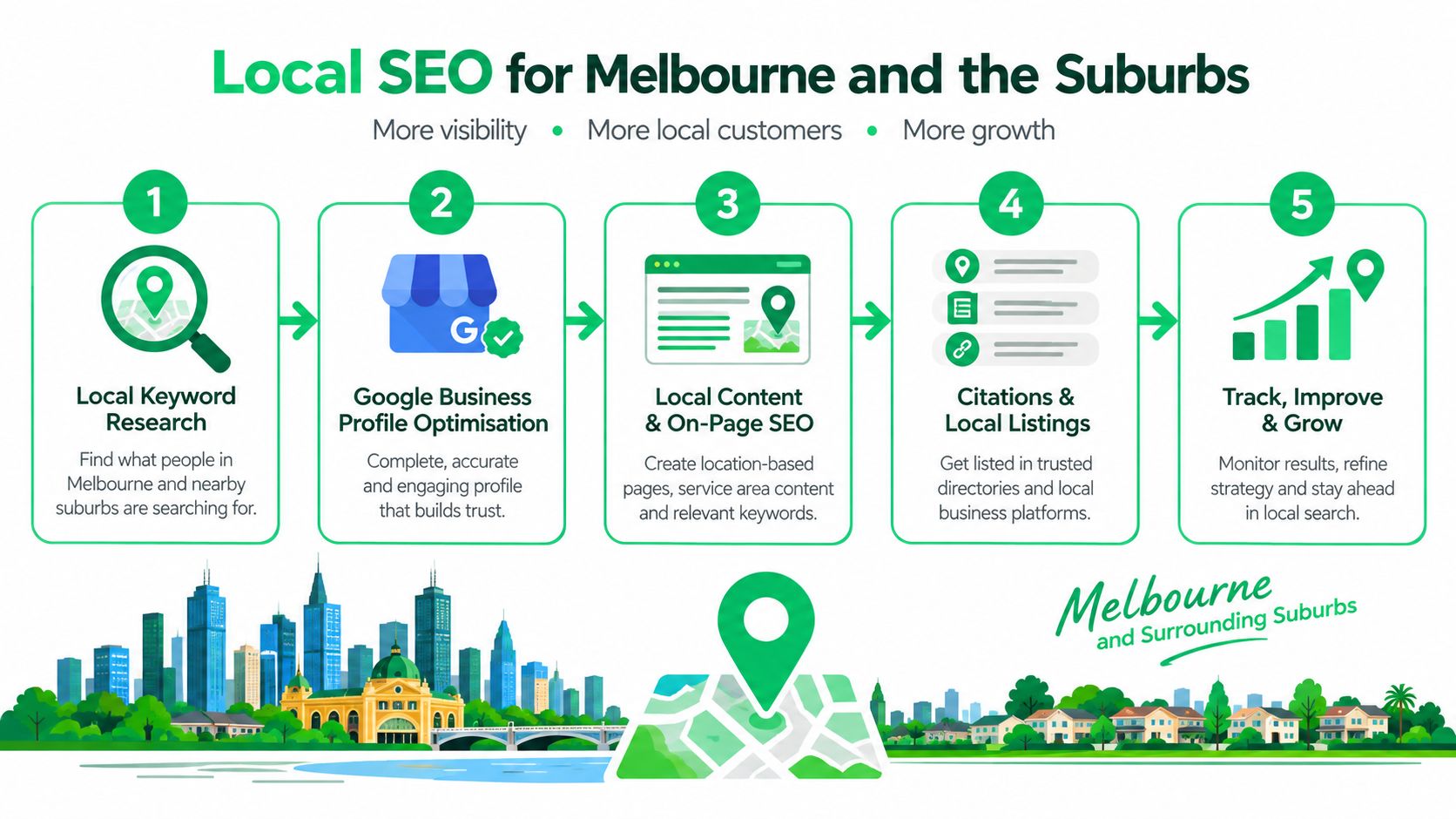
Measurement covered map-pack visibility for “IT support [suburb]”, GBP discovery versus direct searches, calls, website actions and driving-direction clicks. The local work was judged by whether people in the service area could find and contact the business, not by a directory count alone. This aligns with the Melbourne local SEO recommendations that place suburb relevance and profile optimisation ahead of generic content volume.
Measurement Setup and Before and After Results
The numbers were set up before the campaign results were interpreted. Search Console and GA4 were connected, a dedicated Lead – MSP event was configured for the contact form, and tracked phone numbers were used to associate calls with landing pages and Google Business Profile activity. Qualified leads were reviewed separately from raw submissions so spam and poor-fit enquiries didn't inflate the outcome.
The baseline covered the 90 days before the engagement. The comparison window covered months 4 to 6 of the campaign, allowing time for technical changes, page rebuilding and local work to be crawled and evaluated.
| Metric | Before (90-day baseline) | After (Months 4–6) |
|---|---|---|
| Organic impressions | Low visibility for priority commercial terms | Higher visibility across service and Melbourne searches |
| Organic clicks | Limited non-branded activity | More clicks from commercial and local intent |
| Average position for target keyword cluster | Weak positions for priority MSP terms | Stronger positions for Melbourne MSP terms |
| GBP calls | Low and inconsistently attributed | Increased calls from profile discovery |
| Form submissions | Infrequent | More relevant submissions |
| Qualified leads per month | Roughly 2 | Between 8 and 12 |
The headline outcome was that organic enquiries grew from roughly 2 per month to a steady 8 to 12 per month by month six. Call tracking confirmed that at least half originated from the rebuilt service page or the Google Business Profile. The relevant comparison wasn't traffic alone. It was whether a searcher with an active IT need reached a page that explained the service and provided a usable contact option.
Not every metric changed. Branded traffic and direct visits remained broadly stable, which helped separate the result from a general increase in awareness. One negative movement also appeared: desktop LCP briefly regressed before recovering after another asset and caching review.
Measurement warning: A lead count is only useful when the business defines what qualifies as a lead and removes junk submissions, duplicates and enquiries outside the service area.
What Other IT MSPs Can Take From This
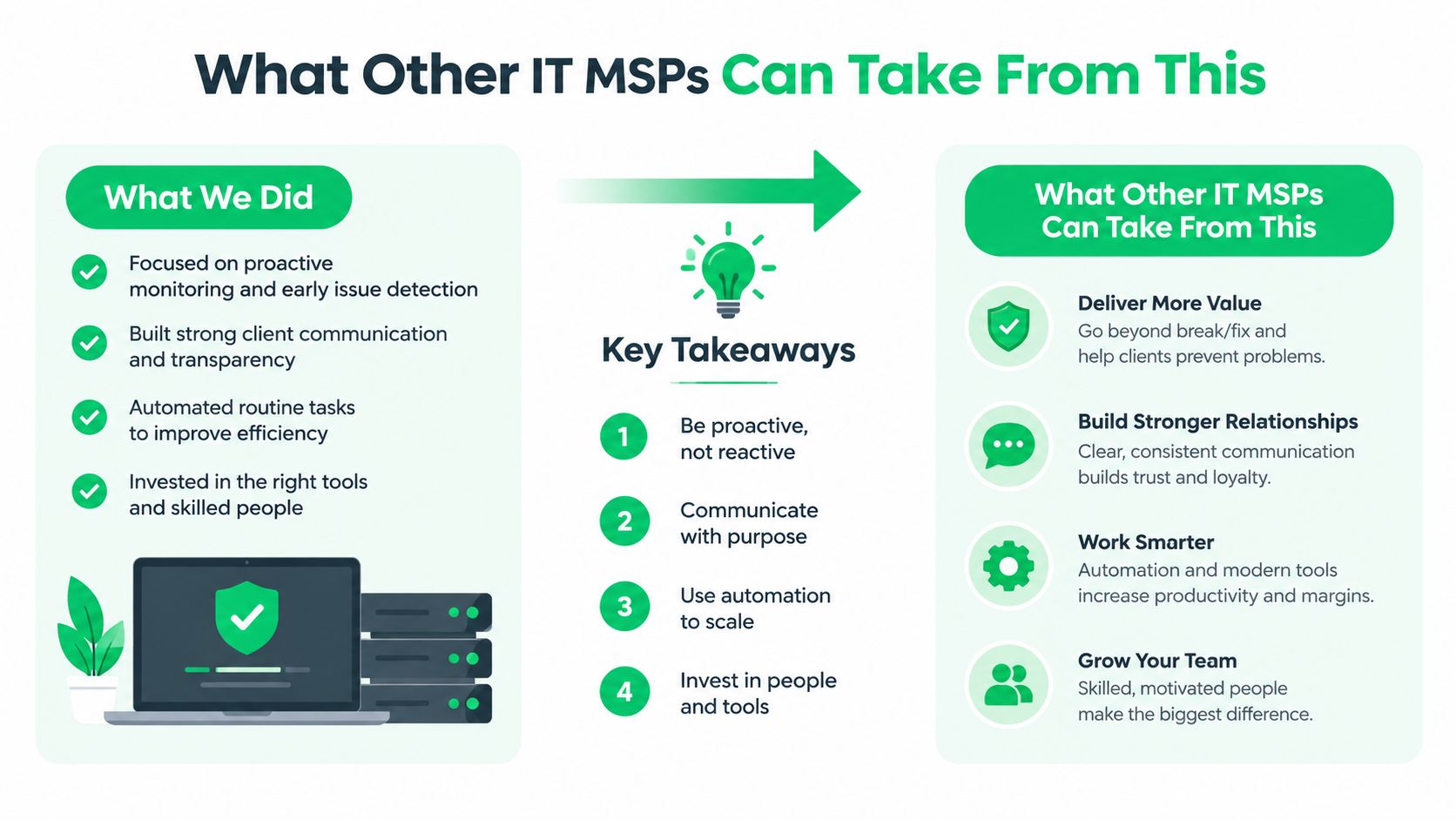
Several changes are repeatable across established MSP websites. A commercial service page should answer the buyer's questions directly, WordPress performance should be measured against real field data, Google Business Profile categories should describe the actual service, and business name, address and phone details should remain consistent across important citations.
Other choices depend on the business. The number of suburb pages should reflect the genuine service radius and the amount of unique information available. FAQ depth depends on the questions sales receives and the page's purpose. Content production should match the team's ability to provide accurate technical expertise, not an arbitrary publishing schedule.
The 8 to 12 leads per month outcome also rested on conditions that another MSP may not share:
- Existing domain history: The website already had a history that search engines could evaluate.
- Defined service radius: Melbourne and the inner suburbs gave the local programme a practical boundary.
- Operational follow-up: The sales process was ready to respond when enquiry volume increased.
- A clear commercial offer: The rebuilt page could explain a service people were actively seeking.
A national MSP would need a different location architecture, stronger authority development and more careful control of overlapping pages. A single-operator consultancy may need fewer locations and a narrower service set. A co-managed services provider should prioritise the terminology and proof points used by businesses that already have internal IT staff.
The broader lesson is that more content wasn't the answer here. Commercial relevance, local trust and technical access worked together. Separating those levers helps another MSP decide what can be copied and what must be adapted.
Practical Checklist and Frequently Asked Questions
Use this checklist to test whether an IT MSP has the same weaknesses. Mark each item as pass or fail:
- Technical: LCP is under 2.5 seconds, INP is under 200 milliseconds and CLS is below 0.1. Compare Search Console field data with Lighthouse diagnostics.
- Indexation: The XML sitemap contains only indexable URLs, canonicals are consistent, and tag or archive pages are not creating unwanted indexation.
- On-page: The main managed IT service page has one clear H1, distinct H2 sections, direct service detail, FAQs, trust signals and an obvious contact path.
- Local: The Google Business Profile is verified, uses the most specific primary category, lists relevant services and reflects the actual service area.
- Citations: The business name, address and phone number match across important Australian directories.
- Location pages: Each suburb page provides distinct local information instead of repeating a template with a different suburb name.
- Measurement: Search Console queries are mapped to landing pages, GA4 records form events, calls are tracked, and qualified leads are separated from junk submissions.
How long does SEO take to show results?
Technical and indexing improvements may appear before commercial rankings settle. Timing depends on the site's history, competition, authority and implementation quality. In this engagement, the clearest lead pattern appeared by month six rather than immediately after the first fixes.
Can a slow WordPress host be rescued without replatforming?
Sometimes. Caching, smaller assets, image optimisation and plugin removal can improve performance, although a heavy host, theme or page builder may limit the result. Test the bottleneck before deciding whether the site needs a rebuild.
Do suburb pages still work after search quality updates?
They can, provided each page serves a genuine area and includes useful, specific information. Pages created by changing only the suburb name are unlikely to help users or strengthen local relevance.
How were leads checked against junk submissions?
Form events and tracked calls were reviewed against the service area, business fit and sales qualification. Raw conversions were not counted as qualified leads automatically, which kept spam and irrelevant requests out of the headline result.
SEO2RANK helps service businesses audit local visibility, technical SEO, commercial pages and lead measurement as one practical programme. For an IT MSP reviewing Melbourne search performance, visit SEO2RANK to explore an audit-led approach focused on qualified enquiries rather than traffic alone.
Find Out What Is Holding Your
Website Back
Get a practical SEO Snapshot showing the biggest issues and opportunities we can see across your search visibility, website and local presence.
GET YOUR FREE SEO SNAPSHOT