
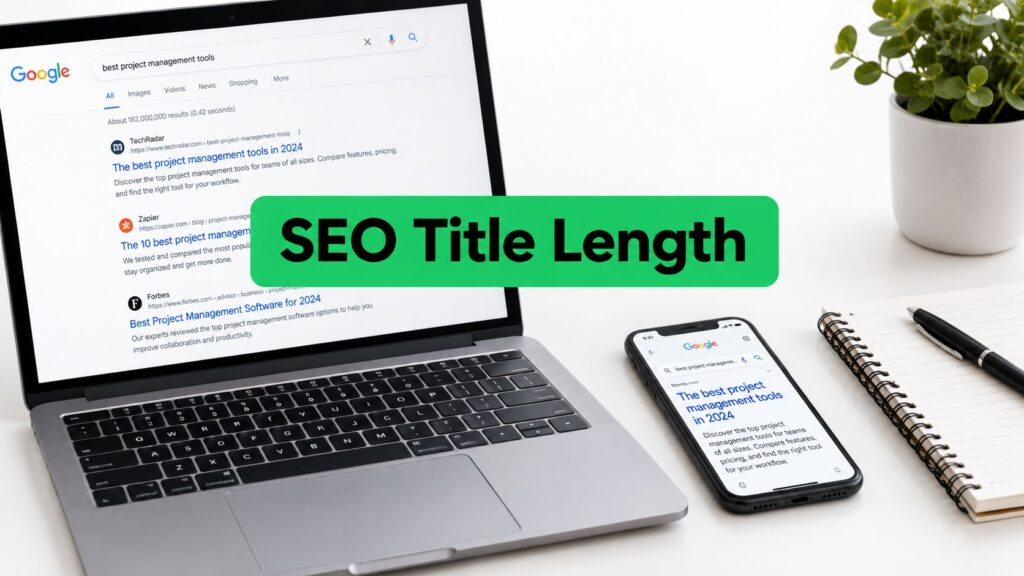
There is no fixed character limit for SEO titles, and Google truncates the visible link by pixel width, which is roughly 600 pixels on desktop. The 50 to 60 character range is a useful editorial guide, not a hard rule.
Most small business pages should still aim for clarity first, because Google can rewrite the title link when it thinks another page element better matches the searcher's query. For a Melbourne service business, that usually means putting the service and location near the front, then trimming anything repetitive or decorative.
Table of Contents
- The Truth About SEO Title Length Limits
- Why Pixel Width Matters More Than Characters
- Optimising for Mobile and Desktop Search Behaviour
- Structuring Titles for Local Service Businesses
- Testing and Managing Google Title Rewrites
- Next Steps for Auditing Your Current Titles
The Truth About SEO Title Length Limits
The biggest myth around How Long Should an SEO Title Be? is that Google enforces a strict character cap. It doesn't. Google's Search Central documentation says the HTML title element has no maximum length, and the displayed title link may be truncated to fit the available device width. It can also be revised from other page elements, including the main heading, prominent on-page text, anchor text, and links pointing to the page. Google's title link documentation
That matters more in Australia than many business owners realise, because Google accounted for 87.9% of Australian search-engine market share in the cited StatCounter dataset, compared with 9.17% for Bing, 1.54% for Yahoo, and 0.92% for DuckDuckGo in the same source. The practical takeaway is simple, write for the way Google displays titles, not for an arbitrary character counter.
Practical rule: if the first part of the title does not tell a searcher what the page is about, the title is too loose, even if it fits neatly in a spreadsheet.
A useful way to think about it is this, the title tag is a writing problem first and a length problem second. A page titled “Emergency Plumber Melbourne | 24/7 Local Repairs” gives both relevance and context fast. A bloated version like “Welcome to Our Website | Home Plumbing, Emergency Service, Repairs, Maintenance, Melbourne” wastes space on filler and repeats the same idea twice.
For readers comparing SEO titles vs H1 headings, the difference matters. The title tag serves search visibility, while the H1 serves the page visitor after the click. A clear breakdown of that relationship helps avoid the common mistake of making both elements identical, which usually adds no extra value. SEO titles vs H1 headings
Why Pixel Width Matters More Than Characters
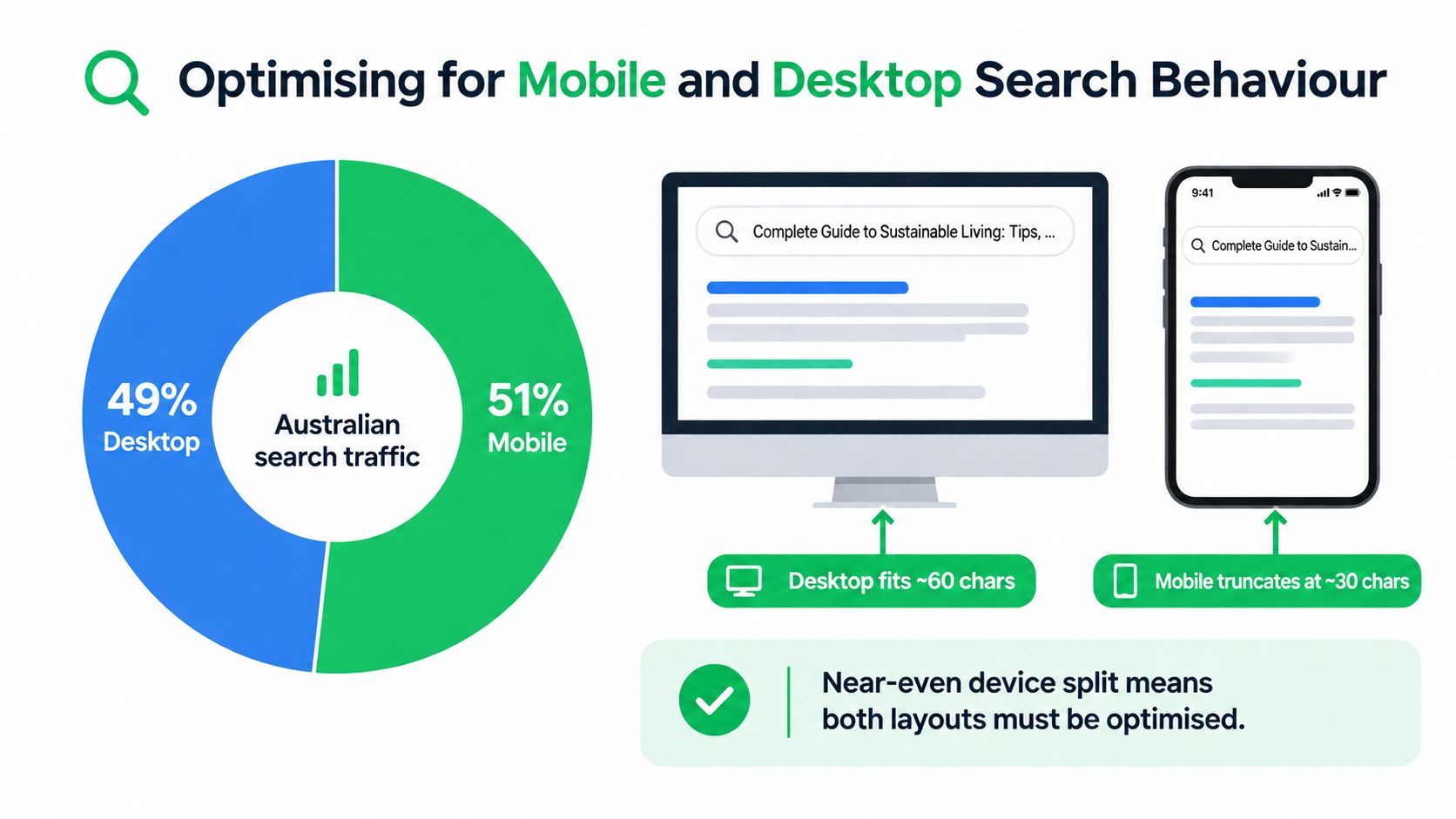
Characters are an easy shorthand, but they're a weak proxy for what shows up in search. Search-result titles are constrained by rendered pixel width, not a character count. A desktop title area is commonly measured at around 600 pixels, which often corresponds to roughly 50 to 60 characters of ordinary text, but that conversion changes with the specific letters used. Title tag length and pixel width
That's why two titles with the same character count can display very differently. Narrow lowercase letters take less room than wide capitals, punctuation, or brand-heavy wording. A title like “best dentist richmond melbourne” can show more words than “Best Dentist Richmond Melbourne | BrightCare Dental,” even though the second one may be more polished on paper.
What gets squeezed out first
When a title is too wide, the part most likely to disappear is the least essential part, usually the brand name or the last qualifier. That is fine if the first words already carry the commercial intent and suburb. It is a problem if the title hides the service type until the end.
A Melbourne business owner should think in terms of visible meaning, not raw length. A title can be short but vague, or slightly longer and far more useful. The second version usually wins because the searcher knows what the page offers before the click.
A simple editing check helps here:
- Prioritise the service: put the main offer first, not a slogan or brand story.
- Keep the location visible: Melbourne, the suburb, or the service area should appear early.
- Remove duplicated wording: don't repeat the same service phrase in slightly different forms.
- Trim decorative text: words like “welcome”, “official”, and “best ever” rarely help search visibility.
For Australian local-service pages, the central question is not “How many characters fit?” It is “Which words must survive truncation so the page still makes sense on search results?”
Optimising for Mobile and Desktop Search Behaviour
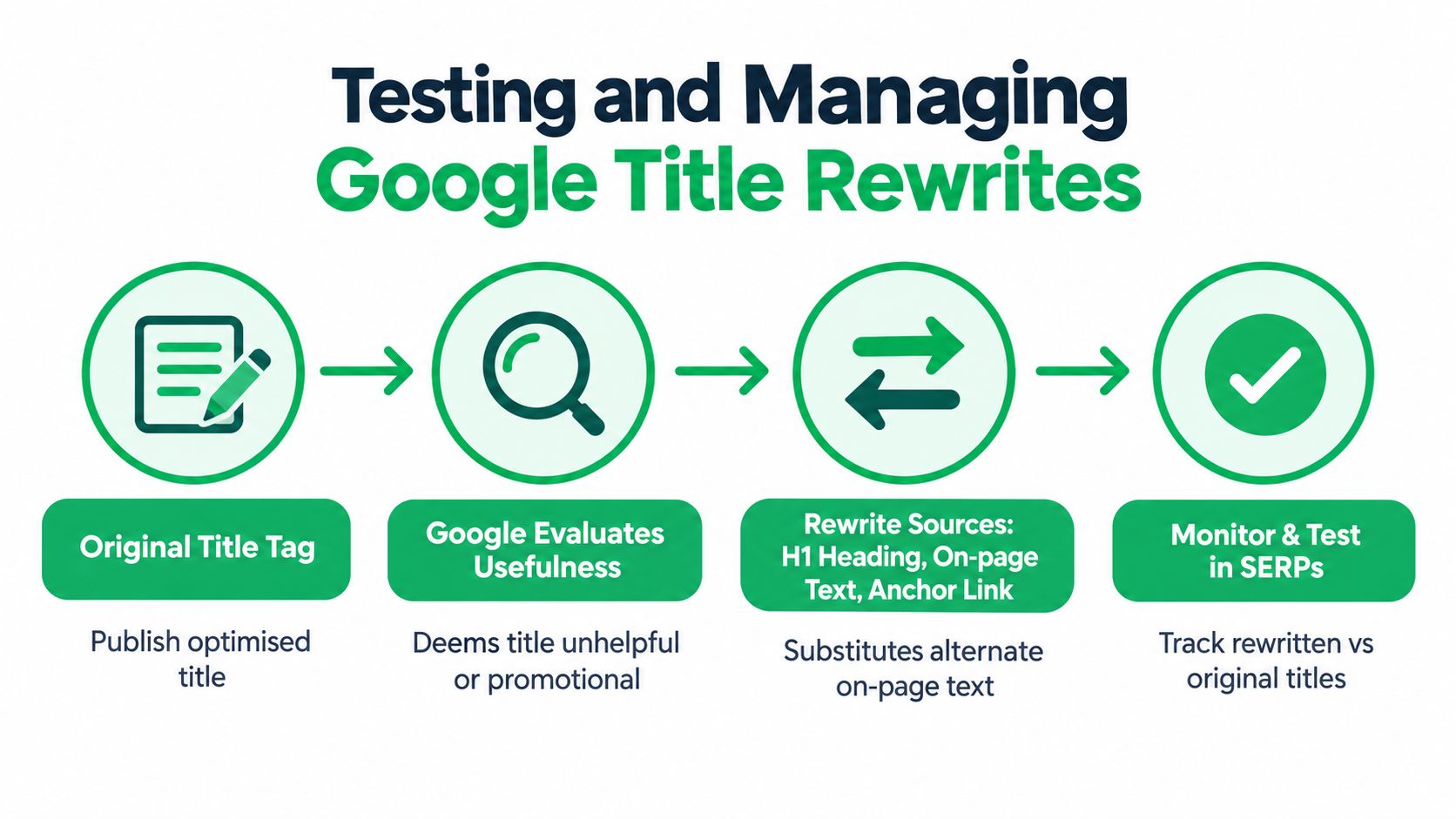
Australian search behaviour is nearly split across devices, so a title that looks clean on a wide monitor can lose its point on a phone. StatCounter's Australia data reports Google at 87.6% of combined desktop and mobile search-engine market share in September 2026, while its Australian platform data reports 50.96% desktop and 49.04% mobile usage for September 2025. StatCounter Australia search engine share That near-even layout means mobile truncation can't be treated as an edge case.
The mobile-first priority order
For local service businesses, the front of the title should carry the highest-value search intent. That usually means service first, suburb or city second, then a differentiator, with branding last if there's room. A title such as “Emergency Dentist Richmond | Same-Day Care | Brand” protects the most useful words if mobile cuts the tail.
That same logic fits other service pages too. “Accountant for Tradies Melbourne” communicates more than “Brand Name | Accounting Services | Melbourne | Tax Help | Trusted Experts.” The second version wastes room on stacking similar promises.
Australian discovery behaviour reinforces the point. Reporting in the source brief notes that mobile accounts for approximately 68% of searches in 2025, Google has more than 97% of Australian mobile search share, and about 51% of Australians reportedly discover new companies or services through smartphone searches. The lesson is not to chase a magic number, it is to make sure the mobile-visible part of the title still carries the main commercial message. Australian SEO statistics and trends
What works better than vanity wording
Titles that lean on branding too early usually underperform for local search clarity. That doesn't mean the brand has no place. It means the brand belongs at the end unless it is the main reason people search.
A practical framing for Melbourne pages is:
- Core service first, so the page matches intent quickly.
- Location second, so the page feels locally relevant.
- Differentiator third, such as same-day, 24/7, or suburb-specific coverage.
- Brand last, only if the title still reads naturally.
The nearby comparison for local optimisation is useful here. The guidance in 15 local SEO tips for Melbourne businesses aligns with the same principle, local relevance should be visible before the snippet gets crowded.
Structuring Titles for Local Service Businesses
The safest structure for a local service title is straightforward, intent first, location second, brand last. That order protects the words that matter most when Google shortens the visible title. It also makes the result easier for a searcher to scan, which is the whole point of the title in the first place.
A Melbourne tradie page does not need clever copy before the service. A title like “Roof Repairs Melbourne | Fast Leak Fixes | Brand” is more useful than “Brand | Reliable Roof Experts | Melbourne Roofing Solutions.” The first version tells the user what the page is about instantly, while the second buries the lead.
| Industry | Poor Structure Truncates Key Info | Optimised Structure Intent First |
|---|---|---|
| Plumber | Brand Name | Melbourne Plumbing Services | Emergency Repairs | Emergency Plumber Melbourne | 24/7 Repairs | Brand |
| Dentist | Family Dental Care and Cosmetic Dentistry by Brand | Dentist Richmond Melbourne | Same-Day Appointments | Brand |
| Accountant | Brand Accounting | Tax, BAS and Business Advice | Accountant for Tradies Melbourne | BAS and Tax Help | Brand |
Put the money keyword and the suburb where the eye lands first, then cut anything that sounds like filler.
A simple writing formula
The title only needs enough detail to match the page and the query. For a local service business, that usually means choosing one main service phrase, one location phrase, and one useful differentiator. If the page tries to cover too many services, the title becomes fuzzy and the page often underperforms.
A cleaner Melbourne example is “Accountant for Tradies Melbourne | BAS, Tax and Bookkeeping.” That title works because it names the audience, the location, and the services without repeating itself. For dentists, “Dentist Richmond Melbourne | Preventive and Family Care” does the same job. For a trades business, “Electrician St Kilda | After-Hours Fault Repairs” keeps the urgency visible.
A title should not read like a stitched-together keyword list. Google explicitly warns against verbose titles and keyword stuffing, and those pages often look awkward even when they technically fit on screen. Businesses that need help aligning titles with the rest of their on-page structure often review the broader approach in a technical or local SEO audit, such as the one outlined in SEO2RANK's technical SEO checklist for small business.
Testing and Managing Google Title Rewrites
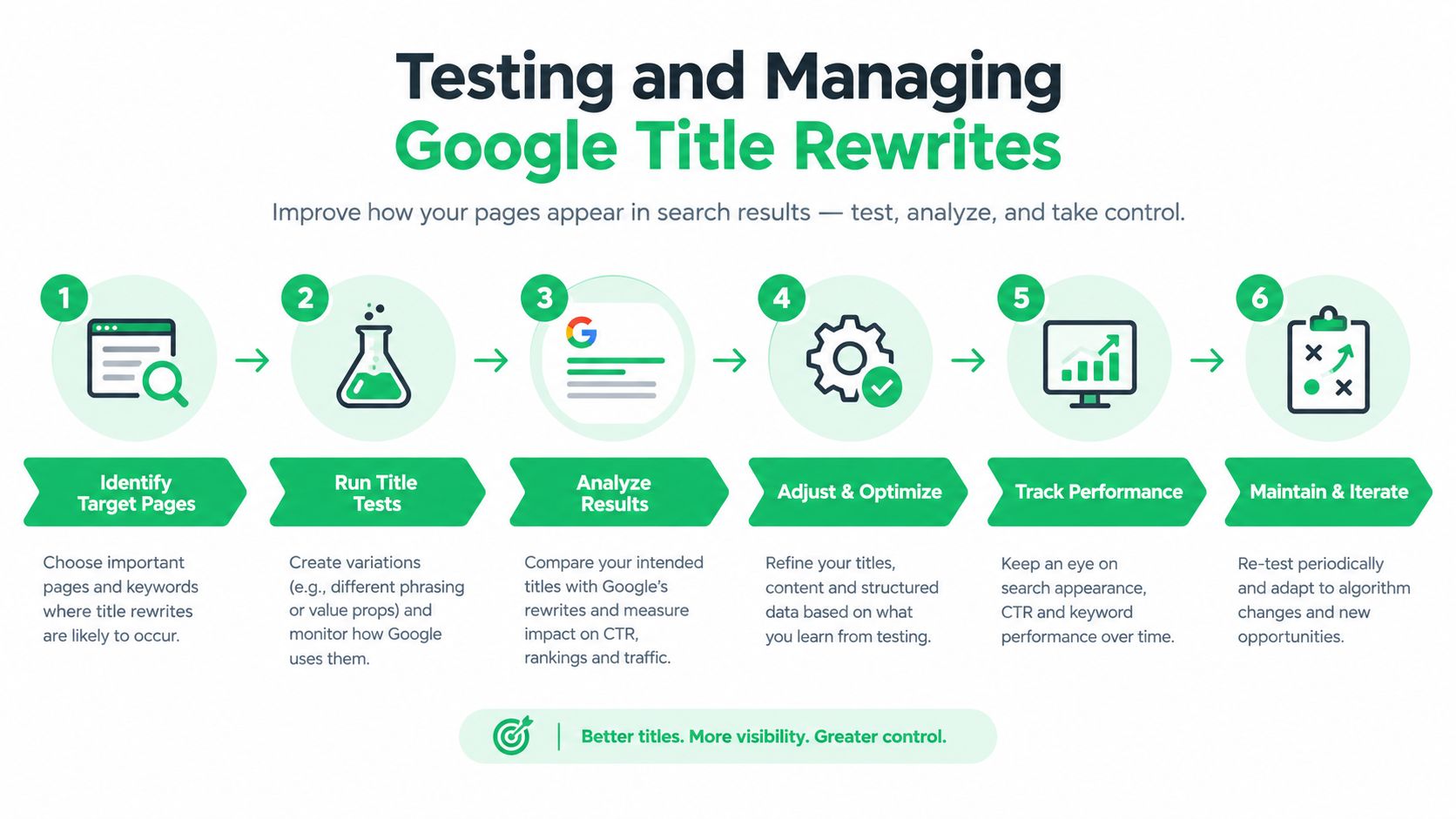
Google does not always show the title a business writes. It may replace part of it with a heading, on-page text, anchor text, or another page element if the original title feels thin, repetitive, or overly promotional. The title tag still matters, but the page has to support it with matching language.
A practical testing workflow
The best way to manage rewrites is to test titles on pages with enough search impressions to show a pattern. Search Console gives the clearest read on whether a title revision improved impressions, clicks, and click-through rate for Australian query groups. That makes it useful for comparing the original title against a revised version instead of changing every page at once.
A simple workflow looks like this:
- Pick one important page: choose a service page that already gets search impressions.
- Rewrite the title once: remove repetition, bring the service and location forward, and keep the wording natural.
- Check the heading structure: make sure the H1 and prominent on-page text support the title rather than contradicting it.
- Watch Search Console trends: compare clicks, impressions, and CTR after the change.
- Adjust only if needed: if Google keeps rewriting the title, the page probably needs cleaner supporting text.
The relationship between title and snippet often overlaps with the meta description as well. A clear meta description does not directly force a title rewrite, but vague or generic page signals can make the whole snippet less coherent. That's why title work is usually part of a broader on-page review, not a stand-alone edit. Do meta descriptions affect Google rankings
What to watch for
Titles that promise too much or sound like ads are more likely to be replaced. Titles that repeat the same phrase several times can also trigger rewrite behaviour, especially when the page content says the same thing more cleanly elsewhere.
The remedy is usually not to chase the algorithm with tricks. It is to write a better title, then align the H1, supporting copy, and internal links so the page tells one clear story. That gives Google fewer reasons to improvise.
Next Steps for Auditing Your Current Titles
A useful title audit starts with the pages that matter most, not with a full-site rewrite. For a Melbourne service business, that usually means the top service pages, the main location pages, and any pages that already bring in enquiries. A business that reviews those first will get a clearer return than one that tweaks every title on the site in one go.
Start by reading each title out loud. If it sounds padded, repetitive, or vague, it probably is. If the service and suburb do not appear near the front, the title probably needs tightening. If the brand takes up most of the visible space, it is probably crowding out the search intent.
The next check is practical. Open the page in search results previews or look at how it appears on different screens, then ask whether the most important words are still visible. That same logic is part of a broader technical SEO checklist for small business, because titles, crawlability, and page structure all affect whether the page earns a click.
A sensible audit order is:
- Top priority pages: service pages that drive leads.
- Location pages: suburb or area pages that need local relevance.
- Overwritten titles: pages where Google keeps changing the displayed snippet.
- Verbose titles: pages that repeat keywords or lean too hard on branding.
For many businesses, the pattern is the same. The page has useful content, but the title hides the best part of it. Fixing that does not require gimmicks, just better structure and a cleaner order of information.
SEO2RANK helps Melbourne businesses improve page titles as part of broader on-page and technical SEO work, so service pages are easier to understand in search and easier to click. If the current titles on your site feel too long, too vague, or too focused on branding, visit SEO2RANK to see how a practical SEO audit and implementation plan can help.
Find Out What Is Holding Your
Website Back
Get a practical SEO Snapshot showing the biggest issues and opportunities we can see across your search visibility, website and local presence.
GET YOUR FREE SEO SNAPSHOT