Google Search sits at approximately 94% of Australia's general-search market, so stopping SEO usually does not make a site vanish overnight. It removes the maintenance that protects visibility, technical health and enquiry flow, so the damage shows up as a slow decline, not an instant cliff.
Most owners ask the wrong question. They ask whether Google will punish them, when the better question is what happens after the site stops being actively looked after while competitors keep improving theirs.
Table of Contents
- The Question Behind Stopping SEO
- How Search Engines Actually Treat a Paused Site
- Short-Term and Long-Term Effects on Rankings, Traffic and Leads
- The Hidden Risk of Stable Rankings in an AI-Shifted Search
- Local Service Businesses Versus National Sites
- A Realistic Mitigation Plan for a Paused SEO Budget
- How to Decide Whether to Pause, Downsize or Restart
- Common Questions About Pausing SEO
The Question Behind Stopping SEO
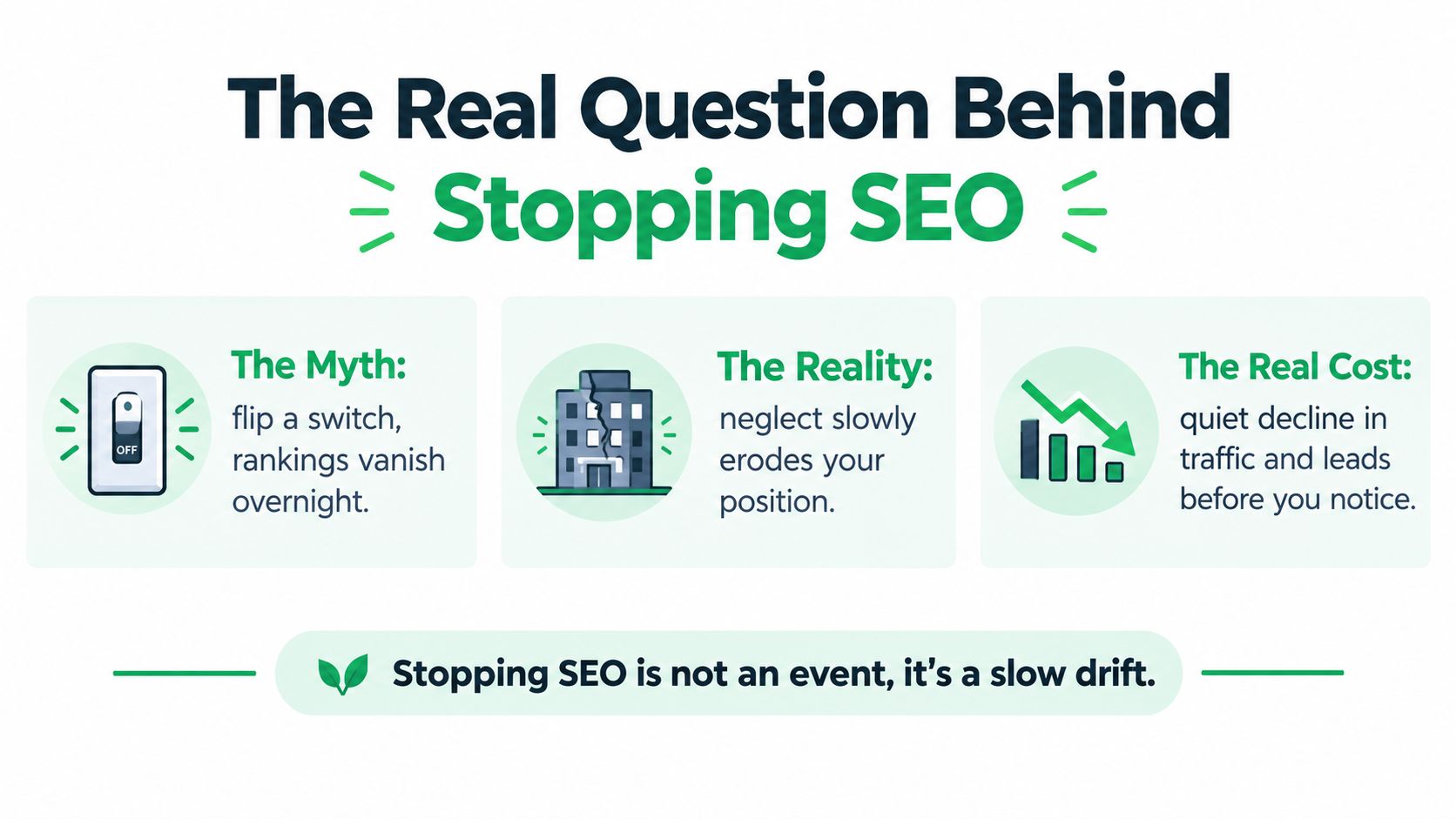
Stopping SEO is less like switching off a light and more like letting a building age without maintenance. Google still sees the site, existing pages can keep their strength for a while, and rankings often hold longer than budget discussions assume. But the technical fixes stop, service pages stop being refreshed, and competitors keep moving.
The Australian market makes that a serious mistake. The Australian Competition and Consumer Commission recorded Google Search at approximately 94% of Australia's general-search market in August 2024, with Bing at 4.7%, Yahoo at 0.8%, DuckDuckGo at 0.6% and Ecosia at 0.1%. Google was also the preset search engine on at least 91% of Australian mobile browsers and 77% of desktop browsers at the time, so a Melbourne service business that backs away from SEO is backing away from the main discovery channel.
The bigger issue is maintenance. Once it stops, technical problems sit unresolved, new competitor content keeps appearing, local signals go stale, and enquiry volume can soften before the owner notices. In an AI-shifted search environment, stable rankings can still mean fewer enquiries if your pages stop earning clicks, answers, and trust signals that feed discovery.
Practical rule: if search drives leads, SEO is not a campaign you buy once. It is work the business keeps in motion.
For a tradie, dentist, accountant or other service business, the question is simple. If the site stops being monitored, who catches broken links, stale suburb pages, indexing errors and weak local signals before they become expensive? Nobody does, and that is where the decline starts.
How Search Engines Actually Treat a Paused Site
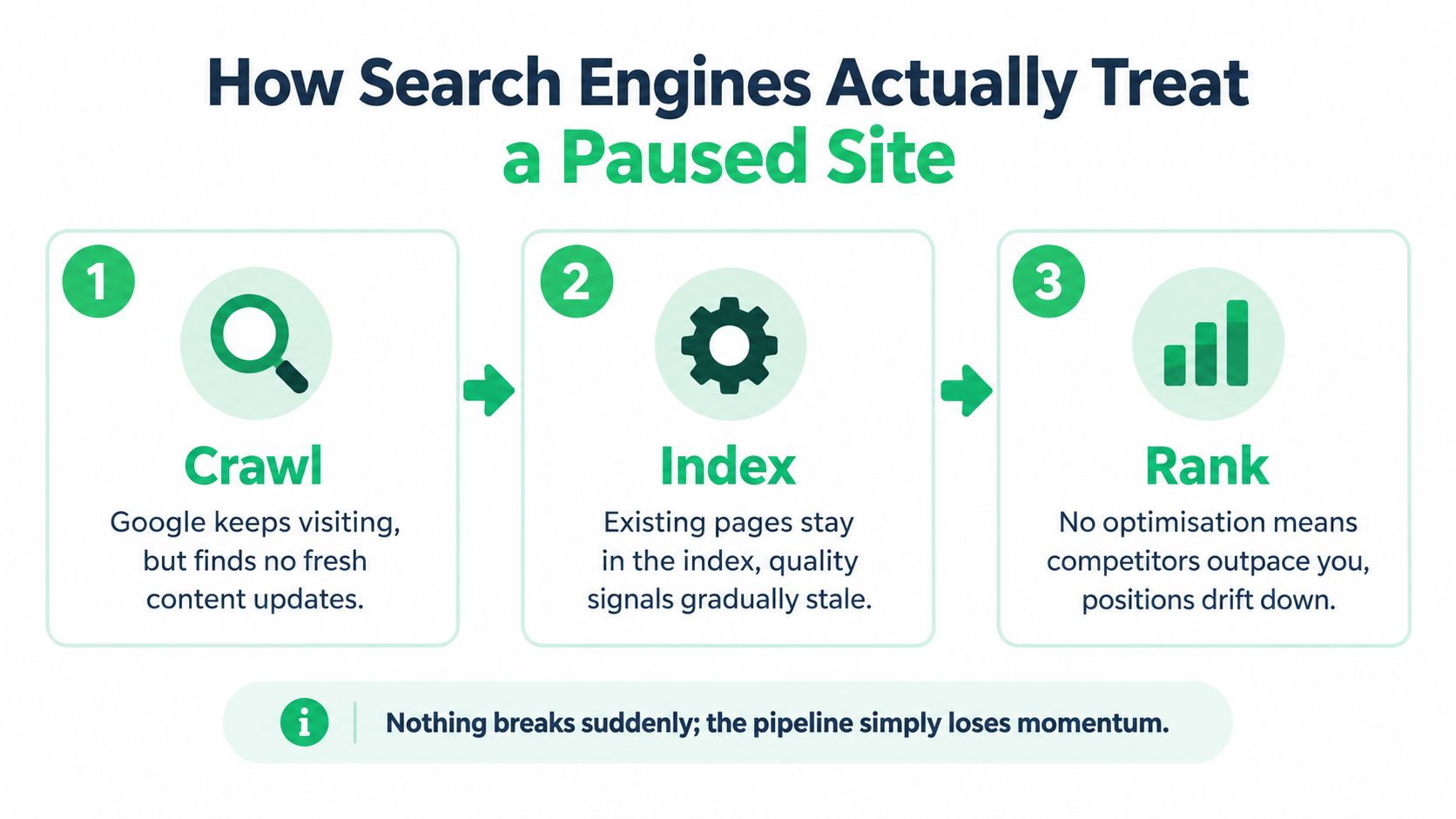
Google describes Search as a three-stage system, crawling, indexing and serving results. Crawlers discover pages, Google analyses them and stores what it finds in the index, then the system serves pages it considers relevant and useful for a query. That basic pipeline keeps working even if an SEO retainer ends.
What keeps working for a while
Existing pages do not lose their value the moment payments stop. Links already pointing at the site still exist, useful content still exists, and technical improvements already in place can keep helping. That is why rankings often linger.
The catch is that Google also says crawling and indexing depend on many factors, and it can't guarantee when any URL will be crawled or indexed. That means a paused site is not protected by memory. It is only protected by whatever quality and authority it already has, and that protection weakens when new problems go unchecked.
What stops getting corrected
When optimisation stops, nobody is watching for the small failures that usually matter most. A site redesign can create a broken canonical, a CMS update can block resources, a developer can add a faulty redirect, or a service page can drift out of date. If no one is checking Search Console, those changes can sit there for weeks.
Google's own guidance on how crawling and indexing works is clear enough to make the point: a sitemap helps discovery, but it does not guarantee indexing or rankings. The same goes for the site as a whole. Search access is conditional, not automatic. That is why a paused SEO programme is still a live technical risk, which is why many teams keep a standing process around robots.txt and index controls even when broader work slows down.
Google doesn't “pause” with the budget. It keeps crawling, comparing and re-evaluating pages against everything else in the results.
The difference between stopping SEO and taking a site offline matters here. Stopping SEO usually means the site stays visible while maintenance fades. Taking the site down means search access can disappear outright. Those are not the same event, and they don't have the same consequences.
Short-Term and Long-Term Effects on Rankings, Traffic and Leads
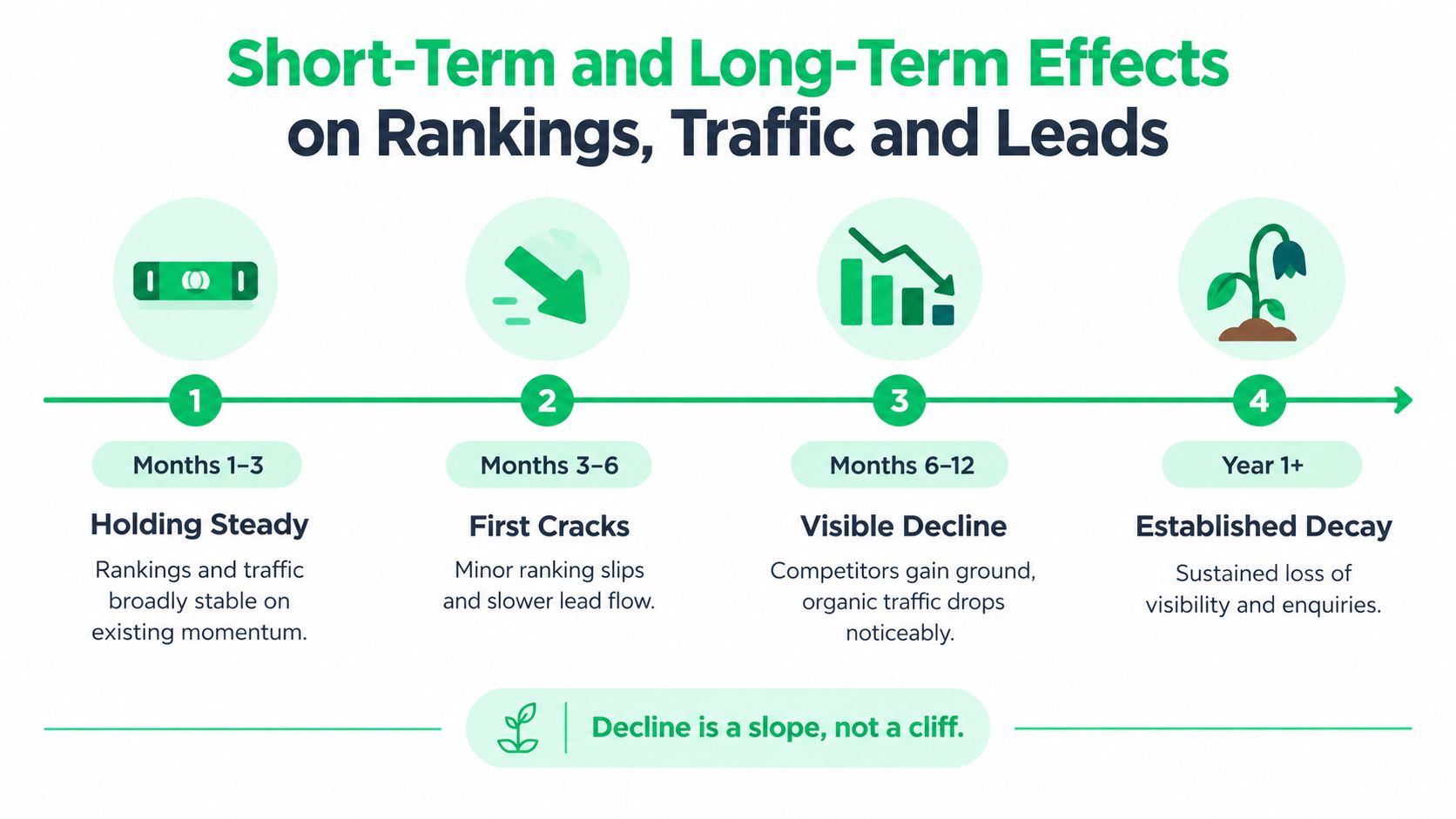
In the short term, a paused SEO programme usually looks calmer than owners expect. Rankings may stay broadly stable, traffic can hold up and the phone may keep ringing because the site is still benefiting from earlier work. That's the trap. Stability early on can hide the fact that the business has stopped making progress while competitors haven't.
Where the first losses show up
The first losses are usually subtle. A strong page gets nudged down by a competitor who refreshed theirs. A service page starts attracting fewer clicks because another result looks newer or more complete. Local search visibility softens because profile activity, reviews and site signals aren't being maintained with the same care.
The Australian Bureau of Statistics reported that in 2024-25 more than 91% of businesses said their internet met most or all of their business needs, up from 88% in 2021-22, and 51% used social media for their online presence, compared with 47% in 2021-22. Yet only 7% measured the contribution of digital activities to overall business performance in 2024-25, although that was more than double the 3% recorded in 2021-22. That gap matters because many businesses won't see the slow deterioration until enquiries have already softened. The ABS business technology release shows how common digital dependence has become, and how weak measurement still is.
What gets worse over time
Longer term, the problems stack up. Content goes stale, internal links drift, technical errors linger and local relevance weakens. Seasonal pages stop reflecting current demand. A site can still be online while its commercial pages slowly lose the sharpness that used to win clicks.
Bottom line: the decline usually starts in rankings, but the business pain shows up in traffic quality, call volume and enquiries.
A practical way to spot the slide is to watch more than sessions. Compare branded searches, organic conversion rate, calls, form fills and assisted conversions. The clearest evidence of damage is not a chart line dropping suddenly. It's a steady reduction in qualified enquiries after the site has stopped being maintained. For a working checklist on this pattern, these ranking-drop checks are more useful than guesswork.
The Hidden Risk of Stable Rankings in an AI-Shifted Search
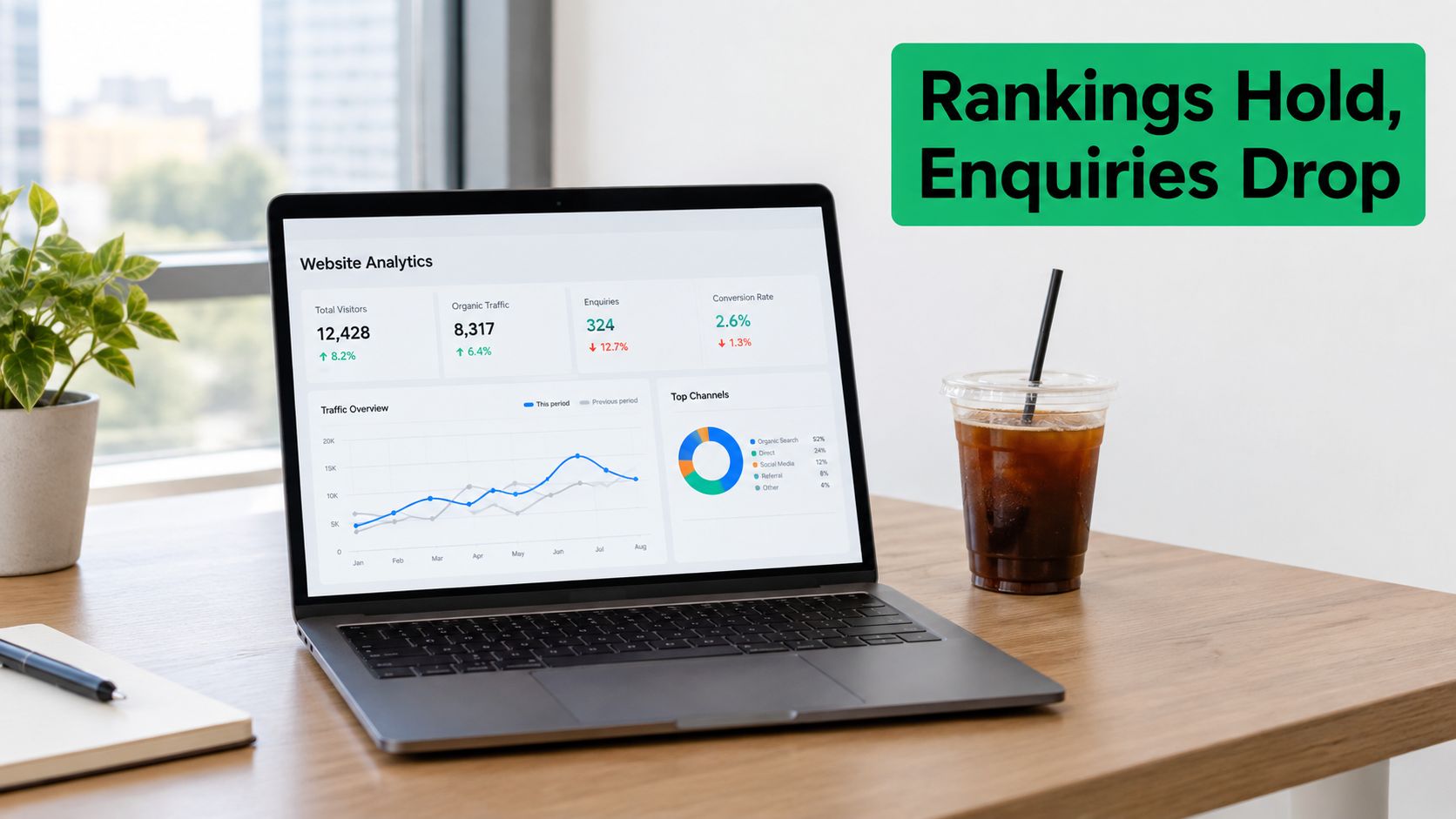
Stable rankings can still deliver weaker enquiry flow. That is the part many owners miss when they pause SEO and only check position reports. The business may hold its keyword positions while searchers get answers from summaries, maps, and other result features before they ever reach the site.
Why the click can fall even when the ranking holds
Australian evidence indicates that AI Overviews appeared for about 12% of desktop searches in 2025. Rocket Agency's Australian AI search analysis reported an average 8-20% reduction in clicks when AI Overviews are present. The same study found AI Overviews in 48% of health-related searches. Those figures point to a simple risk. The business may not have lost the keyword, but it may have lost the visit, as our analysis of AI search reducing website clicks explains.
That shift hits service businesses hardest. A dentist, accountant or tradie can keep ranking and still get fewer calls if searchers get what they need without clicking through. Checking position reports on their own is no longer enough.
What to watch instead
Watch the business signals, not just the ranking.
- Branded searches show whether people still know the business name and are looking for it directly.
- Local Pack actions matter because map interactions often count more than a blue-link click for local services.
- Calls and form completions connect search visibility to enquiries.
- Assisted conversions show the leads that start in search and finish later through another channel.
- Organic conversion rate can expose weaker lead quality even when traffic looks stable.
Paused SEO without better measurement is a bad trade. Rankings can look fine while the funnel leaks elsewhere. A business owner who only watches position reports can miss the decline until the inbox is noticeably quieter.
Local Service Businesses Versus National Sites
A Melbourne service business loses different things when SEO pauses. A local operator relies on a tight set of assets that must stay current, while a national publisher depends more on fresh content, broader topic coverage and ongoing authority building.
What matters most for local operators
For a tradie, dentist or accountant, the weak points are practical. Google Business Profile details, opening hours, suburb pages, service-area pages, reviews, click-to-call paths and internal links all need to stay accurate. If those slip, enquiries slip with them. The Google Business Profile optimisation tips that matter most are the ones that keep those contact and location signals clean.
Australian local-search data reports that Google is used by 94.5% of Australians for local business discovery (Red Search's local SEO statistics for Australia). Business websites also make up 47% of first-page organic results. That combination makes maintenance a practical issue, not a nice-to-have. A business cannot rely on a name, address and phone number sitting somewhere on the web and expect enquiries to keep flowing.
What can pause, and what can't
Not every SEO task needs the same urgency. New blog production and broad topic testing can slow down for a while without immediate harm. Foundational upkeep is different.
- Can usually pause briefly: new blog production, broad topic experimentation, large content expansion.
- Should keep going: opening-hours accuracy, review generation, form testing, redirect checks, indexability reviews, local page freshness.
- Should never be ignored for long: website migrations, profile verification issues, broken enquiry paths, outdated service details.
A local site does not need endless publishing. It needs accurate information, technically accessible pages and a business profile that still matches reality.
That is why a pause plan for a service business should look different from a pause plan for a national content brand. If location signals and conversion paths break, the lost leads usually come from the market that was already closest to buying.
A Realistic Mitigation Plan for a Paused SEO Budget
If the budget has to slow down, the answer is not to let the site drift. It's to keep the minimum viable maintenance in place so the pause doesn't become a rebuild later. That means protecting measurement first, then the technical basics, then the local assets that directly drive calls.
What to keep on the owner's checklist
- Protect tracking: keep Search Console, analytics and conversion tracking active so declines can be seen early.
- Review the site quarterly: check crawl errors, index coverage, redirects, canonical URLs and mobile usability.
- Keep the Google Business Profile clean: opening hours, service areas, phone number, photos and services should stay current.
- Refresh money pages: update core service pages and suburb pages when offers, staff or service scope changes.
- Watch lead paths: test forms, call buttons and booking actions after any site change.
- Maintain review flow: ongoing reviews help keep the profile believable and current.
Google says pages intended for search must be accessible to anonymous users and must not be unintentionally blocked by robots.txt rules. It also says robots.txt controls whether crawlers can request content, but it isn't a reliable way to prevent indexing. That's the technical reason a pause can go wrong so easily. A developer change that looks harmless can make the site harder to crawl or interpret. Google's getting-started guidance is clear on that point.
What still needs specialist oversight
Some tasks are better left to someone who knows the edge cases. Structured data validation, migration oversight, access and indexation checks after a redesign, and diagnosis when rankings shift for no obvious reason are all the sorts of things that benefit from specialist review. A Melbourne business can absolutely keep the lights on between engagements, but it shouldn't guess at technical fixes.
SEO2RANK is one option for that kind of ongoing support in Melbourne, combining technical checks, local SEO, content work and measurement for service businesses that need a controlled level of oversight rather than a full stop. The point isn't to keep paying forever. The point is to avoid letting a temporary budget pause turn into preventable loss.
How to Decide Whether to Pause, Downsize or Restart
The cleanest decision is rarely “all in” or “all out.” The actual choice is whether the business can safely reduce effort without losing visibility it can't easily win back.
When pausing is lower risk
A pause is less dangerous when the site has recently been audited, the technical health is sound, the local profile is active and conversion tracking is working. It's also less risky when the business has a small, stable service range and the existing pages already cover that offer well. In that case, a lighter-touch maintenance plan can hold the position for a while.
When pausing will hurt quickly
A pause becomes risky when there are already signs of neglect. Recent migrations, unresolved technical issues, weak review velocity, stale location pages or missing measurement all make decline faster. If the business can't tell whether leads are coming from search, pausing SEO is usually a bad bet because there's no clean way to see the damage early.
What a smart downsize looks like
Downsizing is usually better than disappearing. A lean version of SEO can keep measurement, local assets and technical hygiene alive while content expansion slows. That gives the business breathing room without cutting the line that connects search visibility to enquiries.
Google also says sitemaps help it discover and prioritise important pages, but a sitemap does not guarantee indexing or improve rankings by itself. That's the reason a “we've got a sitemap” argument isn't enough. Google's crawling and indexing FAQ makes it plain that a sitemap is support, not strategy.
Common Questions About Pausing SEO
Rankings don't usually fall off a cliff the day SEO stops. Damage is more often gradual, and whether it can be reversed depends on how long the site has been neglected and how competitive the market is.
If SEO starts again later, some gains can be recovered, but not always cleanly. Competitors may have filled the gap, and technical problems that went unnoticed may need fixing first.
During a pause, monthly checks should focus on Search Console, key rankings, calls, form completions and Google Business Profile activity. If those move in the wrong direction, the pause has already become a problem.
Pausing SEO is usually safer than pausing Google Ads only if the site already has strong organic demand and clean tracking. If the business depends on immediate lead flow, neither channel should be treated casually.
SEO2RANK works with Melbourne service businesses that want search visibility tied to leads, not just reports. If the budget is under review, SEO2RANK can help assess what can pause, what should keep running and what needs fixing before a slowdown turns into lost enquiries.
Find Out What Is Holding Your
Website Back
Get a practical SEO Snapshot showing the biggest issues and opportunities we can see across your search visibility, website and local presence.
GET YOUR FREE SEO SNAPSHOT