
A Melbourne business can have a website, a Google Business Profile and a few directory listings, yet still miss the calls that matter. Usually the problem is not “SEO” in the abstract. It's that the business is hard to find locally, the pages do not match the search intent, or the site never tracks whether enquiries turn into booked work.
Small Business SEO Guide: How to Rank a Small Business in Melbourne starts with the practical truth that ranking and lead generation are related, but they are not the same job. A plumber in Richmond, a dentist in Carlton, an accountant in South Yarra and a B2B firm in Collingwood all rely on the same basic mechanics, local visibility, clear service pages, technical access and proper measurement, but they apply them to different suburbs, different services and different conversion points. Google Search Console and enquiry data matter more than vanity rankings because they show whether search visibility is producing phone calls, form submissions and booked jobs.
Table of Contents
- What a Melbourne Small Business SEO Plan Actually Involves
- Setting Up Your Google Business Profile and Local Citations
- Building Suburb and Service Landing Pages That Actually Convert
- Fixing the Technical Foundations Search Engines Need
- Optimising Your Money Pages for Commercial Search Intent
- Measuring What Matters With Search Console and Analytics
- Your 90 Day SEO Roadmap for a Small Business Budget
What a Melbourne Small Business SEO Plan Actually Involves
A business owner in Brunswick often thinks the website is “done” because the homepage looks fine and the logo is in place. Then the phone stays quiet. The usual cause is that the site only covers one piece of the search puzzle, while the actual buyer journey depends on four moving parts working together.
The four layers that have to line up
Local presence starts with being discoverable where people search, especially in Google Business Profile and local directories. Technical foundation is what lets search engines crawl, render and trust the site without friction. On-page content is where suburb relevance, service detail and conversion language live. Measurement tells the owner which suburb pages, service pages and calls are producing genuine leads.
If one of those layers is weak, the whole system underperforms. A well-written service page won't help much if Google can't index it, and a perfect profile won't save a slow mobile page that fails on the quote form. That's why a proper small business seo guide: how to rank a small business in melbourne has to talk about both visibility and outcome.
Practical rule: local SEO should be judged by the enquiries it produces, not only by where a page happens to sit in the results.
The same logic applies across Melbourne's common small-business sectors. Tradies need suburb and service pages that match urgent intent. Dental and healthcare practices need clear location signals and trust-building content. Accountants and professional firms need pages that explain specific services without sounding vague. Retailers and B2B providers need pages that make it obvious who they serve and why they're credible in a Melbourne market that is crowded, mobile-first and highly local.
A useful way to think about the work is simple. Search visibility opens the door, but lead quality decides whether that visibility matters. If Search Console shows clicks but the business never gets calls or quotes, the issue is usually not “more traffic”, it's poor page alignment, weak conversion design or missing tracking.
Setting Up Your Google Business Profile and Local Citations
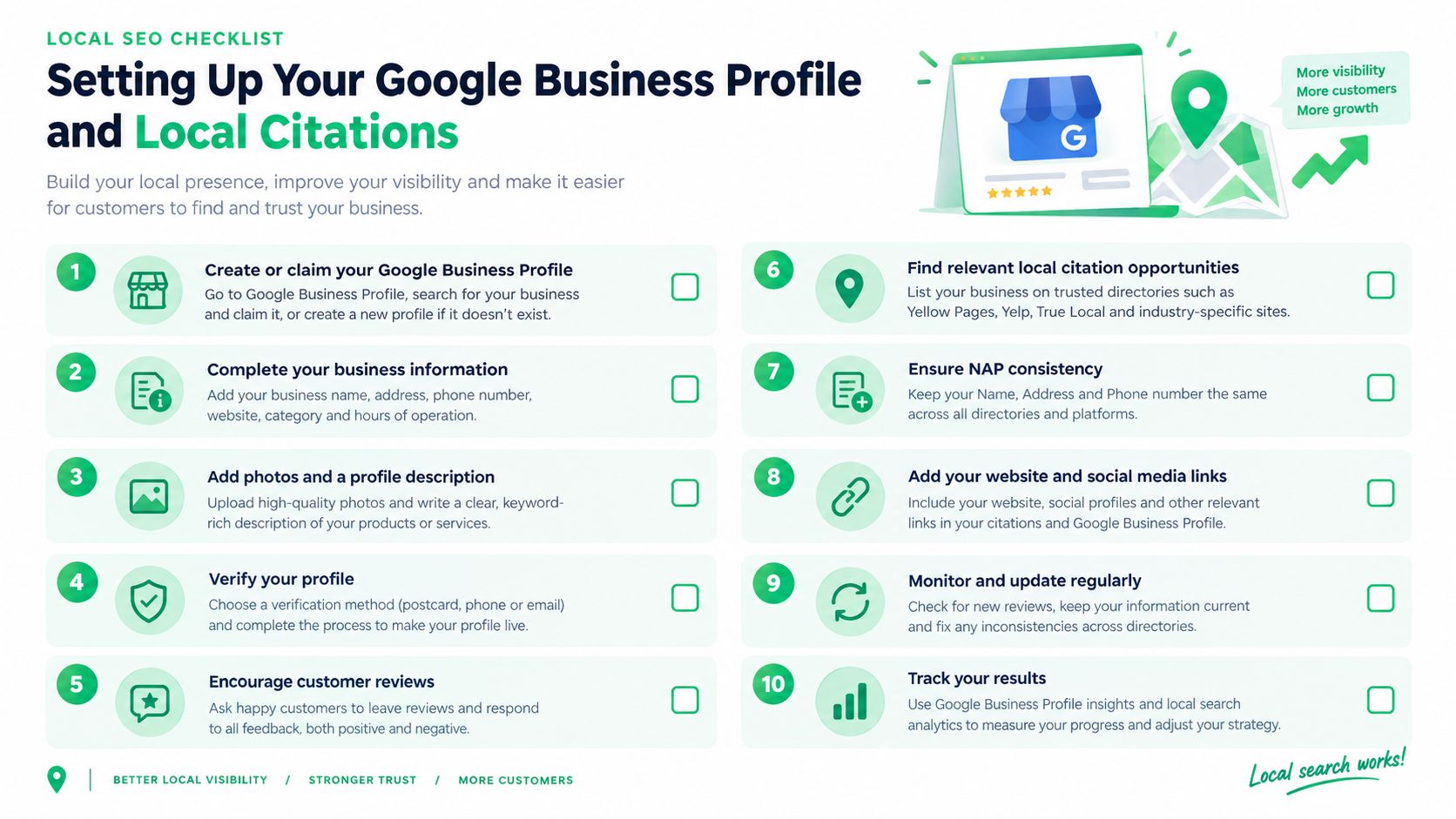
Google Business Profile is the first place to get right because it controls a lot of the local discovery layer. For a Melbourne service business, that means choosing the most accurate primary category, adding every relevant service, and making sure the profile reads like a real business rather than a half-filled listing.
What to verify before touching anything else
Name, address and phone need to match across the website and authoritative Australian directories. Opening hours should be complete and current. Service descriptions should explain what the business does in plain language. Photos should show the business, the team, vehicles, premises or work in context, not generic stock imagery. Attributes and categories need to be filled in carefully because they help Google understand relevance.
For businesses that operate from a service area rather than a public shopfront, the profile still needs to be complete, but the address strategy changes. The listing should reflect the genuine operating model, not a fake office location. That matters because local trust depends on consistency, and Google uses relevance and prominence signals as well as proximity.
Reviews are part of that prominence signal, but they're also a conversion factor. Australian consumer research reports that 83% of consumers check Google reviews before purchasing and 62% would avoid a business with consistently poor reviews RockingWeb's Google Business Profile statistics. That makes review visibility commercially material for Melbourne operators, especially in trades, healthcare and professional services where trust shapes the first enquiry.
The citation stack should start with the major, legitimate sources that support local trust, then expand to industry-specific and local references. A practical place to understand the role of local citations is this guide on what local citations are. The point is not volume for its own sake. The point is consistency, legitimacy and enough corroboration for search engines and customers to recognise the business.
Keep this straight: never incentivise reviews or use templates. Ask after a real job, keep the request natural, and respond professionally to every review.
Building Suburb and Service Landing Pages That Actually Convert
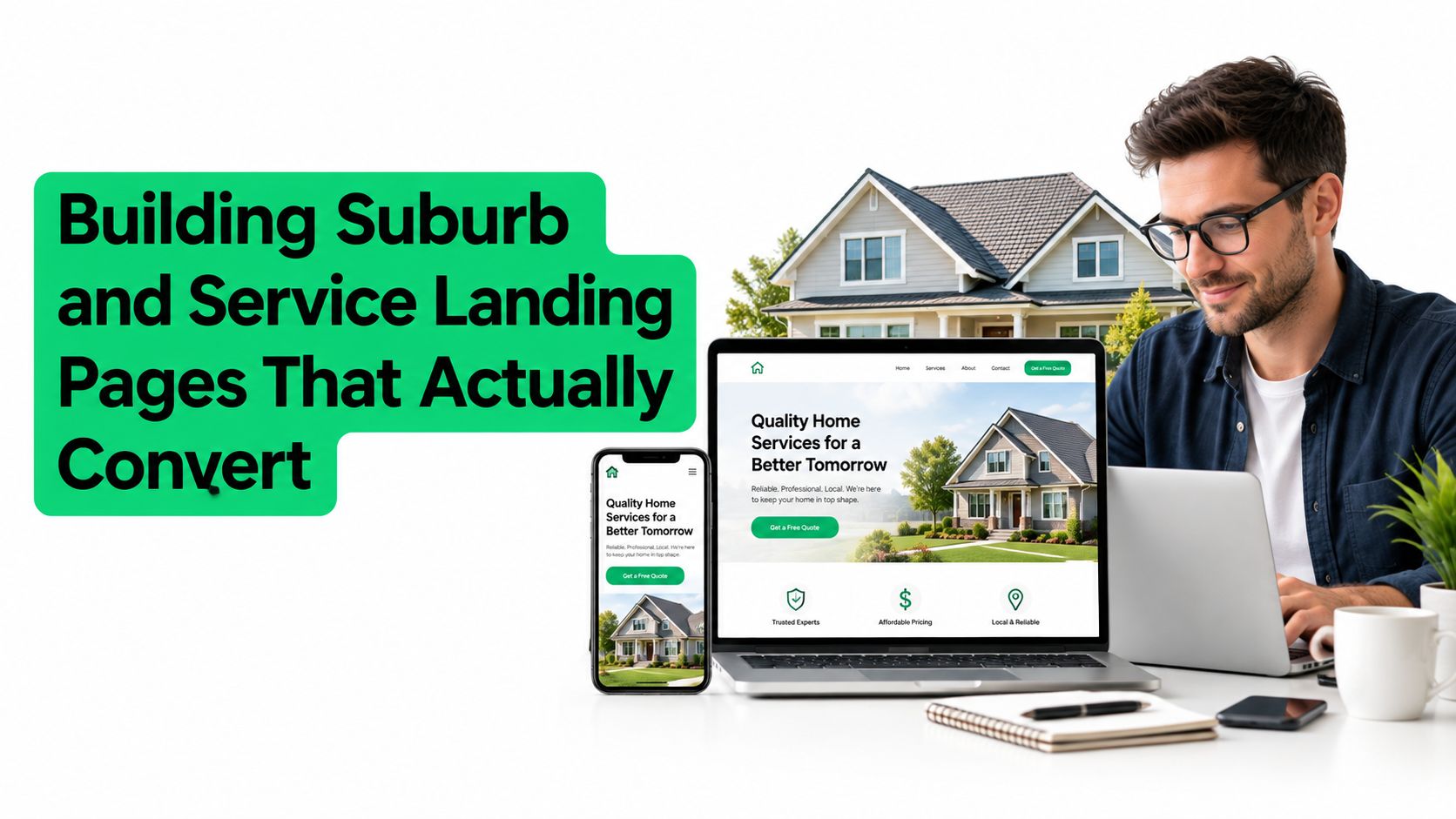
Most Melbourne businesses make one of two mistakes here. They publish one generic service page and hope it ranks everywhere, or they create dozens of near-identical suburb pages that only swap the suburb name. Neither approach works well for users, and the second one often creates weak pages with no unique local evidence.
One strong page beats ten thin ones
A better workflow is to map real commercial queries to one canonical page per meaningful service area. “Emergency plumber Richmond” deserves a focused page if there's genuine demand and a genuine service fit. “Dentist Carlton” deserves another if the practice serves that area. The page title, H1, opening copy, proof of service area, internal links and booking or call action should all reinforce the same intent.
That is where the page earns its place. A strong suburb page answers a local problem, gives a clear next step and shows why the business is relevant to that suburb. A thin postcode page does none of that. It usually reads like a template, hides the actual value and confuses internal signals across the site.
The business case matters too. A federal Small Business Digital Champions fact sheet, citing ABS data, says that only 50% of Australian businesses had a web presence, and that small businesses with higher digital engagement were 50% more likely to grow revenue business.gov.au fact sheet. That does not mean every page needs to be overbuilt. It means that for many Melbourne firms, the basic foundations are still missing, so a small number of well-made pages can outperform a bloated set of weak ones.
What a converting suburb page usually includes
- A specific title and H1: reflect the service and suburb without stuffing keywords.
- A short opening that states the offer: explain what's available, who it's for and where it's delivered.
- Service-area proof: mention suburbs served, local constraints, travel patterns or response zones where relevant.
- Internal links: point users to the main service page and related location pages.
- A direct action: phone, booking or enquiry, placed where a mobile user can reach it quickly.
A useful comparison guide for structuring these pages is what should a good SEO service page include. Pages that attract impressions but never produce qualified engagement should be consolidated, rewritten or retired rather than left to dilute the rest of the site.
Fixing the Technical Foundations Search Engines Need
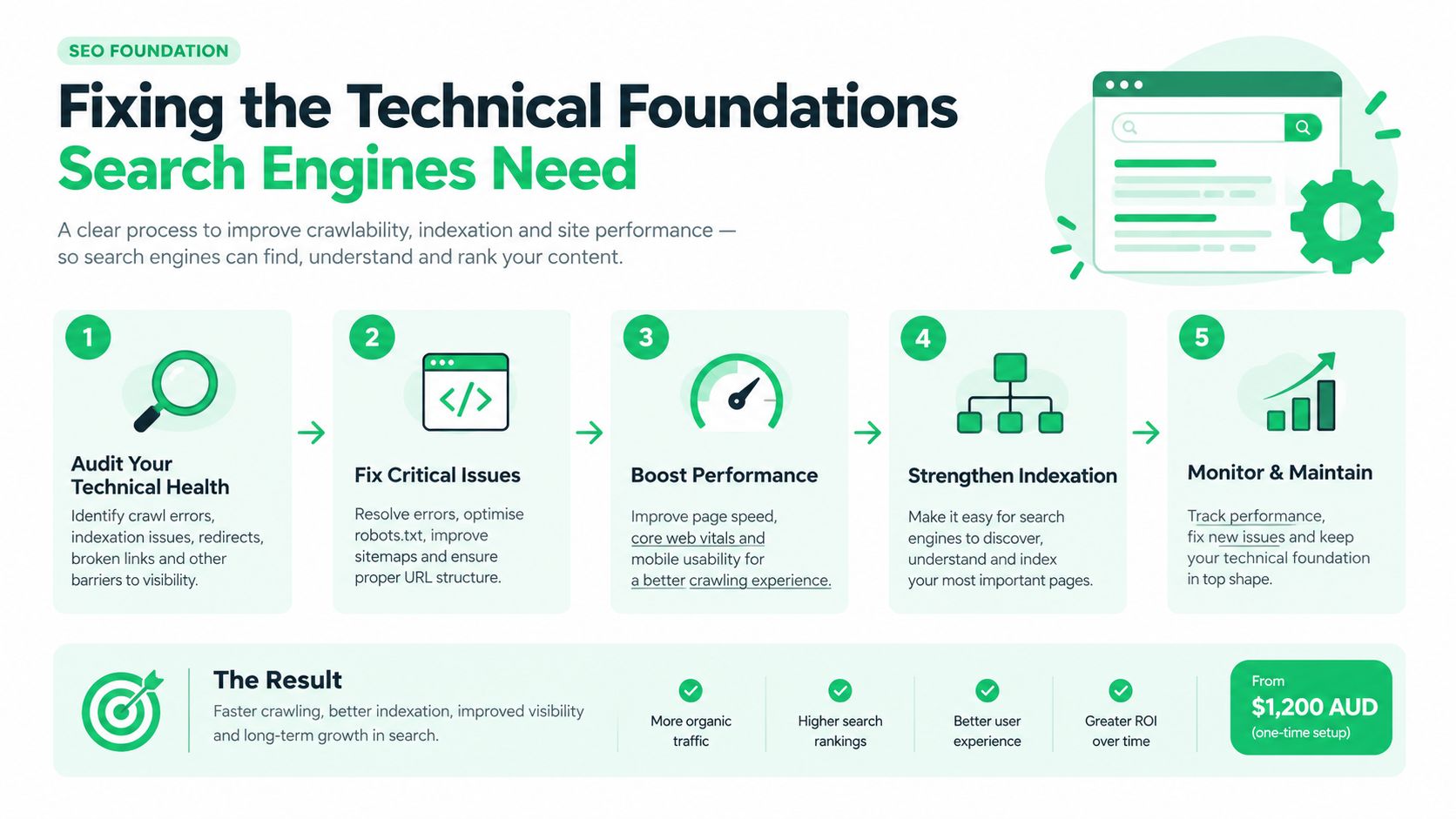
Technical SEO is often treated like a background task, but local businesses feel the consequences quickly when the site is hard to crawl or slow on mobile. The first priority is basic access. Important service pages need to return HTTP 200, use self-referencing canonicals, avoid accidental noindex settings, stay out of robots.txt blocks and appear in the XML sitemap.
Start with crawlability, then move to speed
If Google cannot reliably find and index the right page, everything else is secondary. That's why a crawl audit should come before content expansion. It should identify whether the site architecture is clean, whether the main money pages are linked properly and whether any template is hiding key content behind scripts or broken paths.
Speed comes next, but speed work needs to be grounded in field data rather than a single desktop test. Google's published Core Web Vitals thresholds are Largest Contentful Paint within 2.5 seconds, Interaction to Next Paint below 200 milliseconds, and Cumulative Layout Shift below 0.1, with the 75th percentile of field data used to judge pass or fail Google Core Web Vitals. A page that looks fine in one Lighthouse run can still feel slow to actual users on mobile.
The practical fixes are usually straightforward. Compress and size hero images properly. Serve modern image formats. Reduce render-blocking CSS and JavaScript. Reserve image and ad dimensions so the layout doesn't jump. Defer third-party scripts that are not needed immediately. Then retest the exact templates that drive enquiries, not just the homepage.
Structured data should also be checked carefully. LocalBusiness or a more specific applicable type can help systems interpret the business, but only if the markup matches visible content. Unsupported claims in schema create more risk than value.
Field data matters more than vanity scores, because real customers do not experience synthetic lab conditions.
A practical technical audit should be tied to lead generation, not just performance reports. This technical SEO checklist for small business is the kind of reference that helps owners see which fixes are foundational and which are optional. The aim is simple, remove barriers so the right pages can be found, loaded and used without friction.
Optimising Your Money Pages for Commercial Search Intent
A money page is not a suburb page and not a blog post. It is the page that has to turn interest into action, usually a service page, pricing page, contact page or booking page. If the intent is commercial, the page has to look commercial without becoming pushy.
Align the page to one search intent
A single primary keyword should sit behind each page. That does not mean repeating the phrase over and over. It means the title tag, H1, opening paragraph, subheadings and body all reinforce the same promise. A searcher looking for a dentist in Melbourne is not asking for a general health article. A searcher looking for an accountant near them wants a service page that explains who the firm helps, what work it handles and how to make contact.
Internal linking should follow that logic. Suburb pages should point to the core service page, and the service page should link back to the most relevant locations. That helps both users and search engines understand how the site is organised. Image alt text should describe the service and location naturally, not force keywords into every file name.
A good page also answers the specific questions people ask before they enquire. For a tradie, that might be emergency response times, service area coverage and what happens on the first visit. For a dental practice, it might be appointment availability, treatment types and patient suitability. For an accounting firm, it might be the type of clients served, the work handled and the documents needed to start.
Keep the conversion path visible on mobile
Mobile matters because Australian internet use is overwhelmingly mobile-first. The ACMA reported that 95% of adults used a mobile phone to access the internet in 2024, and 92% accessed the internet through their phones multiple times each day ACMA internet use findings. For Melbourne service businesses, that means the quote button, call link and booking path have to be obvious, easy to tap and visible without hunting.
A useful internal reference for this work is what search intent is and why it matters for SEO. It is worth keeping the tone practical, because the page should answer the buyer's question fast, then make it simple to act.
Measuring What Matters With Search Console and Analytics
If the business only checks rankings, it will miss the full picture. Search Console shows what people searched, which pages got impressions and where clicks came from. Analytics shows whether those visitors took the next step. The useful question is not “did the keyword go up?”, it is “did this suburb and service combination produce a lead the business could handle?”
Separate discovery from commercial outcomes
Discovery metrics include impressions, clicks and profile visibility. Commercial outcomes include phone calls, form submissions, quote requests, direction requests and booked jobs. Those are different signals, and they should be tracked differently. If a Richmond page gets attention but the calls never come through, the page may be attracting the wrong intent or the conversion path may be weak.
The Australian privacy context matters here. The OAIC explains that information associated with web browsing can be personal information when an individual is reasonably identifiable, and recommends considering de-identified data and privacy-by-design practices in analytics projects OAIC key concepts. That means a Melbourne business should be careful about what its analytics, forms and call tracking collect, and should keep the privacy policy current.
Useful habit: track by suburb and service, not just by total traffic. That makes weak pages obvious much faster.
UTM conventions help keep traffic sources separate, especially when social, paid, referral and organic campaigns overlap. Phone clicks, form submissions and direction requests should each be separate events. Assisted conversions matter too, because many service buyers search first, return later and convert on a different visit.
A practical lead-quality framework looks like this:
- Discovery: impressions and clicks by suburb, device and page.
- Engagement: calls, form starts, completed forms and direction requests.
- Commercial value: booked enquiries, won jobs and close rate by service line.
- Quality check: whether the leads match the suburb and service the page was built for.
That is the scoreboard that matters in Melbourne. Rankings are only useful if they feed enquiries the business can answer and convert.
Your 90 Day SEO Roadmap for a Small Business Budget
The cleanest way to run SEO on a small-business budget is to phase it. Trying to fix everything at once usually leads to half-finished work and no measurable change. A Melbourne owner can handle the first layer in-house, then decide where specialist help is worth the spend.
A simple three-phase rollout
Days 1 to 30 should cover Google Business Profile, citation alignment and review process setup. That means filling the profile properly, checking name, address and phone consistency, and setting a repeatable review request process after each completed job.
Days 31 to 60 should focus on the slowest templates and the first one or two high-value suburb pages. Technical barriers on the pages that matter most need to be fixed before publishing more content. If the booking page or quote page is slow on mobile, that gets attention before a new blog post does.
Days 61 to 90 should layer in supporting content, internal links, conversion tracking and a reporting cadence. By then, the business should know which pages are bringing in calls, which suburbs are drawing clicks and which templates need another pass.
The pre-flight check is simple. Confirm the site can be crawled, the profile is complete, the contact paths work on mobile and every enquiry channel is being measured. If those basics are not in place, scaling spend just scales confusion.
Only 44% of Australian small businesses reported that more than 10% of revenue came through online channels in the 2025-26 CPA Australia survey, placing Australia tenth of 11 markets surveyed CPA Australia market summary. That figure is a reminder that stronger organic lead measurement still has room to move for many local operators.
SEO2RANK offers Melbourne-focused local SEO, technical SEO, on-page work and measurement support for service businesses that want search visibility tied to enquiries rather than vanity metrics. For owners who want a structured next step, visit SEO2RANK and look at the snapshot, audit and ongoing support options against the specific pages, suburbs and leads that matter most.
Find Out What Is Holding Your
Website Back
Get a practical SEO Snapshot showing the biggest issues and opportunities we can see across your search visibility, website and local presence.
GET YOUR FREE SEO SNAPSHOT