
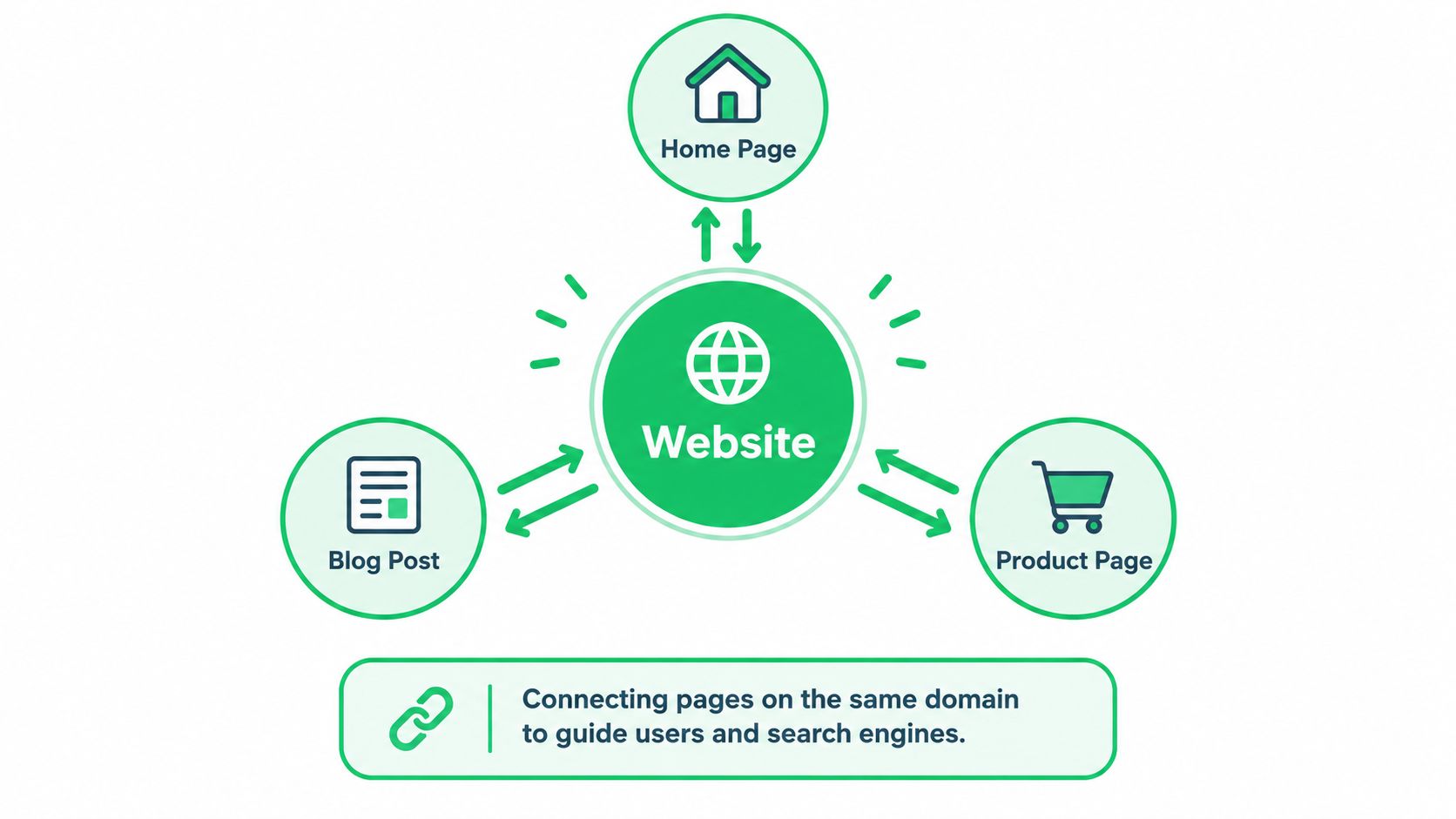
Internal linking is the practice of connecting pages on the same website with hyperlinks. It matters for SEO because it helps search engines crawl, index and prioritise commercially important pages while guiding visitors towards enquiry pages.
A Melbourne business might have excellent service pages, suburb pages and helpful articles, yet still lose opportunities because those pages aren't connected clearly. A blocked-drain guide may attract a potential customer, but without a relevant path to emergency plumbing or a quote page, the visitor and the crawler can both miss the page that matters commercially.
Table of Contents
- What Internal Linking Actually Means
- How Internal Linking Helps Search Engines and Users
- Why It Matters for Melbourne Service Businesses
- How to Build a Strong Internal Linking Structure
- Measuring Whether Your Internal Linking Is Working
- Common Internal Linking Mistakes and How to Avoid Them
- Questions Melbourne Businesses Ask About Internal Linking
- A Clear Path Forward for Your Site Architecture
What Internal Linking Actually Means
An internal link points from one page to another page on the same website. A link from a plumbing guide to an emergency plumbing service page is internal. A link from that guide to a government website or an industry publication is external.
The distinction sounds simple, but it shapes the whole website. Internal links create a navigable structure that lets visitors move between related information and gives search-engine crawlers routes through the site. Google's guidance recommends that important pages be reachable through standard HTML anchor elements with an href attribute, and that each page worth indexing should receive at least one internal link through the site's architecture (Google's guidance on link architecture).
Why the Australian context matters
The architecture matters at significant scale in Australia. The Australian Communications and Media Authority's 2025 internet-use findings recorded that 99.7% of Australian adults used at least one device to go online during the measured six months, compared with 90% in 2019. At-home internet access reached 99% in June 2025, and 94% of Australians used the internet to access news and information in 2025.
For a local dentist, accountant or tradie, this means the website's structure affects a very large potential audience, including people searching on mobile devices. A site with clear pathways can lead someone from an educational article to a relevant service, location and contact page. A site with isolated URLs may leave useful content disconnected from the customer journey.
Google remains the dominant general-search service in Australia. The Australian Competition and Consumer Commission's September 2024 report reported that Google held nearly 94% of Australia's general-search market in August 2024, while Bing held 4.7%. These figures don't prove that any individual link will improve rankings, but they show why crawlable, understandable architecture matters to Australian businesses.
For a practical reference point, a page about XML sitemaps and what they should include can support a broader understanding of discovery, but a sitemap isn't a replacement for meaningful links between pages. Internal linking is a structural decision, not merely a convenience feature.
How Internal Linking Helps Search Engines and Users
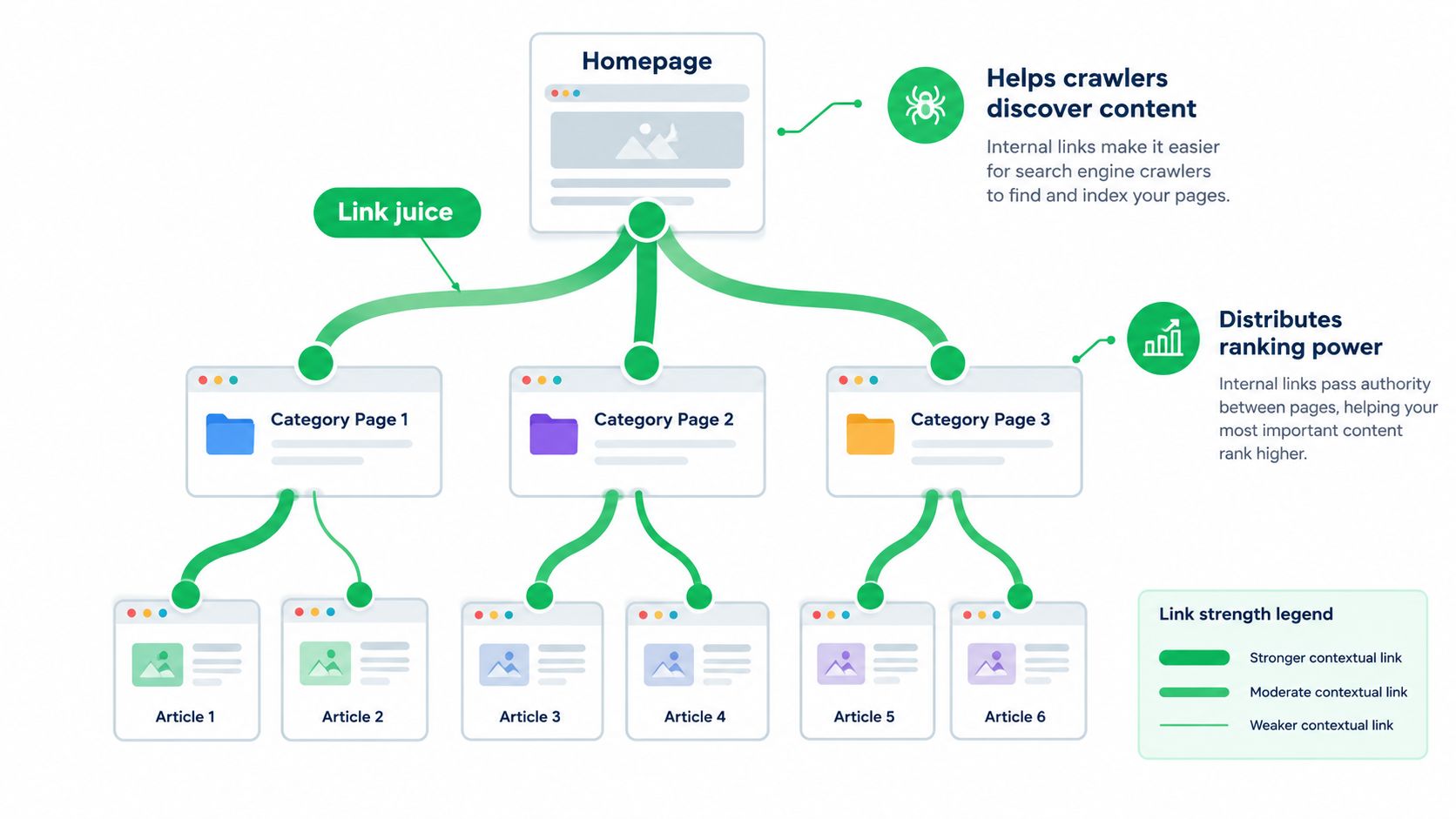
Think of a website as a building. The homepage is the entrance, service pages are important rooms, supporting articles are information areas, and internal links are the hallways and signs between them. A crawler can only understand the building properly when the routes are open and the signs describe where each route leads.
The five connected benefits
Crawlability comes first. Search engines follow crawlable links to discover URLs. If an important service page has no links pointing towards it, the page becomes difficult for both crawlers and visitors to reach. Google's documentation on crawlable links specifically emphasises standard anchor elements and descriptive destinations.
Indexation is different from discovery. Finding a URL doesn't guarantee that Google will store it in its index, but a logical internal route gives the page a fair opportunity to be found, assessed and connected with related content. A new suburb page linked from a relevant service hub is easier to interpret than an orphaned page hidden inside a campaign folder.
Internal authority can flow through links. A well-established page may help direct attention towards a newer or less prominent, relevant page. This isn't a guarantee of rankings, and it doesn't mean every link carries equal importance. The useful question is whether an authoritative internal page is pointing to a destination that genuinely matters to the reader.
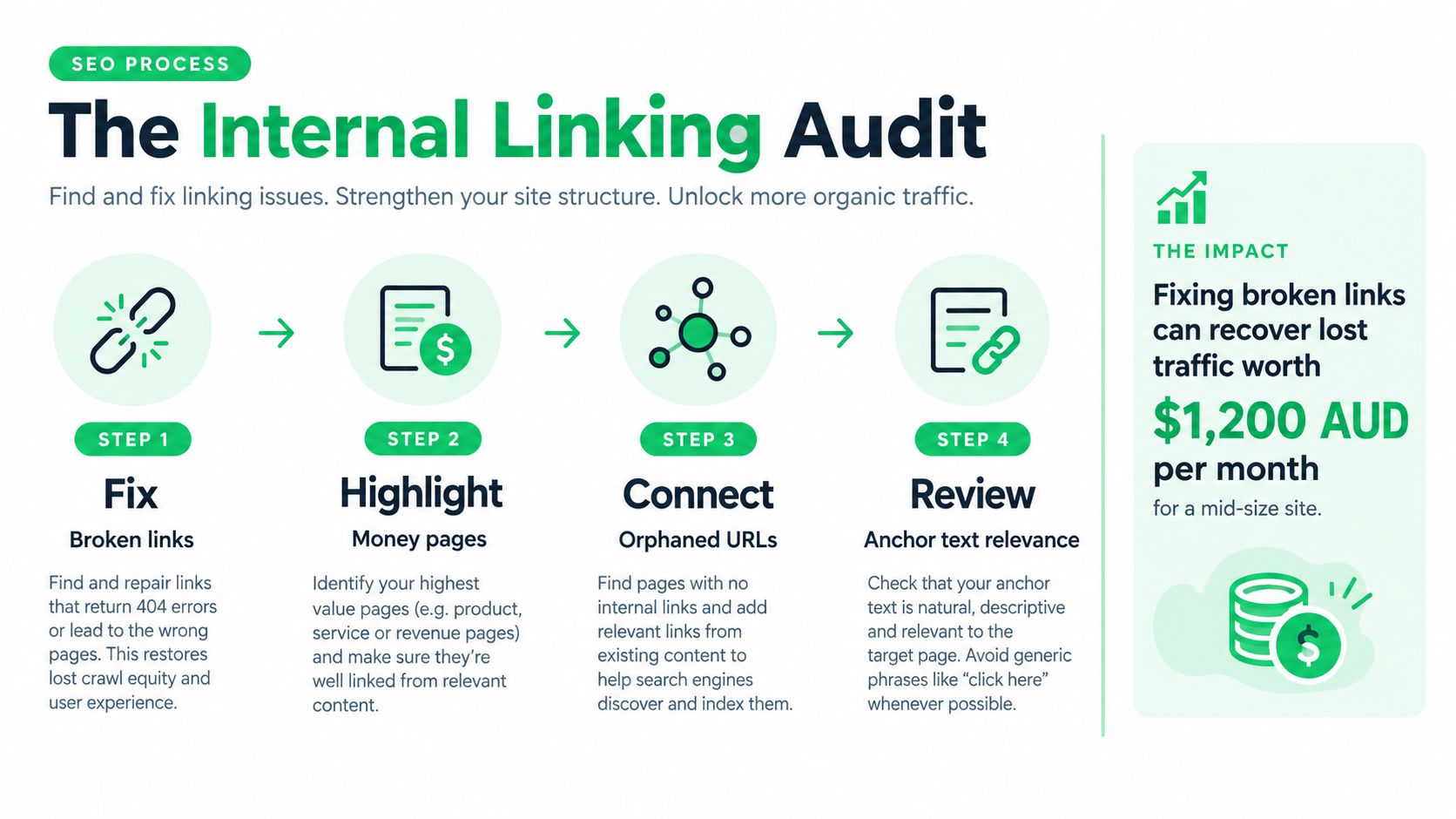
Relevance comes from context. Anchor text is the clickable wording, so “emergency plumbing in Melbourne” explains more than “click here”. The surrounding sentence, the source page and the destination page should all support the same relationship.
User experience completes the chain. A reader researching blocked drains may need urgent plumbing assistance. A link to an emergency plumbing page gives that visitor a sensible next step instead of forcing a return to the menu.
A Melbourne dental site can apply the same logic. An article explaining dental implants might link to the implants service page, suitability information and the booking page. A visitor gets context before making contact, while the site presents a clearer relationship between education, treatment and conversion.
Practical rule: Every internal link should answer a simple question: what useful next step does this give the visitor, and what does it tell a crawler about the destination?
The relationship between search intent and SEO helps determine whether that next step makes sense. An informational article shouldn't link randomly to every commercial page. It should connect readers to the service, location or explanation that matches their likely need.
Why It Matters for Melbourne Service Businesses
Service websites rarely have just one important page. A Melbourne plumber may serve multiple suburbs and offer blocked-drain, hot-water, gas and emergency services. A dental practice may separate examinations, implants, emergency care and cosmetic treatments. An accounting firm may publish distinct pages for tax, business advice and SMSF work.
That creates a practical architecture challenge. Blog content can attract early-stage visitors, while service and location pages usually provide the clearest route to an enquiry. Without internal links between those layers, a website may receive relevant attention but fail to guide people towards the action that supports the business.
Three commercial pathways
Local discovery improves when suburb pages and service pages sit in clear relationships. A suburb page can connect to the relevant service hub, while the hub can connect back to useful local pages. This doesn't replace local relevance, quality content or a properly maintained business profile, but it makes the site's location structure easier to interpret.
Qualified traffic depends on context. Someone reading about blocked drains has already expressed a problem. A carefully placed link to emergency plumbing can move that person towards a more appropriate commercial page than a generic link to the homepage.
Enquiries need a visible route. A service page should make it straightforward to reach a quote, booking or contact page. That route should work for users and crawlers, rather than relying on a visitor to guess where the next step sits in the navigation.
The local SEO guidance for Melbourne businesses complements this architecture approach. Internal linking can't compensate for unclear services, thin location pages or poor conversion information. It can, however, connect the pages that already serve those purposes.
What good looks like
- Priority pages are reachable: Core services and enquiry pages aren't stranded in obscure folders.
- Related pages support one another: Guides, suburb pages and service pages have sensible connections.
- Anchors describe destinations: Link labels make sense without the surrounding paragraph.
- The structure reflects the business: The website mirrors actual services, locations and customer journeys.
- Visitors can move towards action: Informational content offers a relevant next step without forcing a hard sell.
A coherent link graph helps the business avoid a common problem: traffic arriving on a useful article while the page that generates enquiries remains invisible within the site.
How to Build a Strong Internal Linking Structure
A useful internal-linking project starts with business priorities, not with a target number of links. The sequence below gives a small service business a practical way to begin.
Start with an audit
List the pages that support revenue or qualified enquiries. Then inspect how each page is reached.
Look for:
- Orphan URLs: Pages with no meaningful internal links pointing towards them.
- Broken destinations: Links returning an error rather than a usable page.
- Script-only navigation: Menus or interactive elements that don't expose a standard crawlable anchor.
- Unnecessary depth: Important pages buried beneath long chains of clicks.
- Weak destinations: Links pointing to redirected, canonicalised, non-indexable or outdated URLs.
A crawl tool can reveal technical patterns, while a manual review explains whether the links make sense to a customer. The technical SEO checklist for small business can help place internal links within the wider crawl and indexing review.
Put money pages where they belong
A page that generates bookings or quote requests shouldn't be harder to reach than a low-value archive. The homepage and primary navigation should usually expose core services, while relevant supporting content reinforces them.
For a tradie, a suburb page might link to emergency plumbing, blocked drains and the quote page. For a dentist, implant education content can lead to the implants treatment page and then to booking. For an accountant, an SMSF advisory article can connect to the SMSF service page, eligibility information and an enquiry form.
This isn't a demand for every page to link to every other page. It is a prioritisation exercise. Important destinations deserve prominent, relevant routes.
Build hubs and spokes
A hub-and-spoke model gives the site a clear shape. The hub covers a broad commercial topic, while supporting pages answer narrower questions or serve particular locations.
A plumbing hub could link to blocked drains, emergency plumbing, hot-water systems and suburb pages. Those supporting pages can link back to the hub where appropriate, as well as to related services. The same model works for dental treatments and accounting services, provided the relationships are genuine rather than manufactured for keywords.
Write useful anchor text
Anchor text should tell the visitor what lies beyond the click. Descriptive wording can include a location where that information is part of the destination, but it shouldn't be forced into every link.
“View emergency plumbing in Melbourne” is clearer than “learn more”. “Read the SMSF advisory guide” is more informative than “click here”. Repetition can make copy awkward, so natural variations are preferable to mechanically using one phrase.
The accessibility benefit matters too. South Australian guidance on accessible documents and online information notes that descriptive links support WCAG 2.2 Level AA practice because screen readers may present links in a separate list, without the surrounding paragraph.
A link label should still make sense when a reader hears it without the sentence around it.
Remove crawl barriers
After the structure is planned, repair the routes. Update links that point to redirected URLs, remove links to pages marked noindex when those pages aren't intended as destinations, and check that canonicalised URLs aren't being treated as primary targets. The final structure should make the preferred page easy to find through clean, direct paths.
Measuring Whether Your Internal Linking Is Working
Internal linking should be assessed through access, relevance and business outcomes rather than through link counts alone. The first task is to separate three states that are often confused.
Discoverable means a crawler can reach the URL through a crawlable path. A crawl tool can help confirm whether the page has incoming internal links and whether those links return usable responses.
Indexed means the search engine has stored the page as a candidate for search results. Search Console can provide indexing information, but discovery alone doesn't guarantee indexation.
Ranking means the page appears for search queries. Search Console can show impressions, clicks and average position for a target URL. Comparing those signals before and after a considered restructure can reveal whether the page is receiving more search visibility, though several SEO changes may affect the result at the same time.
Analytics adds the customer layer. A business can examine whether visitors move from guides to service pages, whether those pathways assist conversions and whether enquiry rates change after navigation is improved. The point isn't to claim that one link caused every enquiry. Attribution is imperfect, especially when customers return through another channel or contact the business offline.
A practical measurement stack
| Metric | Where to find it | What it tells you |
|---|---|---|
| Impressions | Google Search Console | Whether target URLs are appearing in search |
| Clicks | Google Search Console | Whether searchers visit those URLs |
| Average position | Google Search Console | How the target URL is performing for recorded queries |
| Assisted conversions | Analytics platform | Whether internal pathways support enquiries before conversion |
| Enquiry rate | Analytics and call or form tracking | Whether qualified visits are producing business actions |
| Incoming internal links | Crawl tool | Whether priority pages are connected and discoverable |
| Broken or redirected links | Crawl tool | Whether technical barriers interrupt the intended route |
Results shouldn't be judged overnight. Search engines need to recrawl and reassess changed relationships, and businesses need enough activity to observe meaningful enquiry patterns. Weekly checks can catch broken links, new orphan pages and technical changes. A broader architecture and conversion review suits a quarterly cycle for most service sites.
Common Internal Linking Mistakes and How to Avoid Them
More links aren't automatically better. A dense web of repetitive or unrelated links can make a page difficult to read and weaken the distinction between important and incidental destinations.
A Melbourne dental site might publish an emergency-care page but link to it only from an old blog post buried several levels down. The page technically exists, yet a visitor with urgent intent may never find it, and a crawler receives little architectural evidence that the page matters.
The patterns that cause trouble
- Orphaned commercial pages: Add contextual links from the relevant service hub, location pages and related guides.
- JavaScript-only routes: Use standard HTML anchors for important navigation rather than depending on an interaction that may not expose a crawlable destination.
- Generic anchors: Replace “read more” with wording such as “book a Melbourne dental emergency appointment” when that accurately describes the destination.
- Canonical or non-indexable targets: Link directly to the preferred, indexable URL instead of sending users through redirects or towards a page that isn't intended to appear in search.
- Flat linking: Don't connect every page to every other page. Group related content around clear hubs so the architecture expresses priority and subject relationships.
- Repeated irrelevant links: Remove links that exist only to insert a keyword or fill a template. Relevance and usefulness should decide whether a link stays.
The Google technical explanation of link architecture reinforces the principle that important content should be easy to reach, without prescribing a universal number of clicks or links. A smaller, intentional structure can be more useful than a crowded one.
Internal linking is therefore an architecture-quality problem. It deserves the same care as navigation, page templates and conversion paths, not a last-minute decoration added to blog posts.
Questions Melbourne Businesses Ask About Internal Linking
How many internal links should a page have?
There isn't a useful universal number. A page should link to destinations that help the visitor and clarify the subject, while keeping the content readable and crawlable. A service page may need links to related treatments, locations and booking information, whereas a focused contact page may need far fewer.
Do XML sitemaps replace internal links?
No. Sitemaps can help search engines discover URLs, but they don't provide the same contextual relevance, user navigation or internal authority signals as crawlable links. Important pages still need meaningful routes from other pages.
How often should a service site review its links?
A quarterly review suits most Melbourne service sites, with additional checks whenever services, suburbs, templates or navigation change. New content should receive relevant links soon after publication so it doesn't become isolated.
When should an agency help?
Professional assistance makes sense when an audit reveals structural debt, multiple orphan pages, complex templates, redirect chains or technical barriers that the internal team can't safely change. An agency can also help when the business needs to connect architecture changes with Search Console, analytics and enquiry tracking.
A Clear Path Forward for Your Site Architecture
Internal linking is the connective tissue of a website. For an Australian service business, it influences whether the right service, suburb and enquiry pages can be crawled, indexed, understood and reached by potential customers.
The guiding principle is simple: architecture quality beats link quantity. Audit the existing paths, prioritise money pages, structure related content, write descriptive anchors, fix crawl barriers and measure qualified visits and enquiries.
A practical starting point is a one-page review of one important service URL. Check which pages link to it, whether those links are crawlable and descriptive, whether the page links to a sensible enquiry route, and whether Search Console and analytics can show what happens next.
SEO2RANK helps Melbourne service businesses audit and improve internal links between service pages, location pages, guides and articles, alongside broader local, technical and measurement work. Businesses can visit SEO2RANK to review the available SEO Snapshot, audit and ongoing support options.
Find Out What Is Holding Your
Website Back
Get a practical SEO Snapshot showing the biggest issues and opportunities we can see across your search visibility, website and local presence.
GET YOUR FREE SEO SNAPSHOT