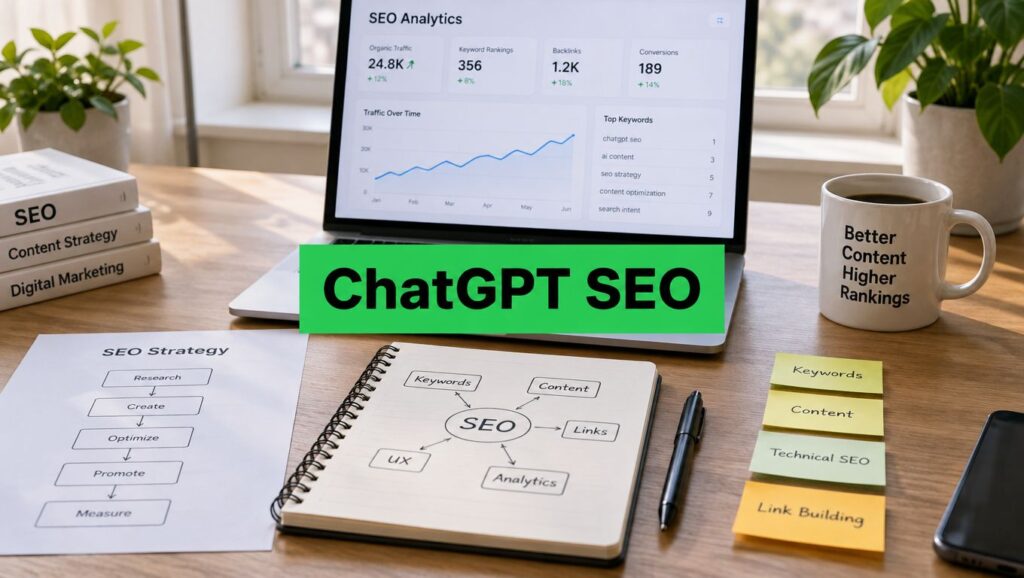
ChatGPT can support substantial SEO production work, but it can't independently guarantee accuracy, crawlability, rankings or lead generation. It works as a controlled assistant for keyword clustering, content briefs, meta drafting and technical audit triage, with human validation at every important decision.
That answer may sound cautious, but it reflects what happens in Australian SEO workflows. Generative AI adoption is growing, with 49% of Australians having used a generative-AI tool in the previous year by January 2025, compared with 38% in 2023, according to Australian search engine usage research. That adoption doesn't prove that an AI recommendation reflects what customers in Melbourne search for, or that it will produce a technically sound page.
Table of Contents
- The Short Answer on ChatGPT and SEO
- How Search Ranking Actually Works
- SEO Tasks ChatGPT Handles Well
- Where ChatGPT Fails and Creates Risk
- A Safe Workflow From Prompt to Verified Fix
- Why Local SEO Needs Human Judgement in Melbourne
- Privacy Rules Australian Businesses Cannot Skip
- ChatGPT SEO and Visibility in AI Search Answers
- Quick-Reference Checklist and When to Get Help
The Short Answer on ChatGPT and SEO
ChatGPT can handle a substantial amount of repeatable SEO production. It can cluster keyword exports, turn research into content briefs, draft title tags and meta descriptions, suggest internal links, generate schema markup, assist with log analysis and sort technical audit findings into likely priorities. The OAIC's guidance on generative AI supports the practical distinction between using AI as an aid and treating it as an autonomous system.
The important boundary is between producing SEO work and delivering SEO outcomes. ChatGPT can draft a recommendation, but it can't independently confirm that a page is crawlable, that structured data renders correctly, that a suburb is relevant, that a keyword has meaningful local demand, or that an enquiry came from the change. It also can't guarantee Australian privacy compliance, factual accuracy, indexing, rankings or lead generation.
For a Melbourne business, the useful model is controlled decision support:
- The business or SEO specialist supplies verified inputs, such as Search Console data, analytics, crawl exports, Google Business Profile information and approved service-area details.
- ChatGPT classifies or drafts against clear criteria, rather than inventing a strategy from an open-ended prompt.
- A human checks the recommendation, tests the implementation and measures what happens after publication.
Practical rule: Use ChatGPT to reduce blank-page time and organise evidence. Don't use it as the evidence.
That distinction matters most for tradies, dentists, accountants and other service businesses. A polished page can still target the wrong suburb, make an unsupported claim or fail to match a customer ready to call. ChatGPT is useful inside a disciplined SEO process, not instead of one.
How Search Ranking Actually Works
Search visibility depends on a pipeline with three broad stages.
Crawling comes first
Search engines discover pages by following links and revisiting known URLs. A page can contain excellent writing and still struggle if the site blocks access, creates confusing navigation or gives crawlers weak signals about which URLs matter.
ChatGPT can explain crawl issues in plain English or help group findings from a crawl export. It can't confirm the live site behaves as expected unless a specialist checks the implementation with the relevant tools.
Indexing decides what enters the library
After a search engine accesses a page, it decides whether and how to store that page in its index. Indexing can be affected by canonical signals, duplication, page quality, technical directives and the relationship between a page and the rest of the site.
A generated recommendation might say that a canonical tag should be changed, or that a page needs more supporting content. That output is only a hypothesis until someone checks the rendered HTML, competing URLs and actual indexing state.
Ranking matches results to a query
Ranking systems select and order pages that appear relevant and useful for a search. Relevance includes the meaning of the query, the service offered, location context and the intent behind the search. Trust and quality depend on the page, the business, the website and the broader evidence available to search engines.
This explains why some SEO tasks suit AI better than others:
- Text-based, repeatable work is easier to accelerate, such as clustering, outlining and rewriting.
- Live-site diagnosis needs access to current technical conditions.
- Local strategy needs suburb, competitor and customer judgement.
- Outcome decisions need conversion data and accountability.
ChatGPT can help someone move through the pipeline more efficiently, but it doesn't control crawling, indexing or ranking. Search engines decide those outcomes after the work is published and evaluated.
SEO Tasks ChatGPT Handles Well
ChatGPT earns its place when the input is reliable and the output is easy to inspect. It's particularly useful for turning messy SEO material into an organised working document.
Clustering and briefing
A Search Console export can contain many variations around the same service or question. ChatGPT can group those queries into themes, identify likely page relationships and create a draft content brief with headings, user questions, internal-link opportunities and required source material.
The human check is straightforward: compare the clusters with actual impressions, clicks, landing pages and search results. A useful workflow can also start with keyword research for customer search behaviour rather than accepting generated keyword ideas as demand evidence.
Metadata and internal links
ChatGPT can produce several title and meta-description options, then adapt them to a brand voice. It can also inspect a supplied page list and suggest links between a service page, a supporting article and a relevant location page.
The reviewer needs to check accuracy, duplication, page relevance and how the text appears in the site's templates. Metadata shouldn't promise a service the business doesn't provide, and an internal link shouldn't send a customer to a merely related page with a different intent.
Schema and technical triage
Structured-data generation is another useful drafting task. ChatGPT can create a first version of JSON-LD from verified business and page details. A technical audit export can also be sorted into categories such as crawlability, indexation, templates, performance and content.
The implementation still needs testing in a structured-data validator, browser rendering tools and the live site. Schema that describes the wrong organisation, service or review is worse than no schema because it introduces inaccurate signals.
Logs and content refinement
With suitable, sanitised log data, ChatGPT can help explain crawler patterns or identify URL groups that deserve inspection. It can also compare an existing draft with a brief, remove repetition and suggest clearer wording.
The reviewer must confirm that the interpretation matches the data and that the revised copy preserves the business's actual expertise. AI can improve structure, but it doesn't supply first-hand evidence.
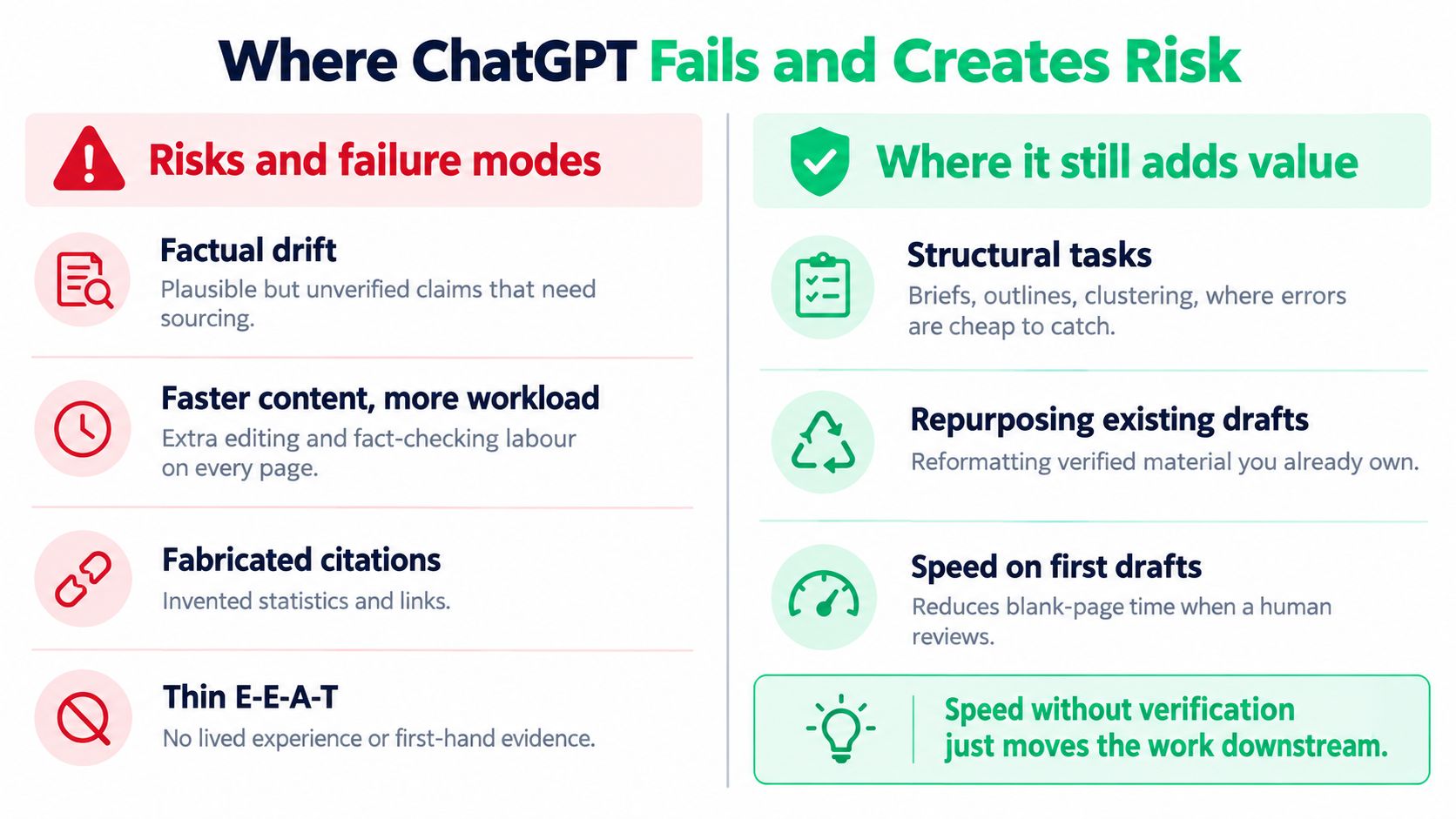
Speed without verification just moves the work downstream.
Where ChatGPT Fails and Creates Risk
Faster content production can increase workload when it creates pages that need extensive factual checking, editing and implementation. A draft that takes minutes to generate can require careful review if it includes unsupported claims, invented references or details that don't apply to the business.
ChatGPT's errors often sound reasonable. It may produce a statistic without a reliable source, describe a service area the business doesn't cover, or recommend a technical change that conflicts with the site's platform. The problem isn't limited to obvious nonsense. Plausible inaccuracies are harder to spot and more likely to reach customers.
Common failure modes
- Fabricated evidence: Generated text can contain invented statistics, citations, links or attributed claims.
- Local mismatch: A suggested suburb or service area may be plausible but irrelevant to the actual business.
- Weak demand: A keyword can describe a service accurately while attracting little real search demand.
- Generic intent: A service page may explain a topic without addressing the commercial question behind a customer's search.
- Implementation errors: Code, schema or redirect advice can be incomplete, syntactically wrong or unsuitable for the platform.
These risks are why a Melbourne SEO team shouldn't publish a generated page merely because it reads naturally. Every fact needs a source or business confirmation, every local statement needs approval, and every technical change needs testing.
A useful companion to this approach is understanding how Google treats AI content, but the practical issue remains broader than whether text was generated. The business still needs useful, accurate information that matches the query and works on the live website.
ChatGPT can't independently guarantee factual accuracy, crawlability, indexing, rankings or lead-generation outcomes. It can help identify possible actions, but an accountable person must decide whether those actions belong on the site.
A Safe Workflow From Prompt to Verified Fix
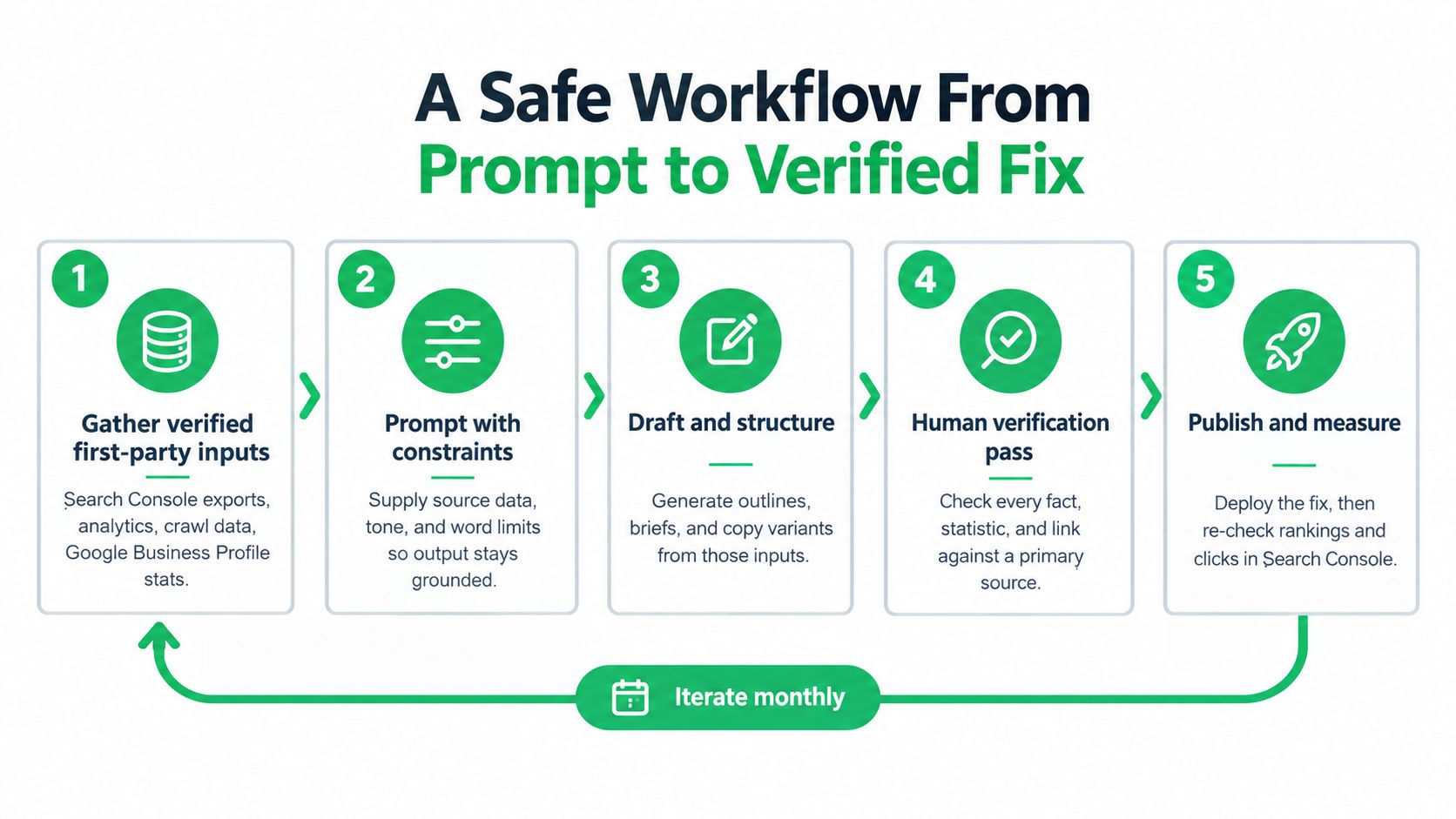
A safe process starts before the prompt. The strongest input is verified, relevant and limited to the decision being made.
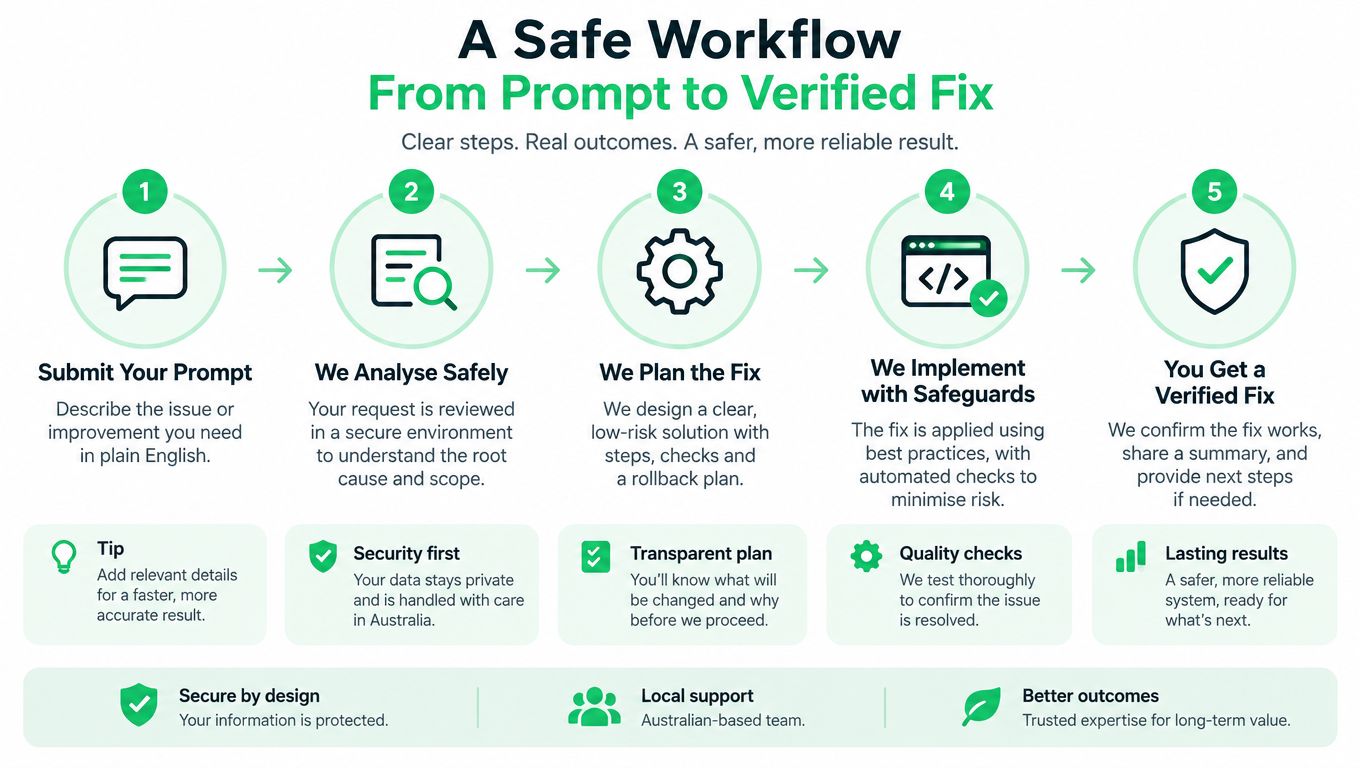
1. Gather first-party evidence
Prepare the material that reflects the actual site and business:
- Google Search Console queries, pages and performance exports
- Analytics landing-page and conversion information
- Crawl findings and URL classifications
- Google Business Profile information and actions
- Approved services, suburbs and service-area boundaries
Remove irrelevant or identifying information before sharing anything with a publicly available tool. The prompt should describe the decision, the available evidence and the limits on what ChatGPT may assume.
2. Set acceptance criteria
An open request such as “improve this page for SEO” encourages generic output. A controlled request is more useful:
Classify these crawl findings by impact and confidence. Use only the supplied data. Don't invent causes. For each item, provide the evidence, the proposed action, the implementation risk and the test required before release.
That instruction gives the reviewer something auditable. It also makes uncertainty visible instead of allowing confident language to hide missing evidence.
3. Draft, validate and measure
Consider a Melbourne plumber's service page. The input might include the current URL, approved services, target suburbs, Search Console queries and a crawl extract. ChatGPT could propose a clearer heading structure, group related queries and draft an internal-link plan.
Before publication, the reviewer checks:
- Each service and suburb is accurate.
- The page matches the intent shown by local search results.
- Claims are supported by business records or primary sources.
- Internal links point to relevant live pages.
- Schema describes the page correctly.
- The rendered page works on mobile and desktop.
- Performance and structured data pass the relevant tests.
- Search Console and conversion tracking can measure the change.
The page is then published and monitored. If the result doesn't match the intended query or produces poor-quality enquiries, the team revisits the evidence rather than asking AI to generate more copy blindly.
Why Local SEO Needs Human Judgement in Melbourne
Local SEO in Melbourne is where AI gets exposed fast. ChatGPT can produce a page that sounds convincing, yet still miss the suburb, the service intent, or the signals Google is showing in local results. For local work, I treat AI as a decision-support layer, not the decision-maker.
A plumber can be given a suburb list that looks tidy on paper but includes areas the business does not service. A dentist can end up with a page built around a broad treatment phrase when the actual opportunity is a suburb-specific query tied to bookings. An accountant can publish polished copy about “business accounting solutions” that never makes clear who it serves, where it serves them, or what the next step is for the prospect.
That gap matters because Melbourne is not one uniform market. Search intent shifts between nearby suburbs, between urgent and research-led services, and between mobile searchers and desktop users comparing options.
What the human layer checks
Before any AI suggestion goes live, the reviewer checks it against evidence from the business and from the live results page:
- Local SERPs: Which businesses are visible, what page types rank, and what details are repeated in titles, headings and GBP panels?
- Search Console queries: Which terms already bring impressions, and which wording Google is already associating with the site?
- Google Business Profile data: Which categories, services, locations and actions line up with the recommendation?
- Competitor context: What local competitors explain clearly that this business still leaves vague?
- Enquiry language: What do callers and form submissions ask for in plain English?
- Compliance constraints: Are there limits on claims, testimonials or advice in this sector?
I also check whether the prompt or draft included anything it should not, especially client details or internal context that does not belong in a general AI tool. That is part of quality control, not just privacy hygiene.
A practical local SEO checklist for Melbourne businesses can organise the work, but a checklist will not tell you whether a Fitzroy page should target the same angle as a Glen Waverley page. Human judgement does that.
Privacy Rules Australian Businesses Cannot Skip
SEO teams often handle information that wasn't collected for AI experimentation. Customer enquiries, patient notes, CRM exports, staff details and named testimonials can all appear in documents used to brief a writer or diagnose a conversion problem.
The Office of the Australian Information Commissioner states that the Privacy Act 1988 and Australian Privacy Principles apply to all uses of AI involving personal information, including training, testing and use of an AI system. The OAIC also recommends, as best practice, not entering personal information, especially sensitive information, into publicly available generative-AI tools because of significant and complex privacy risks, as explained in its guidance on commercially available AI products.
What needs to stay out of ordinary prompts
A business owner should remove or generalise:
- Customer names, phone numbers, email addresses and addresses
- Patient details, treatment histories and appointment information
- Enquiry forms containing personal circumstances
- Named testimonials and identifiable review comments
- Employee names, performance information and contact details
- CRM extracts, invoices or client records
Healthcare, dental and financial-services businesses need particular care because their material can involve sensitive information. Replacing a person's name with “Client A” may not be enough if the surrounding details still make the person identifiable.
Public availability doesn't automatically remove the issue. The OAIC explains in its guidance on generative AI and personal information that accessible information may still contain personal information. Incorrect or artificially generated information can also be personal information when it concerns an identified or reasonably identifiable person.
A safer SEO prompt uses aggregated query data, anonymised examples, approved business facts and public page content that has been checked for personal details. Where the decision involves identifiable information, the organisation should obtain appropriate privacy and legal advice rather than assuming an AI tool makes the data safe.
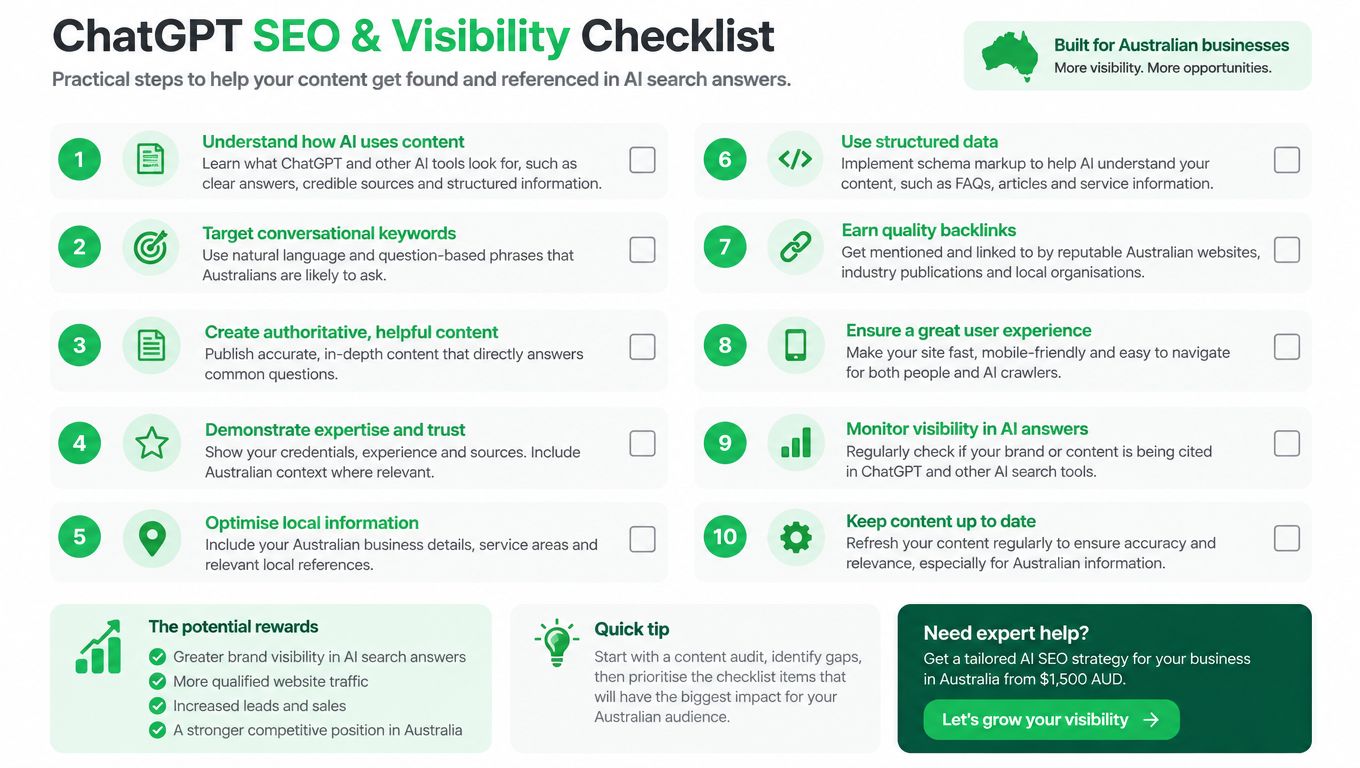
ChatGPT SEO and Visibility in AI Search Answers
ChatGPT can help a business prepare clearer service information, frequently asked questions, entity descriptions and source material for search systems. It can't control whether an AI answer cites the business, recommends it or sends a visitor to the website.
Australian commentary illustrates why AI visibility figures need careful interpretation. One report says AI Overviews appeared for roughly 39% of Australian Google searches in mid-2025, while another benchmark claims 87% for a selected set of marketing searches in October 2026. The Australian AI Overview benchmark presents the difference as a measurement problem, with results varying by dataset, query type, industry, date and method.
Visibility isn't the same as a lead
An AI answer might summarise a service without producing a website click. It might cite a third-party directory instead of the company's page, mention a business without a phone call, or omit a relevant local provider entirely.
That makes “appears in AI answers” a useful observation, but a weak standalone business KPI. A Melbourne business should keep measuring the outcomes that connect to demand:
- Branded and non-branded impressions
- Qualified calls and forms
- Referral traffic where it can be identified
- Google Business Profile actions
- Manually sampled AI answers over time
The sampling process needs consistent questions, locations and records. A team might test service-and-suburb queries, note which businesses appear, record cited sources and compare those observations with Search Console and enquiry data.
AI search may be reducing website clicks is a useful strategic consideration, but AI visibility shouldn't replace technical SEO, local relevance, conversion tracking or revenue-based reporting. The sensible approach is to improve the underlying clarity and accessibility of the business, then observe how different search experiences represent it.
Quick-Reference Checklist and When to Get Help
The following matrix keeps responsibility clear. “ChatGPT alone” means the task is suitable for a draft or classification, not that the output should be published without normal editorial checks.
SEO Task Matrix Who Should Do the Work
| SEO Task | ChatGPT Alone | ChatGPT With Review | Human Only |
|---|---|---|---|
| Keyword clustering | Initial grouping | Validate against Search Console and local demand | Final targeting decision |
| Meta drafting | Variations and tone options | Check accuracy, intent and display suitability | Brand and compliance approval |
| Schema generation | First draft from verified fields | Validate in structured-data tools | Final implementation decision |
| Technical audit triage | Sort and explain findings | Confirm evidence and priority | Live-site remediation |
| Local SERP validation | Summarise supplied observations | Compare suburb, intent and competitors | Strategic local judgement |
| Business Profile optimisation | Draft service and description ideas | Check categories, services and policy fit | Final profile ownership decisions |
| Compliance review | Identify possible issues | Apply internal policy and specialist advice | Legal or privacy sign-off |
| Strategy and reporting | Summarise supplied data | Interpret trends and actions | Commercial priorities and accountability |
A practical starting checklist is short:
- Export the relevant Search Console, analytics, crawl and Business Profile data.
- Remove names, contact details, patient information and identifiable records.
- Give ChatGPT explicit constraints and acceptance criteria.
- Require evidence for every factual recommendation.
- Check local SERPs and actual customer language.
- Test code, rendering, structured data and performance before publishing.
- Record the change and measure impressions, traffic, calls and forms.
- Keep AI visibility as an additional observation layer, not the whole reporting system.
Professional help makes sense when technical problems limit crawling or indexing, local visibility affects lead flow, or AI-assisted production has outgrown the team's review capacity. SEO2RANK offers audits, local and technical SEO, content and on-page work, implementation where access permits, and reporting connected to visibility and enquiry metrics for Melbourne service businesses. A specialist can validate what AI drafts and handle the live-site decisions that require context.
The key takeaway is simple: ChatGPT can accelerate SEO work, but verified data, local judgement, privacy discipline and human accountability still determine whether that work is useful.
SEO2RANK can assess where AI-assisted SEO fits within a Melbourne business's local, technical and content workflow, then validate and implement the changes that matter. Visit SEO2RANK to review the available SEO audits and support options.
Find Out What Is Holding Your
Website Back
Get a practical SEO Snapshot showing the biggest issues and opportunities we can see across your search visibility, website and local presence.
GET YOUR FREE SEO SNAPSHOT