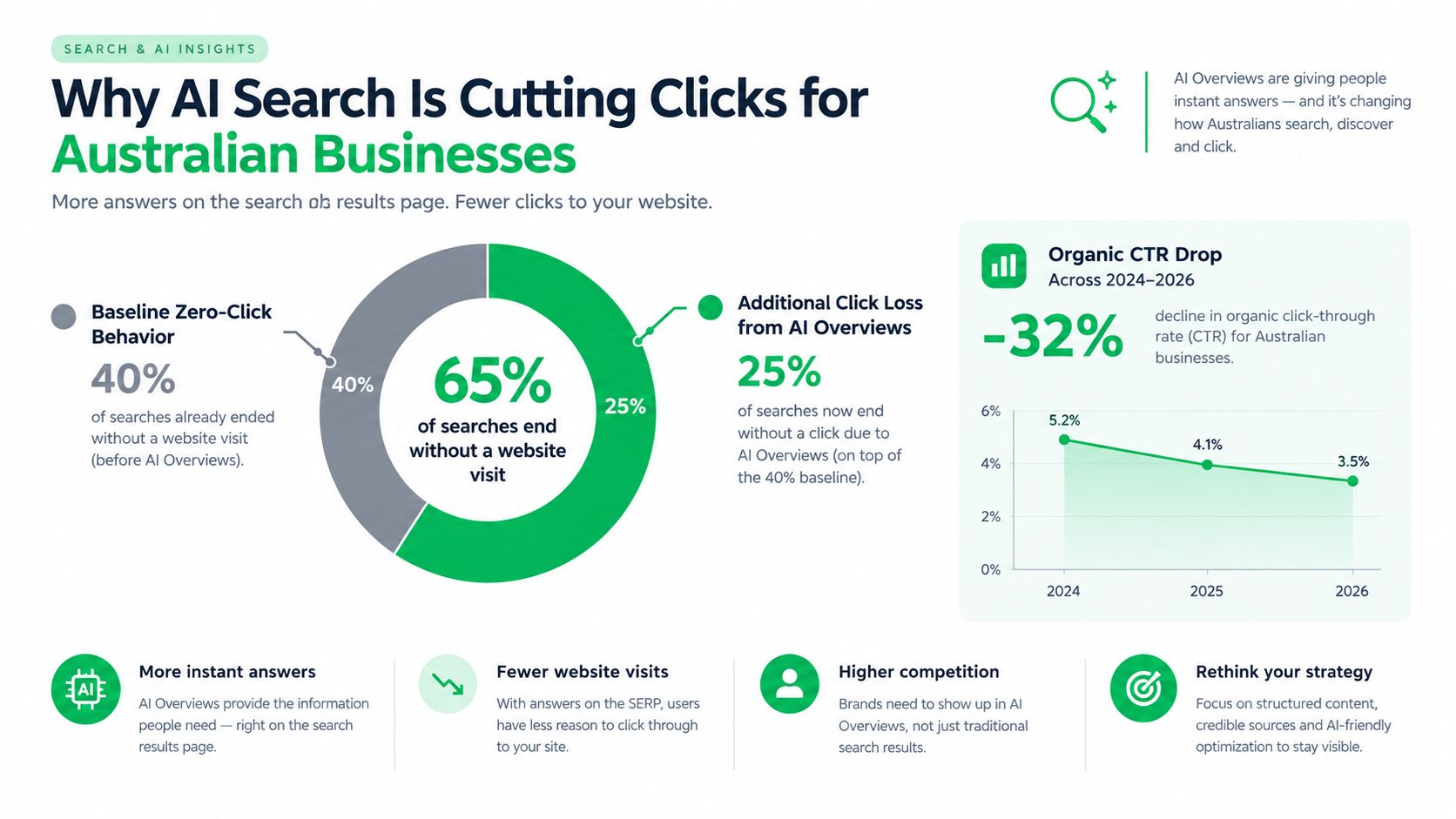
AI Overviews intensify Australia's already dominant zero-click pattern. In Australia, 65% of Google searches ended without a website click, rising to 83% when an AI Overview was present, so ranking alone is no longer enough for Melbourne service businesses.
That changes the commercial SEO brief. A tradie, clinic, accountant or professional practice can still rank well and receive fewer visits because Google answers the question before the searcher reaches the site. The practical response isn't to chase traffic at any cost. It's to make the remaining clicks more valuable, strengthen the Google Business Profile, and give search systems clear reasons to cite the business.
Table of Contents
- Why AI Search Is Cutting Clicks for Australian Businesses
- The Core Terms You Need to Know
- The Click Data at a Glance
- Why Local Service Businesses Are Exposed First
- Optimising for Rich Answers and AI Citations
- Getting More From the Clicks You Still Receive
- Making Google Business Profile Work Harder
- Structured Data That Helps AI Understand Your Site
- Reformatting Pages So Answers Are Easy to Extract
- Measuring What Matters in a Zero-Click World
- A Practical 90-Day Response Plan
- Common Questions About AI Search and Clicks
Why AI Search Is Cutting Clicks for Australian Businesses
AI Overviews extend Australia's existing zero-click behaviour. Map packs, calculators, featured snippets and business panels already answered many searches without a website visit. A generated summary now handles more informational and comparison queries in the same result.
The mechanism is simple. Google combines information from several sources into a conversational response, often placing it before individual websites. Someone searching for the likely cost of a blocked drain, signs of a dental problem or the difference between accounting services may get enough context to delay visiting a site.
What the change means in Melbourne
Melbourne service businesses face the greatest pressure higher in the funnel. Informational and comparison searches often influence later enquiries, yet an AI summary can resolve the first question without sending the searcher to a service page. That removes opportunities to reach pricing pages, suburb pages, booking forms and click-to-call buttons.
Google's feature is also appearing across more tracked searches. An Australian industry analysis citing BrightEdge tracking reported AI Overviews on 48% of tracked queries in February 2026, compared with 31% a year earlier. The Australian State of SEO analysis identifies the growing opportunity for search results to intercept organic clicks.
The commercial response is clear. Treat fewer visits as a planning assumption, then protect enquiry volume through stronger visibility and better conversion paths.
Practical rule: A first-place ranking is now an opportunity to be selected, understood and trusted, not a guarantee of a website visit.
Build three defensive layers. Make pages easy for answer systems to extract. Make the Google Business Profile useful before a click. Improve the conversion rate of visitors who do arrive. Melbourne operators who track only rankings and sessions will miss whether search visibility still produces calls, forms and bookings.
The Core Terms You Need to Know
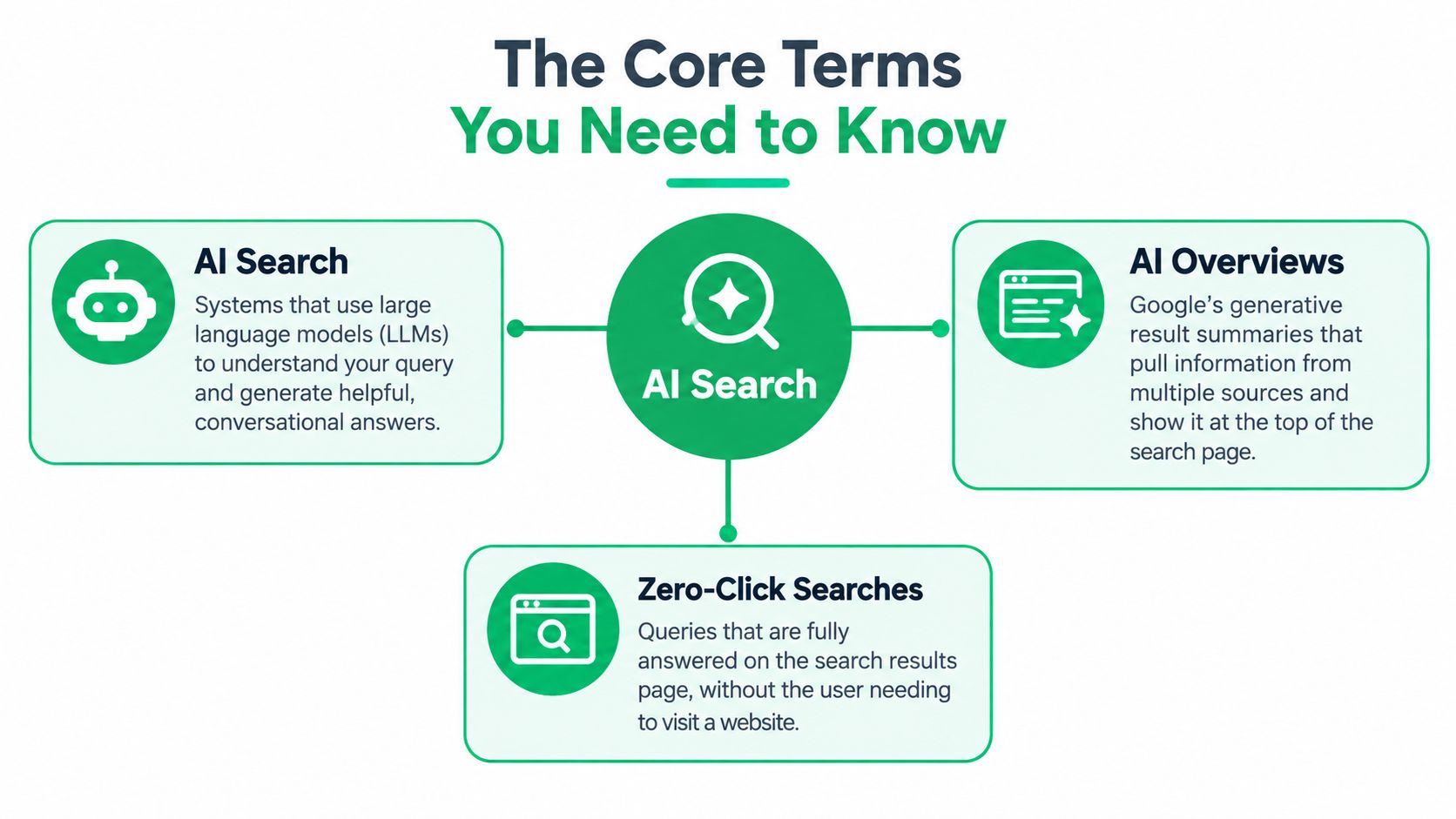
AI search describes a search experience that uses language models to generate, summarise or organise an answer. It can exist inside a search engine or in a standalone tool. For a plumber, a customer asking how to fix a leaking tap may receive a generated explanation rather than a list of pages to browse.
AI Overviews are Google's generated summaries that appear within eligible search results. They can draw together information from multiple sources and may include links to cited pages. They're different from an ordinary blue-link result because the summary occupies attention before the searcher evaluates individual websites.
Zero-click search means the query is resolved without a visit to an external website. A search for “emergency plumber South Melbourne” might end with a phone call from a Google Business Profile, while “how to fix a leaking tap” might end after reading the answer displayed by Google.
A citation is a source that an AI system explicitly names or links within its answer. A citation can help a business earn visibility even when the searcher doesn't click immediately. It also signals that the page contains information the system considers useful enough to reference.
Two related terms
Answer Engine Optimisation, or AEO, focuses on producing direct, extractable answers for search features and answer engines. Generative Engine Optimisation, or GEO, focuses on being mentioned or cited across generative systems. The labels overlap, but the practical work is similar: clear information, strong evidence, consistent business details and pages organised around real questions.
Businesses can identify those questions through keyword research based on customer searches. The important point is simple. AI search doesn't remove the need for useful content. It raises the standard for how clearly that content needs to communicate.
The Click Data at a Glance
The click pool is tightening from several directions. Australian searches already show a strong zero-click pattern, while AI Overviews can answer more of the query before a website appears. Separate research also shows that AI tools are becoming part of how Australians find information. For a local service business, fewer visits should be treated as a working assumption, not a temporary anomaly.
| Source | Metric | Period | Key Figure | What It Means |
|---|---|---|---|---|
| Australian benchmark | Searches ending without a website click | 2026 | 65%, rising to 83% with an AI Overview | AI summaries add further click loss to an existing zero-click pattern. Australian benchmark |
| Pew findings reported in an Australian search roundup | Searches clicking a traditional result with an AI summary | Pew study period not stated in the cited roundup | About 8% | Traditional links receive limited attention after a summary appears. |
| Pew findings reported in the same roundup | Searches clicking a link inside the AI box | Pew study period not stated in the cited roundup | Under 1% | A citation can build visibility without producing a website visit. Both Pew figures come from the Australian search usage roundup |
| Australian search research roundup | Australians encountering an AI Overview | 2026 | Around 64% | AI-generated answers are becoming familiar to local searchers. |
| Australia-focused search research | Australians using an AI tool as their primary information source | 2026 | 12%, up from 5% a year earlier | Some discovery journeys now begin outside traditional search. Both figures are reported in the Australian AI search roundup |
These figures are not one universal click-through rate. They use different datasets, periods and definitions. Read them as directional evidence: Google can satisfy more intent on the results page, and some research now starts in AI tools instead of conventional search.
That changes the job for a local service business. The website still needs to turn high-intent visitors into enquiries, but it cannot carry the entire customer journey. A business must also earn visibility in the answer, appear accurately in local results and make the next action obvious when a searcher does reach the site.
Track enquiry volume alongside sessions, calls, form submissions, profile interactions and direction requests. A fall in organic visits is a warning only when it comes with weaker commercial outcomes. If visits decline while qualified calls and bookings hold steady, the business may be receiving fewer but more decisive clicks. If both decline, the owner needs to improve the pages and local profile that influence the remaining decision.
Why Local Service Businesses Are Exposed First
Local operators face a concentrated problem because their customer journey depends on several Google surfaces at once. The map pack, Business Profile, service page and phone call used to work together as a path to enquiry. An AI summary can interrupt that path before the customer reaches the website.
Four pressure points
- Map visibility: A summary can push local results lower on the page, reducing profile visits even when the business remains visible elsewhere.
- Money pages: Service-area, emergency, pricing and booking pages lose attention when Google provides a direct explanation above them.
- Commercial questions: Searches such as “plumber near me” or “cost to repoint brickwork” contain obvious buying intent. Search systems can answer enough of the question to delay a visit.
- Trust signals: A competitor with more complete business information, stronger reviews and clearer services has more material for Google to display or reference.
Consider a Melbourne drainage business that previously received a search from “blocked drain cost”. The customer might have clicked a service page, checked the call-out information and called. After an AI summary appears, the customer may read a general cost explanation, compare a few names, then call the business whose profile looks most complete. The website ranking still matters, but it no longer controls the whole journey.
The owner should therefore separate discovery from conversion. Discovery can happen in a summary, map result or business panel. Conversion may happen through a phone call, direction request, profile action or later branded search.
A local business doesn't need every searcher to visit the website. It needs the right searchers to recognise the business, trust it and take the next step.
The strongest response combines extractable service content with an accurate Google Business Profile. A page that answers questions clearly can support citations, while a profile that displays services, reviews, hours and contact options can capture demand without relying on a website session.
Optimising for Rich Answers and AI Citations
Answer Engine Optimisation means making a page the cleanest answer available for a specific question. Generative Engine Optimisation adds a second objective, becoming a source that an AI system can confidently name or link. Neither discipline is a magic ranking system. Both reward clear, supported and consistently presented information.
A service page should answer the main question near the relevant heading, not bury it under brand language. A practical block might define emergency drain cleaning, explain who needs it, state what the first visit covers, and direct the reader to call or book.
Changes a business can ship this week
- Put a concise definition directly under important H2 headings.
- Add questions customers ask, with complete answers rather than keyword fragments.
- Use an HTML service or pricing table where comparison helps.
- Name the author and explain relevant qualifications or trade experience.
- Cite reputable sources where safety, health, building or financial claims need support.
- Keep the business name, address, phone number and service descriptions consistent.
- Build depth around one service niche instead of publishing disconnected broad topics.
FAQ schema can help search engines interpret visible questions and answers, but it won't rescue weak content. The words on the page still need to be accurate, useful and available to users.
A ten-point extractability check
- Does each priority page answer its main question near the top?
- Does each major section cover one idea?
- Are definitions written in plain English?
- Can a passage stand alone if removed from the page?
- Are lists and tables labelled clearly?
- Are prices, inclusions and exclusions separated?
- Does the page identify the service area?
- Are claims supported by named sources where appropriate?
- Is the business and author identity clear?
- Does the page offer an obvious next action?
Businesses should avoid manufacturing “AI-friendly” text that sounds unnatural. The useful standard is human clarity. If a customer can scan the page and understand the answer, a search system has a better chance of doing the same.
Getting More From the Clicks You Still Receive
A smaller click pool makes each visit more valuable. Money pages should remove doubt quickly, especially for mobile users who are ready to call but won't tolerate a confusing form or slow page.
The first screen should establish who the business serves, where it operates and why the visitor can trust it. Relevant licence details, the ABN, review evidence, service coverage and a clear phone number can do more than another paragraph of marketing copy. The first 100 words should also match the searcher's language. A page targeting blocked drains shouldn't open with a vague statement about “quality solutions”.
Conversion improvements worth prioritising
- Use a clear action split: Offer “call now” and “book online” rather than forcing every visitor into one path.
- Shorten forms: Ask only for information needed to respond. Add a phone fallback for urgent work.
- Show contact options: Click-to-call buttons are essential on mobile. WhatsApp can suit businesses that actively monitor it.
- Explain pricing: A transparent range or explanation of pricing factors is better than hiding every cost.
- Reduce friction: Review speed, layout stability, tap targets and loading behaviour alongside content.
- Strengthen internal links: Send visitors from informational answers to the exact service or booking page.
Page titles and meta descriptions still influence how a listing is understood and selected, even though meta descriptions don't directly affect Google rankings. They should set accurate expectations rather than promise a service the page doesn't deliver.
A useful test compares two clear conversion paths on the same service page. For example, one version may lead with a phone call while another prioritises an online booking. The business can then judge completed enquiries and lead quality, not just button clicks.
Making Google Business Profile Work Harder
Google Business Profile becomes more important when an AI summary prevents a website visit. It appears in Maps and local results, and its details can support the information Google presents about a local business. The profile is not a substitute for a useful website, but it's one of the few local assets that can generate action without sending the searcher to a page.
Start with the fields that explain relevance and availability:
- Categories: Select the most accurate primary category and suitable secondary categories.
- Services: Add each core service separately, with plain descriptions that match customer wording.
- Service areas: List the Melbourne suburbs the business serves. Don't claim locations that aren't covered.
- Hours: Include normal hours, emergency availability and holiday changes where relevant.
- Description: Explain the service, customer type, location and next step without stuffing suburbs.
- Attributes: Complete relevant accessibility, appointment and business details.
Keep the profile active and credible
Fresh activity should reflect real business activity. Posts can explain a current service or seasonal issue. Job and team photos can demonstrate the work, provided they represent the business accurately. Reviews should arrive through a legitimate request process, and owner responses should address the substance of the feedback.
The Q&A area deserves attention because it can answer questions that otherwise go to the phone. A business can provide accurate answers to common customer questions, but it shouldn't use the section for repetitive promotion.
The profile matters most for branded searches, “near me” service requests and category-plus-suburb queries. The Google Business Profile optimisation guidance provides a useful operational checklist. Owners should treat profile impressions, calls, directions and website actions as commercial signals, not as secondary visibility.
Structured Data That Helps AI Understand Your Site
Structured data is a set of labels that tells search engines what a page element represents. It helps distinguish a business address from ordinary text, a service description from a heading, and a customer review from marketing copy.
A local service business should prioritise the markup that matches visible page content.
| Schema Type | What It Marks Up | Where It Surfaces |
|---|---|---|
| LocalBusiness | Business name, address, hours, contact details and location information | Local search understanding and eligible search features |
| Service | A specific service, its description and available pricing information | Service interpretation and relevant search results |
| FAQPage | Visible questions and their answers | Eligible search features and page interpretation |
| Review or AggregateRating | Review content or an overall rating where permitted | Eligible rich results and business understanding |
The practical workflow is straightforward. A developer or SEO specialist can generate JSON-LD with a trusted plugin or generator, add it to the page head, validate it with Google's Rich Results Test and the Schema.org Validator, then monitor relevant Search Console enhancements.
Avoid the shortcuts that create confusion
Markup must describe content users can see. Hidden text, inaccurate reviews, incomplete locations and inconsistent name, address and phone details can undermine trust. Review markup also needs careful handling because not every service page is eligible to display ratings.
Structured data doesn't guarantee an AI Overview citation. It primarily helps systems interpret the page and can support traditional rich-result eligibility. Citation selection still depends on the usefulness, consistency and authority of the underlying content. The plain-English explanation of schema markup is a useful starting point before implementation.
Reformatting Pages So Answers Are Easy to Extract
Many service pages contain the right information in the wrong shape. The answer sits inside a long introduction, service benefits are mixed with pricing, and suburb coverage appears as a dense block of text. Search systems have to interpret too much before they can identify the useful passage.
A stronger retrofit pattern is simple:
- Lead with a direct definition.
- Add a short explanation of what the service includes.
- Present the process, inclusions or comparison in a structured format.
- Answer the next likely question.
- End with a specific contact action.
A vague sentence such as “The team handles blocked drains across Melbourne” doesn't explain much. A better block would define blocked-drain service, state the common signs, outline the first three steps, and identify the suburbs covered. The page can then link to booking or emergency contact options.
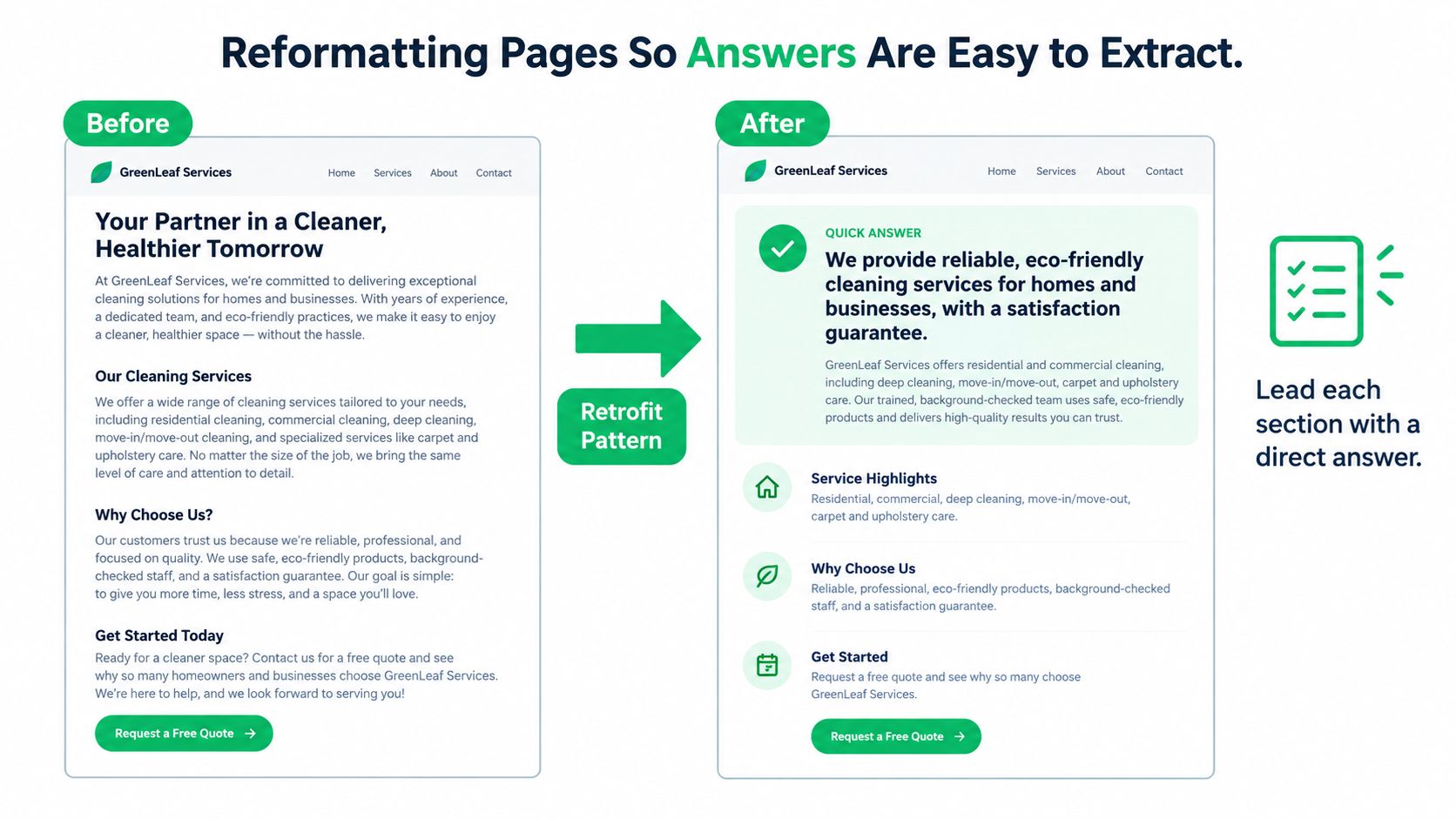
A practical content audit
Look for pages where the main answer is below the first screen, headings contain vague claims, or one paragraph covers several unrelated questions. Replace a wall of suburb text with a labelled service-area list. Separate price factors from features in a table with clear headers. Keep lists focused, usually around five to seven items, so each item remains meaningful.
Avoid opening every paragraph with the brand name. Avoid placing the answer after several sentences of scene-setting. Avoid tables that combine prices, inclusions and qualifications without labels.
The best reform candidates are pages that already receive impressions but produce weak engagement, pages targeting urgent services, and pages that answer questions competitors currently explain more clearly. The objective isn't to make every page look mechanical. It's to make each important answer self-contained and easy to verify.
Measuring What Matters in a Zero-Click World
Sessions and click-through rate can look weaker even when a business remains visible and receives worthwhile enquiries. Reporting should therefore connect search exposure to actions, lead quality and eventual commercial outcomes.
Search Console can show impressions, query visibility and page performance. Google Business Profile can show calls, direction requests, website actions and message interactions. Analytics should record phone clicks, quote-form starts, completed forms and booked consultations as separate events.
A better weekly view
Segment important queries by whether an AI Overview appears. That makes it easier to identify where impressions remain strong but clicks have softened. It also prevents a business from treating every query as if it has the same opportunity.
| Stop reporting or downweight | Start reporting weekly |
|---|---|
| Total sessions without context | Search impressions for priority services |
| Average position alone | Calls and direction requests from the Business Profile |
| Raw form submissions | Qualified enquiries and close quality |
| Website clicks as the only local measure | Profile actions, phone clicks and booking events |
| Traffic volume without intent | Assisted conversions and branded demand |
One vanity metric deserves less attention: total website sessions. It's still useful for diagnosis, but it shouldn't be the headline measure when searchers can discover the business, call it or save the information without visiting the site.
A Practical 90-Day Response Plan
A small business doesn't need to rebuild every page at once. The work should start with measurement and high-intent assets, then expand once the business can see which actions produce qualified enquiries.
Days 1 to 30
Deliverable: a local visibility and conversion baseline.
Tools: Google Business Profile, Search Console, GA4 and call tracking.
Work: audit categories, services, hours and service areas; install phone and form events; rewrite the top three money pages with clearer service matching and calls to action.
Success signal: the business can identify priority queries, profile actions and completed enquiry events.
Days 31 to 60
Deliverable: extractable content on priority services.
Tools: a content editor, schema generator and validation tools.
Work: add visible FAQ and Service markup, create one direct-answer block for each priority service, and establish a legitimate review-request workflow.
Success signal: key pages answer customer questions clearly, display valid markup where eligible and generate cleaner reporting.
Days 61 to 90
Deliverable: a repeatable search visibility system.
Tools: Search Console comparisons, GA4 explorations and a content roadmap.
Work: publish carefully chosen comparison and how-to content, implement LocalBusiness markup, review citation and business-detail consistency, and reset the KPI baseline.
Success signal: the owner can see visibility, profile actions, qualified leads and page-level conversion behaviour together.
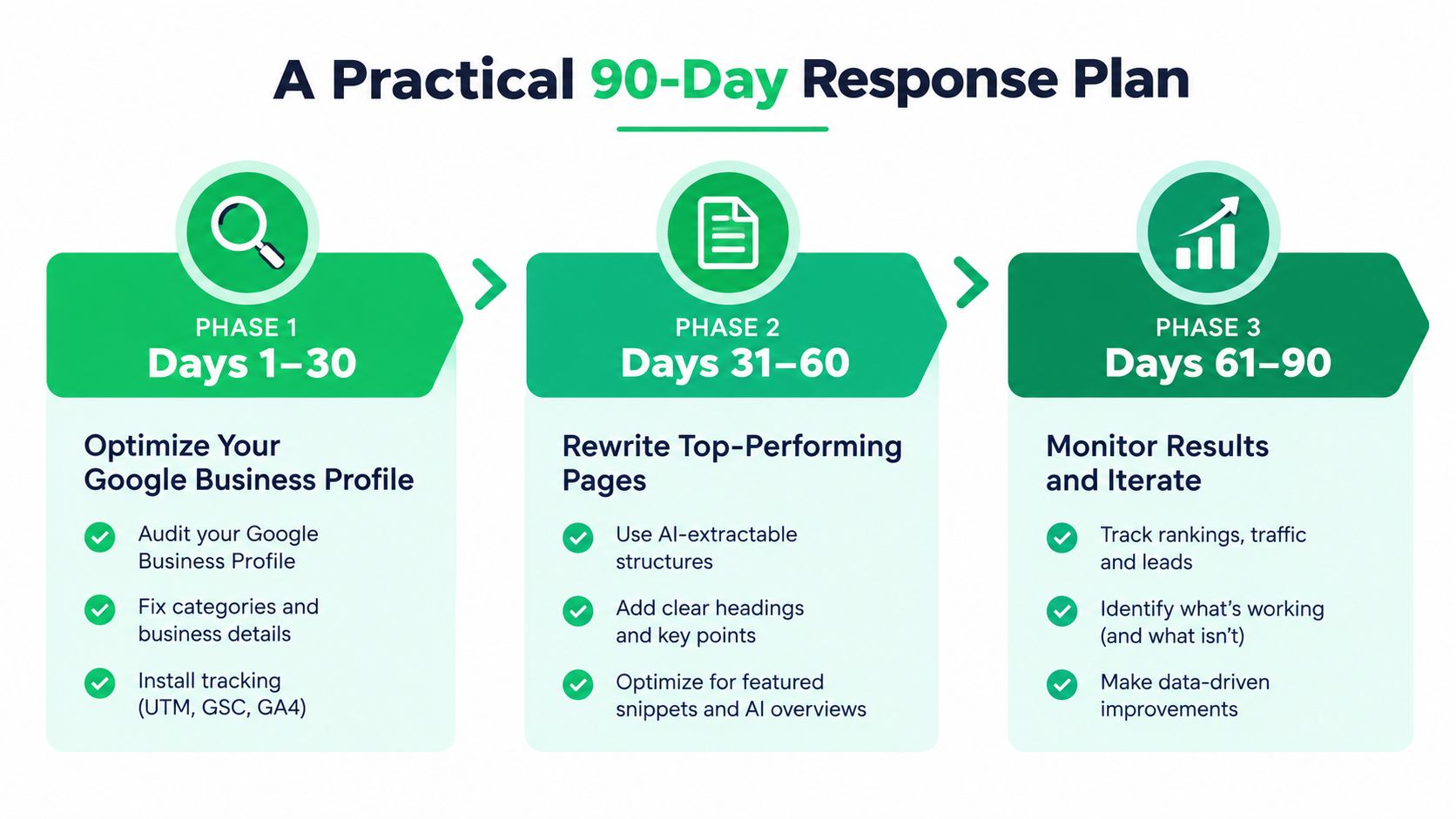
The order matters. There is little value in producing more informational content if the profile is incomplete or the business can't tell which calls came from search. Implementation should follow the commercial priority, not the easiest task on the checklist.
Common Questions About AI Search and Clicks
Can paid ads replace lost organic clicks?
Ads can buy visibility for selected searches, but they don't repair organic visibility or make a weak service page convert. Paid search works best when it has separate budgets, clear call tracking and landing pages designed for urgent intent.
How long does it take to appear as an AI citation?
There isn't a reliable fixed timetable. Citation selection depends on the query, source consistency, content quality and the system being used. A business should publish clear evidence, strengthen its local entity signals and monitor mentions rather than promise a deadline.
Does AI traffic convert worse than Google traffic?
Not automatically. Conversion depends on the searcher's intent, the referring system, the page experience and the clarity of the offer. AI referrals should be measured separately so the business can compare calls, forms and booked consultations.
Should a business optimise only for Google?
No. Google remains important for Melbourne local search, but ChatGPT, Perplexity and other systems may use different sources. Consistent business details, authoritative mentions and useful first-party content provide a broader foundation.
What if competitors are cited instead?
Check the cited pages for the information they make clearer, more specific or easier to verify. Then improve the relevant service page, profile details and supporting evidence without copying unsupported claims.
SEO2RANK supports Melbourne service businesses with local, technical, on-page and measurement work aimed at visibility and qualified enquiries. Businesses can review its approach to AI search, Google Business Profile optimisation and conversion-focused SEO by visiting SEO2RANK.
Find Out What Is Holding Your
Website Back
Get a practical SEO Snapshot showing the biggest issues and opportunities we can see across your search visibility, website and local presence.
GET YOUR FREE SEO SNAPSHOT