

Google 2026 spam updates: what it means for your SEO is simple enough at the surface. If a Melbourne service business saw rankings wobble through June, August, or the September rollout window, the first question is not “What changed in search?”, it's “Which pages, links, or profile signals look like spam now?” The practical answer is that Google spent 2026 tightening enforcement around the same problem patterns it has been pushing against for years, and that means templated suburb pages, copied service copy, off-topic links, and weak Google Business Profile signals are more likely to be filtered, especially on local service sites that rely on location pages.
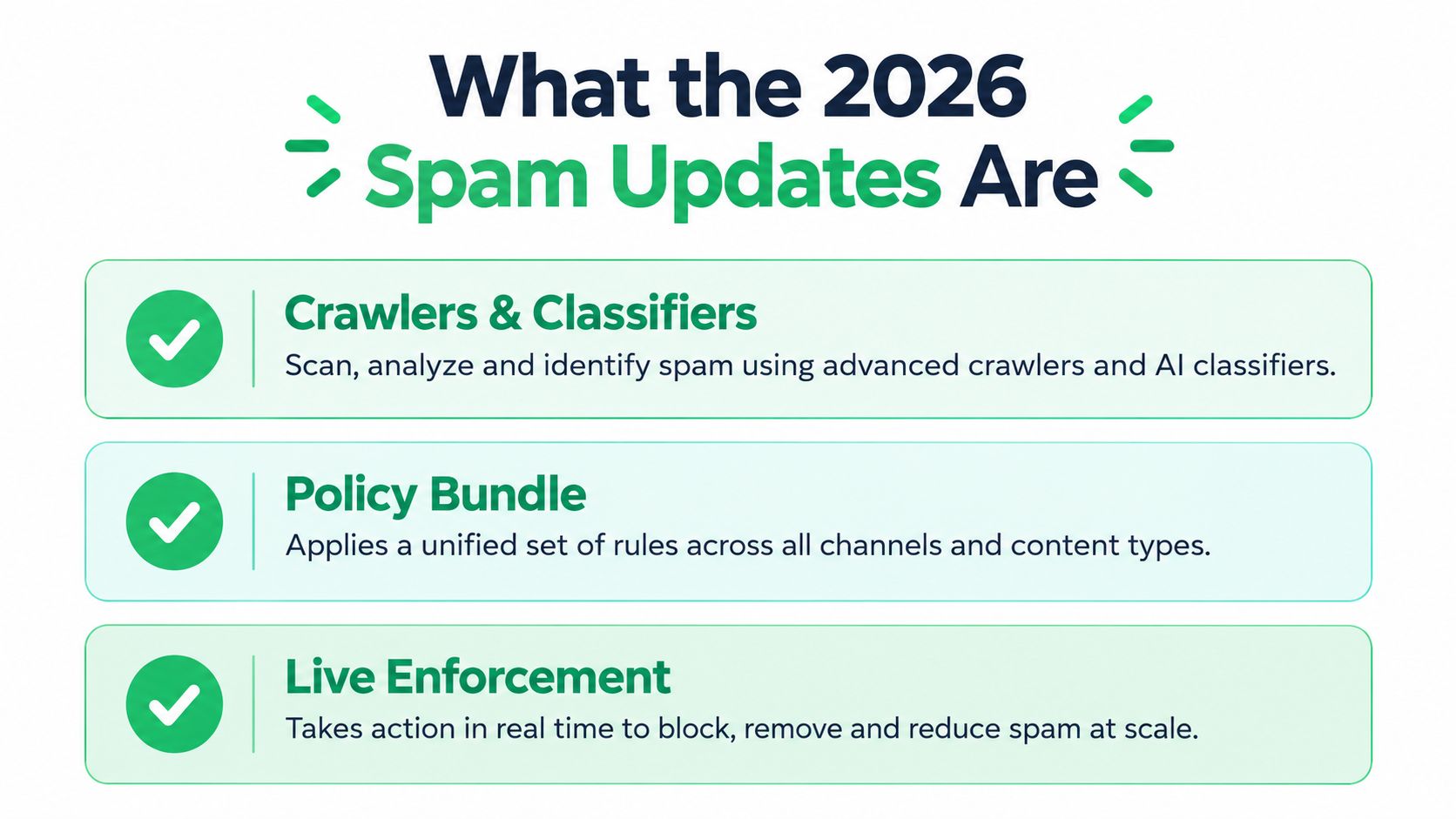
Table of Contents
- What the 2026 Google Spam Updates Are
- The 2026 Rollout Timeline and Why It Matters in Australia
- Spam Policy Areas Google Is Targeting This Year
- Technical and Content Signals That Trigger Action
- What This Means for Your Google Business Profile
- How to Read Your Site Through the Spam Lens
- Remediation Steps in the Right Order
- A Realistic Melbourne Service Business Example
- Monitoring Between Updates So You Are Never Surprised
- When to DIY and When to Bring in an Agency
- Quick Answers to Common Questions
What the 2026 Google Spam Updates Are
Google's 2026 spam updates add a live enforcement layer on top of long-standing spam policies. For Australian service businesses, the practical meaning is straightforward, Google is getting stricter about the same manipulative patterns it has targeted for years, especially on service-area and suburb-targeted sites.
The practical shape of the 2026 cycle
In plain terms, 2026 brought a sequence of spam enforcement pushes across the year. For a Melbourne tradie, dentist, or accountant, the main shift is that Google's systems are more aggressive about identifying scaled content abuse, doorway pages, site-reputation abuse, expired-domain abuse, cloaked content, and hacked redirects. Australian coverage of the September rollout tied the update to those policy areas and noted that template-heavy local service sites were especially exposed. Google's September 2026 spam update history and Australian coverage of the September rollout both describe it as global and language-agnostic.
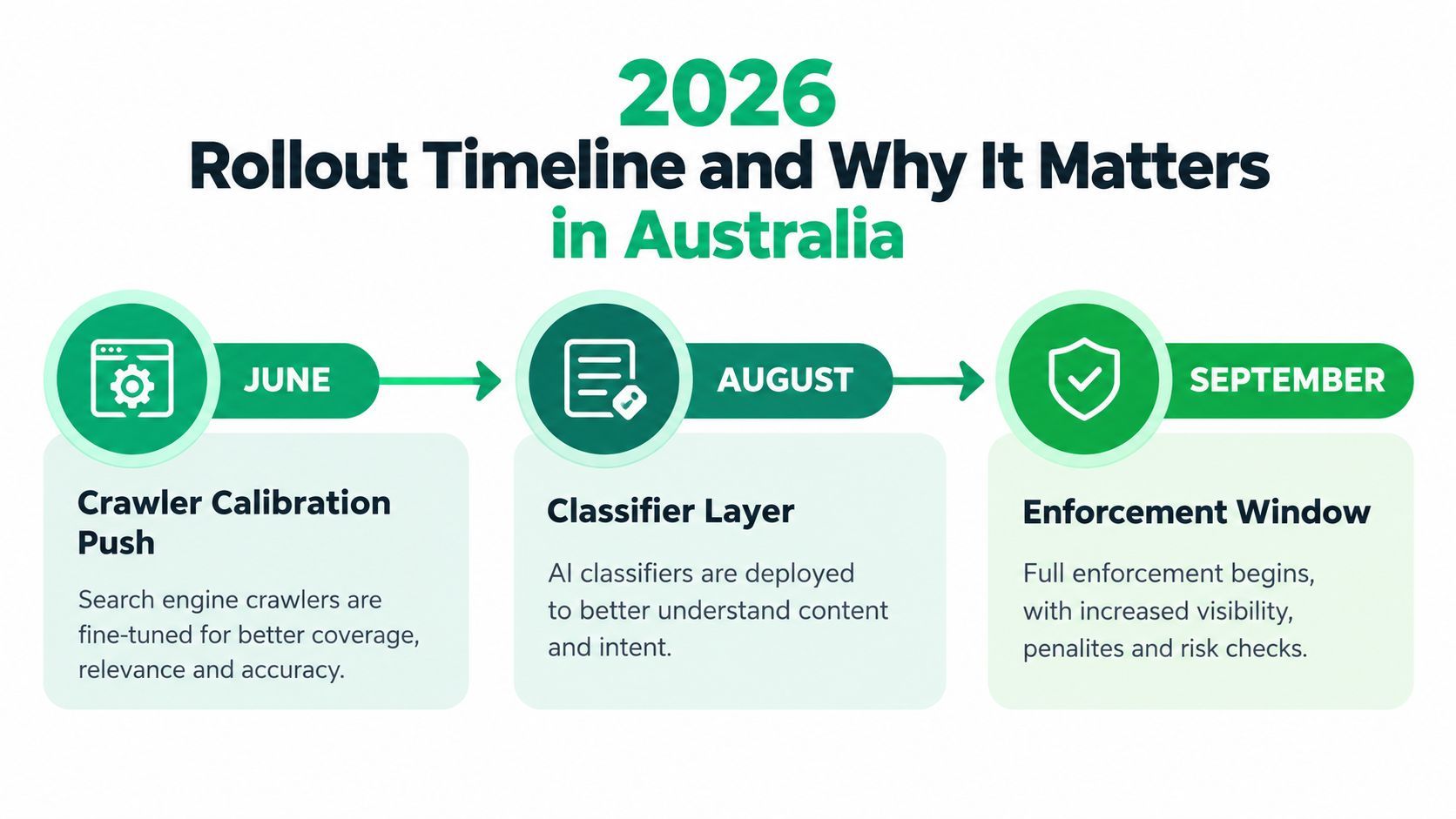
The reporting angle matters because timing changes how you read volatility. Google's September 2026 spam update was confirmed on 24 September 2026 at 9:15am Pacific time, applied globally to all languages, and was expected to take up to two weeks to roll out. In Australia, that release landed on 25 September, so rankings shifts inside that window need to be treated as rollout noise until the system settles. Google Search Status Dashboard history
Practical rule: if a suburb page drops during the rollout window, check the query set, page type, and local timing together before treating it as a lasting ranking loss.
The 2026 Rollout Timeline and Why It Matters in Australia
The three 2026 spam rollouts are best read as one enforcement pattern. June looked like a short calibration pass, August widened the filter, and September created the longest period where Australian reporting had to separate real change from rollout noise.
How the rollouts stack up for local businesses
June started on 24 June 2026 at 9:03am Pacific Time, was global and all-language, and finished on 26 June 2026. That short window matters because Melbourne agencies and in-house teams can easily mistake a brief ranking swing for a page-level problem when the system is still settling. Google Search Status Dashboard for the June 2026 spam update
The August update followed on 18 August 2026 at 9:27am Pacific Time and finished on 21 August 2026 at 01:49 PDT, again with global coverage. By that point, the pattern was clearer, with Google applying stricter filtering across the same policy areas but over a slightly longer check-in cycle. Google Search Status Dashboard for the August 2026 spam update
For Australian service businesses, the reporting challenge shifts with each rollout. A two-day update usually shows up as a sharp but short-lived wobble in suburb pages, branded queries, or map-adjacent traffic. A longer rollout gives more time for spam patterns to be reclassified, which means rank movement can keep changing while the update is still active. That is why September needs tighter local reporting, especially for Melbourne tradies, dentists, and accountants watching lead volume by suburb, not just by sitewide average.
Each rollout changes how quickly spam patterns get demoted, so September needs local reporting discipline.
Spam Policy Areas Google Is Targeting This Year
Google's 2026 spam enforcement is aimed at a familiar set of policy areas, but the key issue is how those policies show up on Australian service sites. A Melbourne audit usually doesn't reveal abstract policy violations. It reveals patterns, page structures, and link habits that look designed to produce rankings first and usefulness second.
What the policy areas look like in the wild
Scaled content abuse usually appears as suburb landing pages that change the place name, swap a few adjectives, and keep the same copy blocks, FAQs, and calls to action. On a tradie site, that's the “plumber in X” page farm. On a dentist site, it's the “cosmetic dentistry in X” replica. The ranking volatility is usually strongest on city plus suburb modifiers and long-tail service phrases.
Doorway pages tend to be the gateway pages built to catch every nearby suburb and funnel people to the same phone number. These pages often create the worst volatility on inner-city and suburb-modifier queries because Google can see they're thin entry points rather than distinct resources.
Site-reputation abuse shows up when a business buys space on a strong domain in an unrelated niche, then publishes service content that exists mainly to borrow authority. That pattern can affect branded and non-branded local visibility when the site starts looking like a link scheme dressed up as content marketing.
Expired-domain abuse is common when a business buys a lapsed domain with old backlinks and repurposes it for a new trade or practice. That can create unstable rankings across mixed-intent queries because the topical history and current site purpose don't line up.
Hidden text, cloaking, and redirect abuse often hide in keyword-heavy footers, mobile-only redirects, or inconsistent content delivery. These patterns can hit exact-match service phrases, especially when the page looks different to crawlers than it does to users.
| Spam Policy Area | Typical Melbourne Page or Link Pattern | Most Affected Local Modifier |
|---|---|---|
| Scaled content abuse | Near-duplicate suburb service pages | Suburb plus service phrase |
| Doorway pages | Gateway location pages that funnel to one office | City and inner-ring suburbs |
| Site-reputation abuse | Guest posts on unrelated sites, paid directory placements | Branded and commercial service terms |
| Expired-domain abuse | Repurposed old domain with mismatched backlinks | Mixed-intent local queries |
| Hidden text or redirects | Keyword footer stuffing, mobile-only redirect paths | Exact-match service phrases |
Technical and Content Signals That Trigger Action
Google doesn't see spam the way a human auditor does. It sees signals, patterns, and inconsistencies. That's why a site can look fine to a business owner and still trip the systems that feed spam enforcement.
What Google can actually crawl and score
One of the clearest signals is cloaking, where the crawler and the user receive different versions of a page. Another is doorway detection, which usually comes from city plus service templates, near-duplicate suburb pages, or pages that exist only to intercept search traffic. Those are easy to spot in a Melbourne audit because the same heading pattern, same copy structure, and same contact block keep repeating across locations.
Scaled content markers are usually more subtle. Thin intros, repetitive H2s, AI-written FAQs with no first-party detail, and the same sentence structure across multiple pages all raise the chance that the site looks mass-produced rather than genuinely useful. If a dentist page, for example, has the same opener, same claims, and same FAQ block as five other location pages, the site is advertising scale, not expertise.
Expired-domain abuse leaves a different footprint. The backlink graph points to one topic, but the site now sells another. That mismatch matters because Google can compare the old and new topical shape of the domain against current content.
Site-reputation abuse is often visible in off-topic outbound linking, paid placements on unrelated sites, and third-party content hosted to borrow authority. Businesses trying to buy trust this way usually create more volatility than stability.
A practical technical audit has to inspect code, copy, and backlinks together. A useful starting point is a technical SEO checklist for small business sites, because spam signals often sit right beside ordinary crawl issues.
| Spam Policy Area | Trigger Signal | Audit Check | Severity |
|---|---|---|---|
| Cloaking | Different crawl and user output | Compare rendered HTML and live page view | High |
| Doorway pages | Repeated suburb templates | Check duplicate intent across location pages | High |
| Scaled content abuse | Repetitive AI-style copy | Review intro blocks, FAQs, and H2 patterns | High |
| Expired-domain abuse | Topic mismatch across backlinks and content | Compare historical link theme to current service theme | Medium |
| Site-reputation abuse | Off-topic placements and borrowed authority | Review outbound placements and hosted partner content | Medium |
What This Means for Your Google Business Profile
Google Business Profile is no longer just a local ranking asset. In a spam-heavy enforcement cycle, it also becomes a trust signal that can pull organic performance down when the profile looks manipulative or inconsistent.
The profile details that now matter more
Keyword-stuffed business names are the obvious risk, but they're not the only one. Virtual office addresses, bulk-verified service-area business profiles, and old categories left sitting on dormant listings can all raise review friction. When those signals don't match the website footer, the contact page, and the actual service model, the profile can look like part of a broader spam pattern.
Soft suspensions are especially painful because the listing can remain visible in some places while losing meaningful reach in others. That's why name, address, and phone consistency matters so much. The website footer should match the profile. Old practice names and stale categories should be retired. Practitioner listings that share the same address footprint need a clear, defensible structure.
Practical rule: if the profile name reads like an ad and the website reads like a brochure, Google has reason to question both.
Plain-language review replies help as well. Templated responses make the profile feel automated, which is the opposite of what a trust-sensitive business needs. For businesses cleaning up profile issues, the operational checklist in SEO2RANK's Google Business Profile optimisation guide is the right kind of reference point.
Recovery paths usually run through the profile redressal process and then back through organic monitoring. The important thing is not to keep changing fields every day. That just makes the evidence harder to read.
How to Read Your Site Through the Spam Lens
A Search Console-led audit is the fastest way to separate spam enforcement from normal ranking noise. The key is to check the right reports in the right order, then compare them against the rollout window rather than against a vague “last month” view.
A practical audit sequence
Start with Manual Actions. If there's a standing action, there's no point arguing about volatility before the actual policy issue is identified. Then move into Performance and filter by query and page. Sudden impression drops on suburb-modifier terms are more meaningful than broad traffic changes, because they often show where spam enforcement hit first.
After that, check Coverage exclusions, especially soft 404s on templated location pages. Those exclusions often expose the pages that Google stopped trusting before the owner noticed a visible ranking loss. Then review Links and Sitemaps for inherited link graphs or pages that shouldn't still be indexed. For selective checks, the URL Inspection workflow is useful for seeing how Google currently treats the page.
A weekly delta sheet keeps the picture honest:
- Indexed page count: watch for location pages that disappear together.
- Average position by service cluster: compare service groups, not one vanity keyword.
- GBP-driven clicks: check whether profile changes line up with organic volatility.
- New referring domains: flag bursts that don't fit normal outreach behaviour.
A complementary crawl resource like robots.txt explained for small business sites helps when pages are indexed or blocked in ways that mask the underlying issue.
Remediation Steps in the Right Order
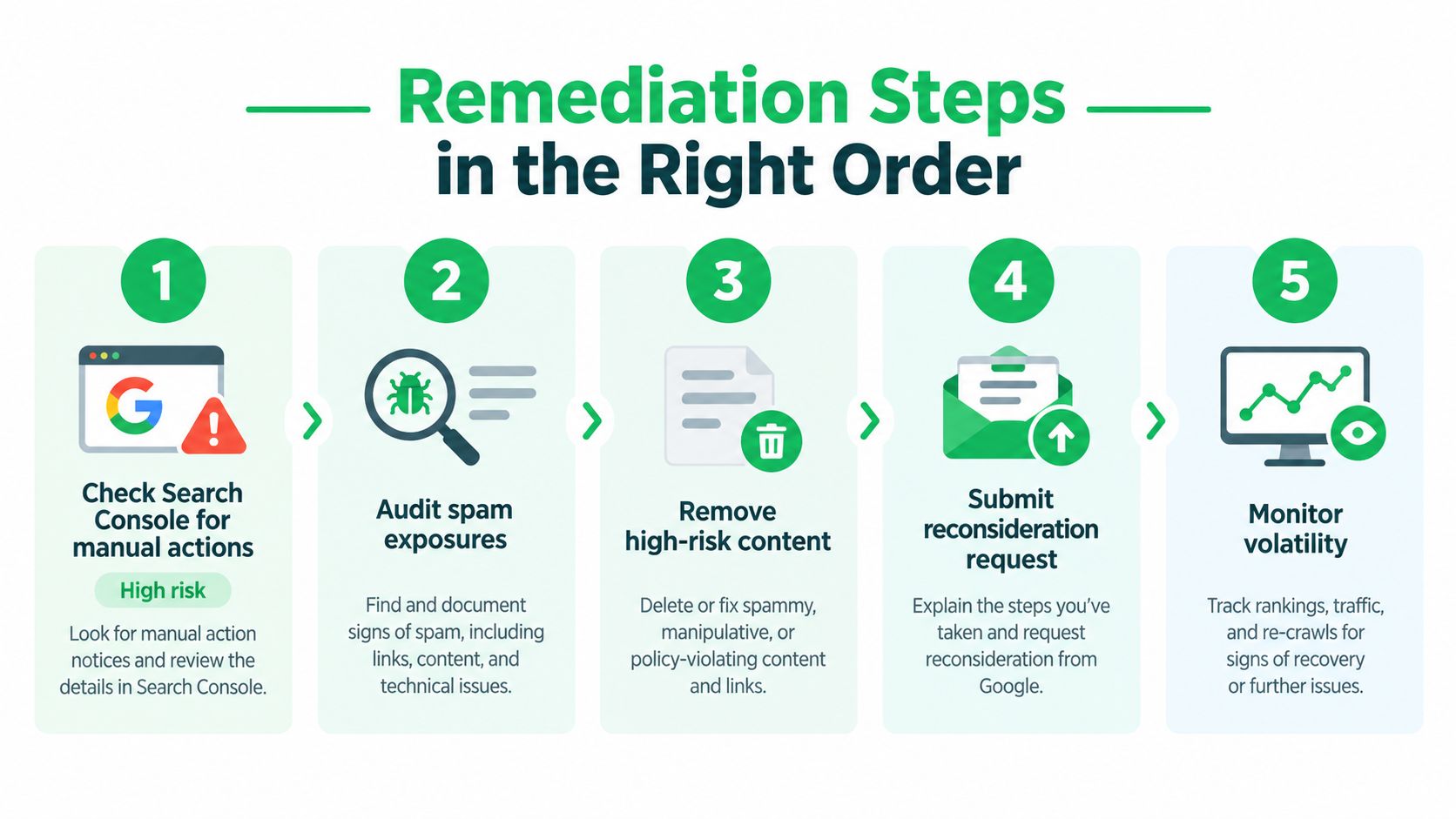
For a Melbourne tradie, dentist or accountant, remediation should start with the exposure most likely to affect trust and indexation. Cosmetic copy edits will not fix a site that still resembles a doorway network or has conflicting business details.
What to fix first
- Contain the active risk. Pause new link acquisition and AI content while the audit is underway. Check Search Console's Security Issues and Manual Actions reports before changing pages.
- Map the affected URLs. Export pages from Search Console by performance and indexation status, then tag each URL by service, suburb, template and action taken. Compare those tags with the XML sitemap so retired, redirected and canonical pages are clearly separated. XML sitemaps explained: what should be included provides a useful reference.
- Consolidate clear duplication. Merge interchangeable location pages into stronger service hubs. Retire pages that add no distinct local evidence or customer value, and set suitable redirects where another URL replaces them.
- Align the profile and site. Rewrite the business description and service list so they match the live website and current offering, rather than an old vendor draft.
- Clean the link profile. Remove obvious low-quality placements. Rebuild the disavow file only when the evidence supports that action.
Sequence matters because each change should reinforce the next. Cleaning the profile while doorway pages remain live leaves the main risk untouched. Polishing copy while noisy links continue sends mixed signals.
Keep a before-and-after diff. It gives a reconsideration request clear evidence of what changed, particularly when a page network has been reduced to fewer, stronger URLs.
A Realistic Melbourne Service Business Example
A four-location Melbourne plumbing business had six suburb pages that were almost interchangeable, a shared stock photo gallery, and a Google Business Profile description written by an offshore vendor in 2023. The site didn't look obviously broken to the owner, but it looked like a classic doorway setup to anyone doing a spam-focused audit.
The fix was not to keep all six pages and “improve the copy a bit”. Three pages were merged into canonical service hubs, the most redundant suburb pages were retired, and the GBP description was rewritten so it matched the wording on the live site. The owner also kept the strongest service page for emergency work in the inner west, because that page had the cleanest intent and the least duplication.
The trade-off was painful but sensible. Fewer indexed URLs meant less visible footprint, but one page started carrying the local intent instead of six thin variants splitting authority. Two weeks after the September rollout window, Search Console showed the cleaner pattern the owner needed, fewer indexed location URLs and a clearer separation between the surviving service hubs and the pages that had been removed.
That's the post-2026 reality. Compliance sometimes means giving up the illusion of scale so the site can earn rankings on the pages that matter.
Monitoring Between Updates So You Are Never Surprised
The safest way to handle spam enforcement is to monitor on a rhythm, not in a panic. Google's Search Status Dashboard and Search Console release notes should be part of the normal operating cadence, because the next rollout won't wait for a convenient traffic dip.
A monthly and weekly rhythm that actually works
Each month, snapshot these baselines:
- Indexed page count per location
- GBP insight trends
- Manual action status
- Backlink delta versus the prior period
A weekly checklist is lighter but still useful. Check branded service keywords, the top five commercial queries, and any new referring domains that don't fit the site's usual profile. If average position drops on a branded service term while impressions stay flat elsewhere, that's a better signal than a broad guess about seasonality.
| Cadence | Core Check | Trigger Threshold | Source |
|---|---|---|---|
| Weekly | Top query and page movement | Sudden drop in branded service visibility | Search Console |
| Weekly | New referring domains | Unusual burst of low-quality links | Link report |
| Monthly | Indexed location pages | Location pages removed or merged in clusters | Coverage report |
| Monthly | GBP clicks and actions | Profile engagement drops without site change | GBP insights |
| Quarterly | Spam update timing review | Changes line up with rollout windows | Search Status Dashboard |
A deeper review still makes sense around the spam-update rhythm that has been recurring since 2024. Search Console email digests, GBP notification filters, and a saved SERP check for the owner's key commercial queries usually catch the problem before the phone stops ringing.
When to DIY and When to Bring in an Agency
Not every site needs outside help. A single-location business with a clean link profile and a small set of indexable pages can usually manage the basics in-house, as long as someone follows the Search Console and GBP workflows consistently.
The decision point is usually page scale
DIY is usually enough when the business has one to three core service pages, a stable Google Business Profile, and no obvious template spam. Once the site grows into ten-plus service and location pages, especially across multiple profiles, franchises, or programmatic landing pages, outside help starts to make more sense. Repeated manual actions, purchased links, and AI-generated suburb pages push the case even further.
An external engagement in Melbourne usually covers a technical audit against spam-style signals, Google Business Profile cleanup across all relevant listings, reconsideration support, and ongoing Search Status monitoring. That work is useful when the owner needs a compressed sprint rather than a slow internal project.
SEO2RANK is one Melbourne option that combines technical audits, Search Console checks for manual actions and security issues, and implementation support for service businesses. That type of engagement is worth comparing against the owner's own time cost, because the trade-off is context versus speed.
| Factor | Handle In-House | Engage a Melbourne Agency |
|---|---|---|
| Site size | Small, simple site | Multiple locations or large page sets |
| Link profile | Clean and modest | Purchased, inherited, or noisy |
| Content type | Hand-written, limited pages | Templated or AI-generated at scale |
| Remediation pace | Slower, owner-led | Faster, structured sprint |
| Risk level | Low to moderate | Repeated manual actions or broad volatility |
Quick Answers to Common Questions
How long does recovery take? Usually weeks rather than days once a manual action or meaningful demotion is confirmed. Cleanup has to be demonstrable, not just promised.
Can a reconsideration request fail and still be worth doing? Yes. If the underlying issue is genuinely fixed, a first rejection doesn't mean the site is doomed. It usually means the evidence trail needs to be clearer.
Is AI content banned? No. Mass-produced, unedited, and unhelpful AI content is the problem, especially when the same pattern is repeated across suburb variants.
Can a Google Business Profile issue affect organic rankings too? Yes. In 2026, GBP problems can spill into broader trust signals, which is why profile cleanup and site cleanup need to be handled together.
Does disavow still matter? It can, but only when the link profile shows harmful patterns. Blindly disavowing everything is as unhelpful as leaving the links in place.
What does a full audit cost in Melbourne? It depends on site size, location count, and how much cleanup is needed. The important part is whether the engagement includes actual remediation, not just a PDF.
For Melbourne service businesses dealing with the 2026 spam updates, the right next step is a clean audit that ties Search Console, Google Business Profile, links, and content back to the same evidence. SEO2RANK works on that kind of problem through technical audits, local SEO, and implementation support for service sites, so if the current rankings dip needs proper diagnosis, visit SEO2RANK and start from the pages, profiles, and links that moved.
Find Out What Is Holding Your
Website Back
Get a practical SEO Snapshot showing the biggest issues and opportunities we can see across your search visibility, website and local presence.
GET YOUR FREE SEO SNAPSHOT