
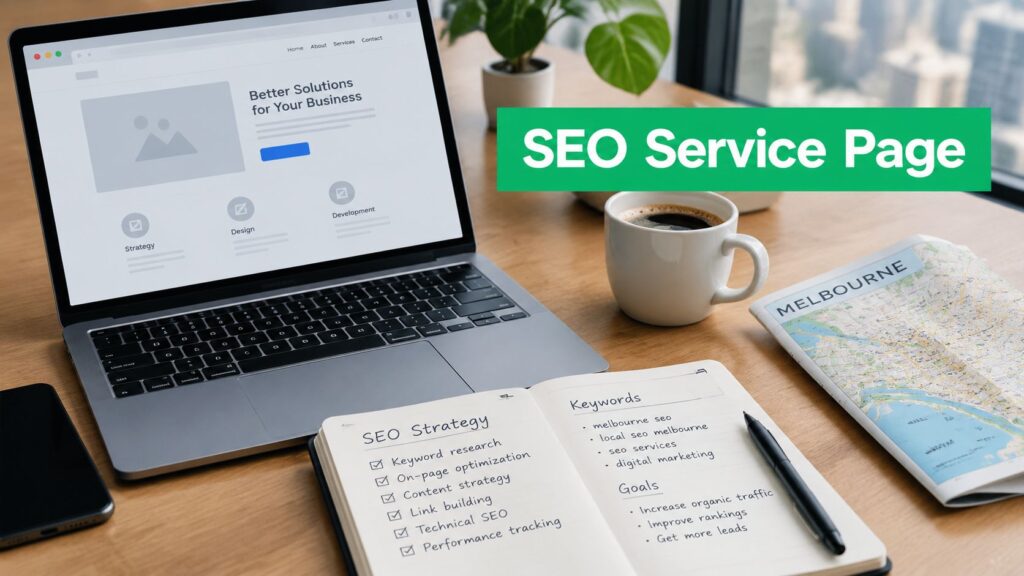
A Melbourne business owner searching for SEO help usually doesn't need another list of vague deliverables. They need to know whether the agency understands their service, suburbs, customers, technical constraints and commercial goals. A good SEO service page should therefore explain what the service does, who it helps, where it operates, why the provider is credible, how the work will be implemented and how enquiries will be measured.
Table of Contents
- The Purpose of a Modern SEO Service Page
- Anatomy of a High-Converting Service Page
- Local Signals and Suburb Relevance
- Technical Foundations and Structured Data
- Trust Signals and Review Credibility
- Implementation and Measurement Roadmaps
- The Ultimate Service Page Checklist
The Purpose of a Modern SEO Service Page
A modern SEO service page has two jobs. It must satisfy the searcher who wants a clear answer, while also helping search engines understand the business, service, audience and location. That makes the page more than a brochure. It becomes a commercial landing page for high-intent discovery.
A page that opens with “We offer digital marketing solutions” gives neither audience enough detail. A potential customer still doesn't know whether the provider handles local SEO for Melbourne tradies, technical SEO for a software company, or content strategy for an accountant. Search engines face the same ambiguity. They need clear relationships between the business entity, its services, its expertise and the areas it serves.
Lead with the customer's problem
The first visible content should identify the service and its practical outcome. For example, a Melbourne dentist might need local visibility for emergency appointments, while an accountant may need qualified enquiries from specific commercial suburbs. The opening should name the relevant service, audience and location without forcing awkward keyword repetition.
A useful opening typically answers:
- What is offered: Identify the service in plain language.
- Who it is for: Name the business type or customer group.
- Where it applies: State Melbourne, relevant suburbs or the wider service area.
- What happens next: Invite a call, quote request, audit enquiry or consultation.
The page should then explain the service in enough detail for a prospect to judge fit. That means describing the work, the decisions involved and the evidence supporting the provider's capability. A generic “full-service SEO” claim is weaker than a focused explanation of local landing pages, technical remediation, structured data, conversion tracking and reporting.
Practical rule: If a visitor can't tell within the opening section what service is being provided and whether it applies to their business, the page is under-positioned.
Search engine optimisation itself involves connected work across crawlability, relevance, authority and conversion. A plain-English explanation of how SEO works can support that context, but the service page still needs to translate theory into a clear offer.
The strongest pages also set boundaries. They explain what the provider can control, what depends on competition and website access, and how progress will be assessed. SEO can improve a business's ability to appear for relevant searches, but no responsible service page should promise a fixed ranking or guaranteed lead volume.
Anatomy of a High-Converting Service Page
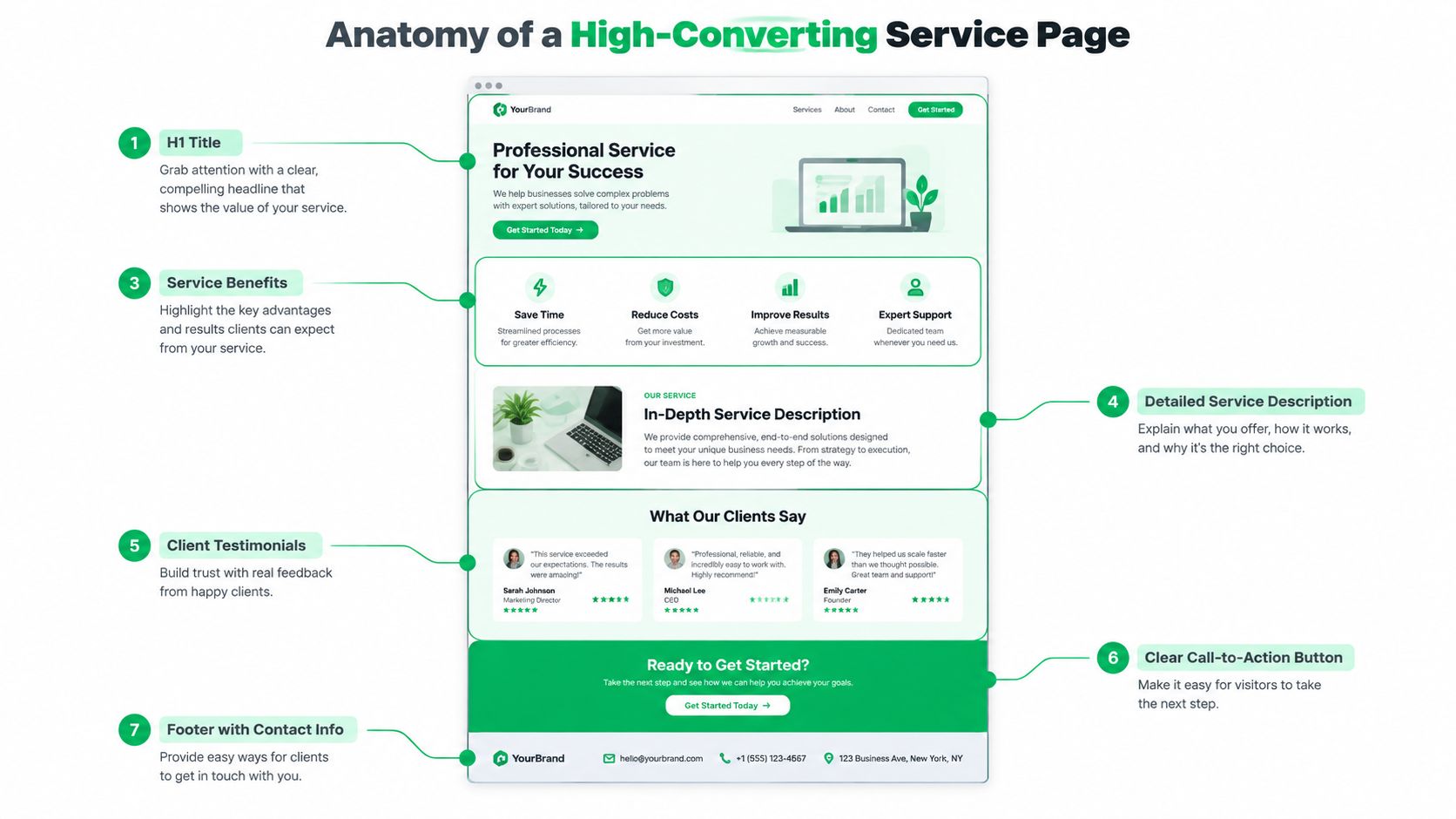
A service page should guide a reader from recognition to action without making them hunt for the important information. Its structure needs to reflect search intent, not a template copied across every service.
The page should normally contain:
- A specific title tag and H1. The primary service and location should be clear when local intent matters, such as “Local SEO for Melbourne Service Businesses”. One page should have one dominant purpose.
- A concise value proposition. The opening should connect the service to a business problem, such as weak suburb visibility, poor-quality enquiries or technical barriers.
- A detailed service explanation. Describe the actual work, including research, implementation, quality checks and ongoing refinement.
- Outcome-focused benefits. Explain how the work supports calls, form submissions, bookings, qualified traffic or clearer reporting. Avoid presenting benefits as guaranteed results.
- Proof and legitimacy. Use genuine testimonials, relevant qualifications, business details, review links or accurately described examples.
- A clear call to action. Give the visitor one sensible next step, rather than competing buttons for every possible enquiry.
- Accessible contact information. Make phone, email, service area and business details easy to find on mobile and desktop.
Build around intent, not repetition
Old-school keyword stuffing might repeat “SEO Melbourne” throughout a page, but repetition doesn't explain expertise or usefulness. An entity-led page connects related concepts naturally. A local SEO page may discuss Google Business Profile management, suburb relevance, citations, review credibility, service areas, internal links and conversion tracking because those topics help define the service.
The site architecture matters too. A service page is often a money page, meaning it carries a direct commercial role. Supporting articles can answer informational questions, but they should link to the relevant service page rather than compete with it. Research into the keywords customers are searching should inform the page's language, while the final copy should remain natural and specific.
Each service and suburb combination also needs a genuine reason to exist. A page for SEO services in Richmond should not be the same text as a page for SEO services in Preston with the suburb name swapped. It should contain meaningful local relevance, a distinct service context and accurate service-area information. Otherwise, multiple pages can create confusion for users and search engines instead of expanding visibility.
Local Signals and Suburb Relevance
For a Melbourne service business, local relevance isn't a decorative paragraph at the bottom of the page. It should shape the page's title, headings, examples, internal links, contact information and calls to action.
46% of Google searches have local intent in Australia, according to Australian SEO and content marketing statistics. Local mobile behaviour is especially commercial. 76% of people who perform a local mobile search visit a business within 24 hours, and 28% of local searches lead to a purchase within one day, as reported by the same Australian source.
Those figures explain why a local service page must help someone act quickly. A visitor searching for a nearby electrician, dentist, accountant or home-service operator may be comparing providers while ready to call. A page that hides its service area or buries the phone number wastes that intent.
Make the location meaningful
Useful local signals include:
- Service-area clarity: State the suburbs, municipalities or broader areas served.
- Local problem context: Explain how the service applies to customers in the target area, without inventing local claims.
- Consistent business details: Keep the business name, address or service area and phone number aligned across the website and public profiles.
- Relevant internal links: Connect suburb pages to the main service page and related services through descriptive anchor text.
- A location-matched call to action: Use language such as requesting a Melbourne consultation or discussing service coverage, when accurate.
A suburb page shouldn't be created solely to capture a place name. If the business doesn't serve that area, publishing the page can create poor user experiences and weaken trust. The same applies to virtual providers that imply a physical office where none exists.
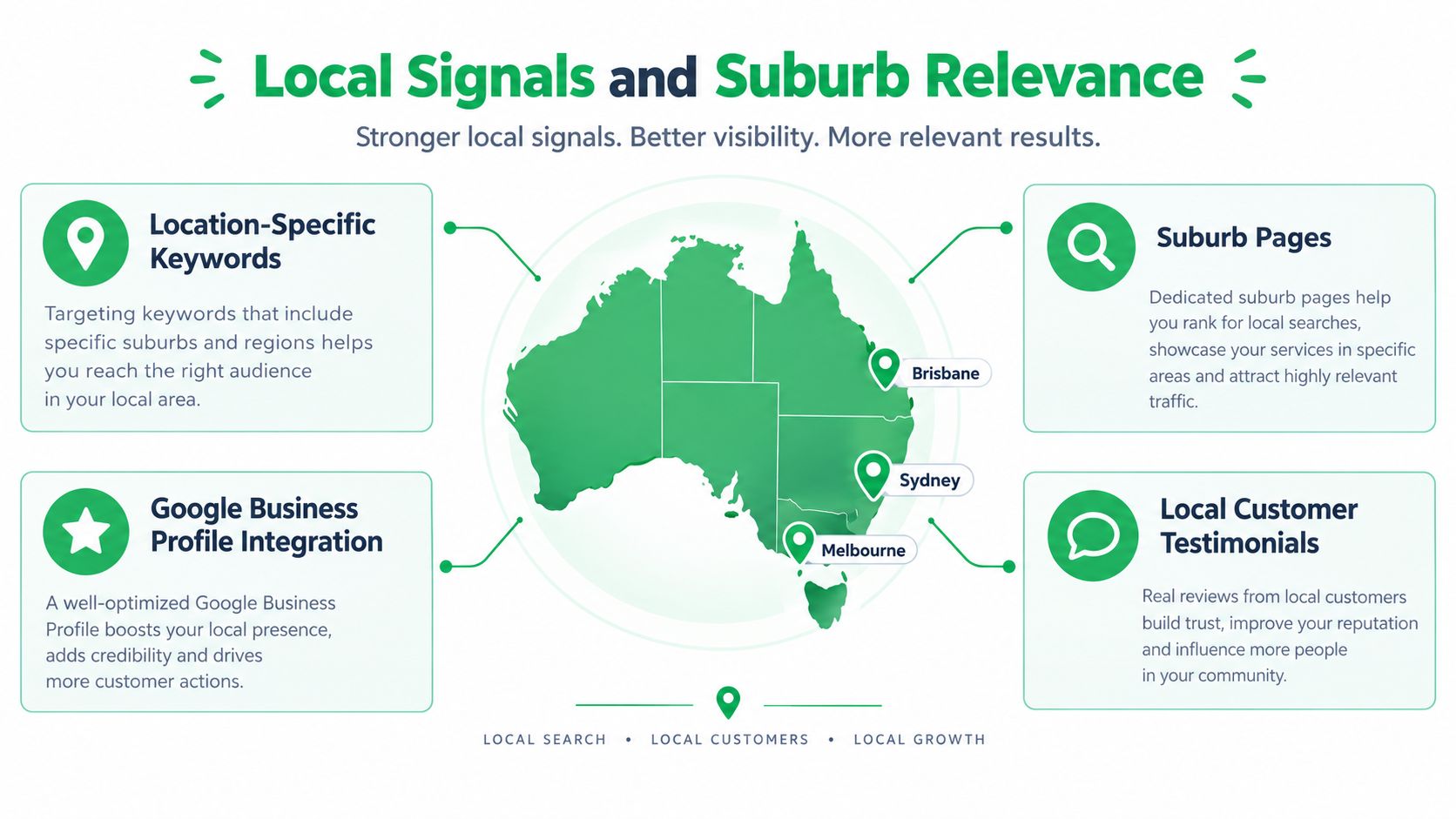
Google Business Profile should support the on-page experience rather than operate as a disconnected task. The profile category, hours, website, phone number, service areas and business description should be accurate and maintained. A practical Google Business Profile optimisation guide can help businesses assess that supporting asset.
The Australian market also requires careful review handling. The ACCC guidance on online reviews warns businesses and platforms about fake or misleading reviews and review manipulation. Genuine local proof is useful, but manufactured praise, selective presentation or incentives that distort review authenticity can create legal and reputational risk.
Technical Foundations and Structured Data
A service page can't generate consistent discovery if search engines struggle to access, interpret or render it. Technical quality should support the commercial page rather than become an isolated technical exercise.
Start with the basics. The page should be indexable, use a clear canonical setup where relevant, load over HTTPS, contain a unique title and description, and present a logical heading structure. Internal links should help crawlers and users reach the service page, while images should have accurate alternative text when they communicate information.
Use structured data carefully
Structured data gives search engines machine-readable context about a page. For a local business service page, relevant implementation may include LocalBusiness details, the business name, address or service area, telephone number, geo-coordinates and opening hours where those details are accurate and appropriate. Markup must match the visible page. It shouldn't be used to claim services, locations or reviews that users can't verify.
Google's structured data documentation explains how markup helps systems understand page content. A service provider may also explain what schema markup is in plain English for non-technical stakeholders, but implementation still requires validation and ongoing accuracy.
Protect mobile experience
Core Web Vitals provide a practical framework for assessing loading, responsiveness and visual stability. Google's Core Web Vitals documentation defines the three key metrics as follows:
| Metric | Description | Good threshold |
|---|---|---|
| Largest Contentful Paint, LCP | When the main visible content appears | Under 2.5 seconds |
| Interaction to Next Paint, INP | How quickly the page responds to interaction | Under 200 milliseconds |
| Cumulative Layout Shift, CLS | How much visible content moves unexpectedly | Under 0.1 |
These thresholds are useful targets, not a substitute for judgement. A page may meet a metric while still confusing visitors with weak copy, poor contrast or a buried form. Conversely, a visually rich page may offer strong persuasion but lose enquiries if scripts delay interaction or layout shifts move the call button while someone tries to tap it.
Technical recommendations should therefore be prioritised by commercial impact. Fix crawl and indexing barriers first, then address templates, speed, mobile layout, forms and tracking. The page needs to remain usable for the person attempting to call or submit an enquiry.
Trust Signals and Review Credibility
Trust is not created by adding the word “trusted” to a headline. A credible service page shows why the provider is legitimate and gives prospects enough evidence to make a sensible decision.
E-E-A-T, meaning experience, expertise, authoritativeness and trustworthiness, becomes practical. A page can demonstrate those qualities through clear business information, a named team or practitioner where relevant, transparent process explanations, accurate service descriptions and genuine customer feedback.
Show evidence without overselling
A useful trust section might include:
- Specific testimonials: Identify the customer or business only where permission exists, and don't edit feedback in a way that changes its meaning.
- Relevant experience: Explain the industries, platforms or problem types the provider works with, without implying expertise that can't be supported.
- Process transparency: Show how discovery, implementation, quality checks and reporting operate.
- Business legitimacy: Include consistent contact details, service areas, policies and accessible enquiry methods.
- Review governance: Explain how reviews are requested, displayed and responded to, without manipulating sentiment.
Case studies can be valuable when they contain genuine context, defined work and an honest account of limitations. A vague statement such as “we transformed online growth” is less useful than an explanation of the original problem, the work completed and the indicators monitored. If confidential client information prevents detail, the page should say less rather than fill the gap with inflated language.
Australian businesses should treat reviews as a compliance matter as well as a conversion asset. The ACCC's guidance on online reviews addresses misleading reviews and manipulation, so service pages shouldn't publish fabricated testimonials, impersonate customers or conceal material context. Genuine criticism can also be handled professionally. A clear response policy often signals more credibility than an artificial wall of praise.
Trust is strongest when the page makes verification easy.
Google's dominance in Australia reinforces the need for a consistent public presence. Statcounter-based reporting places Google at about 88.04% of the Australian search market in June 2026, according to search market reporting for Australia. That concentration makes Google-facing presentation important, but it doesn't remove the need to write for humans. Search visibility without credible proof may produce visits, yet poor trust can still result in weak enquiry quality.
Implementation and Measurement Roadmaps
A deliverables list tells a business what an agency intends to touch. An implementation roadmap explains what happens first, why that order matters and how the work connects to enquiries.
The difference is substantial. "Technical SEO, content, local SEO and monthly reporting" may sound thorough, but it leaves important questions unanswered. Which pages receive attention first? What happens if tracking is broken? How will the agency distinguish a ranking change from a useful lead?
Compare the two approaches
The standard approach
- Lists audits, content, links and reporting.
- Treats every task as equally urgent.
- Reports activity completed.
- Leaves the business owner to infer commercial value.
The roadmap approach
- Begins with discovery, access checks and an audit.
- Prioritises issues by search demand, business value, difficulty and risk.
- Implements changes in phases.
- Tracks calls, forms, bookings or quote requests where measurement is available.
- Reviews evidence and adjusts the next priorities.
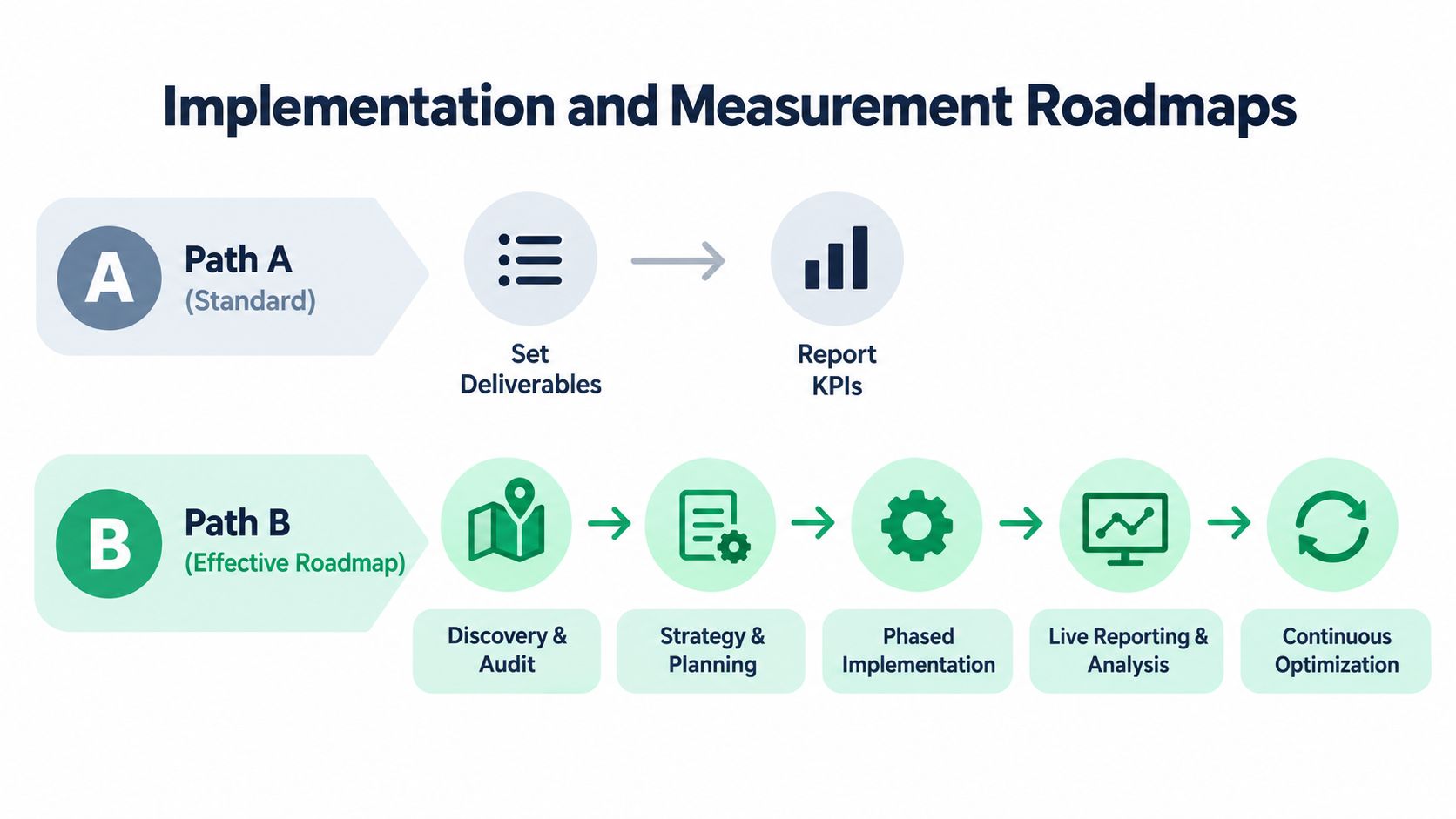
A strong service page should describe this sequence in practical language. Discovery may reveal that the most urgent problem is a noindex directive, weak local information, an unclear service hierarchy or a form that doesn't record submissions. The correct first action depends on the site, not on a fixed package checklist.
Report decisions, not just tasks
Measurement should combine visibility and business signals. Search Console can help assess queries, impressions, clicks and page-level search behaviour. Analytics and call or form tracking can help identify actions after a visit, provided the setup is accurate and privacy requirements are respected.
The service page should state what gets reported, what isn't measurable and how recommendations change. Rankings can fluctuate, calls may be recorded inconsistently and some sales happen offline. A responsible provider acknowledges those limitations while still defining useful indicators.
SEO2RANK is one Melbourne-based option that combines local, technical, on-page and measurement work, including audits, implementation where access permits, conversion tracking and plain-English reporting. The important evaluation question isn't whether an agency lists every discipline. It's whether the proposed roadmap connects the work to the business's actual lead process.
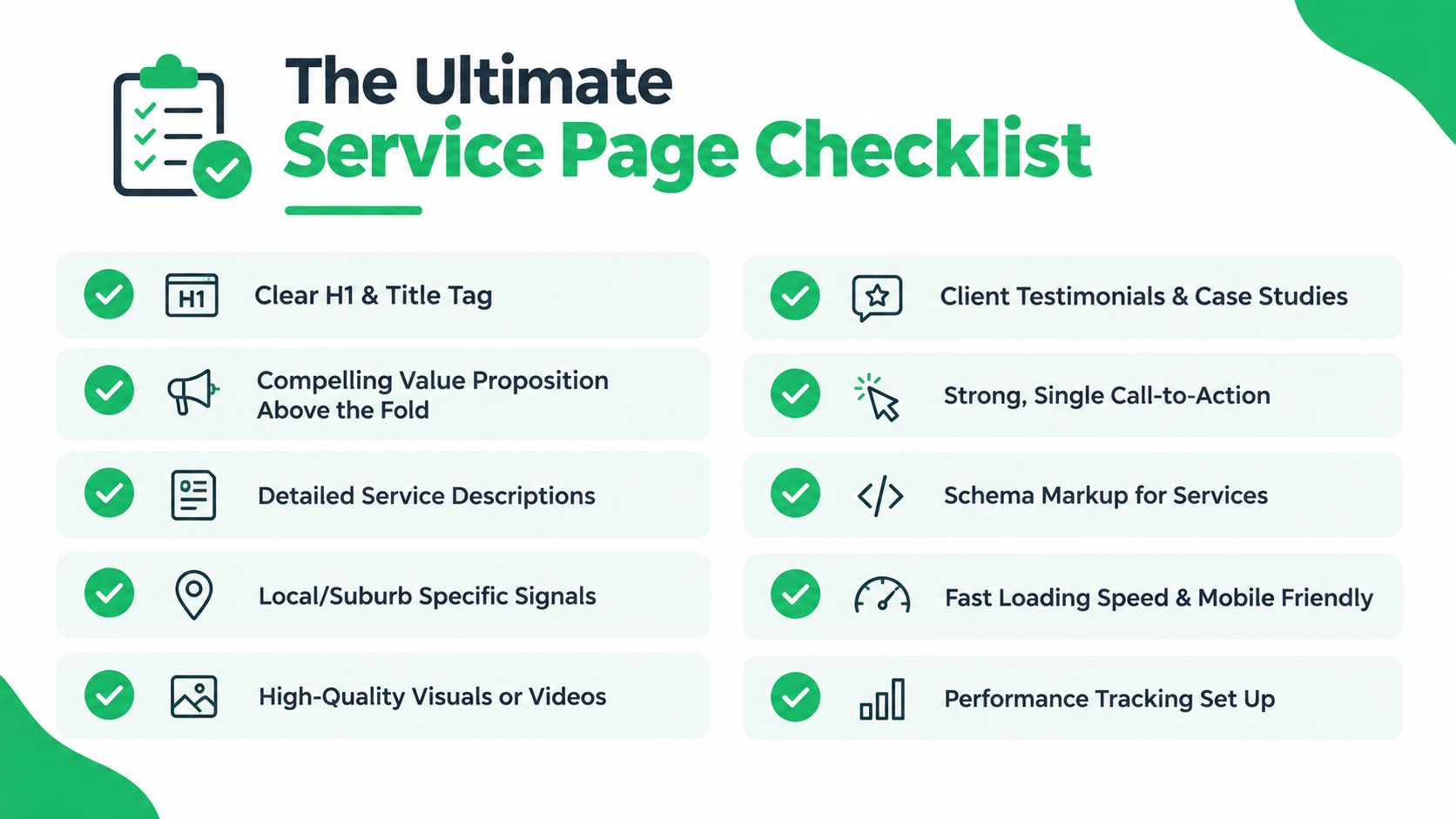
The Ultimate Service Page Checklist
A business owner can audit an existing page or assess an agency proposal against the following criteria:
- Clear H1 and title tag: The page has one obvious service and location purpose.
- Strong opening value proposition: The first content explains the problem, audience and next step.
- Detailed service description: The page explains implementation, not just labels.
- Local relevance: Suburbs, service areas and business details are accurate and meaningful.
- Unique page content: Each service-location page offers a genuine reason to exist.
- Credible proof: Testimonials, reviews and expertise claims are genuine and verifiable.
- Focused call to action: The visitor isn't forced to choose between competing conversion paths.
- Structured data: Relevant LocalBusiness or service markup is accurate and validated.
- Mobile performance: The page is usable, stable and assessed against Core Web Vitals.
- Measurement setup: Calls, forms, bookings or other meaningful actions are tracked where possible.
A page doesn't need every possible feature to perform well. It does need a clear purpose, accurate local signals, useful evidence, sound technical foundations and a measurement plan that reflects how customers contact the business.
SEO2RANK helps Melbourne service businesses connect local, technical, on-page and measurement work to practical visibility and lead-generation priorities. Visit SEO2RANK to review the available SEO services and request a suitable next step for the business.
Find Out What Is Holding Your
Website Back
Get a practical SEO Snapshot showing the biggest issues and opportunities we can see across your search visibility, website and local presence.
GET YOUR FREE SEO SNAPSHOT