
Why can a fast, polished website still sit below a competitor in Google? Google ranking factors are the signals its automated systems weigh when choosing and ordering pages for a search. They help Google assess relevance, usefulness, credibility and usability, but they aren't a fixed checklist that guarantees a position. For local service businesses, searcher location also matters, so success needs to be measured through qualified enquiries, not a single ranking.
Table of Contents
- Google Ranking Factors in Plain English
- The Main Signal Groups Google Weighs
- How Google Judges Relevance and Content Quality
- How Links and Mentions Build Authority
- Page Experience and Mobile Access Checks
- Local Signals That Change Results by Suburb
- Common Misconceptions About Ranking Factors
- Check Priorities and Measure What Matters
Google Ranking Factors in Plain English
A signal is a piece of evidence Google can interpret about a page or its context, such as its words, incoming links, technical accessibility or the searcher's location. The useful answer to “what are Google ranking factors?” is therefore a combined judgement, not a recipe with guaranteed results.
Consider a Melbourne plumber offering emergency repairs and bathroom renovations. Someone searching for an urgent leak repair needs a different answer from someone comparing renovation options. The business might provide both services, but each page needs to make its particular purpose clear.
A cooking competition offers a useful analogy. A judge doesn't assess a dish by counting ingredients alone. The judge considers how those ingredients work together and whether the dish suits what the diner ordered.
Practical rule: Optimising an isolated feature isn't the same as making a page the best answer to a particular search.
That distinction changes how a business should approach SEO. Adding more keywords won't resolve unclear service information. A new website design won't establish professional expertise. A prominent business name won't automatically make every article useful.
What deserves attention first
The starting point is the customer problem, followed by the evidence that the business can solve it. Technical work then makes that evidence accessible, while appropriate reputation-building helps establish credibility.
For a busy owner, the practical questions are straightforward:
- Purpose: What does each signal group help Google assess?
- Priority: Which weaknesses stop a service page from competing effectively?
- Judgement: Which familiar SEO promises confuse a useful practice with a guaranteed outcome?
The balance isn't identical for every search. An urgent local service query and an educational question require different kinds of answers.
The Main Signal Groups Google Weighs
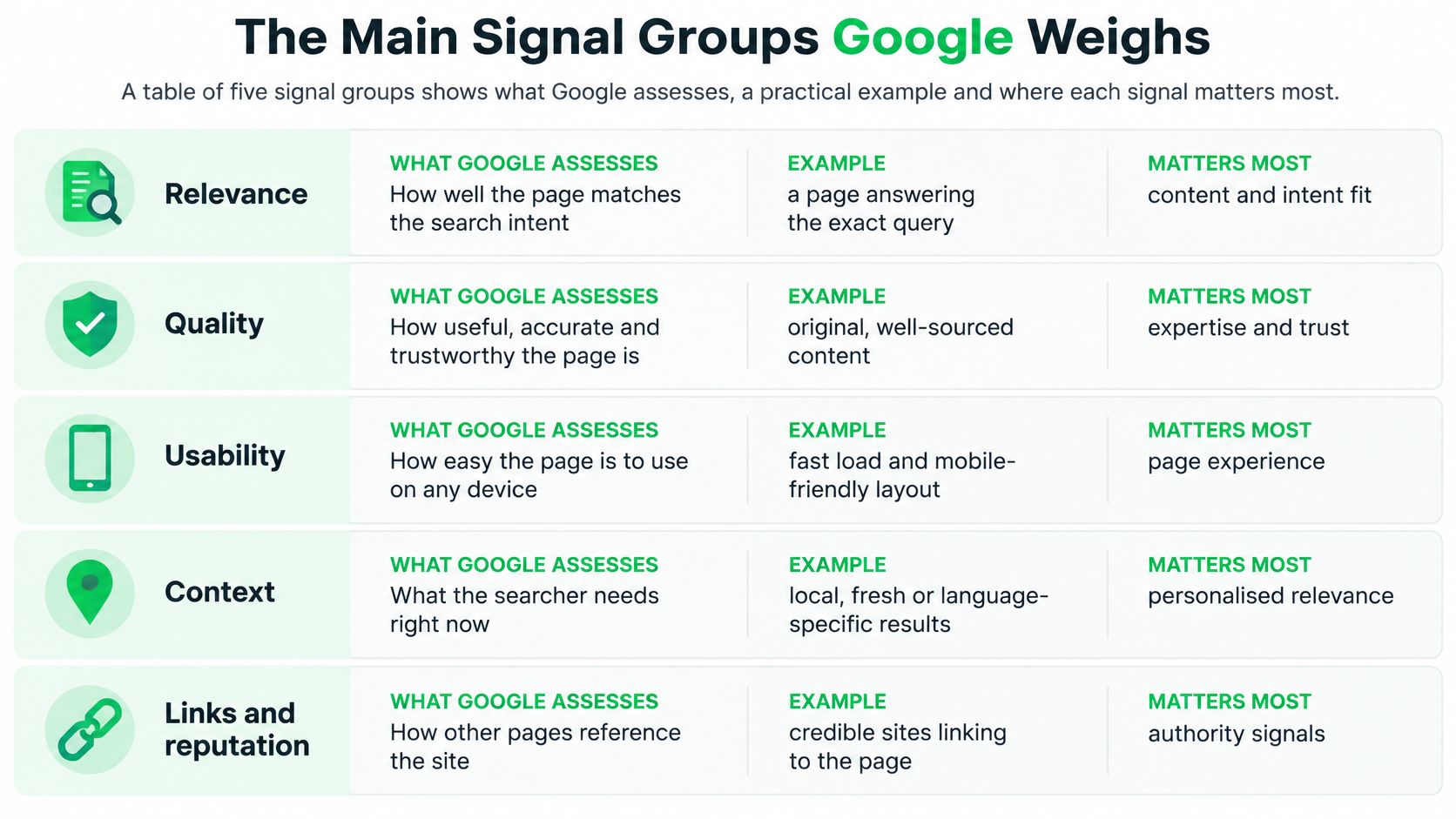
These signal groups provide a practical way to organise SEO work without pretending that Google publishes separate scores or fixed weights for each.
Google ranking signal groups and what they check
| Signal group | What Google assesses | Practical example | Where it matters most |
|---|---|---|---|
| Relevance and search intent | Whether the page matches what the person searched for | An emergency call-out page suits urgent searches, rather than a general history of plumbing | Every page, especially service pages |
| Content quality and E-E-A-T | Whether content is original, accurate and demonstrates first-hand experience | A dental clinic explains treatment using clinician knowledge rather than generic text | Guides, blogs and service pages |
| Links and mentions | How other websites reference the business and its pages | A relevant trade association links to the business | Competitive categories where credibility matters |
| Page experience and technical access | Whether Google can access the page and visitors can use it effectively | A stable mobile page with crawlable navigation | Commercial pages and shared templates |
| Local relevance, distance and prominence | How well the business suits a local search | Accurate profile details aligned with a suburb-focused search | Map results and near-me searches |
Technical eligibility and ranking aren't interchangeable. Google Search Essentials distinguishes technical requirements, spam compliance and ranking best practices, and explains that compliance doesn't guarantee crawling, indexing or appearance in results.
That matters when deciding where to spend effort. Improving an inaccessible page's wording doesn't resolve its access problem. Equally, making a generic page accessible doesn't give customers a compelling reason to choose it.
How the groups work together
Ranking involves comparison for a particular query. A well-linked page can still be less suitable than a competitor's page that answers the actual question more clearly. Strong reputation isn't permission to ignore relevance.
For example, a plumber's emergency call-out page should explain the problems handled, service coverage and contact process. A history-of-plumbing article serves a different purpose and needs its own relevance to educational searches.
The same distinction applies to accounting firms. A page explaining business tax services shouldn't require a prospective customer to infer whether the firm handles their situation from a general company biography.
Check relevance first, unless a technical barrier prevents access altogether. The remaining work should help establish that the answer is credible, usable and appropriately local, rather than distract from what the customer needs.
How Google Judges Relevance and Content Quality
Google generally evaluates ranking at the individual-page level, even though broader website signals can contribute. Its systems assess hundreds of billions of webpages; the Google ranking systems guide also explains that the helpful content system announced in 2022 became part of its core ranking systems in March 2024.
For a Melbourne electrician, this means the switchboard-upgrade page needs to explain switchboard upgrades. A strong homepage doesn't remove the need for a useful service page.
Relevance starts with search intent, meaning what the person hopes to accomplish. Someone researching warning signs needs an explanation; someone seeking a provider needs service details and a practical next step. Understanding what search intent means for SEO helps prevent the wrong type of page being built for a query.
Making E-E-A-T visible
E-E-A-T describes experience, expertise, authoritativeness and trustworthiness. It isn't a public score that a business can increase by adding badges or repeating claims of expertise.
A dental clinic explaining root canal treatment can demonstrate these qualities through:
- Experience: Describing the practical questions patients commonly need answered before an appointment.
- Expertise: Having a suitably qualified clinician explain the treatment accurately.
- Authoritativeness: Making the clinician's professional background and the clinic's identity clear.
- Trustworthiness: Explaining limitations, avoiding outcome guarantees and distinguishing general information from individual clinical advice.
A generic summary might describe the procedure correctly but still omit what a patient needs to understand. Useful professional content explains what happens, why assessment matters and which questions require a consultation.
Specific explanations provide stronger evidence of expertise than repeated claims that a business is experienced.
Original detail beats location substitution
Publishing suburb pages that change only the place name doesn't establish a meaningful reason for each page to exist. A worthwhile service-area page should explain genuine coverage, relevant customer problems and practical service arrangements.
Australian detail should be accurate and necessary. An accountant discussing obligations should identify the applicable Australian context rather than reuse overseas terminology. Where regulated advice is involved, content needs appropriate professional review.
On-page wording should remain straightforward. Titles and main headings should name the actual service using customer language. Image alt text should describe the image meaningfully, while internal link text should explain the destination rather than repeat awkward keyword combinations.
A short editorial self-test helps:
- Immediate answer: Does the opening screen explain the service or answer the question?
- Distinct value: Would a customer learn something beyond a generic summary?
- Demonstrable knowledge: Can the author or reviewer substantiate the experience behind the explanation?
How Links and Mentions Build Authority
More links don't automatically mean better rankings. A link makes more sense as supporting evidence when the referring page has a genuine reason to reference the business.
A backlink is a link from another website. Plausible examples include a trade association's member directory, a relevant council resource or a local news article quoting a business owner about their field.
A business mention without a link can still have practical reputation value, but it shouldn't be presented as equivalent to a backlink or assigned an invented ranking weight. Link count alone doesn't explain relevance, editorial purpose or credibility.
Where promotion becomes manipulation
Google's spam policies classify buying or selling links for ranking purposes as link spam, including excessive reciprocal exchanges and partner pages created primarily for cross-linking; advertising arrangements aren't automatically violations when outbound links are appropriately qualified with rel="nofollow" or rel="sponsored".
Consider an accountant sponsoring a local business event. The sponsorship can introduce the firm to relevant business owners. An appropriately qualified sponsor link acknowledges that commercial arrangement without presenting the payment as an editorial endorsement intended to influence rankings.
Warning signs include:
- Guaranteed link packages: Offers centred on a promised quantity rather than identifiable, relevant placements.
- Directory farms: Collections of listings with little apparent purpose beyond linking to customers.
- Unrelated placements: Links inserted into articles with no sensible connection to the business.
- Compulsory exchanges: Arrangements requiring participants to link to each other primarily for SEO.
Risk check: A placement should have a defensible business or editorial purpose even without a promised ranking benefit.
Reading link reports sensibly
Tools can help identify referring websites and unusual patterns, but proprietary authority metrics aren't Google's own scores. An explanation of Majestic Trust Flow can help distinguish a diagnostic tool metric from evidence of actual search performance.
Useful resources, legitimate memberships and relevant partnerships are more defensible starting points than manufactured link volume. A tradie might publish an original maintenance checklist that a community organisation finds worth sharing.
A sensible maintenance routine includes reviewing backlinks annually and after suspicious activity. An unfamiliar link alone isn't proof of a problem; the review should look for deliberate purchasing, repetitive placements and arrangements that the business controls.
Page Experience and Mobile Access Checks
Core Web Vitals targets for a good user experience
| Metric | Good threshold | What it measures | Quick fix |
|---|---|---|---|
| Largest Contentful Paint (LCP) | 2.5 seconds or less | How quickly the main content appears | Compress hero images and improve server response |
| Interaction to Next Paint (INP) | 200 milliseconds or less | Responsiveness to taps and clicks | Reduce heavy JavaScript and third-party scripts |
| Cumulative Layout Shift (CLS) | 0.1 or less | Unexpected movement during loading | Set dimensions and reserve space for images, embeds and widgets |
Google's page-experience guidance recommends assessing these targets at the 75th percentile of real page loads, separately for mobile and desktop, while emphasising that a good experience doesn't guarantee top rankings.
LCP resembles how quickly a shopfront opens so customers can see what's available. INP resembles how quickly the cashier responds when approached. CLS asks whether the shelves stay still while someone reaches for a product.
These aren't interchangeable problems. Compressing a hero image may help loading but won't necessarily fix a menu slowed by JavaScript. Reserving space for an enquiry widget addresses movement rather than server response.
Real visitors matter more than a tidy test result
A developer's test can look healthy while actual phone sessions struggle. Hosting latency, device limitations and third-party scripts can change what visitors experience; Google's Core Web Vitals documentation explains the role of real-user measurements.
For a Melbourne service page, the practical test includes opening the mobile menu, tapping the phone number and completing the enquiry form. A visually impressive page isn't effective if those controls become difficult to use.
Google also uses the mobile version of content for indexing and ranking. Its mobile-first indexing guidance clarifies that this concerns how content is gathered, not an automatic ranking advantage.
A practical repair order
- Inspect commercial pages: Review Search Console's Core Web Vitals report for service and location pages that support enquiries.
- Repair shared templates: Correct a problematic header, gallery or booking component across affected pages.
- Prevent movement: Reserve space for images, embedded maps and widgets before they load.
- Control heavy scripts: Assess chat widgets, tracking and consent tooling, delaying non-essential code without breaking required functionality.
- Compare mobile content: Confirm that important explanations, navigation and enquiry options remain available on smaller screens.
A technical SEO checklist for small business can help organise these checks. Template and script changes may require a developer, especially where booking systems or consent behaviour could be affected.
Local Signals That Change Results by Suburb
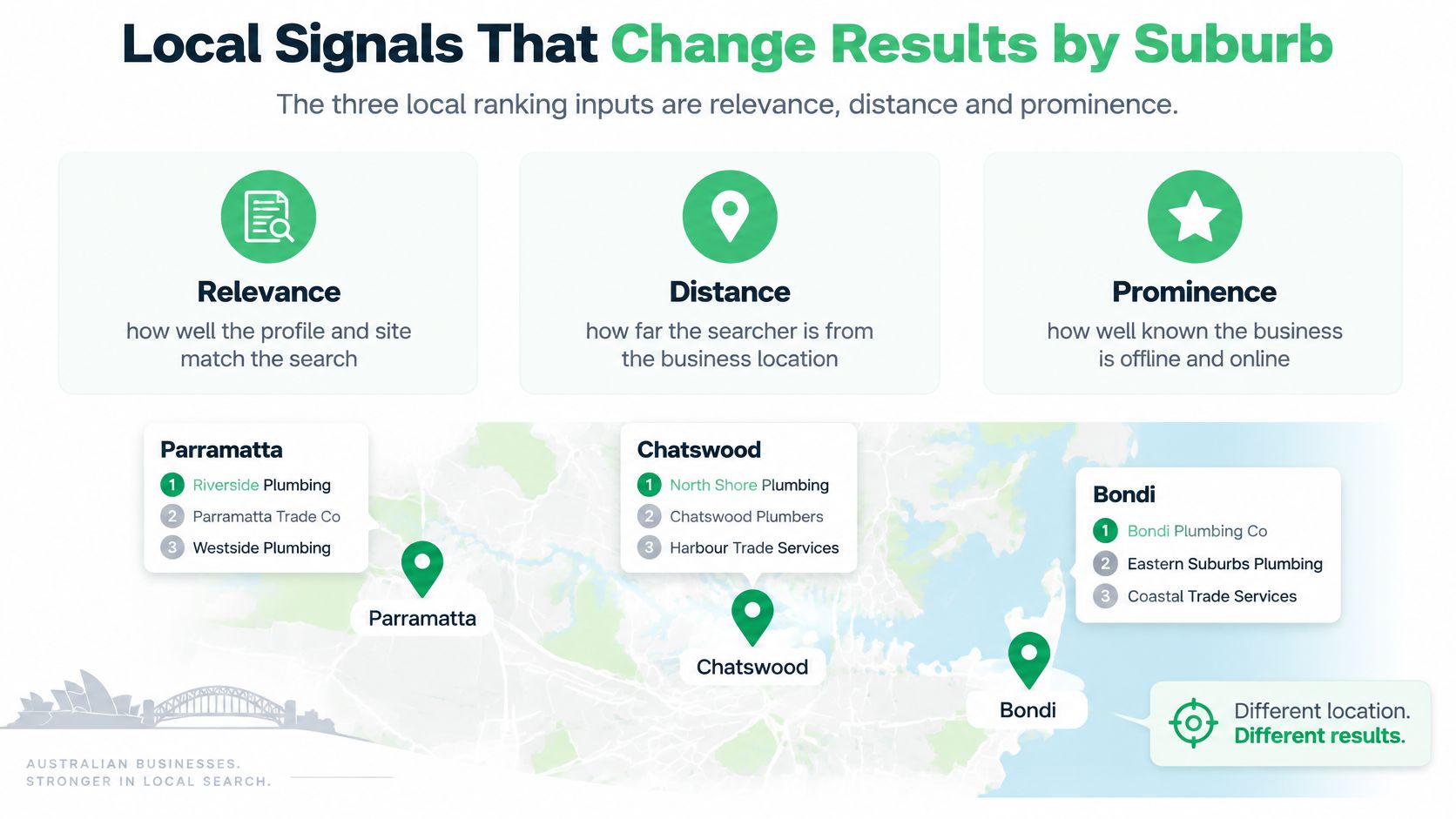
Local ranking factors and what a business can influence
| Local factor | What it means | What a business can influence |
|---|---|---|
| Relevance | How well the profile and website match the search | Accurate categories, services, content and location pages |
| Distance | How far the searcher is from the business location | Limited influence; coverage should reflect genuine service capability |
| Prominence | How well known the business is online | Reviews, links, mentions and consistent business listings |
These local inputs require different decisions. Relevance can be improved through accurate information, while prominence involves reputation beyond the business's own website. Distance imposes a geographic constraint that content alone can't remove.
A 2025 Australian local-SEO statistics roundup from Titan Blue estimated that approximately 46% of Google searches in Australia had local intent. That's a secondary-source estimate, not a published Google measurement, but it illustrates why location deserves attention for service businesses.
Useful coverage isn't an invented presence
Consider a plumber based in Melbourne's eastern suburbs who travels across surrounding areas. A location page can explain which services are available in a suburb and how bookings work. It shouldn't suggest a staffed office exists where there isn't one.
Selecting a service area also shouldn't be treated as a promise of equal visibility throughout it. Operational coverage and search competitiveness are different questions.
The most useful local maintenance tasks are practical:
- Accurate Google Business Profile: Maintain suitable categories, services, opening hours and representative photos.
- Consistent identity: Keep the business name, contact details and relevant address information accurate across legitimate listings.
- Thoughtful review replies: Respond promptly and avoid disclosing private customer information, particularly in healthcare and financial services.
- Substantive location content: Describe real suburbs, available services and relevant customer circumstances instead of swapping place names.
Reviews deserve a careful distinction between reputation management and ranking assumptions. Understanding how Google reviews relate to local rankings helps keep the focus on authentic feedback rather than treating reviews as a mechanical target.
Realistic coverage is ultimately a business decision. A provider should consider travel, appointment capacity and lead value alongside local visibility, rather than pursue enquiries from every suburb just because a location page can be published.
Common Misconceptions About Ranking Factors
The most tempting SEO promise is certainty: complete a list, pay a fee and obtain a predictable position. That promise removes the competitive and contextual parts of search that businesses need to understand.
These common beliefs turn useful practices into misleading guarantees:
- Myth, Google has a fixed secret checklist. Reality: there isn't a universal task list that produces the same result for every query. Practical priorities need to reflect the page and competitive situation.
- Myth, more keywords or pages mean higher rankings. Reality: repetition doesn't establish usefulness. Additional pages need a distinct purpose, rather than create a larger collection of interchangeable text.
- Myth, payment buys better organic local rankings. Reality: Australian Small Business's local SEO guide explains that businesses can't pay Google for better organic local rankings. Paid advertising is separate.
- Myth, passing Core Web Vitals guarantees a leading position. Reality: a healthy performance report doesn't establish that the service matches the search or that its explanation is credible.
- Myth, buying links is an acceptable temporary shortcut. Reality: a tactic doesn't become compliant because a seller claims it works briefly. Deliberate link manipulation exposes the business to avoidable visibility risk.
Why plausible advice becomes misleading
A myth often contains a useful fragment. Speed matters to visitors. Clear service language matters. Relevant links can support credibility.
The mistake is converting that fragment into an absolute rule. A tool might show that leading pages share a feature, but that correlation doesn't establish that adding the feature caused their rankings.
Older advice can also lose context when copied into a new guide. A recommendation originally intended to resolve a particular technical problem may become a supposedly universal requirement.
A credible SEO recommendation explains the problem being addressed, the proposed change and how its effect will be assessed.
What a sensible commitment looks like
A provider can commit to agreed work, implementation checks and transparent reporting. It can't control competitors, searcher behaviour or Google's decisions.
SEO 2 RANK doesn't guarantee first-page or number-one rankings because Google controls search results and changes them continuously. The meaningful commitment is a clear process for identifying weaknesses, making appropriate changes and evaluating outcomes, not ownership of a search position.
Check Priorities and Measure What Matters
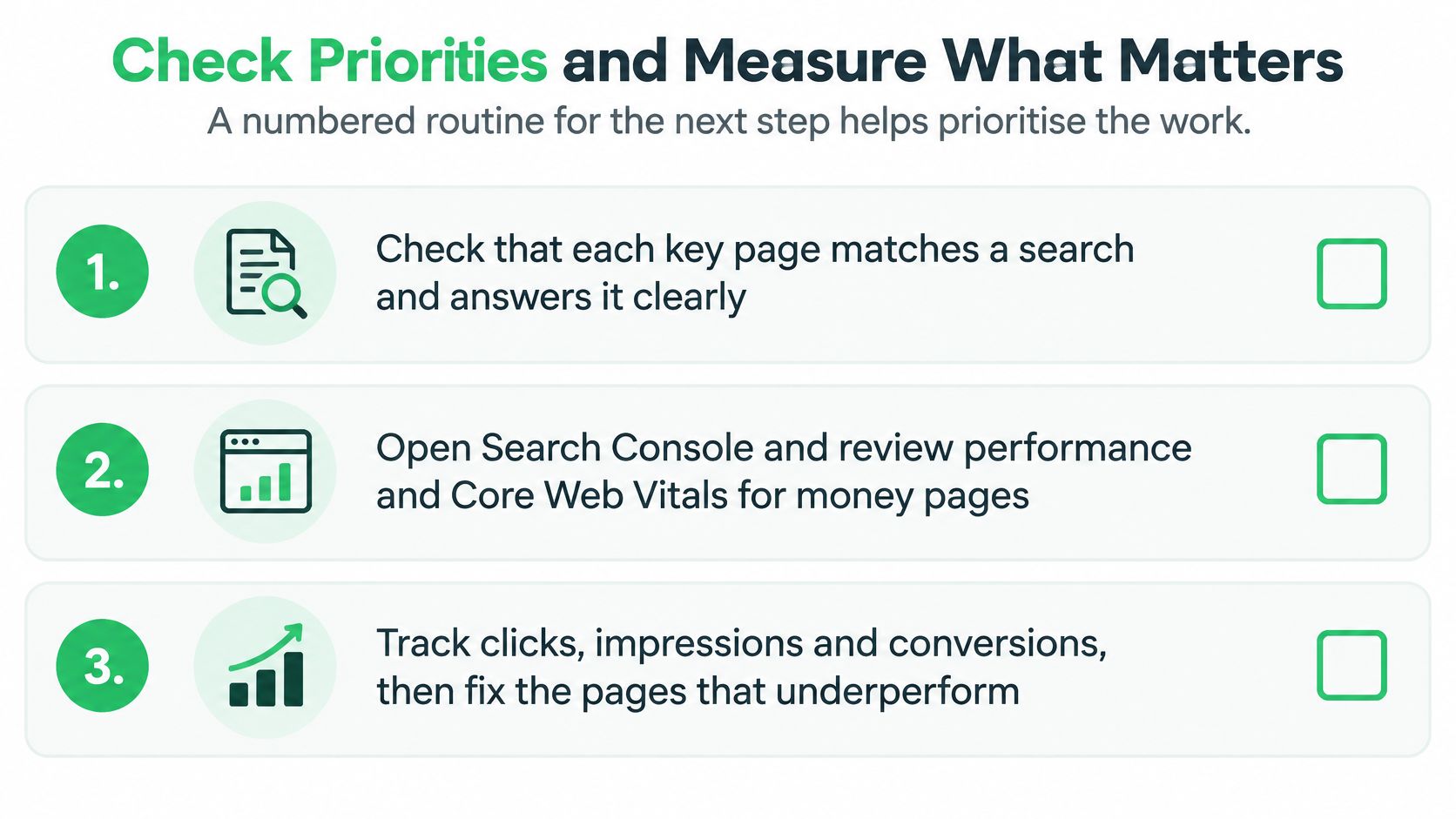
A ranking review works like a pre-purchase inspection on a work vehicle: check each system in order, note what fails, then decide where to spend. These five checks cover the areas most likely to explain weak visibility.
- Match each key page to a search: Confirm that its purpose and opening explanation align with the intended customer need.
- Review Search Console: Examine performance, indexing and Core Web Vitals for the pages that carry commercial weight.
- Verify local information: Check Google Business Profile categories, hours and genuine service coverage.
- Inspect link arrangements: Look for purchased placements or reciprocal schemes that need review.
- Limit simultaneous changes: Make a manageable set of improvements and record what changed, so later results can be traced back to specific work.
Separate visibility from business outcomes
An owner's occasional Google search is a poor measuring tool. Results shift with the searcher's location, device and history, so a page can look stable from the office and stay invisible two suburbs away. Grid-based tracking reveals those geographic differences, while Google Business Profile reporting captures calls, direction requests and website clicks where available.
Keep map visibility, organic visibility and lead quality as three separate measures. A plumber might gain map placements around one suburb while organic service pages stall elsewhere, and neither figure says whether enquiries became booked jobs. Track enquiries and bookings by suburb where practical, and confirm mobile visitors can find contact details and complete the form easily.
SEO 2 RANK uses Google Search Console, analytics and campaign data to understand what is gaining visibility and where opportunities remain. Progress is measured through visibility, qualified traffic and enquiries rather than position checks alone.
Allow time without promising a deadline
SEO work should be planned over months rather than judged in the first weeks. No fixed outcome date is defensible, because starting position, competition, location, website quality and the required repairs all shape the work.
No SEO 2 RANK package guarantees crawling, indexing, rankings, traffic, leads or revenue, because Google controls search results. What a business can control is the order of work. An independent specialist can prioritise an overloaded team's review, while complex technical implementation may require a developer.
SEO 2 RANK offers local, technical and on-page SEO work that connects ranking considerations with practical website improvements and measurement. Visit SEO 2 RANK to discuss a review of service-page relevance, technical access and local visibility, with priorities based on the business's current position.
Find Out What Is Holding Your
Website Back
Get a practical SEO Snapshot showing the biggest issues and opportunities we can see across your search visibility, website and local presence.
Get Your Free SEO Snapshot→