

Majestic Trust Flow is a proprietary 0 to 100 backlink-quality score for a URL, subdomain, or root domain, and it is not a Google ranking factor. That's the counterintuitive part worth grasping first. A site can lift that number and still gain no extra visibility, traffic, or enquiries, because the score only models how trustworthy its links look inside one company's index. Used properly, it helps an Australian service business judge links against close competitors. Used as a target to inflate, it pushes spending toward the highest number rather than the most relevant link.
Table of Contents
- What Majestic Trust Flow Actually Is
- How Trust Moves from Seed Sites
- Reading Trust Flow Beside Citation Flow
- Why Trust Flow Scores Are Not Linear
- Topical Trust Flow on Local Service Pages
- Where Trust Flow Misleads SEO Decisions
- Check Links Before You Chase a Higher Score
What Majestic Trust Flow Actually Is
The Majestic flow metrics announcement introduced Trust Flow in May 2012 as a whole-number score from 0 to 100 for a URL, subdomain, or root domain. A higher value means Majestic's model sees stronger quality signals in the links pointing to that page or site. It doesn't mean the page has more links. Quantity is a separate question, and mixing the two is where most confusion starts.
The model begins with manually reviewed trusted seed URLs, then estimates how trust propagates through the web's link graph. Pages sitting close to those trusted sources tend to score higher. Pages farther away, or surrounded by weaker sites, generally receive less. Because the calculation runs on Majestic's own index, the result is a third-party estimate, not a Google ranking factor, not an Australian government measure, and not a universal authority grade that can be compared directly with scores from other vendors.
What an Australian Business Actually Uses It For
For a Melbourne service firm, the score has three practical jobs. It helps compare competing domains in the same market. It helps assess a prospective referring website before chasing a link from it. It also helps track how a backlink profile changes over time, provided the same scope is measured each time.
Scope matters more than many owners expect. A root domain and an individual service page carry different scores, so a healthy domain figure can hide a thin commercial page underneath it. Always check the exact URL being judged, whether that's a homepage, a suburb landing page, or a pricing page.
Practical rule: Treat Trust Flow as a comparison tool between similar pages, never as a promised ranking or lead outcome.
Trust Flow also needs its partner metric. Citation Flow reflects link quantity rather than quality, and Majestic describes the two as complementary. A large gap where Citation Flow substantially exceeds Trust Flow may indicate many links carrying comparatively weak trust signals, while stronger Trust Flow relative to Citation Flow can suggest a more quality-oriented profile. Reading either number alone invites the wrong conclusion. The scale itself adds a second trap, since the score is logarithmic rather than linear, so small gaps don't mean proportional differences in authority. That scale is examined in detail further down this page.
How Trust Moves from Seed Sites
Think of trust working like a recommendation passed along a street. A respected local recommends a neighbour, that neighbour recommends someone else, and each retelling carries slightly less weight than the original. By the fifth or sixth handover, the recommendation still exists, but it means far less. Trust Flow models links in a similar way.
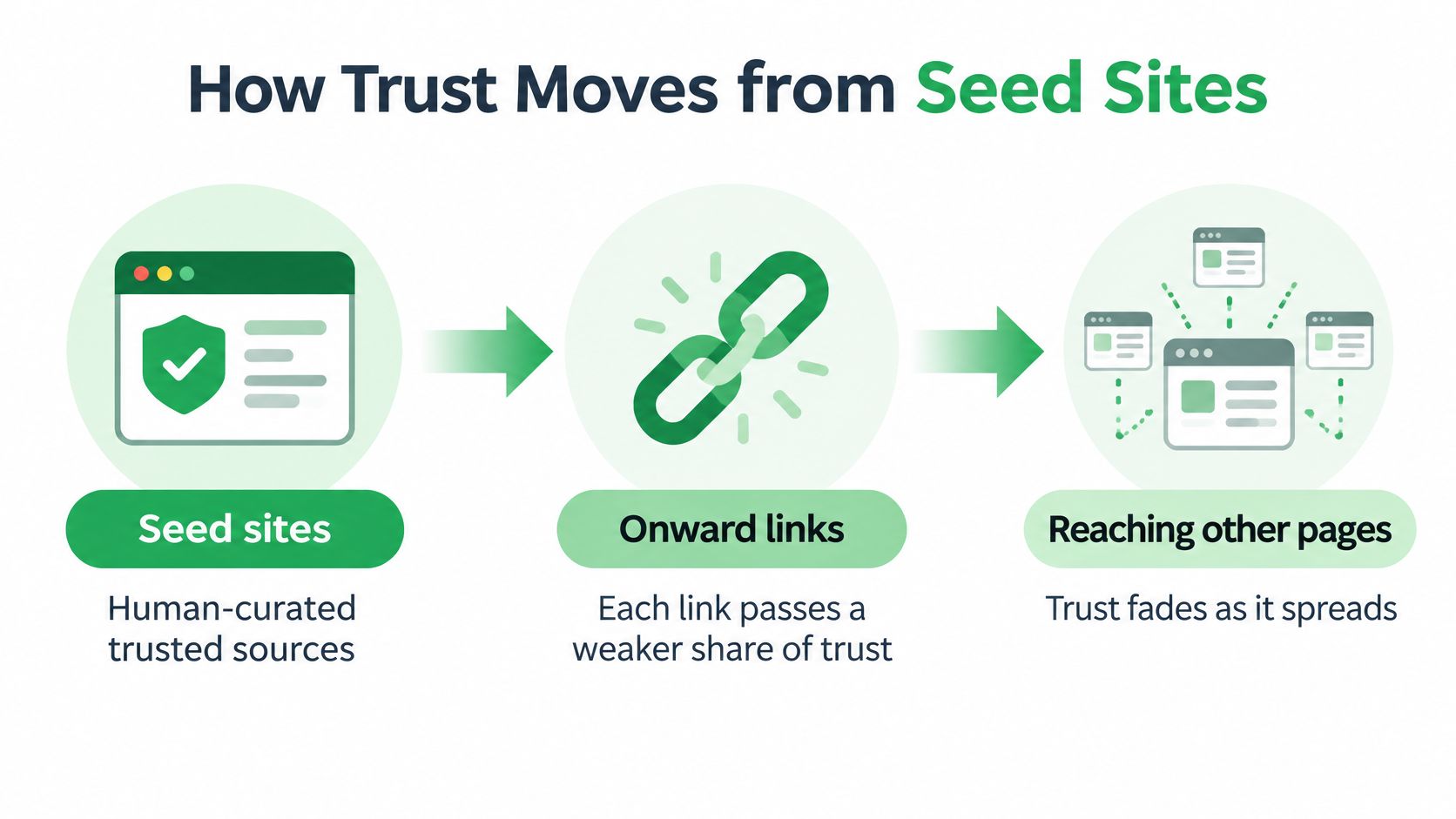
The starting points are seed sites regarded as human-curated or trusted. From there, the calculation follows links outward and passes a diminishing strength signal at each step. The Majestic flow metric scores page says the system models billions of data points in its web map, and that Trust Flow is used together with Citation Flow for toxic-link analysis and penalty remediation. That scale explains why trust can travel through several link relationships instead of depending only on sites linking directly to a page.
Why Neighbourhood Beats Volume
A page linked from credible, well-connected sites sits in a stronger neighbourhood, so it tends to score higher. Links from low-quality or weakly connected pages contribute little, even when they arrive in large numbers. That's why buying hundreds of cheap directory links rarely moves this metric in a meaningful way. A smaller set of credible links can carry more modelled weight than a long list of weak ones.
Domain-level Trust Flow aggregates URL-level scores across a site. A strong root domain therefore doesn't prove that every commercial landing page is strong. An older blog post with solid links can lift the domain figure while the main service page has almost nothing pointing to it. Australian businesses should inspect the exact page being strengthened, such as a Melbourne service page, and check whether its referring links are contextually relevant to that market.
Internal structure plays a supporting role here too. Sensible internal links help important pages receive attention within a site, and the principles behind internal linking for SEO explain how that distribution works in practice. External trust arriving at one page still needs a clear path to the pages that sell the service.
Scores also shift as the index is rebuilt and new links are found or lost. Comparing figures only makes sense when the scope, index, and date match. A domain score from one month set against a URL score from another tells the reader nothing reliable.
Use the score to decide which linking sites deserve a manual review, then check relevance, anchor text, and Search Console performance before acting.
Reading Trust Flow Beside Citation Flow
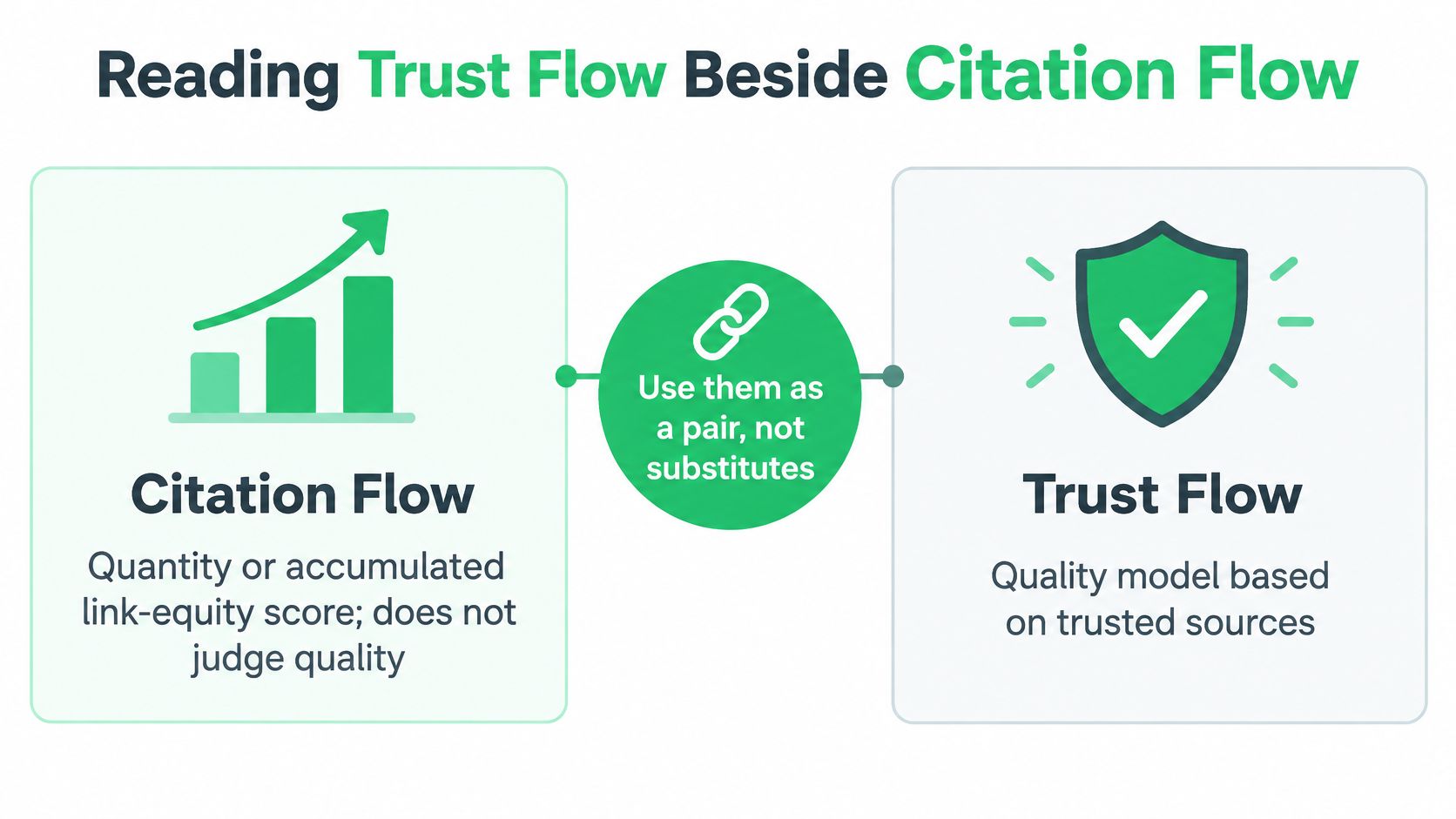
Citation Flow is Majestic's quantity score. It represents accumulated link equity flowing to a page and doesn't judge whether those links are any good. Trust Flow is the quality model sitting beside it. The pair only becomes useful when read together, as the Majestic flow metric scores guide explains when setting out how the two scores interact.
How to Read Trust Flow Against Citation Flow
| Pattern | What it suggests | Sensible next check |
|---|---|---|
| Trust Flow relatively strong versus Citation Flow | Link volume is supported by more credible sources | Confirm topical and geographic fit of the referring sites |
| Citation Flow substantially higher than Trust Flow | Many links but weaker trust signals; possible low-quality or manipulative links | Review the links manually; do not disavow automatically |
| Similar Trust Flow and Citation Flow to a local competitor | A useful benchmark, not a pass or fail | Match industry, service area and URL type before judging |
| Strong root-domain Trust Flow, weaker URL score | Domain aggregate is hiding a thin commercial page | Inspect the exact service or money-page URL |
| Rising Citation Flow with flat Trust Flow | Quantity is growing faster than modelled quality | Check whether new links are relevant and editorial |
Read each row as a pattern to investigate, not a verdict. A profile where Trust Flow holds up against Citation Flow suggests the volume is backed by more credible sources, which is the healthier shape. Citation Flow sitting substantially above Trust Flow can point to many low-trust, weakly connected, or potentially manipulative links. That gap is a reason to open the link list and look properly. It is not an automatic instruction to disavow everything below an arbitrary number.
A similar pair of scores on a comparable competitor is a benchmark. There's no universal good Australian Trust Flow threshold, so chasing a round number copied from an overseas blog post wastes effort. A tradie, dentist, or accountant should compare businesses in the same vertical, the same suburb or service area, and the same URL type. A homepage compared against a competitor's service page produces a misleading gap before the analysis even starts.
Checks That Matter More Than the Gap
- Topical alignment: Does the linking site cover subjects related to the service being sold?
- Geographic relevance: Is the source Australian, ideally connected to the same city or service area?
- Editorial placement: Does the link sit inside genuine content rather than a footer or link list?
- Indexability: Can search engines crawl and index the linking page?
- Referral potential: Could a real person plausibly click through and enquire?
A small set of credible Australian industry, professional, community, supplier, or media links usually serves a local business better than indiscriminate volume. SEO2RANK follows the same logic in its citation work, focusing on relevant, trustworthy listings with consistent information rather than chasing a large volume of low-quality directories. Tracking should cover Trust Flow, Citation Flow, referring-domain quality, organic impressions, and qualified enquiries together, so no single third-party number steers the whole program.
Why Trust Flow Scores Are Not Linear
Doubling sits at the heart of this scale. In Majestic's illustration, roughly 100 quality points may produce a Trust Flow of 5, 200 may produce 6, 400 may produce 7, and 800 may produce 8. Each single-point step therefore needs about twice the modelled quality of the step before it. The Majestic guide to reading Trust Flow charts sets out that progression to show why a two-point increase doesn't represent twice as much link quality.
Treat those figures as a teaching scale, not a formula. The underlying model is proprietary, so nobody outside Majestic can reverse a score into an exact link count or a precise quality value. Any tool or salesperson claiming to know exactly how many links will produce a given score is guessing. The illustration exists to explain the shape of the curve, nothing more.
What the Curve Means in Practice
Gains get harder as the score rises. Moving from a low score toward a moderate one can require fewer additional quality signals than pushing an already high score closer to 100. Early progress often looks encouraging because the first credible links land on an almost empty profile. Later progress slows even when the link quality stays just as good, and that slowdown is built into the maths rather than signalling failure.
Now apply that to a competitor comparison. A Melbourne competitor scoring 40 isn't automatically twice as authoritative as a site scoring 20. Likewise, a two-point gap between 30 and 32 may mean very little in practical terms, particularly when the two businesses operate in different industries or suburbs. Comparisons only hold up between similar markets, similar URL types, and similar backlink profiles, because Trust Flow works as a relative metric rather than a fixed quality grade.
A one or two point movement is weather, not climate. Record it, then look at which links actually changed.
A simple recording routine prevents overreaction. Note the Trust Flow beside Citation Flow, the index used, and the date. Then check whether the referring sites behind any change are credible and relevant. That habit turns a wobbling number into a question with an answer.
Topical Trust Flow on Local Service Pages
Overall Trust Flow answers one question: do the links look trustworthy? Topical Trust Flow asks a sharper one: trustworthy for what subject? According to Majestic Site Explorer topics reporting, the system classifies the web into more than 800 topical categories and reports topical scores at URL, subdomain, and domain level. Instead of only weighing trust, it examines how closely a page connects to trusted sites within a particular category.

Say a Melbourne plumber weighs up two possible links. One comes from a high-scoring overseas page about an unrelated global topic. The other comes from a credible Australian building, trade, or local-community source with a modest score. The second link usually carries more practical value, because its topic and geography both match the business. The first link raises a number while saying nothing about plumbing in Melbourne.
A dental practice should read its profile the same way. Relevant health, medical, or local-business topical signals give better evidence of subject trust than a high overall number built on unrelated links. A practice linked mostly from entertainment or gaming sites might post a respectable score, yet the topical view exposes the mismatch immediately. That gap between general backlink strength and the subjects those links belong to is exactly what Topical Trust Flow is built to reveal.
An accountant faces a similar choice. A mention from a professional body, an industry publication, or a local business group supports the firm's subject area in a way a generic directory listing can't. The directory may still help with consistent business details, but it adds weak topical evidence. Judging both by score alone would rank them incorrectly.
Applying Topical Fit to a Service Page
Topical categories should be checked at the level of the page being promoted, not just the domain. A well-built service page gives relevant links something worth pointing to, and the elements covered in what a good SEO service page should include show how that foundation is put together. Where relevant local opportunities are scarce, a few well-matched links typically matter more than chasing a higher raw number from off-topic sources.
One limit deserves emphasis. Topical Trust Flow remains a diagnostic. It isn't proof that a page holds authority for every keyword in its category, and it doesn't guarantee that any single link will move rankings. The categories guide judgement about fit. Real outcomes still show up in visibility and enquiries.
Where Trust Flow Misleads SEO Decisions
The costliest mistake is treating the score as something it isn't. Trust Flow is not a Google ranking factor, so no movement in it promises a movement in search results. It also isn't an Australian market statistic. The Majestic Trust Flow page describes a global Historic Index covering web data from 6 June 2006 to 26 March 2024, and no verified Australian share of that index is published. Any claim about an average Melbourne score drawn from it would be invented.
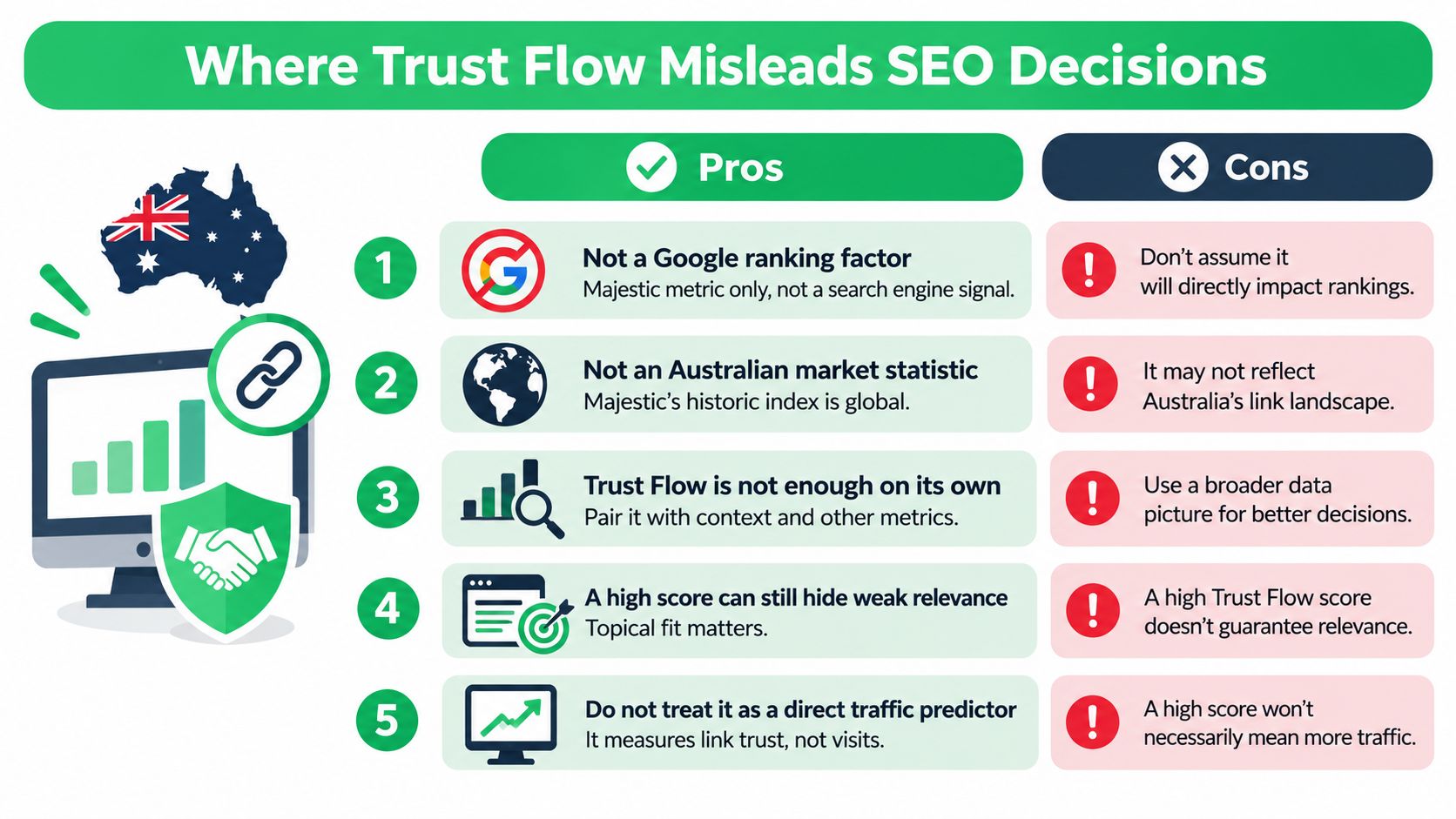
The second mistake is reading the number as revenue. A higher score doesn't mean more phone calls, bookings, or quote requests. Search Console impressions, analytics behaviour, rankings, and qualified enquiry counts have to corroborate any improvement before it counts as progress. A business can hold a modest score and still win its local market through strong service pages and reviews.
Third, a wide Citation Flow gap is a prompt to investigate, not a standing order to disavow. Disavowing links on score alone can remove harmless or even helpful references. Each suspicious link needs a manual look at placement, relevance, and anchor text. Patterns matter more than individual low numbers, and the thinking behind Google spam update guidance reinforces why manipulative patterns, rather than isolated weak links, draw attention.
Fourth, history charts get overread. The Majestic Site Comparator reports Trust Flow and Citation Flow history dating back to 2016, which helps spot a gradual build, a sudden spike, or a loss after a redesign. That chart is a tool capability, not an Australia-specific measurement, and a spike still needs the underlying links inspected before anyone celebrates or panics.
Fifth, small changes and cross-industry comparisons invite false conclusions. A national retailer and a suburban physio operate in different link economies, so their scores aren't comparable. Relative numbers on a non-linear scale only make sense inside a matched competitor set.
Who Should and Shouldn't Lean on It
The metric suits anyone comparing referring sites or watching one domain over time on the same index. A small local business with few realistic link opportunities shouldn't treat it as a standalone KPI, because visibility and enquiry measures answer the commercial question directly. Professional help becomes reasonable when organic traffic has stalled, important pages aren't ranking, a migration is planned, or competitors consistently outrank the site and the link profile needs a prioritised review.
Check Links Before You Chase a Higher Score
What is Majestic Trust Flow, in one line? It's a 0 to 100 third-party quality signal that works best beside Citation Flow and Topical Trust Flow, and it should never be treated as a ranking or lead target. Five checks keep it in that proper place.
- Fix the measurement: Note Trust Flow and Citation Flow for the same URL scope, index, and date every time.
- Match the competitors: Compare two or three Australian businesses in the same vertical and service area, not a famous unrelated site.
- Open the links: Inspect whatever sits behind a wide gap and keep links that are relevant, editorial, and locally credible.
- Prefer fit over size: Choose a local association, supplier, council, or industry mention over a numerically stronger but off-topic link.
- Judge by outcomes: Measure progress through visibility, qualified traffic, and enquiries rather than the Majestic number alone.
That fifth check mirrors how SEO2RANK structures its Build Trust step, strengthening review processes, useful citations, local mentions, and authority signals around a business instead of inflating a score. Its plain-English reporting then explains what changed, what improved, and what happens next. Where a profile looks messy or a site isn't converting existing visibility, a structured SEO audit gives a prioritised starting point. Any recommendation from that review should arrive with a rationale the business owner can check independently.
For Melbourne service businesses that want links judged by relevance and commercial value rather than by score alone, SEO 2 RANK offers audits and ongoing SEO programs that connect backlink work to visibility, qualified traffic, and enquiries. Start with a review of the current link profile, see exactly which links help and which ones don't, and decide the next step from evidence rather than a single number.
Find Out What Is Holding Your
Website Back
Get a practical SEO Snapshot showing the biggest issues and opportunities we can see across your search visibility, website and local presence.
Get Your Free SEO Snapshot→