
If a Melbourne dental clinic has a decent website but enquiries still feel patchy, the problem usually isn't a lack of marketing activity. It's that the site, Google Business Profile, and key treatment pages aren't aligned to the way patients search. How SEO improved for this Melbourne dental clinic came down to four things: fixing local discovery, removing technical barriers, rebuilding treatment pages around intent, and tracking calls and forms properly so visibility could be tied to real enquiries.
That approach suits clinics that already offer solid services but aren't showing up consistently for the suburbs and treatments that matter most. Australia's oral-health data shows a large addressable market, but not everyone visits a dental professional each year, with 52% in 2022–23 and 53.9% in 2024–25 reported by the AIHW and ABS summary, which is why being visible at the moment of need matters so much for patient acquisition (AIHW oral health summary).
Table of Contents
- How We Improved SEO for a Melbourne Dental Clinic at a Glance
- Quick Wins That Unblock Local Discovery
- Technical Fixes That Let Google Find and Trust Your Pages
- Targeting the Right Keywords and Building Pages That Convert
- Measuring What Matters and Proving Enquiry Growth
- Your 30 90 and 180 Day Roadmap on a Small Business Budget
How We Improved SEO for a Melbourne Dental Clinic at a Glance
The work didn't start with blogs. It started by asking a harder question. Which pages and local assets were capable of generating a phone call from someone looking for a dentist in Melbourne right now?
For most small clinics, broad “dentist near me” visibility sounds attractive, but it often becomes a distraction if the core setup is weak. The stronger play is usually to tighten the clinic's local signals, make treatment pages far more specific, and remove anything that stops Google from understanding the site.
The four changes that made the difference
The SEO program centred on four priorities:
- Google Business Profile cleanup: claiming, verifying, and completing the profile so the clinic could compete better in Maps and branded search.
- Technical repair: fixing crawl and indexing issues, improving internal linking, and simplifying weak page structures.
- Money-page rewrites: rebuilding high-intent service pages around actual patient queries such as emergency care, implants, and cosmetic treatments.
- Enquiry tracking: measuring calls, forms, and direction requests instead of treating raw traffic as the main KPI.
Australian local-search behaviour gives a clear reason to work this way. Independent Australian industry reporting notes that about 46% of Google searches have local intent, 76% of people searching for something nearby visit a business within 24 hours, and local clicks are heavily concentrated in the map pack, which makes suburb-level local SEO and profile optimisation foundational for dental clinics competing for high-intent enquiries (Australian Google Business statistics summary).
Practical rule: More traffic doesn't automatically mean more patients. A smaller lift in the right treatment page can be worth more than a larger lift to general blog traffic.
Who this roadmap suits
This kind of work suits clinics that already have a real service area, a functioning website, and enough demand to justify improving local visibility. It's especially useful when the clinic appears in some searches already, but the wrong pages rank, suburb coverage is thin, or no one can say which SEO work leads to enquiries.
Clinics looking for broad guidance on SEO for dentists in Melbourne usually don't need a huge rebuild on day one. They need a prioritised sequence. Quick local fixes first, then page intent, then technical depth, then reporting that proves whether the work is commercially useful.
What didn't get priority
Several tactics were deliberately deprioritised:
- Publishing generic blogs every week: this rarely helps if treatment pages are weak.
- Creating a suburb page for every nearby location: that often leads to duplication and low-value content.
- Obsessing over rank tracking alone: rankings matter, but they don't explain lead quality.
- Adding more pages before fixing crawl problems: if Google can't properly access and interpret the site, content production won't solve the root issue.
The practical lesson is simple. The clinic didn't need more SEO activity. It needed better sequencing.
Quick Wins That Unblock Local Discovery
The fastest gains usually come from fixing the assets Google already uses to decide whether a clinic is relevant nearby. For a Melbourne dental business, that means starting with Google Business Profile and the core local signals around it.
A practice must first claim and verify its profile before it can fully manage details such as address, hours, and categories. Australian dental guidance commonly points to postcard, phone, and email as practical verification methods, making this an operational task, not just a theory (Google Business Profile verification steps for dentists).
Start with the profile, not the homepage
A local SEO cleanup should usually begin with the profile itself. The basics still matter because they affect both trust and matching.
- Business details: the clinic name, address, and phone number need to match the website and directory listings exactly.
- Primary category: “Dentist” should be set as the main category where appropriate.
- Hours and service details: these need to reflect real operations, especially if emergency treatment is promoted.
- Photos: real practice photos help the listing feel current and credible.
Australian dental SEO guidance also recommends a fully completed profile with exact NAP consistency, service listings, and real practice imagery because dental practices often rely heavily on local-pack visibility for high-intent searches (local SEO guidance for dentists in Australia).
The local pages worth building
Not every suburb deserves its own page. That's where many dental sites go wrong.
A suburb page is worth creating when the clinic can serve that area and can write something specific about access, treatments, and local relevance. A thin page that swaps out only the suburb name usually doesn't help. It weakens the whole site.
Australian local SEO guidance for dental practices increasingly points to Google Business Profile, suburb or service-area pages, citations, and review depth as the right foundation. It also notes a practical workflow of auditing Search Console for queries already sitting on pages 2 to 3, rewriting core treatment pages around patient intent, adding LocalBusiness and MedicalBusiness schema, and building realistic suburb pages only where the clinic can serve patients. In Australian dental campaigns, that approach has been associated with outcomes including 38 new page-1 keywords, +261% organic traffic in 90 days, and +340% Google Maps appearances on an already-functioning site (Australian dental local SEO workflow and benchmarks).
What to fix first in the first few weeks
A practical first-pass checklist looks like this:
- Claim and verify the Google Business Profile
- Correct NAP details across the website and key citations
- Review service categories, hours, and practice photos
- Check Search Console for treatment or suburb terms already gaining impressions
- Rewrite weak page titles and headings on priority service pages
- Remove or merge duplicated suburb pages
Thin suburb pages often create the appearance of local coverage without creating real local relevance.
For teams that want a structured implementation reference, a Google Business Profile optimisation guide for local businesses can help turn these early tasks into a proper checklist.
Technical Fixes That Let Google Find and Trust Your Pages
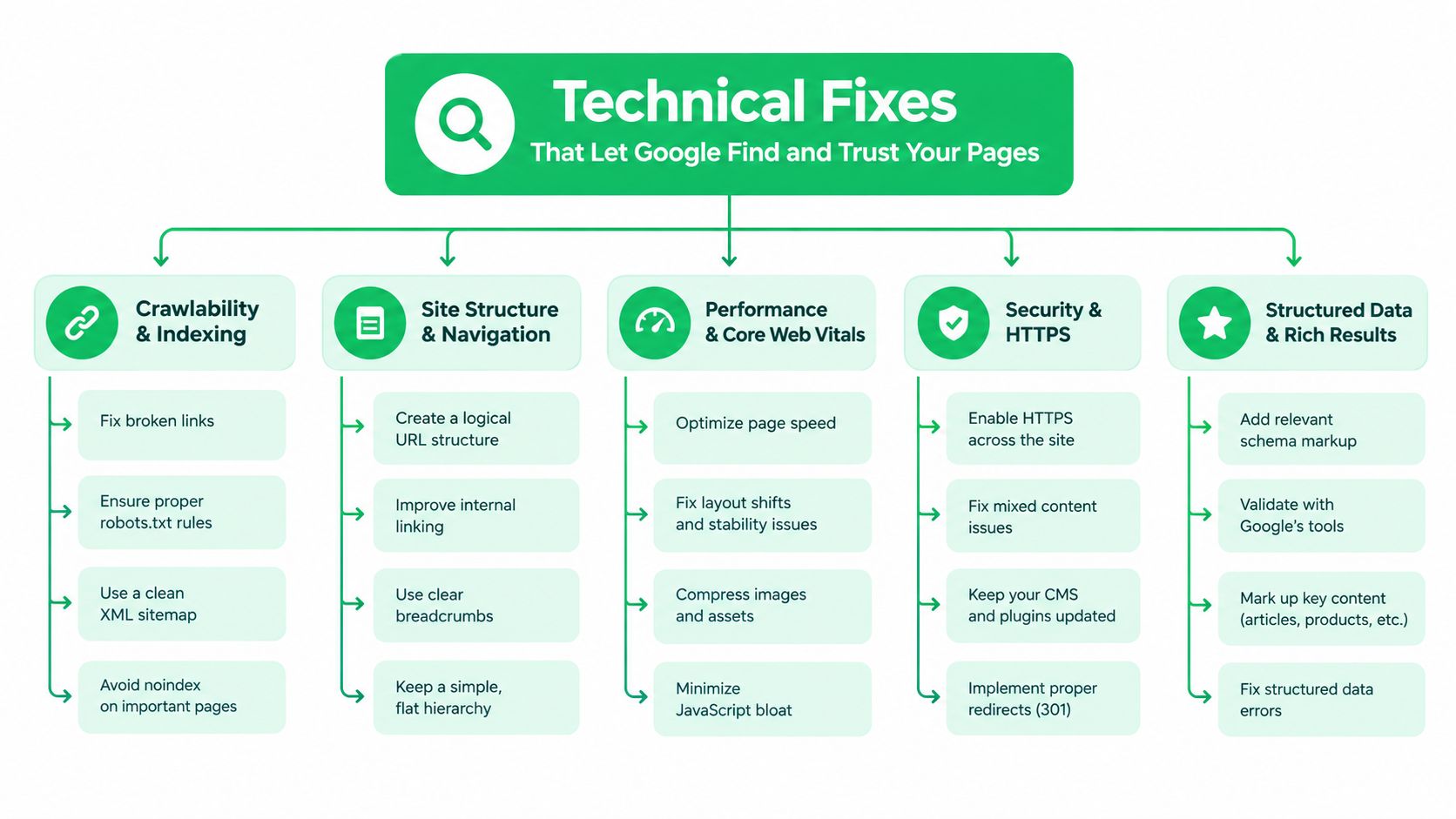
Once the local foundation is cleaned up, the next question is whether Google can reliably crawl, index, and interpret the clinic's pages. Technical SEO isn't glamorous, but it often decides whether good service content ever gets a fair chance.
A lot of dental sites look polished on the surface and still underperform because they rely on heavy templates, unclear architecture, or weak internal linking. The issue isn't always “content quality”. Sometimes Google doesn't get a clean path through the site.
The technical layer that usually matters most
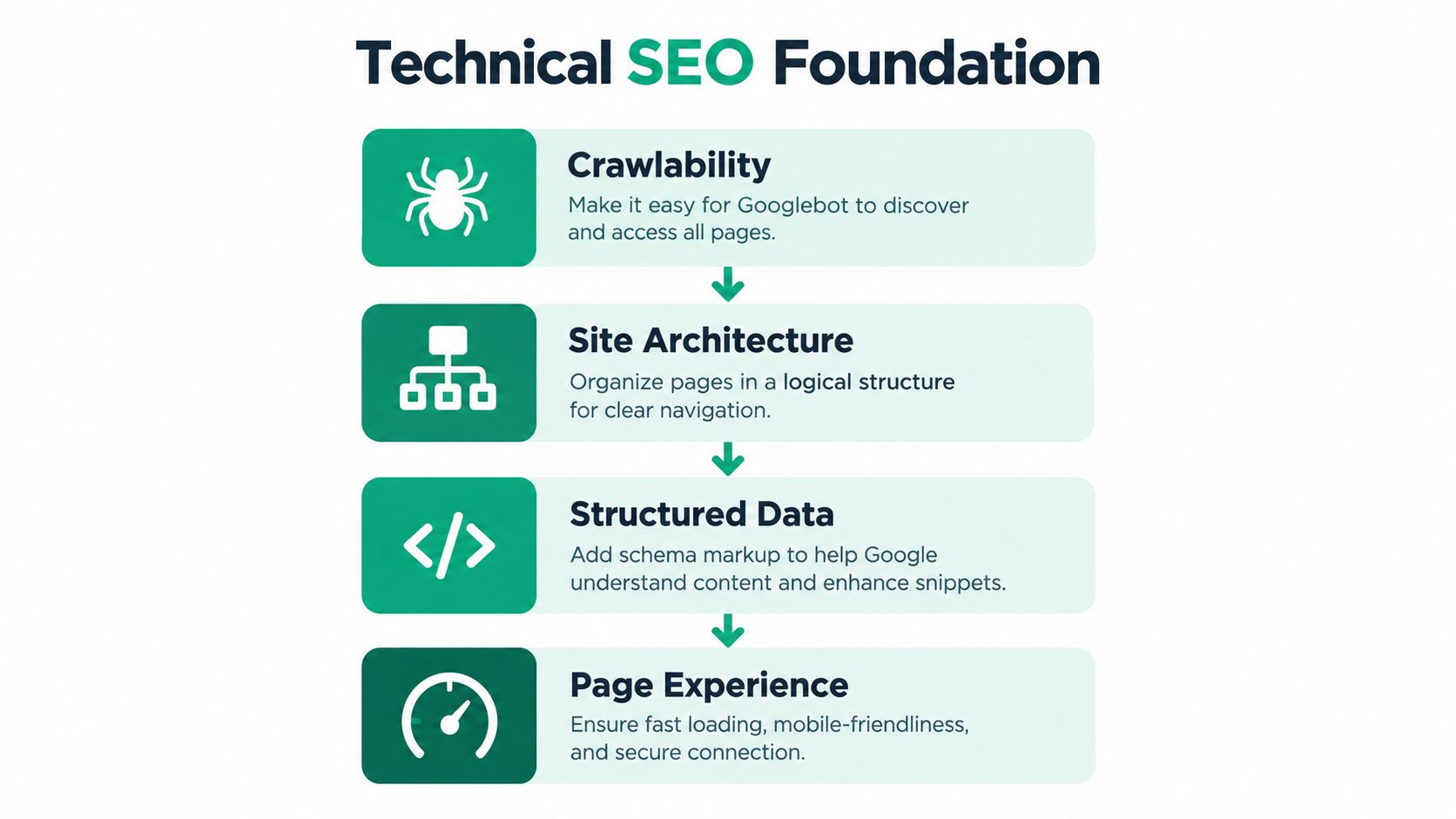
For an Australian dental clinic, the technical priorities should usually be:
- Crawlability: making sure important pages can be discovered and accessed
- Architecture: giving each service a clear place in the site structure
- Structured data: helping search engines understand the clinic, services, and supporting details
- Measurement setup: ensuring later improvements can be tied to outcomes
Australian dental technical SEO case studies support that order of operations. They show that technical programs should prioritise crawlability, architecture, structured data, and conversion tracking before scaling content, because many gains come from removing indexing barriers and aligning pages to intent rather than just publishing more pages. In those case studies, rebuilding JavaScript-heavy or poorly structured sites, using one dedicated landing page per service, and adding schema such as LocalBusiness, DentalClinic, Service, and AggregateRating were associated with top-3 keyword dominance for 49 of 93 tracked terms, while a multi-location dental campaign recorded 129% growth in monthly organic clicks and 102% growth in non-branded clicks. One Australian example also reported a 60% increase in website lead actions in six months after fixing structure and local SEO together (Australian dental technical SEO case studies).
The fixes that tend to have real impact
The most useful technical changes are usually straightforward:
- Consolidate thin service pages so each treatment has one strong destination instead of several overlapping weak ones.
- Tighten internal linking from the homepage, nav, and related treatment pages to core commercial pages.
- Add relevant schema such as LocalBusiness, DentalClinic, Service, and AggregateRating where appropriate.
- Include practitioner details and FAQs on treatment pages so the page answers more of the search journey in one place.
- Reduce template bloat if the site is visually heavy but structurally vague.
A clean architecture also helps with newer search experiences. Australian guidance on Google Business Profile changes and AI-driven search argues that clinics may need less blog content and more evidence-rich service pages, structured data, practitioner details, FAQs, and operationally accurate profile data to stay visible as search results surface direct answers, maps, and AI summaries more often (Australian guidance on clinic visibility and AI-driven search).
Use measurable page-experience signals
“Improve site speed” is too vague to be useful. Google's current Core Web Vitals documentation focuses on Largest Contentful Paint, Interaction to Next Paint, and Cumulative Layout Shift, and these can be tracked directly in Search Console's Web Vitals reporting (Google Core Web Vitals documentation).
That matters because a clinic can look at actual reporting instead of guessing whether the site feels fast enough. When technical work is measured this way, decisions become easier. Which template is dragging key pages down, which mobile layout shifts need fixing, and which pages are failing to deliver a stable experience.
For practices reviewing this layer properly, a technical SEO audit for Melbourne dentists is one way to turn abstract “site issues” into a ranked list of fixes.
Targeting the Right Keywords and Building Pages That Convert
A dental clinic doesn't need to rank for every broad term in Melbourne to improve enquiries. It needs the right pages to appear for the right searches, then make it easy for that visitor to take the next step.
That changes the keyword strategy completely. Instead of treating SEO like a race for generic visibility, the better approach is to build pages around treatment intent and local relevance.

Broad terms versus high-intent pages
Here's the trade-off.
A broad page targeting “dentist Melbourne” may help with general visibility, but it often mixes too many user needs into one URL. Someone looking for an emergency appointment is in a very different state from someone comparing veneers or implants.
Treatment-specific pages work better when each one is built around a distinct intent, such as:
- Emergency dentistry
- Dental implants
- Cosmetic dentistry
- Children's dentistry
- General check-ups and cleans
Australian dental SEO guidance has increasingly pushed this direction. One of the more useful contrarian points is that the bigger bottleneck for many clinics isn't traffic volume but lead quality and enquiry attribution, because local search journeys often involve Google Maps, review platforms, and treatment pages before a call or form submission. That makes page intent and measurement more important than raw keyword volume for private dentistry (local SEO framing for dentists in Australia).
A page should match the question a patient has when they're ready to act, not the phrase a marketer wants to report on.
What strong money pages usually include
A useful treatment page doesn't read like a generic brochure. It should help a patient decide whether to contact the clinic.
Strong pages often include:
- A clear treatment focus in the title, H1, and opening copy
- Practical FAQs that answer real concerns
- Suburb or service-area relevance where it's genuine
- Internal links to related treatments and contact paths
- Schema markup aligned to the service
- Clinician and practice details that support trust
By contrast, weak pages usually have padded text, stock explanations, and no clear next action.
When to build suburb pages and when to combine
The decision usually comes down to whether the clinic can support a page with real specificity. If the same implants page can serve nearby suburbs without becoming vague, one stronger page is often better than multiple thin near-duplicates.
A practical keyword workflow is to start with Search Console and look for:
| Signal | What it suggests | What to do |
|---|---|---|
| Existing impressions for a treatment term | Google already sees the page as relevant | Improve headings, copy, and internal links |
| Clicks on broad pages but low enquiries | The traffic may be too general | Rework the page around commercial intent |
| Multiple weak pages on one topic | Relevance is split | Merge into one stronger service page |
| Suburb queries with no matching landing page | Local intent exists | Build a genuine suburb page if the clinic serves it |
For teams mapping this properly, keyword research based on how customers actually search is far more useful than pulling a big export of phrases and trying to target all of them.
Measuring What Matters and Proving Enquiry Growth
If SEO reporting ends at rankings and traffic, the clinic still won't know whether the work is paying off. For private dental practices, the commercial question is simpler. Did the site and local assets generate more qualified enquiries?
That means tracking the actions that signal intent, not just visibility.
The KPIs that matter most
A Melbourne clinic usually needs to measure at least three conversion paths:
- Phone calls
- Form submissions
- Direction requests or map-driven actions
Those metrics matter because local dental searches are often multi-touch. A patient may find the clinic in Maps, read reviews, visit a treatment page, leave, return later, then call from a mobile result. If reporting only counts last-click website traffic, that journey gets flattened into something misleading.
From visibility to enquiries what to track weekly
| KPI | Source | What It Tells You |
|---|---|---|
| Google Business Profile calls | Business Profile insights and call tracking | Whether map visibility is producing direct contact |
| Contact form submissions | Website analytics and form tracking | Which pages generate active enquiries |
| Direction requests | Business Profile insights | Whether nearby users see the clinic as visit-worthy |
| Landing page clicks from Search Console | Google Search Console | Which treatment and suburb pages are gaining search traction |
| Branded versus non-branded query trends | Google Search Console | Whether discovery is expanding beyond existing awareness |
| Internal page pathways | Analytics behaviour reports | Whether users can reach key service pages without friction |
What to review weekly and monthly
Weekly checks should stay operational. Look for call drops, broken forms, and sudden visibility changes on priority pages.
Monthly reviews should be more diagnostic:
- Which treatment pages gained impressions but not clicks
- Which local pages attract traffic but no enquiries
- Whether internal links are feeding core commercial pages
- Whether calls and forms are concentrated on a small set of high-value URLs
One useful habit is keeping reports in plain English. A clinic owner doesn't need a dashboard full of SEO terminology. The report should connect activities to business outcomes. Which page was improved, what changed in visibility, what happened to calls or forms, and what gets priority next.
Worth watching: a page can gain traffic and still fail commercially if the message is too broad or the conversion path is weak.
Your 30 90 and 180 Day Roadmap on a Small Business Budget
A small business budget usually can't support everything at once. That's fine. Dental SEO improves faster when the work is sequenced properly instead of spread thinly across dozens of tasks.
The roadmap below keeps the focus where it usually belongs. Local visibility first, treatment-page quality second, then expansion based on real data.
First 30 days
The opening phase should be practical and corrective.
- Claim and verify the profile: fix categories, hours, service details, and practice imagery.
- Check NAP consistency: align the website and key citations.
- Audit Search Console: identify pages already earning impressions for treatment or suburb terms.
- Review conversion paths: confirm that calls and forms are trackable and working.
- Remove obvious duplication: especially weak suburb pages and overlapping service pages.
At this stage, the aim isn't to produce more content. It's to stop leakage.
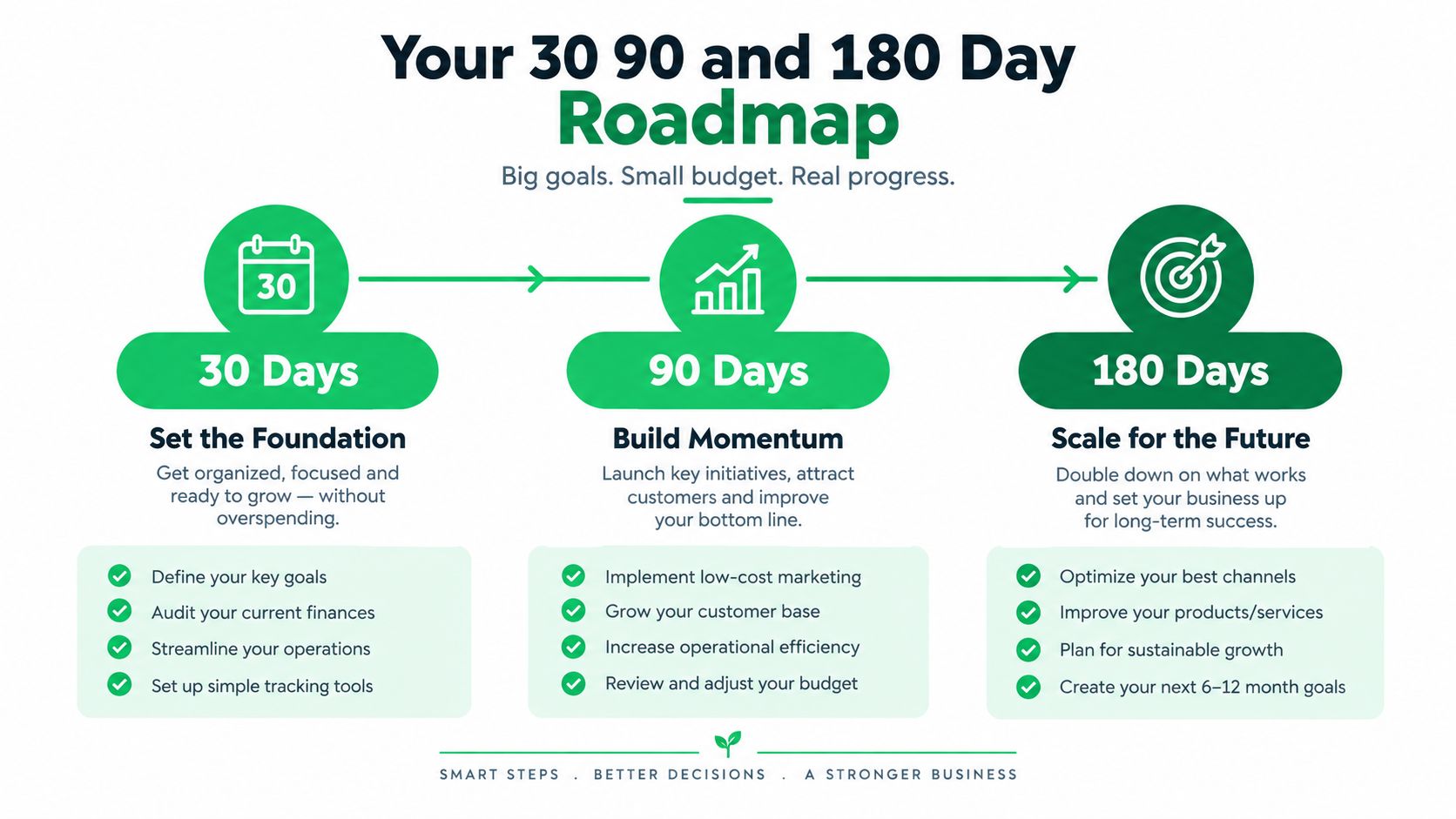
By 90 days
Most of the meaningful page work should happen.
A sensible 90-day mark usually includes rewritten money pages for the clinic's key treatments, stronger internal linking, and relevant structured data across commercial pages. It's also the point where review growth, profile completeness, and page intent should start working together instead of sitting in separate marketing silos.
Helpful outputs in this phase often include:
- One strong page per major service
- FAQs added to major treatment pages
- Local relevance added where genuine
- Schema for business and service information
- A clear monthly report tying visibility to enquiries
By 180 days
The clinic should have enough data by this point to make sharper decisions.
Some pages will justify further expansion. Others won't. A suburb page that never earns traction may need consolidation. A treatment page that gains impressions but not leads may need a stronger offer, clearer trust signals, or better supporting copy.
A realistic 180-day focus includes:
- Expand only what's working
- Prune what's thin or duplicative
- Keep review growth steady
- Refine call, form, and direction tracking
- Update the roadmap based on lead quality, not just traffic
One practical option for clinics that need help choosing priorities is to use a provider that combines local, technical, on-page, and measurement work in one implementation process. SEO2RANK is one Melbourne-based option that offers dentist-focused audits, technical remediation, Google Business Profile work, page improvements, and reporting sized to small-business needs.
The key takeaway from How We Improved SEO for a Melbourne Dental Clinic is straightforward. Intent beats volume, and measurement beats guesswork. Clinics usually don't need endless blog production. They need accurate local signals, stronger treatment pages, a technically sound website, and clean attribution so the work can be judged properly.
SEO2RANK helps Melbourne service businesses, including dental clinics, improve local visibility, strengthen treatment pages, fix technical SEO issues, and track the enquiries that matter. If that's the stage a clinic is at now, visit SEO2RANK to look at the available audit and implementation options.
Find Out What Is Holding Your
Website Back
Get a practical SEO Snapshot showing the biggest issues and opportunities we can see across your search visibility, website and local presence.
GET YOUR FREE SEO SNAPSHOT