

A Melbourne tradie can finish a full day on the tools, check the phone and find no worthwhile enquiries for next week. How tradies can get more leads from Google comes down to a connected system: a useful Google Business Profile, service pages aimed at profitable suburbs, a fast mobile website, genuine reviews and reliable enquiry handling. More visibility only helps when the business can answer, qualify and quote the work it attracts.
Table of Contents
- Why Tradies Quietly Lose Leads on Google
- Turn Your Google Business Profile Into a Lead Engine
- Build Fewer, Better Suburb and Service Pages
- Fix the Technical Barriers That Block High-Intent Pages
- Reviews, Citations and Local Content That Build Trust
- Measure What Actually Generates Qualified Work
- Your 30-Day Quick-Win Plan and When to Bring in Help
Why Tradies Quietly Lose Leads on Google
A quiet phone isn't automatically a pricing problem. Before cutting rates, a trade business should check whether customers can find it, understand its services and make contact without hunting through a website.
For someone comparing plumbers or electricians on a phone screen, the practical questions are straightforward. Does this business handle the job? Does it cover the suburb? Is it available, and does its work look credible? A vague listing or buried phone number leaves those questions unanswered.
Clear information beats a vague online presence
Historical Australian Bureau of Statistics data cited in the Australian Government's Small Business Digital Champions Project found that only 50% of Australian businesses had a web presence, illustrating the longstanding digital gap rather than today's exact adoption rate, according to the Digital Champions project fact sheet.
The useful lesson isn't that half of a tradie's current competitors are offline. It's that a properly organised online presence can distinguish a business from operators whose services, coverage and contact details remain unclear.
Google visibility deserves attention because someone searching for an emergency electrician in Melbourne has a specific problem to solve. The business needs to match that intent, not merely appear when someone already knows its name.
- Discovery: The profile and website should describe the actual trade, services and locations.
- Decision: Customers need relevant job evidence, accurate availability and straightforward service explanations.
- Contact: Calls and quote requests should reach someone responsible for responding.
- Commercial fit: Enquiries should match the business's travel boundaries, capabilities and quoting capacity.
Diagnose the missing link
An owner should review the customer journey before buying more traffic. A business might receive search impressions but few enquiries because its page doesn't explain the service. Another might receive calls but book little work because nobody records the enquiry or follows up the quote.
These are different problems, and they need different fixes. Changing keywords won't repair an unanswered phone.
Practical rule: Treat Google lead generation as part of dispatch and quoting, not as a separate marketing task.
The right objective is more qualified, profitable work, not more appearances across Melbourne. That distinction should guide every profile edit, page and reporting decision.
Turn Your Google Business Profile Into a Lead Engine
The Google Business Profile should help a customer choose and contact the business without needing a website visit. Treating it as a directory entry wastes an opportunity to explain the service at the point of enquiry.
Google/Ipsos research involving more than 2,000 Australians found that 9 in 10 wanted to call a business directly from Search, making phone access a priority for tradies, according to the Australian click-to-call research. That finding supports a phone-first approach, although it shouldn't be mistaken for a current conversion forecast for an individual business.
Make the listing commercially accurate
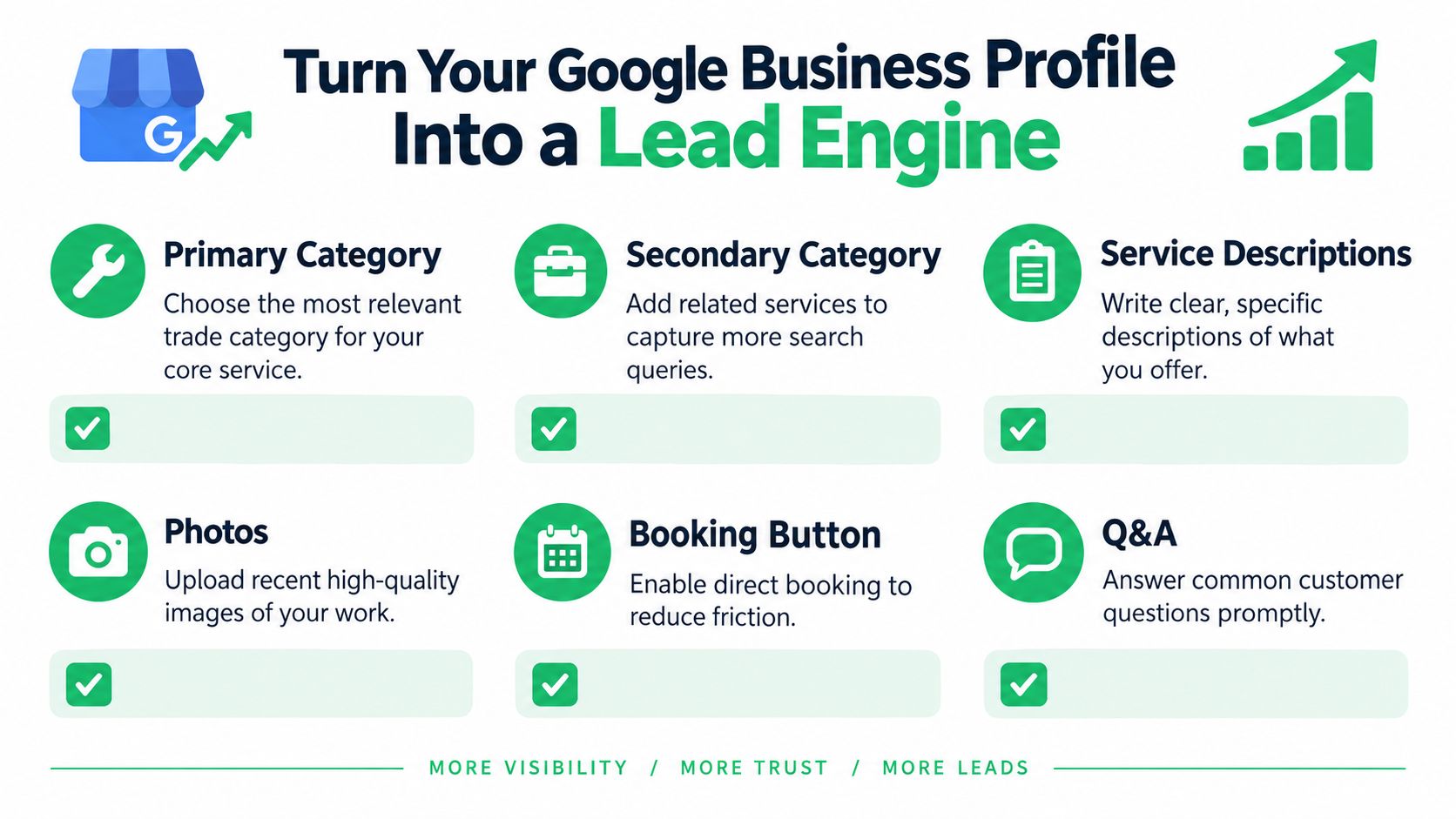
Start with verification, then select the primary category that most accurately describes the core business. Secondary categories should reflect genuine additional services, not a wish list of searches the owner would like to appear for.
The description should explain what the team does, where it works and what distinguishes its service delivery. Plain wording about switchboard upgrades, blocked drains or land construction is more useful than a string of suburb names.
- Service areas: Match coverage to the actual operating model. A service-area business shouldn't imply that customers can visit a shopfront that doesn't exist.
- Hours and emergencies: Publish honest trading hours and emergency availability. An emergency claim needs an operational response behind it.
- Service information: Describe the jobs accepted, exclusions and quote process so unsuitable enquiries can be filtered early.
- Work photos: Use recent, genuine images that help customers assess relevant workmanship.
- Customer questions: Answer common questions through available profile features and website FAQs. Topics might include call-out arrangements, inspection requirements and what information helps prepare a quote.
The checklist highlights the main profile components, but booking and enquiry features should only be enabled when available and supported by a monitored workflow.
Make contact actions traceable
A trackable Australian phone number should route reliably to the business. Test it from a mobile, check the missed-call process and assign responsibility for callbacks. Tracking that breaks contact is worse than no tracking.
Add UTM tags, labels attached to website links that identify where a visit originated. A tagged profile link helps analytics distinguish visits from the listing from other Google traffic.
Calls, website clicks and other available profile actions should remain separate records. A direction request isn't equivalent to a quote enquiry, particularly for a business that travels to customers.
The Google Business Profile optimisation guide provides a useful implementation reference. The operational standard remains simple: every advertised contact route should work, and every incoming enquiry should have an owner.
Build Fewer, Better Suburb and Service Pages
Publishing a page for every Melbourne suburb isn't a strategy. A tradie based in the north might welcome a substantial project across town while rejecting a small maintenance job in the same location. Geography alone doesn't determine whether a lead is useful.
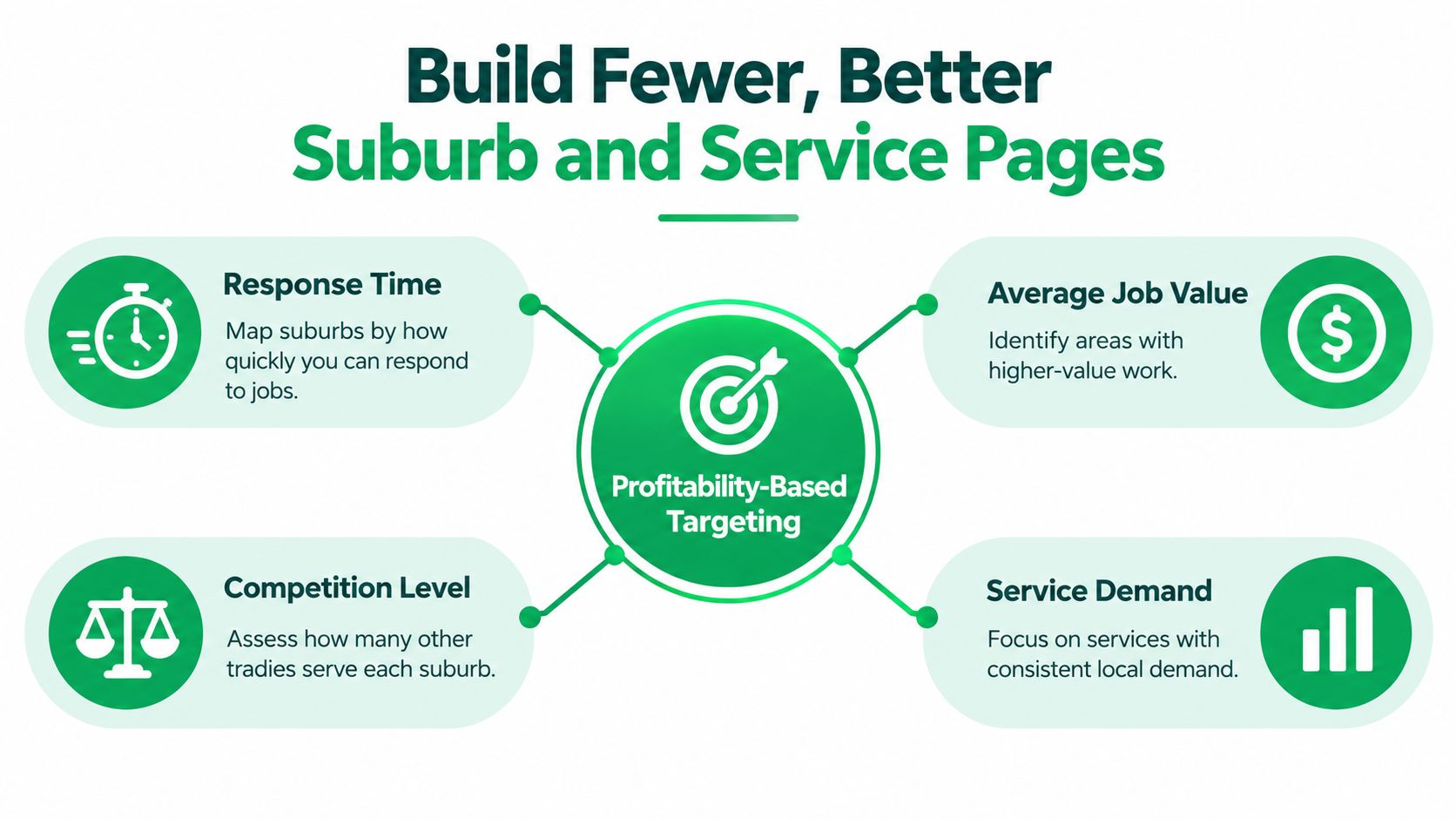
The stronger approach is profitability-based targeting. Choose services and locations together, using travel economics and the team's capacity to quote and deliver.
Decide which locations deserve investment
Existing job records provide a better starting point than a long suburb list. Review where accepted work came from, which quotes were declined and where travel or repeat site visits reduced the value of the job.
| Decision factor | What the owner should assess |
|---|---|
| Response time | Whether the team can meet the availability described |
| Job value | Whether the likely work justifies travel and quoting effort |
| Travel cost | Driving, parking, access and return visits |
| Competition | Whether the business has a credible point of difference |
| Close rate | Whether enquiries from the area become accepted work |
| Capacity | Whether suitable jobs can actually be scheduled |
Keep locations that support a viable service offering. Consolidate or remove pages that merely swap suburb names, describe unavailable services or attract work the business routinely declines.
Give each page a reason to exist
A worthwhile service page explains the job, the area covered and the next step. Near the top, it should show a clickable phone number and a quote option, followed by relevant work photos, actual licence details where applicable, scope information and genuine warranty terms.
Pricing transparency doesn't require inventing a fixed price for work that needs inspection. The page can explain whether the business charges a call-out fee, what affects the quote and whether a site visit is necessary, using only the business's actual arrangements.
Australian local-search reporting indicates that more than half of mobile local searches can produce zero-click outcomes, while 61% of mobile users contact a local business directly from search results, according to Dank Designs' local SEO statistics reporting. These secondary figures support planning for enquiries inside Google, not predicting a particular tradie's results.
That doesn't make the website redundant. Complex installations and construction work still need space for scope, evidence and qualification. The guide to what a good SEO service page should include helps distinguish a useful commercial page from a thin location template.
A suburb page should represent a service the business can deliver profitably, not a postcode the owner hopes to rank in.
Fix the Technical Barriers That Block High-Intent Pages
A useful page can't generate organic enquiries if Google can't access it or the customer can't use it comfortably. Technical work should start with commercially important pages, not a broad exercise in chasing perfect scores.
Open Google Search Console and identify service pages receiving relevant search impressions. Prioritise pages associated with jobs the business wants, especially where mobile usability or indexing needs attention.
Check access before polishing performance
Confirm that important pages are published, accessible and linked from relevant navigation or other pages. Use URL Inspection to investigate indexing status and ask a developer to check unintended indexing restrictions, broken links and incorrect canonical settings, which can point Google towards a different preferred page.
A sitemap should reflect the pages intended for discovery. Submitting one isn't a substitute for a coherent site structure or useful content.
The image illustrates the customer-facing problem: an enquiry journey that stalls on a mobile phone.

Set a mobile implementation gate
Google recommends Largest Contentful Paint of 2.5 seconds or less, Interaction to Next Paint below 200 milliseconds and Cumulative Layout Shift below 0.1 for a good Core Web Vitals experience, according to its Core Web Vitals documentation. Google also makes clear that these measures are only part of its broader page-experience and relevance systems, not a guarantee of top rankings.
In plain English, those measures cover main-content loading, responsiveness to interaction and unexpected movement on the page.
- Reduce heavy assets: Compress oversized job photos and avoid loading entire galleries immediately.
- Review scripts: Remove unused third-party tools and defer non-essential JavaScript where the platform permits.
- Stabilise layouts: Reserve space for images, review displays and quote widgets.
- Protect contact controls: Keep call and quote options usable without intrusive pop-ups covering the page.
- Retest real usage: Review available field data in Search Console or the Chrome UX Report after deployment, rather than relying only on laboratory tests.
Apply fixes to service and suburb pages, not just the homepage. Shared templates can carry the same slow map embeds or review widgets across the commercial parts of the site.
Structured data should accurately describe the business and visible content. Local business, service and FAQ markup needs a relevance check; adding it shouldn't be sold as a guaranteed enhanced search display.
The technical SEO checklist for small business can organise the work. Bring in a specialist when the site builder, hosting or plugin conflicts prevent safe implementation, and require testing of enquiry forms and phone links after changes.
Reviews, Citations and Local Content That Build Trust
Trust needs evidence, not a manufactured perfect rating. Genuine customer feedback, consistent business details and relevant examples of work help a prospective customer assess whether the operator is suitable.
Review generation also carries compliance responsibilities. The ACCC says reviews must reflect genuine customer experiences, and businesses must not create misleading reviews or present commercial relationships as impartial feedback, as explained in its guidance on online reviews.
Keep the customer in control
A review request should invite honest feedback from completed customers through a consistent process. It shouldn't select only customers expected to leave praise, supply flattering wording or choose a rating on their behalf.
The ACCC's Service Seeking example shows why the mechanics matter. The company was ordered to pay $600,000 after its Fast Feedback feature enabled misleading reviews, with approximately 21,000 reviews created and about 17,000 automatically published without customer input, according to the ACCC's Service Seeking enforcement announcement.
In the Aveling Homes matter, the Federal Court ordered penalties totalling $380,000 after review websites were misrepresented as independent and negative reviews were withheld, as described in the ACCC's review enforcement update.
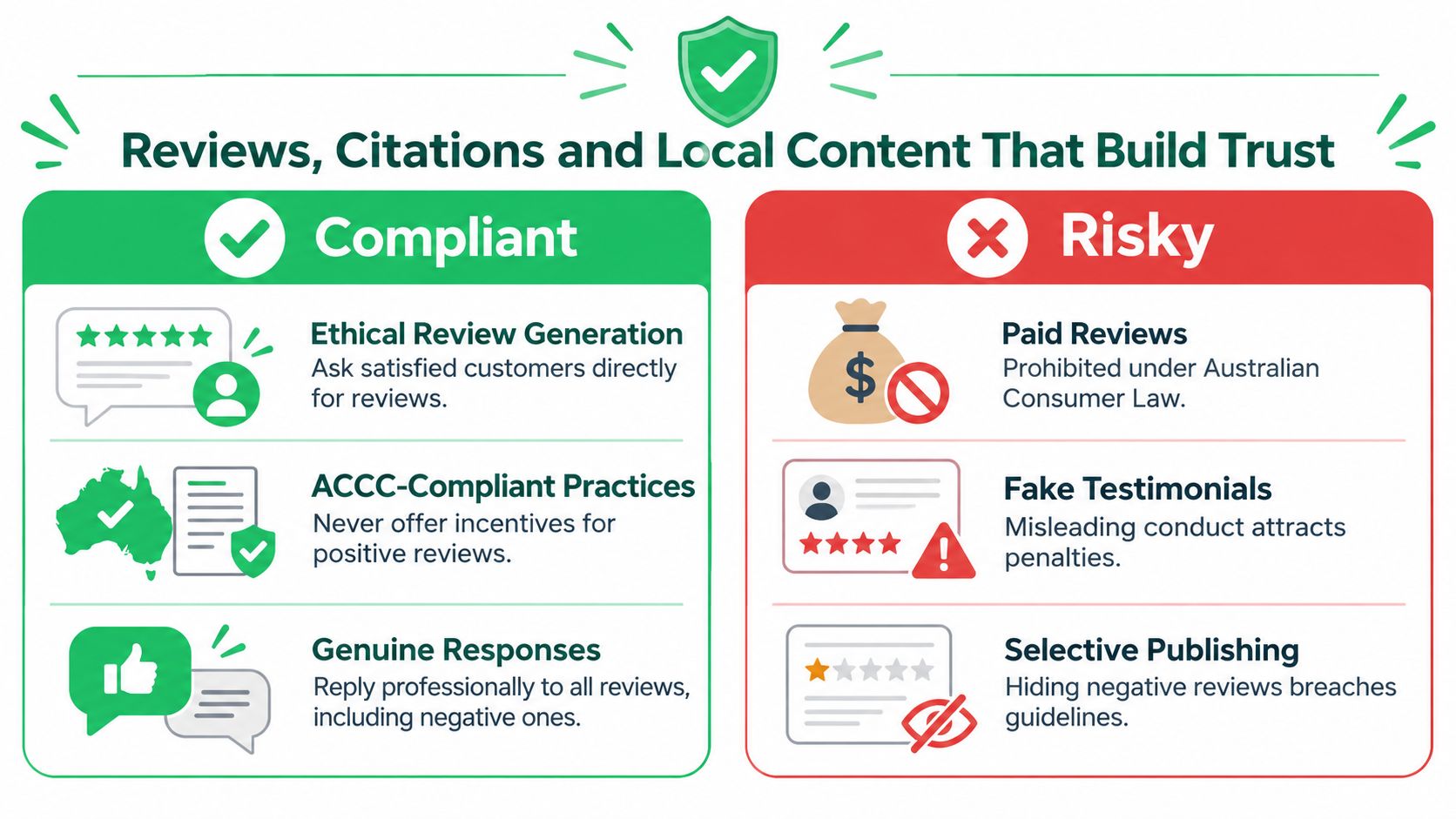
The safest practical policy is no rewards for positive reviews and no scripted testimonials. Commercial relationships need transparent disclosure; the ACCC guide for businesses and review platforms explains why undisclosed incentives and misleading omissions create risk.
Make supporting evidence consistent
Citations are business mentions or listings elsewhere online. Audit the directories the business uses, including Australian listings such as Yellow Pages and True Local, and correct conflicting names, contact details and website links.
Consistency is a housekeeping recommendation, not a promise that adding directories will produce rankings. There's little value in maintaining listings nobody checks while the main business information remains wrong.
Local content should also help a customer make a decision:
- Project galleries: Show actual work with permission and explain the relevant scope.
- Service explanations: Address access, preparation and quoting questions that apply to the work.
- Maintenance content: Publish relevant advice without inventing suburb-specific conditions or unsupported seasonal claims.
A workable review process sends a neutral request after completion, lets the customer write independently and assigns someone to respond professionally. The guide to Google reviews and local rankings provides further context, but authentic feedback matters more than pursuing a flawless-looking score.
Measure What Actually Generates Qualified Work
A report showing more impressions isn't proof of more profitable jobs. The owner needs to know which enquiries were suitable, which received quotes and which became completed work.
CPA Australia's 2025–26 Asia-Pacific Small Business Survey reported that 44% of Australian small businesses generated more than 10% of revenue through online channels, with Australia ranking tenth among 11 markets surveyed, according to the Australian market summary. That demonstrates a commercial role for digital channels, but it isn't a Google-specific benchmark for tradies.
Separate activity from outcomes
Use Search Console for search visibility, website analytics for landing-page behaviour and call analytics for incoming calls. A CRM, or a disciplined spreadsheet, should record what happened after contact.
The reporting chain should distinguish:
- Visibility: Relevant impressions and available profile views.
- Contact activity: Calls, profile website clicks, other available profile actions and form submissions.
- Qualification: Suitable service, location, timing and job scope.
- Sales progress: Booked estimates, quotes issued and accepted work.
- Delivery: Completed jobs, cancellations and commercial value.
A call-duration threshold can help flag calls for review, but it shouldn't automatically define a qualified lead. A short call may book a straightforward job; a long call may be a supplier conversation.
Record lead source, requested service, suburb, response status, quote outcome and reason for loss. Deduplicate customers who call and then submit a form so the report doesn't count the same opportunity twice.
Reporting test: If the owner can't identify which enquiries became completed work, the report is unfinished.
Use suburb results to make operating decisions
Compare enquiry quality and job outcomes by service and location. A suburb producing frequent calls but little accepted work may need different messaging, tighter coverage or less investment.
Don't assume every search query can be matched to an individual caller. Search Console provides query-level visibility, while enquiry records provide customer outcomes; these datasets often support a directional comparison rather than a precise person-by-person connection.
Review gross margin where reliable cost records exist. Revenue alone can conceal travel, materials and quoting effort that make apparently attractive work less worthwhile.
Measurement should also reveal capacity problems. If suitable enquiries wait too long for estimates, the next improvement may be quoting support rather than additional SEO. The business needs enough visibility to fill profitable capacity, not an unlimited queue of unserved leads.
Your 30-Day Quick-Win Plan and When to Bring in Help
The quick-win plan should prioritise unfinished essentials, not promise rankings within the month. A business can complete useful implementation work during that period, but search outcomes depend on the starting position, competition and whether changes are delivered properly.
Finish each block before expanding
- Start with the profile: Correct categories, coverage and availability, then test every contact route.
- Choose priority pages: Select the services and suburbs that fit current capacity and job economics.
- Repair technical obstacles: Resolve access problems and improve the important mobile pages before adding more content.
- Formalise feedback: Establish a neutral post-job review request and tidy inaccurate business listings.
- Close the reporting gap: Confirm that enquiries reach a responsible person and receive an outcome record.
The owner should keep a short implementation register showing the task, responsible person and completion check. Unfinished recommendations don't help customers contact the business.
Bring in help for complexity, not basic housekeeping
Outside support makes sense when multiple locations need coordination, competitive Melbourne suburbs require sharper prioritisation, or technical debt blocks changes. Specialist help is also useful when tracking systems produce conflicting totals or nobody can connect enquiries to job outcomes.
An engagement should specify what will be audited, what will be implemented and how progress will be assessed. Costs depend on the website's condition, geographic scope, content needs and measurement complexity, so a generic price without scope isn't a sound comparison.
The practical aim is sustained visibility and better use of existing demand. Lower acquisition costs and more suitable calls are possible outcomes, not guarantees. A tradie owner should begin by checking the main service page, testing the phone journey and reviewing recent enquiry outcomes before expanding into another suburb.
SEO2RANK offers Melbourne service businesses integrated local, technical, on-page and measurement work, including audits, implementation and ongoing reporting. Tradie owners considering outside support can visit the agency to discuss a scoped plan linking Google visibility with qualified enquiries, quoting capacity and commercially viable service areas.
Find Out What Is Holding Your
Website Back
Get a practical SEO Snapshot showing the biggest issues and opportunities we can see across your search visibility, website and local presence.
GET YOUR FREE SEO SNAPSHOT