
Within six months, priority dental keywords moved from position 23 to position 2, visibility increased by approximately 75%, calls and website clicks rose from 5 to 28 per month, and monthly bookings or form submissions grew from 5 to 22. The result came from fixing technical access first, then improving high-intent service pages, strengthening the Google Business Profile and measuring completed enquiries rather than rankings alone.
That sequence matters for any Melbourne dental practice. A website can publish useful content and still underperform if search engines can't reliably crawl its important pages, patients can't find the right service, or the booking process breaks down on mobile. Dental SEO also has an Australian compliance layer, so persuasive copy must be replaced with accurate, clinically responsible information.
Table of Contents
- The Results We Achieved for a Dental Practice
- How We Audited the Dentist's Website
- Technical SEO Findings and Fixes
- Optimising the Google Business Profile for Local Enquiries
- Rewriting Service Pages for High-Intent Searches
- Keeping Dental Content Compliant With AHPRA Rules
- Measuring SEO Results That Actually Matter
- Privacy-Safe Measurement for Dental Websites
- Your Dental SEO Playbook and Next Steps
The Results We Achieved for a Dental Practice
The engagement combined technical SEO, local search optimisation, on-page improvements and conversion measurement. The work wasn't treated as a traffic exercise. Each change had to support a practical business outcome, whether that meant better discovery in Melbourne searches, more calls from the Google Business Profile or more completed appointment enquiries.
| Metric | Before | After six months |
|---|---|---|
| Priority keyword position | 23 | 2 |
| Search visibility | Baseline | Approximately 75% higher |
| Google Business Profile calls and website clicks | 5 per month | 28 per month |
| Monthly bookings or form submissions | 5 | 22 |
The keyword movement showed that the website could compete for valuable searches once its structure and page relevance improved. The local profile data showed that visibility was reaching people willing to contact the practice, while the booking figures confirmed that stronger search performance was producing more than impressions.
Practical rule: A dental SEO programme hasn't proved its value until search visibility connects to qualified calls, booking forms or attended appointments.
The figures should still be read in context. They describe this engagement, not a guaranteed result for every clinic. Competition, location, services, website platform, operational responsiveness and the quality of the booking journey all affect performance.
The broader Australian market reinforces why this approach needs to address both demand and access. The Australian Institute of Health and Welfare dental data reports that 52% of Australians surveyed in the 2023 ABS Patient Experience Survey had visited a dental professional during the previous 12 months. That figure varied from 65% in the least disadvantaged areas to 42% in the most disadvantaged areas, and 18% said cost had caused them to delay or avoid needed dental care. For a Melbourne practice, service, suburb and affordability-related pages can therefore answer more useful questions than a homepage targeting only “dentist”.
How We Audited the Dentist's Website
The audit began with evidence about access and behaviour, not a large keyword list. Search Console showed whether Google was discovering, crawling and indexing important URLs, while analytics and enquiry data helped identify which pages attracted meaningful visits and which actions users took afterwards.
The central problem was poor technical structure and weak indexing signals. Some important service pages weren't being crawled or understood effectively, which meant rewriting them before fixing access would have risked polishing pages search engines couldn't consistently process.
What the audit looked for
The first pass grouped findings into four practical questions:
- Can search engines access the page? The review checked crawlability, robots directives, accidental noindex instructions and blocked resources.
- Can Google understand the page? Titles, headings, metadata, canonical signals and service descriptions were compared with the actual treatment offered.
- Can users reach the page? Internal links were assessed from navigation, location pages and related services.
- Does the page support an enquiry? Phone links, booking forms, service explanations and next actions were reviewed on mobile and desktop.
This order kept the work focused. A page with strong copy but no internal link path is difficult for both users and crawlers to find. A page with a descriptive title but a noindex directive won't contribute to organic visibility. A page that ranks but gives no clear booking route may generate attention without helping the practice.
Prioritising the repair list
Findings were ranked by likely impact and implementation effort. Indexing and sitemap issues came first because they affected the website's basic availability in search. Internal linking and metadata followed, then service-page rewrites and local profile improvements.
The audit was repeated after implementation rather than treated as a one-off document. Improved crawl activity and visibility began appearing within a few weeks of fixing the sitemap, internal links, metadata and indexing issues. That early movement didn't mean the campaign was finished. It confirmed that search engines could access the revised structure, creating a sounder base for the ranking work that followed.
Technical SEO Findings and Fixes
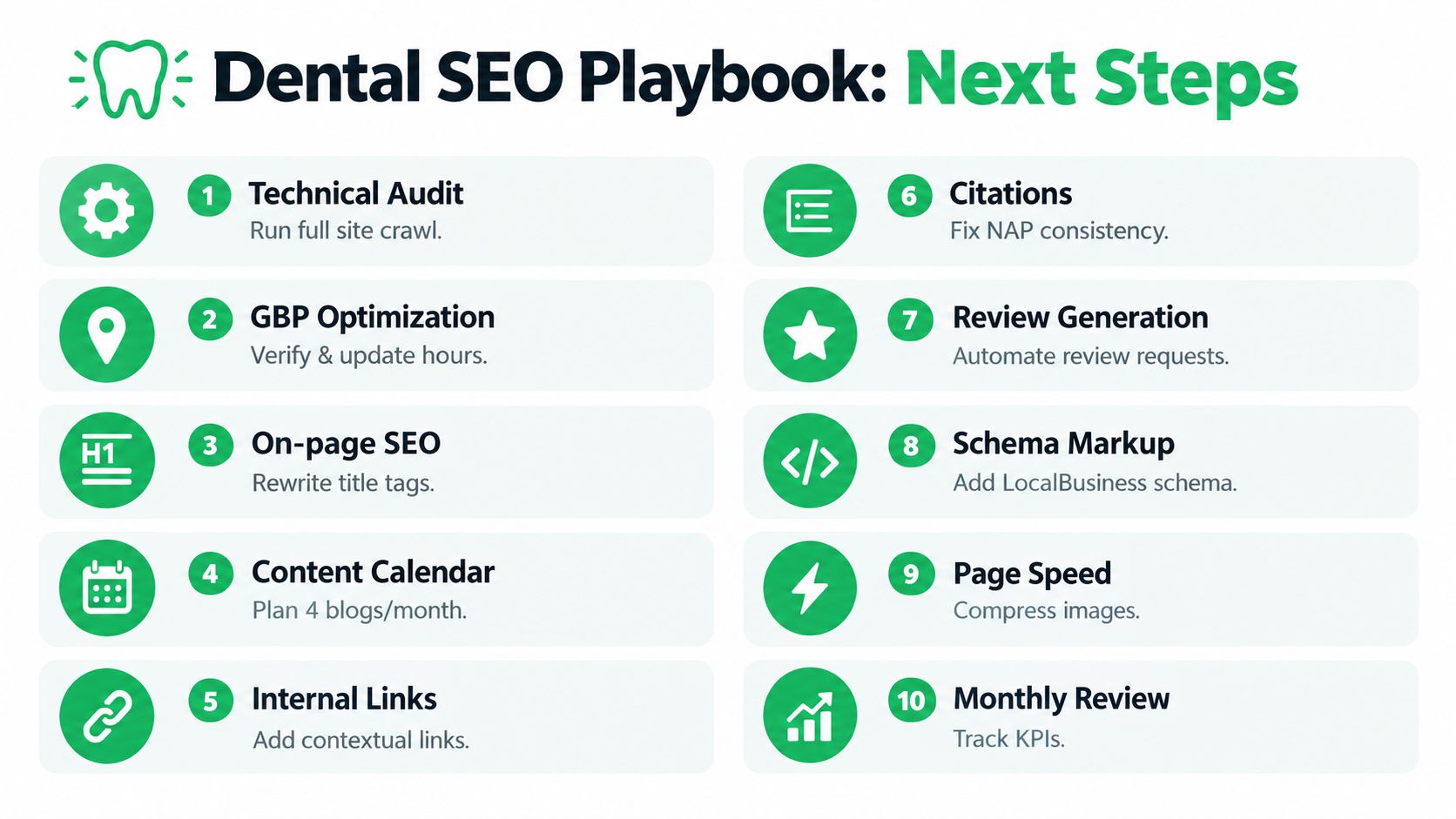
Technical SEO is the part of a dental website that patients rarely see, but it determines whether search engines can reliably reach and interpret the pages patients need. The most important repairs were straightforward in principle, although each required testing after deployment.
The repair sequence
The sitemap was corrected first. It needed to point search engines towards the canonical, indexable pages that mattered, rather than leaving important service URLs isolated or allowing low-value URLs to dilute the signal.
Internal linking was rebuilt around patient journeys. The main service pages received relevant links from navigation, location content and related treatments. A page about emergency dentistry should be reachable from useful context, not exist as an orphaned URL that users and crawlers encounter only through a search result.
Metadata was rewritten to describe the actual page. Titles and descriptions were aligned with the service, location and intent without forcing awkward keyword repetition. A page targeting emergency dentistry in Carlton needs a clearer purpose than a generic title such as “Our Services”.
Indexing signals were checked directly. Accidental noindex directives, blocked resources and canonicalisation errors can prevent a page from appearing as intended. Each important URL was checked for crawlability, indexability and alignment between the visible page and its declared canonical version.
A plain-English reference for this process is the technical SEO checklist for small businesses. It helps practice owners understand why a developer may need to inspect templates, robots rules and page-level signals before content production continues.
Mobile and structured data checks
Booking pages received additional attention because technical friction at that point affects real patient actions. Mobile templates were tested for blocked resources, slow interaction, confusing layouts and broken calls to action. A technically valid page still needs to let someone call, request an appointment or find opening information without excessive scrolling.
For local entity information, Google's LocalBusiness structured-data guidance supports details such as business name, physical address, telephone number, URL, opening hours and geographic coordinates. The markup should match the actual practice, connect to the exact location page and remain accessible to Google. It should be validated with the Rich Results Test and checked through URL Inspection, rather than added once and forgotten.
Improved crawl activity appeared within weeks, but rankings and enquiries required a longer period of observation. That distinction helps set realistic expectations. Technical fixes can remove a barrier quickly, while search engines still need time to reassess page relevance and local prominence.
Optimising the Google Business Profile for Local Enquiries
A Google Business Profile isn't a directory entry to complete once. It acts as a local contact surface, so inaccurate categories, incomplete services or inconsistent business information can create friction before a patient reaches the website.
The profile was refined in five areas:
- Primary and secondary categories: Categories were adjusted to represent the practice accurately, without selecting irrelevant options just because they appeared attractive.
- Services: The service list was expanded so users could understand the treatments available from the profile itself.
- Descriptions: Business and service descriptions were clarified and aligned with the website's actual language.
- Posts: Regular posts supported current service information and practical patient questions, without turning the profile into a stream of exaggerated claims.
- Website consistency: The profile and website used matching practice details, location information and service boundaries.
These changes contributed to local calls and website clicks rising from 5 to 28 per month. The result wasn't assigned to a single post or category change. The profile became more complete, while the website provided consistent supporting information for people who wanted to investigate further.
The Google Business Profile optimisation guidance provides a useful operational checklist, but accuracy matters more than filling every field with marketing language.
The local entity layer
The website should reinforce the same local facts. Australian address formatting needs to remain consistent across the practice website and profile, including the practice name, address, phone number, opening hours and location references. For a multi-location practice, each clinic needs an independently useful location page and a corresponding local business entity, not copied pages with only suburb names changed.
The practice should also track profile actions separately from website actions. Calls, website clicks, direction requests and booking completions answer different questions. A profile can attract discovery while the booking page loses the patient, so combining all actions into one broad “lead” number hides the operational problem.
The Australian Bureau of Statistics reported that 53.2% of Australians saw a dental professional in 2023–24, with participation varying by age from 61.1% among people aged 65–74 to 46.9% among people aged 25–34. Those figures don't predict a clinic's results, but they support building local pages around the populations and treatments the practice genuinely serves.
Rewriting Service Pages for High-Intent Searches
The strongest on-page uplift came from rewriting key service pages around searches with a clear patient purpose, including dentist Melbourne and treatment-specific terms. The work increased visibility by approximately 75% and moved priority keywords from position 23 to position 2 within six months.
The important change wasn't inserting the same phrase repeatedly. Each page was given a distinct job. A general Melbourne dentist page addressed location, trust, services and booking. An emergency page addressed urgency, what to do next and how to contact the practice. A treatment page explained suitability, process, limitations, recovery and the appropriate next step.
Why service pages carried the work
A homepage often has to represent an entire practice. It can't provide enough detail for every treatment and every patient concern without becoming vague. Dedicated service pages give search engines and users a clearer match between the query and the answer.
The rewritten pages improved four connected elements:
- Titles and headings identified the service and location in natural language.
- Service copy explained what the treatment involves, who may need an assessment and what the appointment pathway looks like.
- Internal links connected related treatments, preventive care, emergency information and the booking route.
- Calls to action matched intent, such as calling for urgent advice or requesting a consultation for a planned treatment.
The guide to building an effective SEO service page is useful for checking whether a commercial page answers practical questions instead of acting as a thin keyword container.
Relevance without unsupported promises
Australian access data makes affordability and clarity important content themes. The AIHW reported that 18% of respondents in the 2023 ABS Patient Experience Survey had delayed or avoided dental care because of cost. A Melbourne practice can respond with accurate information about fees, payment options, eligibility, health-fund arrangements and what an appointment involves, provided the information is complete and kept current.
That doesn't justify publishing vague discounts or making treatment guarantees. It means answering the questions patients ask before contacting a practice. A strong page reduces uncertainty while leaving diagnosis and suitability to the dental professional.
The results came from the combination of page relevance, technical access and internal context. Rewriting one title in isolation wouldn't explain the movement. The pages became easier to crawl, more closely matched high-intent searches and gave users a clearer route to enquiry.
Keeping Dental Content Compliant With AHPRA Rules
Dental content is healthcare advertising, not ordinary promotional copy. The assumption that testimonials, treatment-result stories and before-and-after persuasion are necessary for enquiries is especially risky in Australia.
Section 133 of the National Law prohibits advertising a regulated health service using testimonials or purported testimonials about clinical aspects of care. The Dental Board of Australia advertising guidance covers the relevant obligations, while Ahpra's testimonial guidance explains that clinical aspects can include symptoms, diagnosis, treatment and treatment outcomes.
That can affect patient stories, success stories and favourable review excerpts placed on a practice website or Google Business Profile. Reviews about non-clinical matters such as communication may be treated differently, but selectively publishing favourable material can still create a misleading impression.
What replaced persuasive proof
The content workflow relied on evidence-led information:
- Practitioner identification: Name the clinicians and present relevant qualifications accurately.
- Procedure explanations: Describe the treatment process in plain English.
- Eligibility and limitations: Explain that suitability depends on an individual assessment.
- Risks and recovery: Include material information patients should understand before booking.
- Pricing clarity: Where pricing is advertised, make the claim accurate, clear and complete.
- Review controls: Check service pages, FAQs, review widgets, profile posts, metadata and schema-visible text.
The purpose isn't to make pages cold or unhelpful. Patients can trust a practice because it explains what happens, who provides care and what questions should be discussed, rather than because the page promises a particular result.
This compliance review should happen before publication and after material changes. It belongs in the SEO workflow because highly visible content can still create regulatory exposure if the language crosses from explanation into misleading clinical persuasion.
Measuring SEO Results That Actually Matter
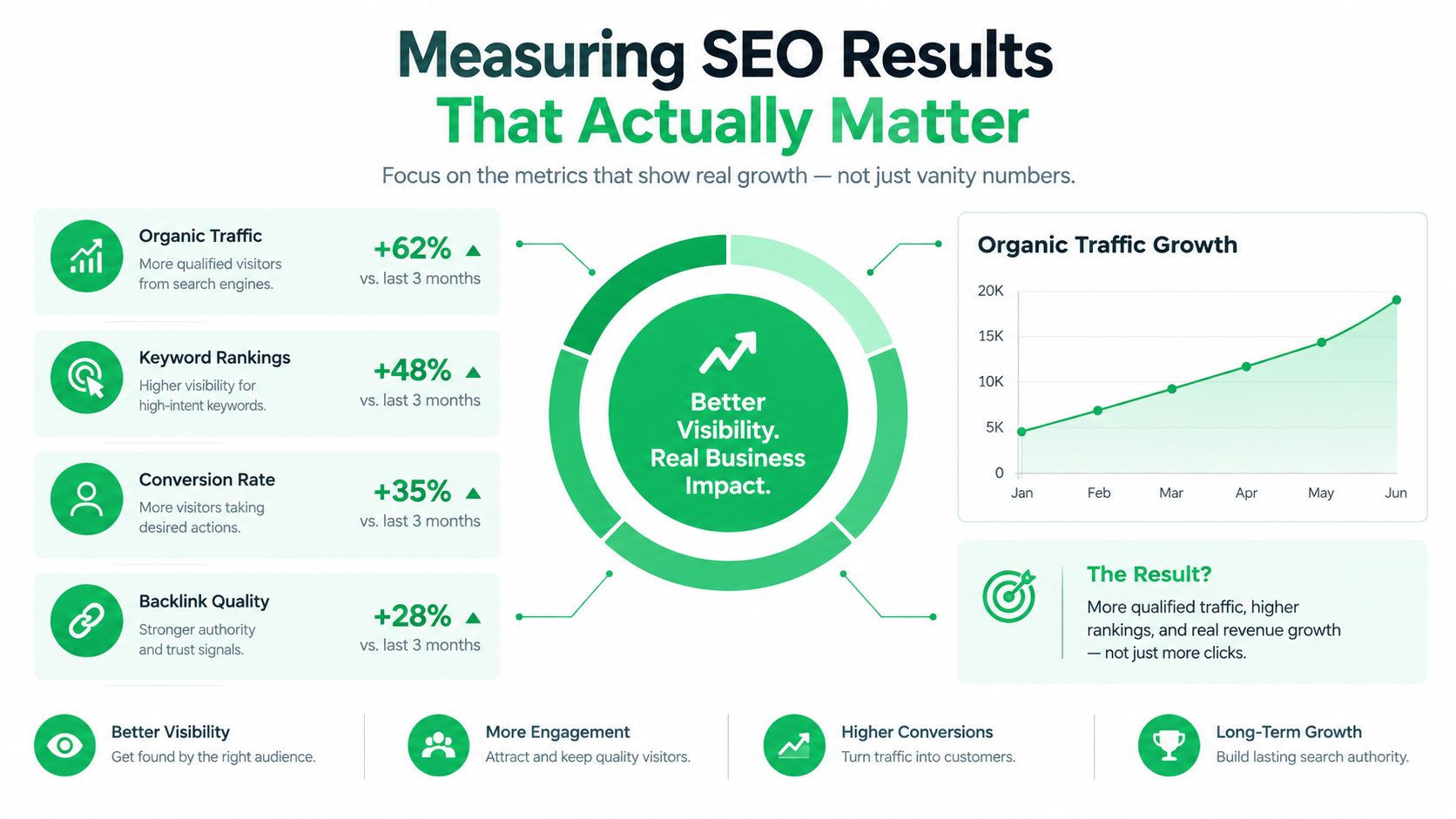
Rankings helped diagnose progress, but appointment enquiries demonstrated commercial value. The measurement framework separated branded and non-branded searches, Google Business Profile actions, calls, booking-form completions and the pages that generated those actions.
Monthly bookings or form submissions increased from 5 to 22. That result connected the ranking and visibility gains to a business outcome, although it still required sensible qualification. A form submission isn't automatically an attended appointment, and a call isn't automatically a new patient.
The dashboard structure
A practical dental SEO dashboard should answer these questions:
- Discovery: Are non-branded searches finding service and suburb pages?
- Engagement: Which pages receive relevant organic visits and profile clicks?
- Contact: How many qualified calls and completed booking forms came from search?
- Intent: Are enquiries about emergency care, children's dentistry, implants, check-ups, location or pricing?
- Quality: Which enquiries become suitable appointments or attended consultations?
Search Console provides query and page visibility signals. Analytics can show page engagement and referral paths. Call tracking and booking systems need careful configuration so the practice can connect an enquiry to its source without exposing unnecessary health information.
Measurement principle: A page that ranks but produces no useful patient action may be visible, but it hasn't yet delivered a meaningful SEO improvement.
Page-level reporting also reveals where the strategy needs adjustment. If an emergency page attracts calls but the general service page attracts only informational visits, the practice can improve the latter's calls to action without weakening the useful information.
The Australian Bureau of Statistics reported that 53.9% of people saw a dental professional in 2024–25, compared with 53.2% in 2023–24, as shown in the latest ABS patient experience release. Those national figures don't establish a clinic's conversion rate. They do support a measurement approach that connects recurring healthcare demand with qualified patient actions rather than reporting traffic alone.
For planning realistic timelines, the SEO timeframe guide can help separate early technical signals from slower ranking and enquiry changes.
Privacy-Safe Measurement for Dental Websites
Dental measurement needs tighter boundaries than ordinary lead generation because appointment information can reveal health details. The Office of the Australian Information Commissioner guidance on key privacy concepts identifies dental records, appointment and billing details, symptoms, diagnoses, treatment notes, reports and test results as health information.
Analytics data collected through cookies, such as page visits, is generally not personal information unless an individual is reasonably identifiable. That qualification matters when analytics is combined with enquiry forms, call tracking, advertising pixels or CRM records.
Safer implementation rules
- Keep URLs anonymous: Don't place names, symptoms, treatment descriptions or free-text medical details in page URLs.
- Use neutral event names: Track an event such as
booking_form_started, rather than sending the patient's treatment details. - Limit form integrations: Send only the information needed to respond and operate the booking process.
- Restrict reporting access: Separate anonymous engagement dashboards from identifiable enquiry records.
- Review call tracking: Avoid recording or exporting more personal information than the practice needs.
- Check vendor settings: Understand what analytics, CRM and advertising platforms retain and who can access it.
The aim is useful attribution without turning an SEO dashboard into a patient record. A practice can identify that a service page generated a booking action while keeping the person's name, free-text concerns and clinical details out of reporting tools.
Privacy review should happen alongside conversion tracking, not after a campaign has collected data. The safest measurement plan is usually the one that answers the business question with the least personal information.
Your Dental SEO Playbook and Next Steps
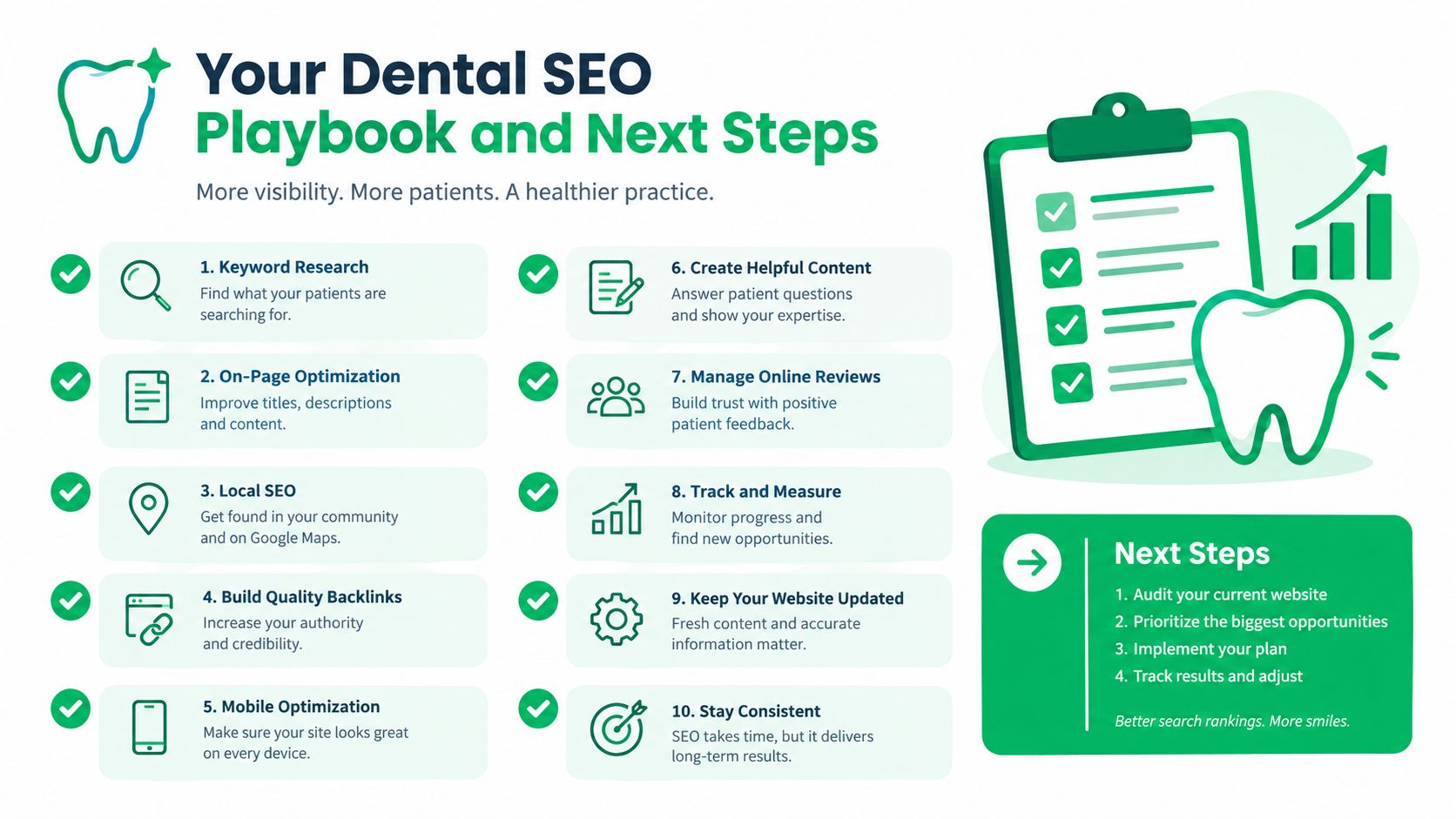
The engagement can be converted into a repeatable sequence for a dental practice, provided each stage is checked before the next receives more effort.
- Audit search access. Use Search Console, analytics and a crawl to find pages that aren't being discovered, crawled or indexed effectively.
- Repair the technical foundation. Correct the sitemap, internal links, metadata, canonical signals, blocked resources and accidental noindex directives.
- Test the mobile booking path. Make phone numbers, forms, opening information and emergency instructions easy to use.
- Build the local entity. Keep the practice name, Australian address, phone number, hours and location details consistent.
- Refine the Google Business Profile. Select accurate categories, expand services, update descriptions and publish useful posts.
- Map services to intent. Create useful pages for treatments, emergency care, children's dentistry, preventive care and relevant suburbs.
- Write for informed decisions. Explain process, suitability, limitations, risks, aftercare, fees and payment information accurately.
- Apply the AHPRA review. Check testimonials, review widgets, clinical outcome claims, FAQs, metadata and structured-data text.
- Connect actions to sources. Separate branded and non-branded queries, profile interactions, calls, bookings and page-level enquiries.
- Review performance continuously. Use early crawl changes to confirm access, then assess rankings, qualified enquiries and appointment quality over the following months.
The sequence prevents a common waste of effort. Publishing more blog posts won't solve an indexing problem, and higher rankings won't solve an unanswered phone or confusing booking form. Improved crawl activity can appear within weeks after technical repairs, while meaningful ranking and enquiry movement normally needs observation across several months, as the engagement results demonstrate.
Professional assistance is most useful when the practice lacks access to Search Console, analytics, the website platform or the booking system, or when technical and compliance decisions overlap. SEO2RANK offers integrated local, technical, on-page and measurement work for Melbourne service businesses, including dental practices, with reporting tied to visibility and enquiry signals rather than rankings alone.
SEO2RANK can audit a dental website, repair crawl and indexing barriers, improve service and location pages, optimise the Google Business Profile and connect search activity to qualified enquiries. Visit SEO2RANK to review the available approach and decide whether a structured dental SEO assessment suits the practice.
Find Out What Is Holding Your
Website Back
Get a practical SEO Snapshot showing the biggest issues and opportunities we can see across your search visibility, website and local presence.
GET YOUR FREE SEO SNAPSHOT