
Local SEO can work for a Melbourne service-area business without displaying a public street address. The practical formula is accurate Google Business Profile configuration, useful service and suburb pages, trusted business information, genuine reviews and local links, and measurement focused on enquiries as well as rankings.
That matters in a country where small businesses represented 97.3% of all businesses in Australia as of June 2025 (Australian Small Business and Family Enterprise Ombudsman data). A Treasury analysis also found that 62% of Australian SMEs had a website, while a further 7% intended to get one within 12 months, leaving a substantial group reliant on profiles, citations and local pages for discovery (Australian Small Business Key Statistics and Analysis).
The following 15 Local SEO Tips for Melbourne Businesses follow an implementation order. They begin with eligibility and profile control, then move through citations, suburb and service pages, technical SEO, trust signals, structured data and reporting. Recommendations such as image frequency, response timing and audit intervals are practical operating preferences, not permanent Google rules. Google's requirements can change, so businesses should check current guidance before making major profile or website changes.
Service-area businesses should never use a virtual office, staffed-looking location or invented suburb presence to appear closer to searchers. Copied suburb pages, fabricated reviews, misleading business names and unsupported claims can weaken trust and create policy or reputation problems. A smaller, accurate coverage area is usually more defensible than a large one the business can't serve.
Table of Contents
- 1. Claim and optimise your Google Business Profile
- 2. Build local citations across consistent directories
- 3. Create location-specific landing pages for service areas
- 4. Optimise your website for mobile-first indexing
- 5. Build authority with local backlinks and partnerships
- 6. Implement structured data markup for local businesses
- 7. Manage and respond to customer reviews strategically
- 8. Develop location-focused content that answers local search intent
- 9. Ensure consistent NAP data across all online presence
- 10. Optimise your website's on-page elements for local relevance
- 11. Create service pages optimised for each primary service
- 12. Monitor Core Web Vitals and page experience
- 13. Use local schema types and validation tools carefully
- 14. Choose review platforms and request methods that fit customers
- 15. Manage citation directories as an ongoing process
- 15-Point Local SEO Comparison for Melbourne Businesses
- Turn the 15 Tips Into a Practical Local SEO Roadmap
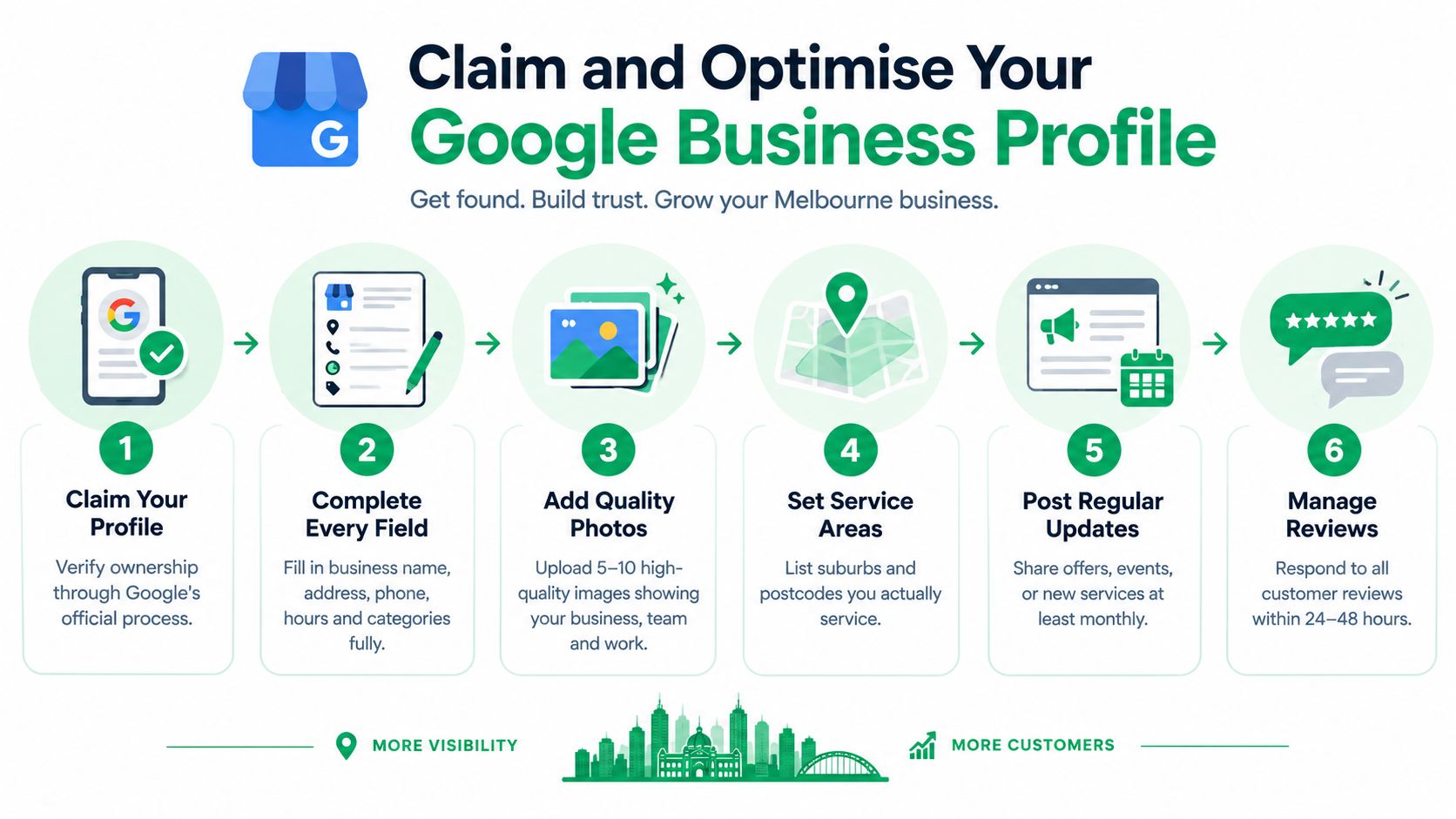
1. Claim and optimise your Google Business Profile
A verified Google Business Profile gives a Melbourne business control over core information shown in Google Search and Maps. It should reflect what the business is, not every service or suburb it hopes to capture.
Google says local results are mainly influenced by relevance, distance and prominence (Google's explanation of local ranking). That makes the primary category important, but it doesn't make category selection a shortcut. A mobile electrician should choose the category that best describes the business, list genuine services and configure service areas accurately. A dental practice should keep opening hours, appointment information and accepted payment details current.
A practical profile review should cover:
- Business identity: Use the real-world business name, not a keyword-stuffed version.
- Category and services: Select accurate categories and describe only services offered.
- Contact details: Match the website and other trusted listings.
- Photos: Show the team, work, premises or vehicles where relevant, using current images.
- Hours and updates: Record ordinary, holiday and seasonal hours clearly.
- Customer communication: Monitor questions and respond to reviews professionally.

For a service-area business without a customer-facing premises, the address should be handled according to Google's current eligibility and service-area rules. The Google Business Profile optimisation guide can help teams turn the profile into an operating asset rather than a one-off listing.
2. Build local citations across consistent directories
A local citation is a business mention on another website, commonly including the name, address and phone number. Citations help customers confirm that a business exists, but their value depends on accuracy, relevance and trust. A large collection of weak or duplicated listings won't compensate for an inaccurate Google profile or poor website experience.
Start with directories that Australian customers and the relevant industry use. Yellow Pages and TrueLocal may be reasonable starting points, alongside professional associations, trade directories, health platforms or local business groups where the listing fits. A Melbourne accountant, for example, should prioritise credible professional and business directories over a long list of unrelated websites.
A simple spreadsheet can record:
- Listing location: The directory or organisation hosting the profile.
- Business details: The exact name, phone, address or service-area wording used.
- Website destination: The correct homepage or relevant service page.
- Access details: Who controls the listing and how changes are requested.
- Review date: When the information was last checked.
Descriptions should explain the business naturally, including the services and areas served. They shouldn't repeat suburb names mechanically. A mobile plumber that serves Brunswick, Coburg and Preston should state that coverage clearly only where the business can meet its response and service commitments.
Citation work is most useful when it removes confusion. It isn't a numbers game, and businesses shouldn't pay for every directory submission without checking audience quality, relevance and duplicate-listing risk.
3. Create location-specific landing pages for service areas
Suburb pages can help a business explain where it works and how its service fits local needs. They don't create a legitimate presence by themselves. A page for Fitzroy should contain useful information about serving Fitzroy, not a Brunswick page with one suburb name replaced.
The strongest approach is to begin with the service areas that generate valuable enquiries and that the business can support. A Melbourne electrician might prioritise pages for a small group of nearby suburbs where jobs are common, while a specialist consultant may need fewer, broader service-area pages. Publishing every suburb in Melbourne at once often creates thin, repetitive content and a difficult maintenance burden.
Each useful page can include:
- A clear service promise: Explain what the business does in that area.
- Coverage detail: Describe travel limits, appointment arrangements or response expectations.
- Local context: Mention relevant housing types, commercial areas, transport considerations or conditions only when they affect the service.
- Proof: Add a real testimonial, completed project or team photograph only when permission and accuracy are clear.
- A next step: Provide a phone number, enquiry form or booking route that works on mobile.
- Internal links: Connect the page to the relevant service page and broader coverage information.
Use areaServed and other structured data only when the markup accurately reflects visible content. A suburb page should answer a customer's question, not exist solely to capture a location phrase.
4. Optimise your website for mobile-first indexing
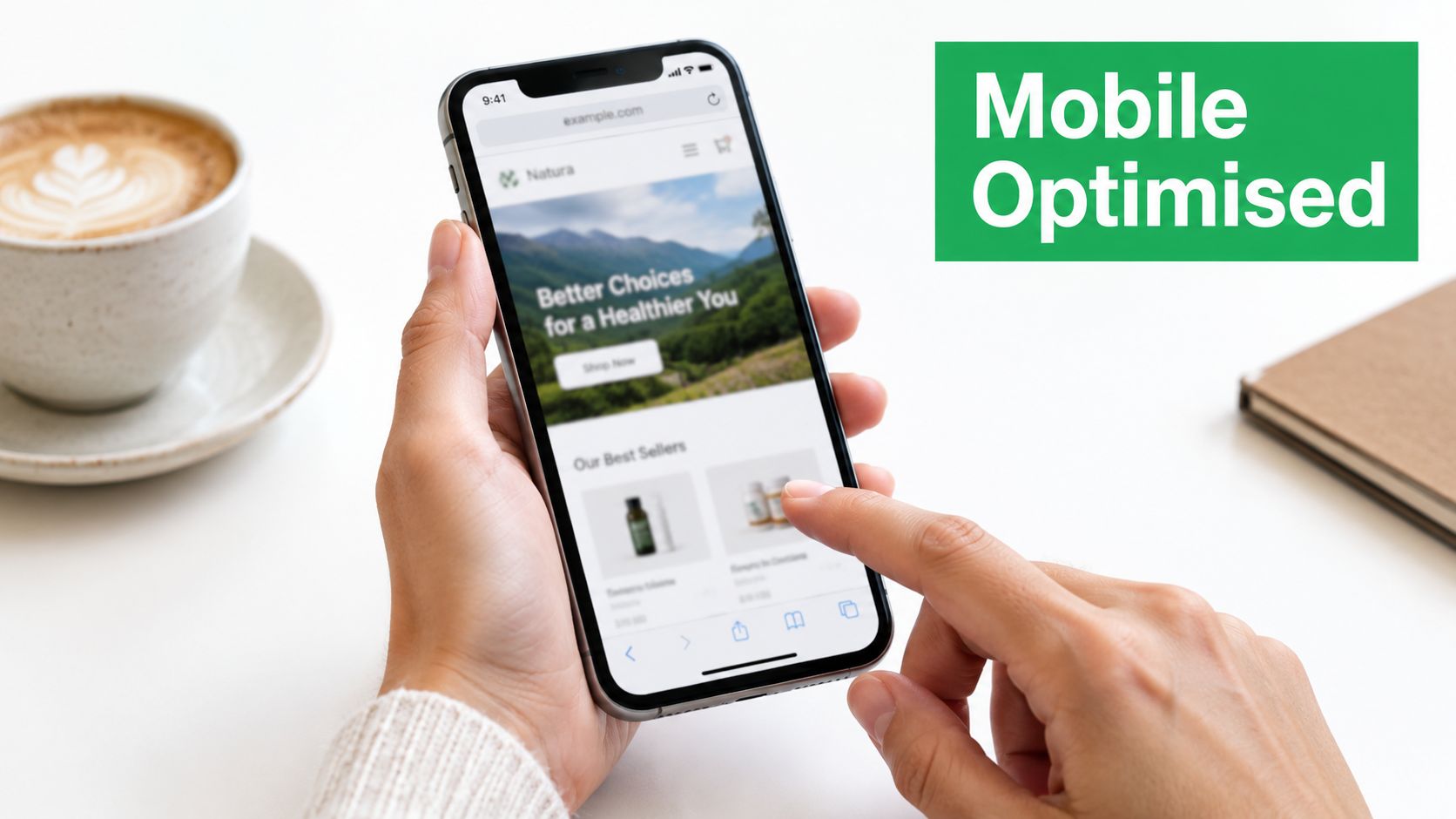
Local customers commonly search while travelling, standing near a problem or comparing providers on a phone. A mobile page that hides the phone number, loads large banners slowly or makes the enquiry form awkward can lose the lead before rankings become the issue.
Google's mobile-first indexing means the mobile version is the primary version used for indexing where applicable. Businesses should compare the mobile and desktop pages rather than assuming a responsive theme has solved everything. A Melbourne dentist should make appointments easy to request, while a mobile tradie should make calling or sending job details straightforward.
Technical checks should include:
- Content parity: Important text, links, headings and structured data should be available on mobile.
- Readable layouts: Text should work without pinching or horizontal scrolling.
- Tap targets: Buttons, menus and form controls need enough space to use comfortably.
- Image handling: Compress large photographs and serve appropriate sizes.
- Script control: Remove tools that add little value but delay interaction.
- Search Console monitoring: Review mobile usability and indexing signals after changes.
A content delivery network, browser caching and minified files may help, but they shouldn't be applied blindly. A low-quality optimisation that removes useful functionality can reduce enquiries. Mobile SEO is successful when the page remains clear, fast and practical for a person trying to contact the business.
5. Build authority with local backlinks and partnerships
Google's explanation of prominence includes signals such as links from other websites and customer reviews. A backlink from a relevant Melbourne organisation can therefore do more than pass authority. It can introduce the business to a local audience that already has a reason to trust the referring organisation.
Useful opportunities are usually relationship-based. A commercial electrician might contribute safety guidance to a local property or facilities publication. A healthcare practice could participate in a reputable community information resource. A B2B provider may contribute expertise to an industry association or Melbourne business network.
The most defensible link opportunities include:
- Professional memberships: Join relevant associations that publish genuine member profiles.
- Community activity: Support an event or initiative that has a real connection to the business.
- Expert contribution: Offer clear, useful commentary to local journalists or industry editors.
- Complementary partnerships: Create referral relationships with businesses serving the same audience.
- Original resources: Publish a local guide, explanation or tool that others can cite.
Practical rule: A link should make sense to a human reader before it is considered an SEO opportunity.
Avoid mass guest-post schemes, paid links presented as editorial coverage and reciprocal link pages that exist only for search engines. Local Reddit or Facebook participation can support reputation and discovery when contributions answer questions helpfully, but promotional posting can damage the very trust the business is trying to build.
6. Implement structured data markup for local businesses
Structured data is machine-readable information that helps search engines interpret a page. It doesn't guarantee a rich result or a higher ranking, but accurate markup can reduce ambiguity around the business, its services, hours and other visible details.
A service business should normally begin with the most specific valid type available. A dentist might use an appropriate dental business type, while a plumber can combine a suitable local business description with Service markup. The markup should match the page and the visible business information. A service-area business shouldn't add a public address in schema merely because an address field appears convenient.
JSON-LD is generally the practical implementation format. Teams should:
- Describe the entity: Keep name, phone, website and hours aligned with visible content.
- Represent services carefully: Mark up actual services and genuine coverage.
- Avoid unsupported ratings: Don't add review or rating data that the page doesn't visibly and legitimately support.
- Validate before release: Test the result with Google's Rich Results Test and Schema.org tools.
- Recheck after edits: Hours, phone numbers, service names and templates can drift.
The guide to what schema markup is provides useful background for teams that need to distinguish structured data from ordinary page copy. Schema supports understanding, not deception. It cannot turn an empty suburb page into local expertise.
7. Manage and respond to customer reviews strategically
Reviews influence how potential customers judge a business, and Google identifies review quantity and other prominence signals as part of local visibility. The practical benefit of review management is broader than rankings. A thoughtful response can clarify expectations, show accountability and help a prospective customer decide whether the business is suitable.
A review process should fit the actual service workflow. A tradie can send a request after a completed job and invoice. A dental practice can make the request part of an appropriate post-appointment communication. A professional services firm can ask after a defined project milestone, provided the request complies with platform policies and privacy obligations.
Review handling works best when staff follow a consistent approach:
- Ask clearly: Invite genuine feedback without demanding a positive rating.
- Make access simple: Use a direct review link or a clearly explained request.
- Personalise responses: Refer to the customer's actual experience where appropriate.
- Protect privacy: Don't reveal sensitive details in a public reply.
- Resolve offline: Move complex complaints to a private channel without sounding dismissive.
- Learn from patterns: Repeated comments can identify operational problems.
Businesses shouldn't buy reviews, create reviews for themselves or pressure customers to remove criticism. A polished response can't repair a service issue by itself, but it can show that the business takes responsibility and has a workable resolution process.
8. Develop location-focused content that answers local search intent
Melbourne searchers don't only ask for a provider. They ask whether a service suits a particular property, suburb, condition, schedule or local requirement. Content earns its place when it answers that question more clearly than a generic service page.
A local electrician could explain common electrical concerns in older inner-suburban homes. A home-services business might address access, parking or appointment preparation where those details affect the job. A dentist can explain treatment options in plain language and connect the information to the practice's actual services, without making unsupported clinical promises.
Content planning can use:
- Google Autocomplete: Record recurring phrases that reflect real customer wording.
- People Also Ask: Look for follow-up questions that deserve direct answers.
- Service-team knowledge: Ask staff which questions delay bookings or create confusion.
- Seasonal relevance: Update useful advice when Melbourne conditions or customer needs change.
- Internal links: Connect educational pages to the commercial service and booking pages.
Local content should include suburb names only where they add meaning. A page stuffed with every nearby suburb may look artificial and fail to answer anyone's question. Content should also be reviewed when regulations, service conditions, operating hours or business processes change. For regulated industries, a qualified professional should verify technical or compliance statements before publication.
9. Ensure consistent NAP data across all online presence
Name, address and phone data should be consistent enough for customers and search engines to connect every listing to the same business. Formatting differences aren't always fatal, but conflicting phone numbers, old addresses, duplicate profiles or misleading location details create avoidable uncertainty.
The first step is to create a master record. It should state the official trading name, phone number, website, public address where eligible and service-area wording where the business doesn't receive customers at a public location. That record becomes the reference for the website, Google profile, social accounts, directories and professional listings.
An audit should look for:
- Old contact details: Previous phone numbers, emails or addresses.
- Duplicate profiles: Multiple listings that split attention or confuse customers.
- Incorrect categories: Descriptions that no longer match the business.
- Location conflicts: A service-area business shown as operating from an unstaffed address.
- Inconsistent hours: Different opening information across platforms.
The NAP consistency guide explains why this housekeeping matters. Updates should be prioritised according to customer impact, beginning with the Google profile and website, then moving through the most visible and relevant directories. A spreadsheet helps when several people manage listings or when the business has multiple genuine locations.
10. Optimise your website's on-page elements for local relevance
On-page elements tell both searchers and search engines what a page offers and where it applies. A page title such as “Emergency Plumbing in Brunswick” is more useful than “Services” when the page covers emergency plumbing in Brunswick. The wording should match the page rather than promise a broader service than the business can deliver.
Each important page should have a distinct purpose. A suburb page can target local coverage, while a service page can explain the work, process, suitability and next step. Repeating the same service and suburb phrase in every heading creates a poor reading experience and doesn't demonstrate relevance by itself.
A practical on-page pass checks:
- Title tag: State the main service and location naturally where relevant.
- Meta description: Summarise the page accurately and make the next action clear.
- H1 heading: Use one descriptive main heading that reflects the page.
- Subheadings: Organise questions, process details and service benefits.
- Image alt text: Describe the image for accessibility, adding location only when meaningful.
- Internal anchor text: Name the destination page rather than using “click here”.
- URL structure: Keep addresses readable and stable.
Search snippets can change, so carefully written metadata isn't a guarantee that Google will display the exact wording. Its value is clarity and alignment. A business should never use a Melbourne location in a title when it doesn't serve that area.
11. Create service pages optimised for each primary service
A single “Services” page forces different search intents into one shallow destination. Separate pages let a business explain what each service involves, who needs it, what preparation is required and how to request help.
An emergency electrician page needs different information from a rewiring page. The former should make urgency, availability and safety guidance clear. The latter may need detail about assessment, disruption, approvals and the information required before quoting. A dental practice can similarly separate general dentistry, orthodontic care and specific treatment pages when each attracts a distinct patient question.
A strong service page usually includes:
- Service definition: Explain the work in plain English.
- Fit and limitations: State who the service suits and when another option may be better.
- Process: Describe assessment, scheduling, delivery and follow-up.
- Evidence: Use genuine reviews, credentials, images or examples that relate to the service.
- Questions: Address practical concerns without making unsupported guarantees.
- Conversion route: Offer a visible phone, enquiry form or booking option.
The guide on what a good SEO service page should include can support page planning. Location pages should link to these service pages, but they shouldn't replace them. A suburb page explains where the business operates. A service page explains what the customer is buying.
12. Monitor Core Web Vitals and page experience
Core Web Vitals help teams assess how quickly a page displays useful content, how soon it responds to interaction and whether the layout moves unexpectedly. The commonly used metrics include Largest Contentful Paint, Interaction to Next Paint and Cumulative Layout Shift. Older documentation may refer to First Input Delay, so teams should use current Google guidance when setting up monitoring.
The right workflow starts with measurement, not a blind performance plugin installation. Google Search Console can show patterns across indexed pages, while PageSpeed Insights can provide page-level diagnostics and field data where available.
Priorities commonly include:
- Large visual elements: Resize and compress hero images and service photographs.
- Critical rendering: Reduce resources that block the first useful display.
- JavaScript: Remove unnecessary scripts and defer non-essential tools.
- Layout stability: Reserve space for images, embeds and forms.
- Hosting and caching: Check whether the server and cache settings suit the site.
- Third-party tools: Review chat widgets, trackers and booking integrations.
A fast website still needs complete service information and a clear contact path. Performance work should be judged alongside usability, accessibility and enquiry completion, not treated as a score-chasing exercise.
13. Use local schema types and validation tools carefully
Local schema is often discussed as if one block of code can solve local rankings. In practice, it works as a consistency layer. It gives search engines structured clues about the business, services, contact details and coverage, provided those details are accurate and visible to users.
A suitable implementation might combine a specific local business type with Service data on a service page. A multi-location practice should keep each location's details separate. A service-area operator should describe service coverage without inventing a customer-facing premises.
The implementation process should include:
- Type selection: Use the most specific supported type that reflects the business.
- Visible alignment: Keep schema name, phone, hours and service wording consistent with page copy.
- Relationship mapping: Connect the service, organisation and website entities logically.
- Validation: Use Google's Rich Results Test for supported result features and Schema.org's validator for syntax and vocabulary checks.
- Change control: Revalidate after redesigns, migrations, template edits or changes to business information.
Structured data can contain errors that are invisible to ordinary visitors. A developer or SEO specialist should inspect the generated JSON-LD, especially when a content management system inserts values automatically. Review markup deserves particular caution because visible testimonials don't automatically justify aggregate rating markup.
14. Choose review platforms and request methods that fit customers
Google is central for local discovery, but industry-specific platforms can matter when customers compare providers in a particular category. The relevant mix depends on whether the business is a tradie, healthcare practice, accountant, consultant or retailer. A platform should be selected because customers use it and the business can monitor it, not because a directory promises a ranking benefit.
Request timing should fit the customer journey. A home-service company can include a review link in a completion message. A clinic can use an approved post-appointment communication. A team working on longer professional engagements may ask after a clearly completed phase rather than sending repeated requests during an active issue.
Reliable methods include:
- Direct links: Put the intended review destination in post-service email or SMS.
- QR codes: Use them at a genuine physical touchpoint where customers can choose whether to respond.
- Staff prompts: Train staff to invite honest feedback without coaching the wording.
- Reminders: Send a limited follow-up for customers who may have missed the first request.
- Monitoring ownership: Assign someone to check new reviews and escalate sensitive complaints.
Automation can reduce missed requests, but it shouldn't become spam. Businesses should also avoid review gating, where only happy customers receive a review invitation. Honest feedback produces a more credible profile and highlights service problems that internal reporting may miss.
15. Manage citation directories as an ongoing process
Citation management overlaps with NAP consistency, but the operational emphasis is different. The first task identifies and corrects conflicting information. This task creates a repeatable system for deciding which directories deserve attention and keeping those listings useful over time.
A Melbourne service business should begin with relevant, reputable platforms, Australian business directories and industry associations. A physiotherapy clinic, for example, may need health-specific listings and professional profiles. A building contractor may gain more value from trade and construction networks than from a generic directory with no local audience.
A sensible management system records:
- Priority: Why the listing matters to customers or the industry.
- Ownership: Which person controls the account.
- Profile URL: The live listing and any claimed duplicates.
- Information scope: Name, contact details, services, coverage and imagery.
- Review history: When the listing was last checked and what changed.
An audit should check for outdated information, duplicate profiles, broken website links and inappropriate categories. The process can be scheduled periodically, but urgent changes such as a phone number, public address or operating model should be corrected sooner. Citation services may help businesses with several genuine locations, though a provider should explain what it will change, where it will submit information and how duplicates will be handled.
15-Point Local SEO Comparison for Melbourne Businesses
| Tactic | Key features | Value 💰 | Standout ✨🏆 | Target 👥 & Quality ★ |
|---|---|---|---|---|
| Claim & Optimise Google Business Profile | GBP setup, categories, photos, posts, reviews | High local visibility; free/low cost 💰 | Immediate local‑pack control ✨🏆 | 👥 All local service businesses · ★★★★★ |
| Build Local Citations (Directories) | NAP listings across general & industry directories | Improves local rankings & referrals 💰 Low–Medium | Signals legitimacy across platforms ✨ | 👥 Tradies, healthcare, multi‑location · ★★★★☆ |
| Create Location‑Specific Landing Pages | Dedicated suburb pages, local content, local schema | High‑intent leads; scales ROI with quality 💰 Medium‑High | Targets suburb queries & conversion uplift ✨🏆 | 👥 Service areas / tradies · ★★★★★ |
| Mobile‑First Indexing Optimisation | Responsive design, speed, Core Web Vitals | Better mobile rankings & conversions 💰 Medium‑High | Required by Google; improves UX ✨🏆 | 👥 All mobile search heavy businesses · ★★★★★ |
| Local Backlinks & Partnerships | Local news, directories, sponsorships, guest posts | Boosts authority & referral traffic 💰 Medium | Community credibility & high‑value local links ✨ | 👥 Established/local brand builders · ★★★★☆ |
| Structured Data Markup (Schema) | LocalBusiness, Service, Review, FAQ JSON‑LD | Rich snippets → higher CTR; low dev cost 💰 Low‑Medium | Rich results & knowledge panel potential ✨🏆 | 👥 All local businesses (dev help) · ★★★★☆ |
| Manage & Respond to Customer Reviews | Monitoring, requests, responses, sentiment tracking | Improves rankings, trust & conversions 💰 Low ongoing | Directly impacts CTR & reputation ✨ | 👥 All customer‑facing services · ★★★★★ |
| Location‑Focused Content | Local blogs, guides, case studies, FAQs | Long‑term qualified traffic & authority 💰 Medium ongoing | Answers local intent & builds trust ✨ | 👥 Businesses educating buyers · ★★★★☆ |
| Ensure Consistent NAP Across Web | Unified name, address, phone; audits | Foundation for local rankings; prevents loss 💰 Low‑Medium | Prevents data conflicts; essential groundwork ✨🏆 | 👥 All local businesses · ★★★★★ |
| On‑Page Local Optimisation | Titles, metas, headings, alt text, URLs | Quick relevance & CTR improvements 💰 Low | Fast, easy wins for local queries ✨ | 👥 All websites · ★★★★☆ |
| Service Pages for Each Offering | Dedicated service pages, CTAs, case studies | Better conversion & service‑specific rankings 💰 Medium | Matches commercial intent & tracks performance ✨🏆 | 👥 Service providers · ★★★★★ |
| Core Web Vitals: Metrics & Tools | LCP, FID, CLS; PageSpeed & GSC reports | UX & ranking impact; measurable gains 💰 Low‑Medium | Quantifiable page‑experience improvements ✨ | 👥 Sites with performance needs · ★★★★☆ |
| Local Schema Types & Validation Tools | Schema types list + Rich Results & validators | Ensures correct markup for rich results 💰 Low | Reduces schema errors; improves rich result eligibility ✨ | 👥 Devs / technical SEOs · ★★★★☆ |
| Review Platforms & Request Methods | GBP, industry platforms, email/SMS/QR requests | Increases review volume & platform reach 💰 Low ongoing | Practical, repeatable collection tactics ✨ | 👥 All customer‑facing businesses · ★★★★★ |
| Citation Directories & Management | High‑value directories, audits, tracking | Protects local visibility; reduces errors 💰 Low‑Medium | Focus on authoritative listings & upkeep ✨ | 👥 Multi‑location / high‑volume listings · ★★★★☆ |
Turn the 15 Tips Into a Practical Local SEO Roadmap
The fifteen tips work best as a sequence, not as fifteen disconnected tasks. Melbourne businesses should start by confirming that the business is eligible for a Google Business Profile and that the profile configuration reflects the actual operating model. A storefront, a hybrid practice and a mobile service-area business have different location requirements. An operator who doesn't receive customers at a public address shouldn't publish a virtual location to gain map visibility.
The first operational phase is information control. Claim the profile, select the most accurate category, set hours and services, define legitimate service areas, and check that the website presents the same business identity. Then audit the major directories and remove or correct obvious conflicts. This phase may feel less creative than publishing suburb pages, but inaccurate information can undermine every later activity.
Google describes local visibility through relevance, distance and prominence (Google's local ranking guidance). Those factors give Melbourne businesses a useful prioritisation model:
- Relevance: Build clear service pages, accurate categories and useful answers that match the customer's query.
- Distance: Explain genuine service coverage and configure the profile according to the business's real location or service-area model.
- Prominence: Earn authentic reviews, relevant local links and credible business mentions.
Suburb expansion should come after service and information quality. Independent Australian research reported that local-search demand across six major markets rose 25% from 2024 to 2025, then fell 38% in 2026, ending about 23% below early-2024 levels (Australian local-search demand research). Those changes make blanket suburb publishing a risky strategy. A business should measure which services, locations and query types produce qualified enquiries before adding more pages.
Search-result structure also deserves attention. In a study of 65 Australian service-business queries, a map pack appeared on 96.9% of searches, People Also Ask appeared on 92.3%, and the first organic result averaged position 4.12 because several result features appeared above it (Australian search results study). Reddit appeared in the top ten on 38.5% of those searches. The implication isn't that every business needs to chase every feature. It is that local visibility includes the full results page, not only the blue organic links.
The website phase should strengthen the pages closest to revenue. Build or improve the primary service pages first, then create only the suburb pages that can offer distinct, useful coverage. Add internal links between them, check mobile usability, review indexation and validate structured data. Technical work should remove barriers rather than distract from unclear offers or weak contact paths.
Measurement should track more than rankings. A Melbourne business can monitor Google Business Profile actions, calls, form submissions, booked appointments, qualified leads and the locations associated with enquiries. Search Console can help identify query and page visibility, while analytics and a customer relationship management system can show whether traffic becomes useful work. Ranking tools should be treated as directional because local results vary with searcher location and query context.
Documentation protects the process. Record profile edits, page launches, redirects, schema changes, review activity and citation corrections. When enquiries change, the business can then connect the movement to actual work instead of guessing. Results also need a realistic review period, because crawling, indexing, customer feedback and local prominence develop at different speeds.
Specialist support becomes sensible when a site migration, address change, multi-location setup, structured data implementation or conversion-tracking problem creates technical risk. A business should ask for a clear scope, access requirements, reporting method and explanation of what will be implemented. SEO recommendations that never reach the website or profile won't produce a dependable operating system.
SEO2RANK is one relevant option for Melbourne service businesses that want an audit, implementation support and plain-English reporting. Its services cover local SEO, technical SEO, on-page and content work, strategy and measurement, with support for trades, healthcare, accounting, B2B and other service businesses. Details about its approach and available services are available at SEO2RANK.
The immediate next step is practical. Confirm eligibility, secure the profile, create a master business-information record, identify the highest-value services and service areas, and measure enquiries before expanding the programme. That sequence gives a small business a clearer basis for investment than publishing dozens of weak pages or collecting low-value directory listings.
SEO2RANK offers Melbourne businesses local SEO, technical audits, service and suburb page implementation, citation work, structured data support and reporting tied to visibility and enquiries. Businesses that need a practical review of their current setup can visit SEO2RANK to explore the agency's services and choose an appropriate next step.
Find Out What Is Holding Your
Website Back
Get a practical SEO Snapshot showing the biggest issues and opportunities we can see across your search visibility, website and local presence.
GET YOUR FREE SEO SNAPSHOT