
A Google Business Profile can generate 1,120 views and 67 customer actions per month for an average Australian business, with 5% of listing views converting into a website click, call or direction request according to an Australian industry summary covering Google Business Profile activity. Effective optimisation isn't one setting. It combines accurate business information, relevant services and areas, genuine trust signals, useful activity, a helpful website and measurement that connects profile actions with calls, visits and qualified enquiries.
Table of Contents
- Make Your Profile Work as a Local Lead Channel
- 1. Complete and Accurate Business Information
- 2. Optimise Business Photos and Visual Content
- 3. Build Genuine Reviews and Manage Them Properly
- 4. Define Genuine Service Areas and Local Relevance
- 5. Use Google Posts for Useful, Current Updates
- 6. Support the Profile With Accurate Structured Data
- 7. Make the Linked Website Fast and Mobile-Friendly
- 8. Keep NAP Consistent Across Important Citations
- 9. Manage Q&A as Public Customer Service
- 10. Measure Profile Activity Through to Qualified Enquiries
- 10 Google Business Profile Optimisation Tips, Comparison Matrix
- Turn Profile Improvements Into Better Enquiries
Make Your Profile Work as a Local Lead Channel
For Melbourne service businesses, a well-maintained Google Business Profile helps the right searchers understand what the business offers, where it operates and how to contact it. Visibility alone isn't the commercial goal. A profile can attract views without producing worthwhile leads if the phone number is wrong, the service area is vague, reviews go unanswered or the linked website gives visitors no clear next step.
The following 10 Google Business Profile Optimisation Tips focus on the parts that usually deserve attention first:
- Accurate core information and categories
- Useful photos and visual evidence
- Genuine reviews and responsible responses
- Specific service areas and local relevance
- Google Posts that support current demand
- Website structure and structured data
- Mobile experience and page performance
- Consistent business details across citations
- Helpful Q&A management
- Measurement from profile activity through to enquiries
The profile and website should work as one local-search system. A Melbourne plumber might need a genuine North Melbourne service page, while a dentist with one clinic may need a strong treatment page and clear clinic information rather than multiple near-identical suburb pages. Thin pages that swap suburb names rarely help customers and can weaken the overall experience.
These recommendations also account for effort and limits. Profile completeness matters, but it can't overcome every proximity disadvantage. Regular posts can support engagement, but filler content won't replace service relevance. Reviews build trust when they're genuine, but attempts to manipulate them create compliance risk. The useful question is always commercial: which improvement can make the next call, visit or qualified enquiry more likely?
1. Complete and Accurate Business Information
Google Business Profile information acts as the public operating record for a local business. The business name, category, phone number, website, hours, address and service areas should agree with the details customers encounter elsewhere. Google says businesses should use the fewest categories needed to describe the core business, maintain one profile per business and represent the business consistently with its real-world identity in its Business Profile guidelines.
That makes accuracy more important than keyword stuffing. A Melbourne plumbing company should use its real trading name, select the most precise plumbing category available and describe the suburbs it services. A dental practice with outdated hours can miss appointment enquiries, while a home-services operator without a clear website link creates an unnecessary opportunity for a competitor.
Practical rule: The profile, website footer, invoices, signage and major directories should tell the same basic story.
A useful audit compares:
- Core identity: Confirm the business name matches customer-facing branding, without adding promotional keywords.
- Contact details: Check the primary phone number and website link on every important listing.
- Operating information: Review regular hours, holiday hours, appointment requirements and accessibility details.
- Categories and services: Select a primary category that reflects the main commercial service, then add only relevant secondary information.
For businesses with several service areas, conservative accuracy is better than claiming all of Melbourne. The Google Business Profile categories guide can help businesses assess category choices without treating categories as a substitute for genuine local relevance.
2. Optimise Business Photos and Visual Content
Photos can influence whether a prospective customer feels ready to call. They provide evidence of the business behind the profile. A tradie might show completed work, a branded vehicle and the team on site. A dental practice could include the reception area, treatment rooms and staff. For a cleaner, recent project images can communicate the standard of work more clearly than a generic description.
Google provides guidance on adding photos and videos to a Business Profile. Build a gallery around the questions customers need answered: who will arrive, what the premises look like, what equipment is used and what finished work looks like. A useful mix includes business identity, people, premises, equipment, process and completed projects. The purpose is to reduce uncertainty, not create an advertising catalogue.
Clear phone photos are suitable when they are current, well framed and properly lit. Dark rooms, clutter and repeated images can make the profile appear unattended. Captions may explain what customers are seeing, but adding suburb names or unsupported claims can weaken trust and create a mismatch with relevant Melbourne service-area pages.

Build a gallery that answers customer doubts
Useful uploads include:
- Team photographs: Show the people customers may meet, where appropriate.
- Work examples: Use recent, representative projects instead of only exceptional results.
- Location images: Help visitors identify a shopfront, clinic or reception area.
- Process photographs: Show preparation, installation, treatment or service delivery.
- Current branding: Keep vehicles, uniforms and signage consistent with the profile identity.
Visuals should support genuine local landing pages, not thin suburb pages made by changing place names. A Melbourne electrician's gallery can reinforce a local electrical-services page when that page adds original details about the service, process and coverage. The local SEO checklist for Melbourne businesses connects photo work with accurate local content, customer trust and measurable enquiries. Prioritise new imagery when customers cannot judge the work, premises or people from the existing profile.
3. Build Genuine Reviews and Manage Them Properly
Reviews affect customer trust and local visibility, but a high star rating alone is not the objective. Specific feedback, recent customer experiences and sensible owner responses give prospective customers stronger reasons to enquire. A measured reply to criticism also shows how the business handles accountability.
Australian review compliance matters. The ACCC's online reviews guidance explains that businesses must not create misleading review content or conceal commercial relationships that could change how a review is understood. Ask for genuine feedback, rather than buying reviews, writing them for customers or offering benefits for favourable sentiment.
Use a repeatable request process. After completing a job, send a direct Google review link in the follow-up message and invite honest feedback without suggesting a rating. Staff should know when to escalate a serious complaint before it becomes a public dispute.
Respond with context, not templates
Positive replies can mention a real service detail, such as punctuality, clear communication or the work completed. Negative replies should acknowledge the concern, explain that the business will investigate and move detailed discussion to a private channel. Avoid arguing in public.
If a review appears false or misleading, contact the platform and request removal. Google applies its policies to reviews, photographs and videos, so review management should follow the Google content policy requirements. See the Google Business Profile optimisation guide for a review workflow checklist.
A trustworthy review record supports the wider local-search system. It reinforces relevant Melbourne service-area pages, gives visitors confidence in the business and can improve the quality of profile-driven enquiries. Prioritise this work when reviews are outdated, unanswered or inconsistent with the customer experience.
4. Define Genuine Service Areas and Local Relevance
Service-area businesses should list only locations they serve. Adding every suburb within reach may increase apparent coverage, but it can create a poor customer match when the business rarely accepts work there. Accurate areas support trust, relevant enquiries and a clearer connection between the profile and the website.
A Melbourne plumber working in Collingwood, Fitzroy and Abbotsford can name those suburbs and explain the services available in each. A business covering a wider radius can describe that model in plain language, provided the profile reflects actual travel and scheduling arrangements. Search demand alone is not a reason to claim a location.
Use local keywords where they clarify the offer, including service descriptions, website headings, project examples and customer-facing explanations. Repeating suburb names mechanically across profile fields can make the information harder to read and does not create genuine local relevance.
A suburb page earns its place when it helps a customer make a decision. Changing the suburb name on duplicated copy does not.
Connect the profile to useful local pages
A useful Melbourne service-area page should explain:
- Which services are available in that area
- Access, scheduling or property considerations
- Relevant project or process information
- Clear contact options and realistic response expectations
- Links to the main service and booking pages
These pages should support the profile, not exist solely to capture suburb searches. A dental practice with one clinic may not need a page for every nearby suburb unless each page contains different, useful information. A mobile trade business may have a stronger case when travel coverage, service conditions or local examples vary by area.
Review the pages alongside profile data. If the listed suburbs, service descriptions and contact details do not align, fix the inaccurate information before adding more location content. Prioritise pages that help visitors understand availability and take the next step, then measure whether they contribute to qualified enquiries. Research should start with how customers describe their needs, using a practical resource for finding the keywords customers search for.
5. Use Google Posts for Useful, Current Updates
Google Posts place timely information in front of people viewing a business profile. Use them for seasonal services, availability changes, new services, events, practical advice and genuine offers. Each update should support the wider local-search journey, from accurate profile information to a relevant Melbourne service-area page and a measurable enquiry.
A Melbourne plumbing business could post emergency availability during a cold-weather period and link to its emergency plumbing page. A clinic might explain a new booking process. A cleaning company could introduce an end-of-lease service and link to a page covering inclusions, preparation requirements and quote requests. The destination should be a genuine, useful page, not thin suburb content created only to capture searches.
Give every post one purpose and one next step. Use Call, Book or Learn More according to the action the customer needs. Match the landing page to the post's promise. Sending every update to the homepage makes the journey harder to follow and weakens attribution.
Useful topics include:
- Service changes: Explain a new offering or change in availability.
- Seasonal needs: Answer a predictable customer problem with practical advice.
- Project evidence: Share a completed job only with customer approval.
- Business updates: Clarify holiday hours, booking arrangements or temporary access changes.
- Helpful answers: Address questions that repeatedly delay enquiries.
Publish when there is something useful to say. A short, current update is stronger than a forced schedule. Track clicks, calls and enquiries where possible, then keep the post formats that assist qualified customer journeys. Profile activity alone is not a reliable measure of commercial value. Prioritise posts when they clarify availability, build trust or direct customers to a relevant service page.
6. Support the Profile With Accurate Structured Data
Structured data is website code that helps search engines interpret the organisation, location, services, opening hours and contact details. It can clarify how a business website relates to its Google Business Profile, but it cannot support claims that visitors cannot verify or guarantee enhanced search displays.
For a service business, markup should describe information shown accurately on the site. A clinic might identify its organisation and relevant services. A plumber could identify the business, service pages and contact details. The business name, address, phone number and opening information should match the profile and visible page content. That consistency supports trust across the profile, Melbourne service-area pages and local search results.
Keep markup aligned with visible evidence
Apply structured data carefully:
- Use relevant types: Mark up the business and services that exist on the website.
- Match visible content: Do not add ratings, prices or offers that visitors cannot verify on the page.
- Validate the code: Use Google's current structured-data testing resources and review warnings before publishing.
- Update changes: Amend hours, services and business details when the information changes.
- Avoid duplication: Use a clear organisation and location structure instead of competing business entities across pages.
Review markup needs particular care. A business should not add aggregate ratings because reviews appear elsewhere online, or present customer feedback in a way that misleads searchers. Structured data helps search engines interpret a page, while useful content, relevant local landing pages, clear internal linking and an obvious enquiry path help customers decide what to do.
A profile improvement deserves priority when customers click through but cannot quickly confirm the service, service area, availability or next step. Technical markup may improve interpretation in that situation, but it will not compensate for thin suburb pages, inaccurate information or a poor customer journey. Measure the result through relevant actions and qualified enquiries, rather than profile activity alone.
7. Make the Linked Website Fast and Mobile-Friendly
A Google Business Profile click has commercial value only when the linked page helps the visitor take the next step. Local customers may be ready to call, book, visit or compare providers. Slow loading, awkward mobile navigation or a buried phone number can waste that demand.
Choose the landing page around the search intent. A Melbourne orthodontist might link to a clinic or treatment page, while a service-area electrician may need a location-specific electrical page. That page should confirm the service, genuine coverage and contact method quickly. A thin suburb page with swapped place names adds little value and can weaken trust.
Test the customer journey, not only the page score
Check these points on an actual mobile device:
- Mobile actions: Keep the phone number, booking option and enquiry form easy to find.
- Page stability: Stop images, banners and pop-ups shifting important buttons during loading.
- Image handling: Resize and compress photographs while keeping project evidence clear.
- Script control: Remove unnecessary plugins, chat tools and tracking scripts from priority pages.
- Connection testing: Review the site on slower connections, not only a fast office network.
Google Search Console and PageSpeed Insights can help identify technical issues, but a score is not the enquiry outcome. A page can pass technical checks and still leave visitors unclear about the service, location or next step. Conversely, targeted technical work may deserve priority when profile visitors click through but struggle to contact the business.
Measure calls, forms, bookings and other qualified enquiries where possible. If those actions remain weak, improve the landing page and local relevance before publishing more suburb pages.
8. Keep NAP Consistent Across Important Citations
Name, address and phone number, or NAP, should match wherever customers and search engines find the business. Check the Google Business Profile, website, directories, social platforms and relevant industry listings. An outdated phone number or previous address can send a Melbourne customer to the wrong contact point and undermine trust before an enquiry begins.
Listing accuracy is also a customer-service issue. One Australian local SEO source reports that 63% of consumers have encountered inaccurate business information on listings, while 47% would switch to a competitor after finding incorrect information online in its local SEO statistics coverage. Treat citation maintenance as part of keeping the local-search system reliable, alongside accurate service-area pages and a clear contact path.
Build a single approved business record
Start with a written version of the details the business has approved:
- Set the canonical details: Confirm the public business name, address and phone number.
- Check priority listings: Review Google, the website, major Australian directories and relevant industry associations.
- Remove outdated information: Correct moved addresses, changed phone numbers and retired business names.
- Handle locations separately: Give each genuine location accurate details and relevant customer-facing context.
- Audit after changes: A rebrand, relocation or new phone number should trigger a listing review.
Keep the business name intact. Adding suburb keywords to a profile or directory name can create mismatches, compliance issues and confusion with the website. Citation work deserves priority after a move or rebrand, when customers report incorrect details, or when profile activity reaches an old location. For a stable business with accurate listings, improving the linked page or measuring qualified enquiries may deliver more value than chasing minor directory variations.
9. Manage Q&A as Public Customer Service
A well-managed Q&A section removes practical objections before they become missed calls. Use it for service areas, access, booking, payment, preparation, availability and what each service includes. Keep answers easy to scan, while including enough detail to prevent an incorrect expectation.
For example, a Melbourne trade business can explain whether it covers a particular suburb and how it assesses urgent jobs. A dental practice might outline appointment preparation or payment arrangements. A cleaning company can state whether customers provide products or the team brings them. Repeated questions often show where a service page or genuine local landing page needs clearer information. A useful local page should explain the service, local operating context and customer next steps, rather than offering thin suburb copy.
Public answers need regular checks. Review new questions, correct misunderstandings politely and report spam or misleading content through Google's available mechanisms. Staff should stay within their qualifications, especially when answering health, financial or safety-sensitive questions. A response that sounds confident but exceeds the business's expertise can weaken trust.
Use recurring questions as evidence for practical website and profile changes. Add common inclusions and exclusions to relevant service pages, clarify travel limits on genuine Melbourne service-area pages, and state what customers need before requesting an appointment or quote. Keep service wording consistent between the profile, website and any supporting local-search information. Review requests can also mention the aspects future customers care about, but they should invite honest feedback rather than direct sentiment.
Q&A also supports conversational local discovery. Australian guidance recommends aligning profile fields, website content and citations so systems can interpret service areas, opening hours and customer questions consistently in its discussion of Google Business Profile and AI-driven local search. Write for customers first, then check that the same facts appear across the profile, relevant pages and contact path. Prioritise this work when unanswered questions are delaying enquiries, the business serves several suburbs, or customers repeatedly ask about the same service detail.
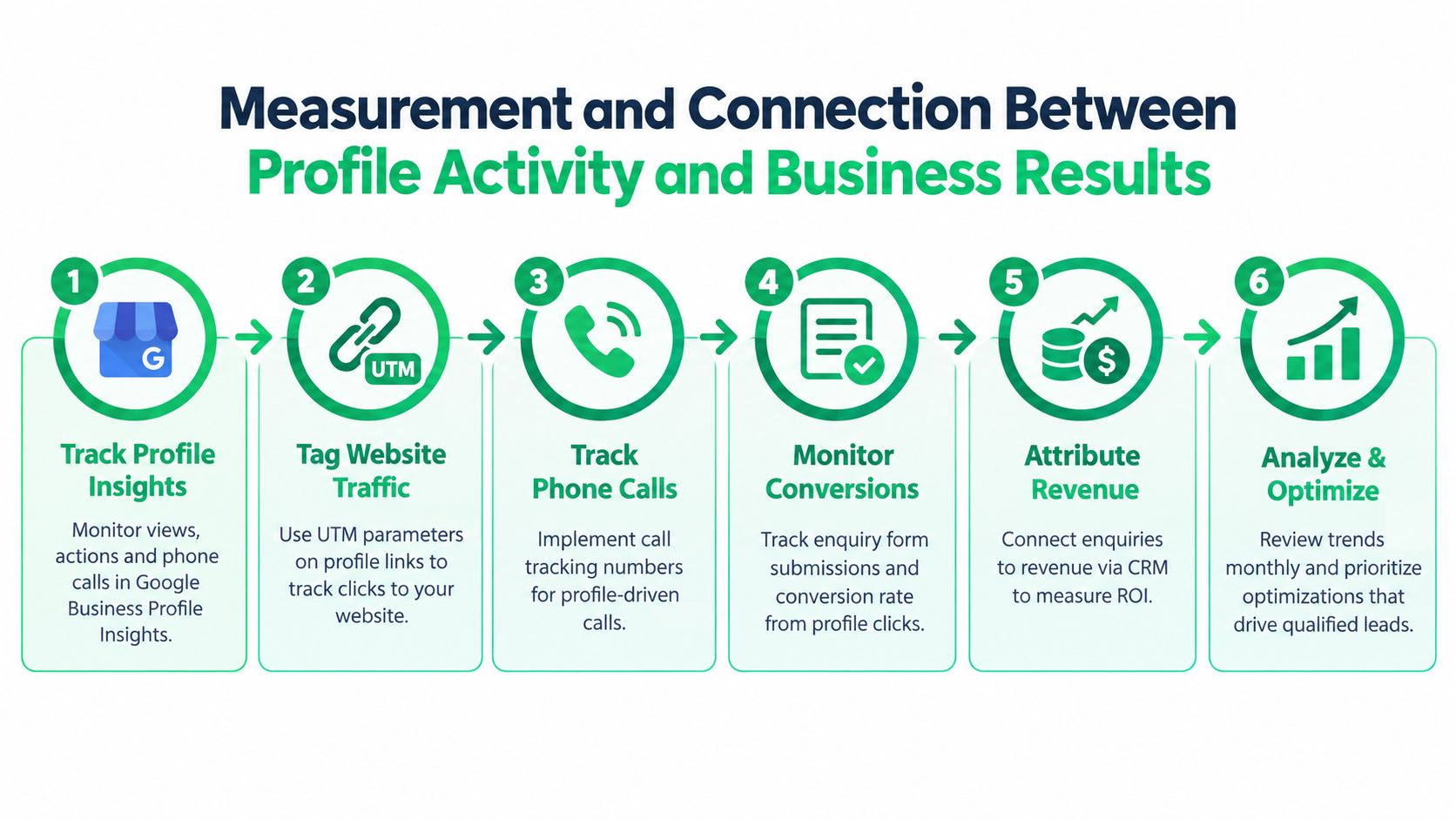
10. Measure Profile Activity Through to Qualified Enquiries
Profile impressions, clicks, calls and direction requests show activity, not necessarily commercial value. A missed call, an irrelevant service request and a booked consultation need separate outcomes. Measure the profile as part of the local-search system, linking accurate profile data with relevant Melbourne service-area pages, customer trust and completed enquiries.
Use call tracking and GA4 conversion events to compare profile actions with pack visibility, review activity, competitor presence and business results, as outlined in a guide to measuring local SEO performance. UTM-tagged website links, suitable call-tracking arrangements and a basic enquiry record can show which interactions produce qualified work. Keep contact details accurate and avoid inconsistent tracking numbers across public listings.
Review performance by enquiry quality
A monthly review should examine:
- Profile actions: Did calls, website clicks or direction requests change after an update?
- Lead fit: Did enquiries match the services and Melbourne suburbs the business wants?
- Assisting pages: Did visitors reach a genuine local landing page or relevant service page before contacting the business?
- Priority changes: Should the next test focus on categories, services, photos, reviews or the linked page?
- Commercial value: Did a post, page or tracking method create useful enquiries, or activity without a viable outcome?
A local landing page should offer specific service information, travel limits, proof and a clear contact path. A thin suburb page may attract a visit without helping a customer decide, so profile work should take priority when accurate data and relevant pages can convert existing demand.
One summary reported around 36 daily opportunities for Australian businesses to engage customers through their profiles in its Google Business Profile listing analysis. That figure does not predict an individual business's results. It does show why profile actions belong in an enquiry process, rather than a report built only around visibility.
10 Google Business Profile Optimisation Tips, Comparison Matrix
| Feature | Quality ★ | Value 💰 | Target 👥 | Unique ✨ / Excellence 🏆 |
|---|---|---|---|---|
| Complete & Accurate Business Information | ★★★★★ | 💰 Low cost · High ROI | 👥 Tradies, healthcare, accountants, B2B | ✨ Foundation for local ranking · 🏆 Local‑pack essential |
| Optimized Business Photos & Visual Content | ★★★★ | 💰 Low–Med (pro shoots) · ↑ CTR | 👥 Tradies, retail, healthcare, tech | ✨ Photos + video increase engagement · 🏆 Visual trust builder |
| Customer Reviews & Review Management | ★★★★★ | 💰 Low cost (process) · High ROI | 👥 All businesses | ✨ Recency-weighted ranking signal · 🏆 Strong credibility factor |
| Service Area Definition & Local Keywords | ★★★★ | 💰 Low cost · Improves qualified leads | 👥 Tradies, field services, healthcare | ✨ Suburb-level targeting · 🏆 Reduces wasted views |
| Regular Posts & Updates (Google Posts) | ★★★ | 💰 Very low cost · Medium ROI (time) | 👥 All; great for seasonal promos | ✨ Time-sensitive visibility · 🏆 Keeps profile fresh |
| Structured Business Schema & Rich Snippets | ★★★★ | 💰 Med cost (dev) · ↑ CTR | 👥 Service businesses with pricing/availability | ✨ Rich snippets (stars, price) · 🏆 Boosts SERP CTR |
| Mobile-Friendly Site & Fast Page Loading | ★★★★★ | 💰 Med–High (dev) · High ROI on conversions | 👥 All (critical for mobile searches) | ✨ Core Web Vitals compliance · 🏆 Improves ranking & conversions |
| Consistent NAP Across Citations | ★★★★★ | 💰 Low–Med (audit) · High impact | 👥 All, esp tradies/home services | ✨ Verification & trust signal · 🏆 Citation authority |
| Q&A Section Management & Engagement | ★★★ | 💰 Very low cost · Improves trust | 👥 B2B & field‑service businesses | ✨ FAQ content indexed · 🏆 Reduces repetitive enquiries |
| Measurement & Linking Profile Activity to Results | ★★★★★ | 💰 Med cost (tracking) · Critical ROI clarity | 👥 All businesses (budget‑aware) | ✨ UTM + call tracking integration · 🏆 Proves optimisation ROI |
Turn Profile Improvements Into Better Enquiries
A Google Business Profile becomes a useful lead channel only when its information, website and customer experience agree. Start by correcting the business name, category, phone number, hours, website and service areas. Then connect the profile to relevant Melbourne service-area pages, add current photographs, collect genuine reviews, respond thoughtfully and answer recurring customer questions.
The linked website must confirm the promise made in the profile. A Melbourne plumber may need a well-developed emergency plumbing page for a genuine service area. A dentist may need a treatment page with booking information and clinic details. An accountant may need clear service explanations, local proof and a straightforward enquiry path. These pages help visitors decide whether to call, book or request a quote.
Create local landing pages selectively. A page earns its place when the business has real service coverage, a credible proposition for that suburb and useful information that differs from nearby pages. Thin pages that only replace “Richmond” with “Hawthorn” give customers little reason to trust the business and provide weak evidence of local expertise. The same test applies to profile posts, photographs, services and Q&A. Each asset should answer a real question or support a genuine decision.
Reviews require consistent governance. Australian businesses operate under rules that make authenticity and disclosure important. The ACCC has reported conducting an internet sweep of online reviews and testimonials in late 2022, while Australian reporting citing ACCC estimates said fake reviews affected about $900 million of spending in 2021 and represented 4% of online reviews in coverage of the ACCC's online review work. Google reported detecting and removing over 2.7 million suspected fake reviews from Maps in 2021, out of 46.7 million written that year. These figures support genuine review requests and careful policy compliance, not a race for volume.
Priority depends on the business type, service radius and conversion path. A tradie with incorrect service areas and an unanswered phone should fix those issues before producing more posts. A clinic with accurate profile information but a weak treatment page may gain more from improving the website and booking journey. A multi-location business may need consistent NAP and location governance before expanding content.
Complete profiles can support stronger engagement than empty ones. An Australian local SEO roundup reports that complete profiles earn 7× more clicks than empty profiles, and states that 88% of local searches lead to a call or visit within 24 hours in its Australian local SEO statistics. Those figures do not guarantee results for every Melbourne business. They do support a practical order of work: remove avoidable friction, make the service and location clear, then measure qualified enquiries rather than views alone.
SEO2RANK is an option for Melbourne service businesses seeking hands-on local SEO, technical implementation, relevant landing pages, citation and NAP review, and plain-English reporting. Businesses can also begin independently by auditing the profile, website and tracking together, then fixing the clearest commercial gap first.
SEO2RANK supports Melbourne businesses with Google Business Profile optimisation, local SEO, technical SEO, relevant landing pages and measurement connected to visibility and enquiries. Businesses can review the available approach and request a practical starting point through SEO2RANK.
Find Out What Is Holding Your
Website Back
Get a practical SEO Snapshot showing the biggest issues and opportunities we can see across your search visibility, website and local presence.
GET YOUR FREE SEO SNAPSHOT