
AI-written content can rank on Google when the finished page is useful, original and made for people, and using AI is neither a ranking advantage nor an automatic penalty. That answer surprises many owners because the tool is not the deciding factor. Google judges what a visitor receives, who stands behind it and whether it can be trusted, while a page can gain visibility and still fail to produce a call or booking if those trust signals are missing.
For a Melbourne service business, the useful question is therefore narrower than whether AI helped. It's whether the published page answers a real customer question better than a generic draft could, using accurate local detail and clear professional accountability. The sections below separate Google's ranking rules from the separate commercial test of earning an enquiry.
Table of Contents
- Yes When the Page Is Genuinely Useful
- How Google Judges AI Pages
- Rankings That Still Lose the Enquiry
- How to Edit an AI Draft Before You Publish
- Service Page Examples That Can and Cannot Rank
- Checks for Accuracy Privacy and Performance
- Decide What to Publish Next
Yes When the Page Is Genuinely Useful
Yes, AI-written content can rank on Google, but it doesn't rank because a model wrote it. It can rank when the final page is useful, original, accurate and satisfies the person who searched. Using AI is neither a shortcut to page one nor an automatic breach.
In Google's guidance published on 8 February 2023, Google said its ranking systems aim to reward original, high-quality content demonstrating experience, expertise, authoritativeness and trustworthiness, known as E-E-A-T. The same guidance says using AI or automation isn't automatically against its guidelines, while content generated primarily to manipulate rankings violates spam policies whether a person or a machine produced it.
Which AI Uses Can Rank and Which Count as Spam
| How AI is used | Google's rule | Realistic outcome |
|---|---|---|
| Draft, research or expand a page, then a person corrects it | Allowed when the published page is useful, original, accurate and shows E-E-A-T | Can rank on the same basis as any helpful page |
| Outline, classify or translate to speed production | Permitted automation if the finished page serves the reader | Ranks on quality and relevance, not on the tool used |
| Many low-value pages made mainly to manipulate rankings, including light human edits on top | Spam, including scaled content abuse, whether written by AI, people or both; cosmetic edits do not make it compliant | Risk of poor rankings, demotion or removal |
| Generic suburb or service copy with errors or invented expertise | Fails helpful, people-first quality expectations | May be indexed yet struggle to rank or be trusted |
The first two rows describe AI as production help. A business might ask a tool to organise research, outline a treatment page or turn detailed notes into a first draft. A knowledgeable person then corrects the claims, adds local detail and removes anything the business can't verify.
The third row is where owners often misunderstand the rule. Changing a few opening lines doesn't rescue a large batch of thin pages created mainly to capture searches. Google looks at the purpose and value of the publishing pattern, not only whether someone lightly polished the output.
The fourth row covers polished writing that still isn't ready. A suburb page might read smoothly while naming services the business doesn't offer there, inventing qualifications or repeating advice that could belong to any competitor. Fluency isn't evidence.
Practical rule: Treat the AI draft as unpublished working material until a qualified person has checked every claim a customer might rely on.
Google also says automatically generated content should be manually fact-checked for accuracy and trustworthiness before publication. That check should confirm service details, operating areas, credentials, price conditions and contact information. A local page also needs the judgement behind what E-E-A-T means in the age of AI search, not just an author name added at the end.
None of this promises a ranking. It gives the page a legitimate chance to compete because a real business has supplied the expertise, local relevance and quality control that the model couldn't supply on its own.
How Google Judges AI Pages
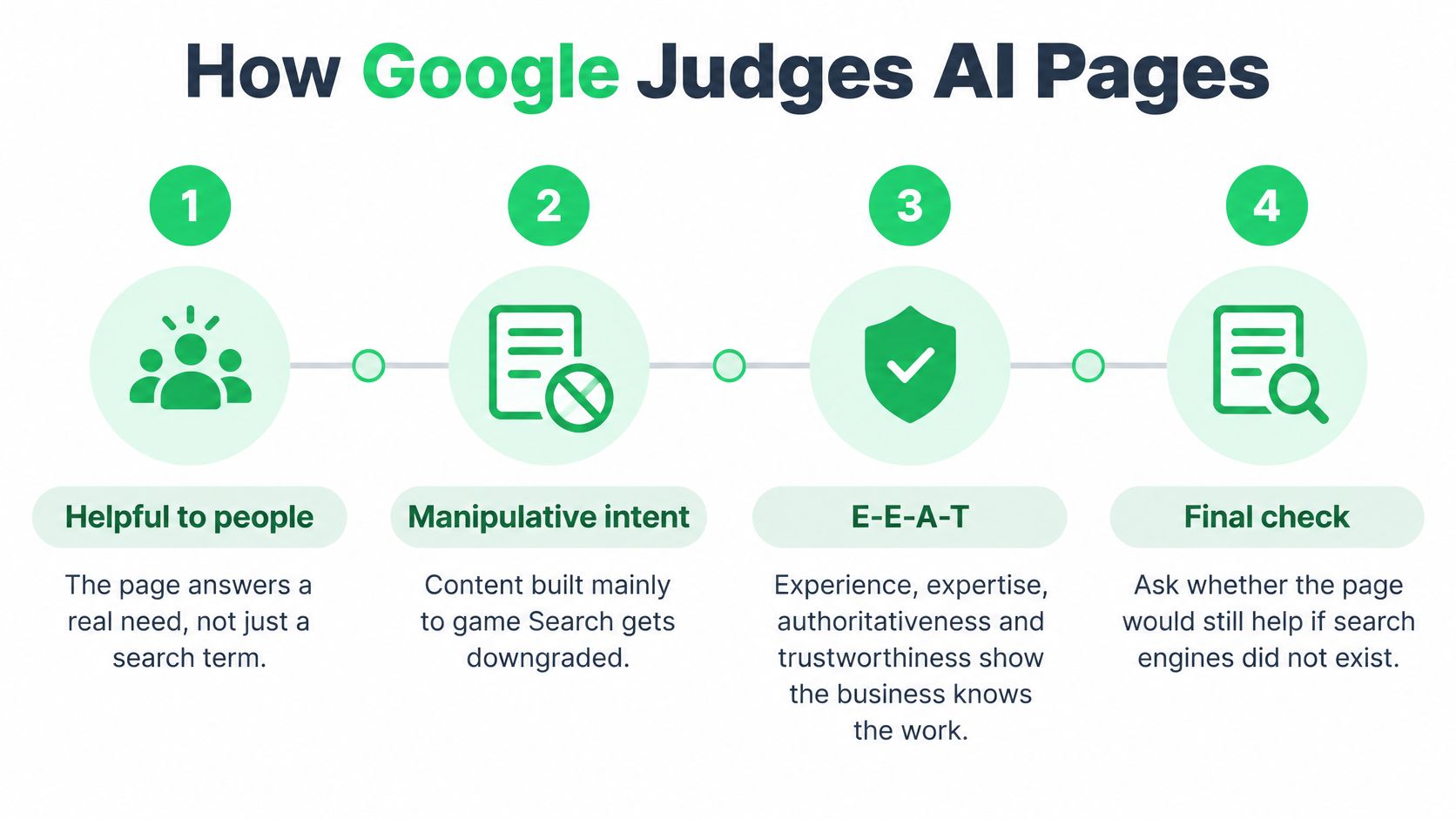
Google applies a simple underlying test. Was the page made mainly to help a person, or mainly to manipulate Search? The production method matters less than the answer.
Automated, AI-assisted and human-written pages pass through the same ranking and spam systems. There's no special AI bonus for producing text quickly and no automatic penalty merely because AI helped draft it. Human-written material can also be spam if it's unoriginal, misleading or created at scale for rankings.
The timeline below shows how that test works as a publishing check.
E-E-A-T in Plain English
E-E-A-T isn't a badge a business buys or a single score it can inspect. It's a set of signals that help Google and readers judge whether the business knows the work, can be identified and can be relied on. For a service page, those signals might include who provides the service, relevant credentials, accurate process details, clear limitations and an easy way to contact the business.
Experience should be visible in specifics a generic model wouldn't know. A useful page explains how an assessment works, when a service isn't suitable, what information the customer should prepare and which Melbourne areas are served. Broad claims about quality or customer care add little because every competitor can make them.
What Changed With Scaled Content Abuse
According to Google's March 2024 spam-policy update, Google expanded enforcement against scaled content abuse regardless of whether pages were produced by automation, humans or a combination of both, including cases where it's difficult to identify whether low-quality pages were created purely by automation. The core rule stayed the same. Automation, including generative AI, is spam when its primary purpose is manipulating Search rankings.
That change closed a common loophole. A business can't make dozens of near-identical location pages acceptable by asking a person to swap a sentence on each one. If the pages add little beyond a suburb name and repeated service claims, the operation still looks like low-value publishing at scale.
The historical pattern is therefore stable. Google first confirmed that AI assistance could be acceptable, then broadened enforcement against mass-produced pages with little original value. Owners can read Google's 2026 spam updates for related policy context, but the publishing test remains practical rather than technical.
Before publication, ask three questions. Does the page answer the search that brought the visitor there? Does it add local or professional knowledge that isn't generic? Could the business safely stand behind every statement if a customer relied on it?
The page must also meet the same Search Essentials baseline as any other page, including being accessible and eligible to appear in Search. Meeting that baseline doesn't create quality. It means a worthwhile page isn't blocked by avoidable technical problems.
Rankings That Still Lose the Enquiry
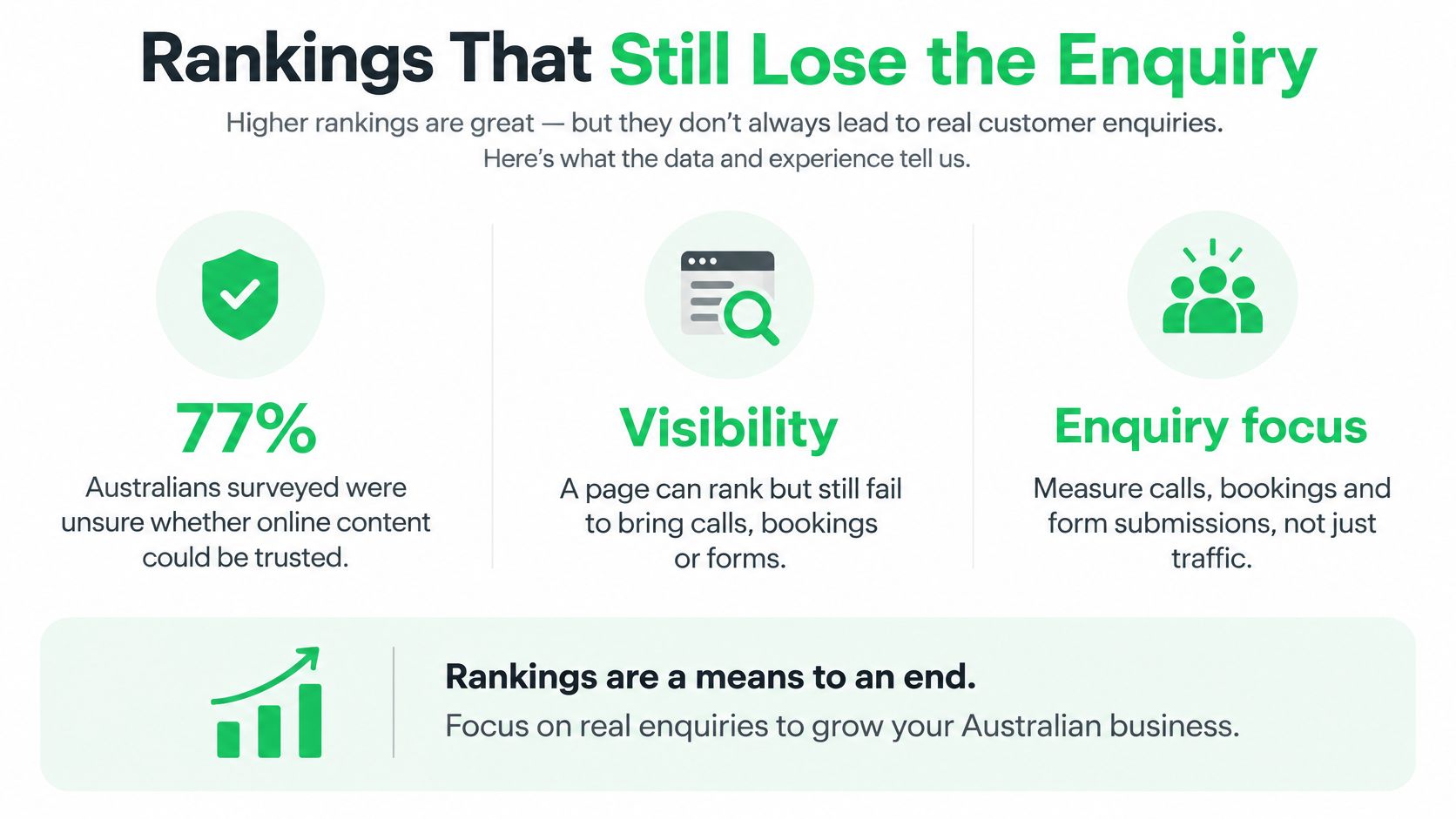
A first-page ranking only creates an opportunity. The visitor still decides whether to call, book or submit a form, and that decision leans heavily on whether the page feels authentic and accountable.
That caution is already widespread. In the KPMG Australia snapshot on trust, attitudes and use of AI, 77% of Australians surveyed were unsure whether online content could be trusted because it might be AI-generated. A page that reads as anonymous automation meets a sceptical audience before it has said a word.
Why Trust Matters More for Services
A person choosing a dentist, healthcare provider, accountant, tradie or B2B adviser isn't buying an article. That person is judging whether it's safe to hand over money, personal information, property access or a health concern. Anonymous advice creates friction at exactly the point where the business wants confidence.
Consider two versions of the same physiotherapy page. The first is fluent but generic, with no named clinician, no explanation of who the treatment suits and no local practice detail. The second names the reviewing clinician, explains the assessment process, states when referral may be needed and gives a clear booking path.
Both pages might contain similar search terms, and both could plausibly rank. The second gives the visitor more reasons to act because a real professional is visibly responsible for the information. That gap is easy to miss in reporting, because impressions, clicks and average position can all look healthy while the phone stays quiet. The trade-off is real: a generic draft is faster to publish, but it asks the reader to trust a business that won't show its face.
Disclosure and Authenticity Signals
Google doesn't require a blanket AI label on every AI-assisted page. A business should still consider disclosure where AI materially shapes customer-facing information, particularly if readers might reasonably assume a named professional wrote every word personally. The reason is customer trust, not a supposed ranking trick.
Useful authenticity signals include:
- Named reviewer: Show who checked the page and what qualifies that person to do so.
- Service-specific detail: Explain the actual process, limits, preparation and local availability.
- Evidence for factual claims: Cite an authoritative source where a claim needs support.
- Human contact path: Make it easy to ask a person when the page can't answer an individual situation.
A page can win the click and lose the enquiry if the visitor can't see who stands behind the advice.
This doesn't mean every paragraph needs a personal story or every page needs a long biography. It means the business shouldn't hide accountability behind polished, anonymous text. For high-trust services, clear authorship and review are part of conversion quality, not decorative extras.
How to Edit an AI Draft Before You Publish
Think of AI as a fast junior writer. It can gather material and produce a readable draft quickly, but a qualified tradesperson, clinician, accountant or consultant still has to inspect and sign off the work. The workflow below is designed for one suburb or service page.
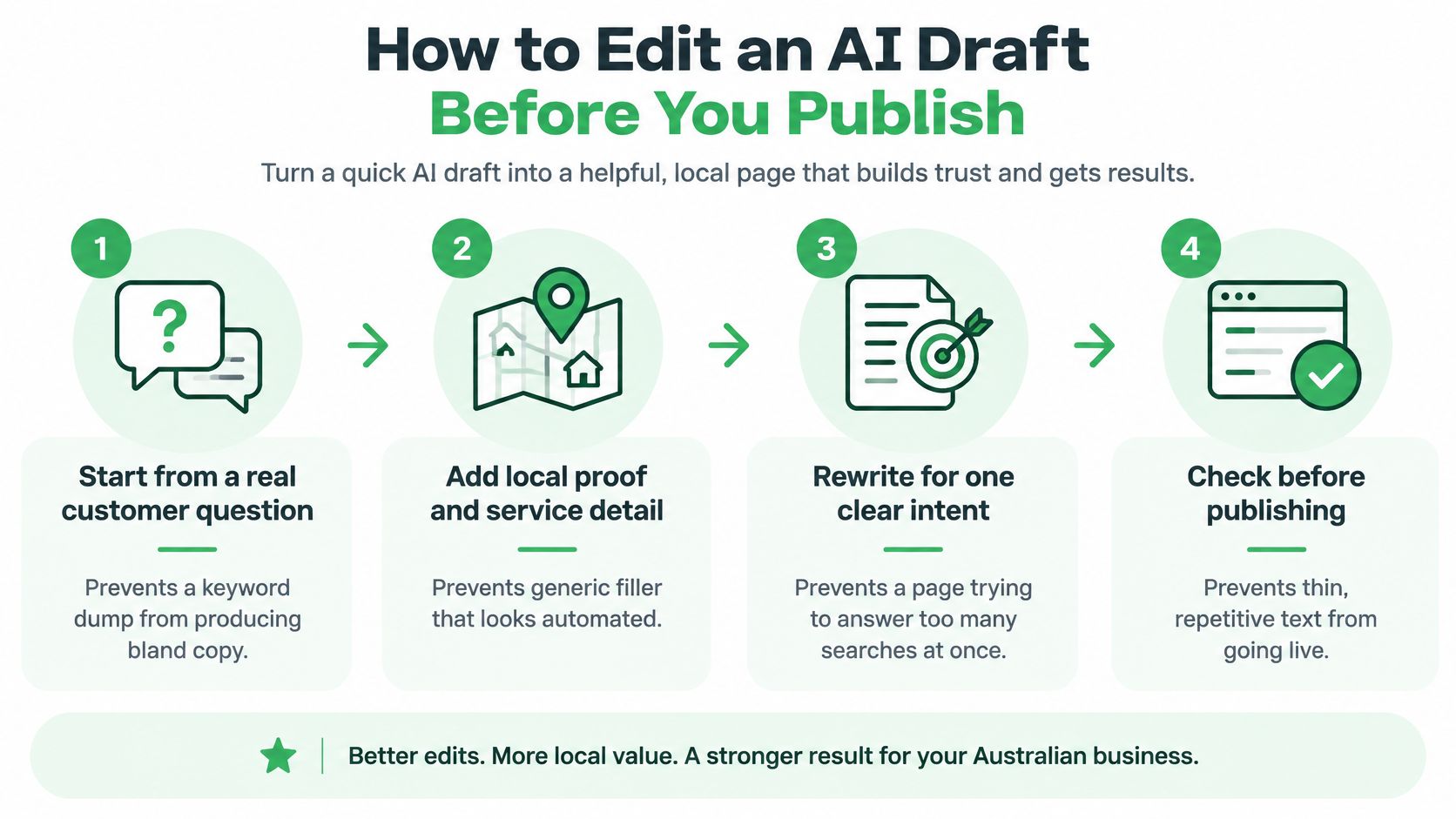
The process map summarises the same discipline in four broad stages, from a real customer question through to the final check.
A Seven Step Editing Workflow
Start from a real customer question. Use questions from calls, consultations, quote requests or reception staff. This prevents a keyword list from producing a page nobody asked for, filled with loosely related paragraphs and no clear decision for the reader.
Use AI to organise research or draft the structure. Keep customer names, case details and other private information out of public tools. This prevents confidential material from being exposed and stops the model from turning fragments of a real case into published claims.
Add what the model cannot know. Insert suburbs served, how the job is performed, practitioner or licence credentials, relevant Australian requirements, price conditions and accurate contact details. This is the step that turns interchangeable copy into a page about a particular business and service.
Have the person who does the work fact-check it. The reviewer should test every factual claim, cut generic paragraphs and delete anything the business cannot stand behind. This prevents the most damaging AI problem, a plausible error written with complete confidence.
Match the page to one main search intent. A visitor comparing treatment options needs risks, suitability and alternatives, while a visitor ready to book needs availability, process and contact details. Mixing every intent into one long page can leave each visitor without a clear next step.
Check the page furniture. Revise the title, meta description, headings, internal links, structured data and image alt text so they describe the finished page. This prevents template leftovers, such as schema naming the wrong service or a heading promising a location the business doesn't cover.
Read it aloud and publish selectively. Listen for unnatural repetition, brand mismatch and claims that sound stronger than the evidence. Publish one strong page rather than dozens of near copies, which prevents a useful drafting process from becoming scaled thin content.
Where Owners Commonly Rush
Step 3 is often reduced to changing the suburb name. That's not local detail. Useful local detail might explain travel arrangements, common property issues in that area, appointment availability or which parts of the service are provided on site and which happen elsewhere.
Step 4 is also more than proofreading. A reviewer should ask whether the draft has invented a process, overstated a benefit, omitted an important limitation or presented general information as personal advice. Spelling can be perfect while the substance is unsafe.
There's no fixed time for the edited page to rank. Competition, the site's existing authority, technical health, topic choice and the strength of competing pages all affect the outcome. Promising a position by a particular date would ignore those variables.
Stop rule: If a page fails step 4, it stays unpublished, even if the wording sounds polished and the keyword coverage looks complete.
This workflow takes longer than publishing a raw draft. That's the trade-off. The time saved by AI should be reinvested in local knowledge, expert review and clearer answers, not used to multiply the number of pages.
Service Page Examples That Can and Cannot Rank
The following illustrations are fictional. They're not case studies and they don't describe actual rankings, clients or results. Each one shows how the same drafting tool can lead to a very different publishing decision.
Three Fictional Melbourne Service Pages
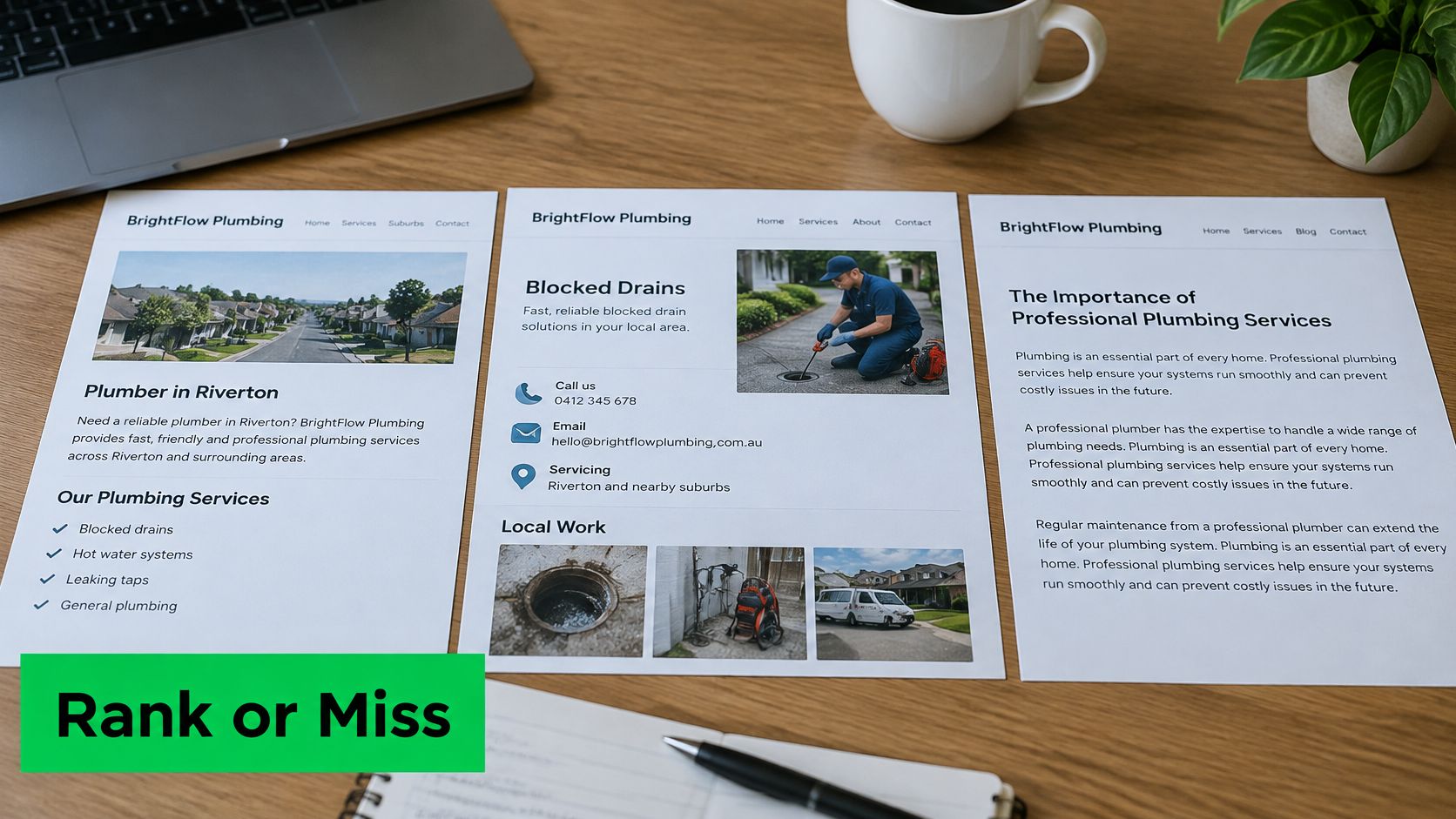
A plumber's copied suburb pages. Say a plumbing business creates twenty location URLs by swapping the suburb name in the heading and opening paragraph. Every page repeats the same blocked-drain tips, with no licence information, service limits, response arrangements or detail about jobs the business performs in those areas.
A person lightly edits each introduction. That doesn't solve the underlying problem because the set still offers little original value from one URL to the next. It resembles scaled publishing designed to capture location searches rather than help residents in each suburb.
A dental treatment page with invented details. Say an AI draft states recovery times and fees that sound precise but don't match what the practice tells patients. Publishing it would create a trust and safety problem before SEO even enters the discussion. A clinician needs to replace those statements with the practice's real guidance, explain that suitability requires assessment and remove any figure the practice can't support.
That page could become publishable after clinical review. The useful version would explain who may or may not suit the treatment, what happens at the consultation and when another option may be safer. It would not present invented certainty as professional advice.
An accountant's question-led guide. Say an accounting firm starts with questions clients commonly ask at tax time and uses AI to organise the draft. A named accountant reviews it, separates general information from personal advice and adds the records clients should bring to a meeting. The guide then links naturally to a relevant page explaining what a good SEO service page should include.
That page has a clearer path to ranking because it answers a defined need with professional judgement. It also helps the reader decide whether to contact the firm rather than merely repeating definitions available anywhere.
Access to AI is no longer unusual. According to Adobe's 2025 survey of more than 400 Australian marketing, advertising, creative-design and customer-experience professionals, 78% of Australian marketing teams reported already using AI to support content production and workflows. The advantage therefore sits in the review standard, not in just having a tool.
Capacity also matters. The Australian Bureau of Statistics release on business adoption of AI in 2024-25 reported that approximately 12% of Australian businesses used AI in the workplace, compared with about 35% of large businesses and approximately 11% of small and micro businesses. A small firm shouldn't copy a high-volume publishing habit if it doesn't have the staff to review the output properly.
The final test is simple. If the page could be pasted onto a competitor's website by changing only the business name, it isn't ready.
Checks for Accuracy Privacy and Performance
Checks fall into two stages. Before publication, the business controls accuracy, privacy and page quality. After publication, it can only observe how Google and visitors respond, then improve or remove weak pages.
Before the Page Goes Live
Confirm every factual claim, local detail, credential and price condition against a reliable internal source. Remove leftover model phrasing, repeated sentence patterns and confident statements that nobody can verify. Then check that headings, internal links and structured data describe the actual page rather than the template used to create it.
Privacy needs a separate stop check. The Office of the Australian Information Commissioner's guidance on privacy and developing and training generative AI models states that the Privacy Act applies to the collection, use and disclosure of personal information in developing or training generative-AI models, personal information includes inferred, incorrect or artificially generated information about an identified or reasonably identifiable person, and generating or inferring personal information with AI is a collection of personal information subject to Australian Privacy Principle 3.
In plain English, staff shouldn't paste customer names, health details, financial information or enquiry records into public AI tools unless the use is lawful, reasonably necessary and managed consistently with Australian privacy obligations. If the team isn't sure, it should pause and obtain appropriate privacy advice. Removing a surname may not make a detailed case anonymous.
A technical SEO checklist for small business can help confirm the page is crawlable and internally reachable. Technical readiness still doesn't excuse weak content. It prevents a sound page from being undermined by indexing or site-structure problems.
What to Measure After an AI-Assisted Page Goes Live
| Signal | Where to look | A healthy result |
|---|---|---|
| Visibility for the intended query | Google Search Console | Impressions and clicks for that query, not a pile of unrelated searches |
| Indexing of the new URL | Search Console page report | The important URL is indexed and not one of many excluded duplicates |
| On-page behaviour | Analytics | Visitors reach the service information or enquiry path rather than leaving immediately as the only outcome |
| Enquiry quality | Calls, forms or bookings | Enquiries match the service and area, and can be tied back to the page |
| Mentions in AI answers | Manual checks of important questions | A mention is extra evidence only; absence is not a failure by itself |
Review the page after a meaningful period rather than reacting to daily movement. If it attracts irrelevant queries, rewrite it around the intended customer problem. If people arrive but don't enquire, inspect trust signals, service clarity and the next step before producing more content.
An appearance in an AI-generated answer can be useful evidence of visibility. It isn't a target the business can force, and no process can guarantee crawling, rankings, traffic or leads because Google controls its results. Owners should therefore judge the page by relevance and enquiry quality, not by a single position screenshot.
Timing and cost also need honest expectations. There's no fixed period before a page ranks, and costs depend on staff time, reviewer time, tools and the depth of checking required. The reviewer's time is the cost that cannot be skipped without changing the risk.
Decide What to Publish Next
AI-written content can rank when the finished page is useful, original and properly reviewed. It shouldn't be published as a raw draft or expanded into a mass of near-duplicate suburb pages in the hope that volume will compensate for weak substance.
Publish Revise or Pause
- Publish: A qualified person has checked the facts, the page answers a real customer question and local or professional detail is visible.
- Revise: The draft is fluent but generic, anonymous or full of claims the business cannot verify.
- Pause and get advice: Privacy, regulated claims or an existing pattern of thin pages could create a wider problem.
A sensible SEO partner treats AI as help for research and production inside an ongoing organic strategy, not as a one-off shortcut. SEO2RANK reviews client-facing work against search intent, factual accuracy, brand fit and commercial value before publication, and AI doesn't replace strategy, quality control or accountability. It also doesn't promise guaranteed ChatGPT recommendations, guaranteed AI citations or secret access to an algorithm.
For an established Melbourne service business, the right first step may be an audit rather than more content. An audit can show whether the immediate problem is thin service pages, weak local relevance, technical barriers or poor enquiry tracking. That diagnosis prevents a business from producing additional pages on top of an unresolved foundation.
Start with one important service page. Run the editing workflow, publish only if a qualified reviewer can stand behind it, and measure relevance and enquiries before deciding what to produce next.
If an important service page is attracting searches without producing suitable enquiries, SEO2RANK can audit the content, local signals and technical barriers before more pages are created. Its Melbourne team can then prioritise expert-reviewed improvements that make the page clearer for customers and easier for Google to understand. Visit SEO2RANK to discuss a practical first step for the business.
Find Out What Is Holding Your
Website Back
Get a practical SEO Snapshot showing the biggest issues and opportunities we can see across your search visibility, website and local presence.
Get Your Free SEO Snapshot→