

SEO for plumbers starts with a complete Google Business Profile, focused service pages, genuine service areas, a fast mobile call path and enquiry tracking, before extra content or AI work. Commercial pages should aim for a Largest Contentful Paint of 2.5 seconds or less so customers aren't left waiting for the main content.
For a Melbourne plumbing business, the problem often isn't a lack of website visitors. It's a phone ringing for work outside the service area, enquiries arriving when nobody can attend, or customers disappearing before the contact button works. Effective plumbing SEO treats visibility as a dispatch problem, matching search demand to jobs the business can complete.
Table of Contents
- The SEO Priorities That Win Plumbing Jobs
- Suburbs, Service Areas and Honest Local Pages
- Mobile Speed Before the Customer Hangs Up
- Reviews That Explain the Job
- Ads AI Answers and Honest Claims
- Start With the Jobs You Can Attend
The SEO Priorities That Win Plumbing Jobs
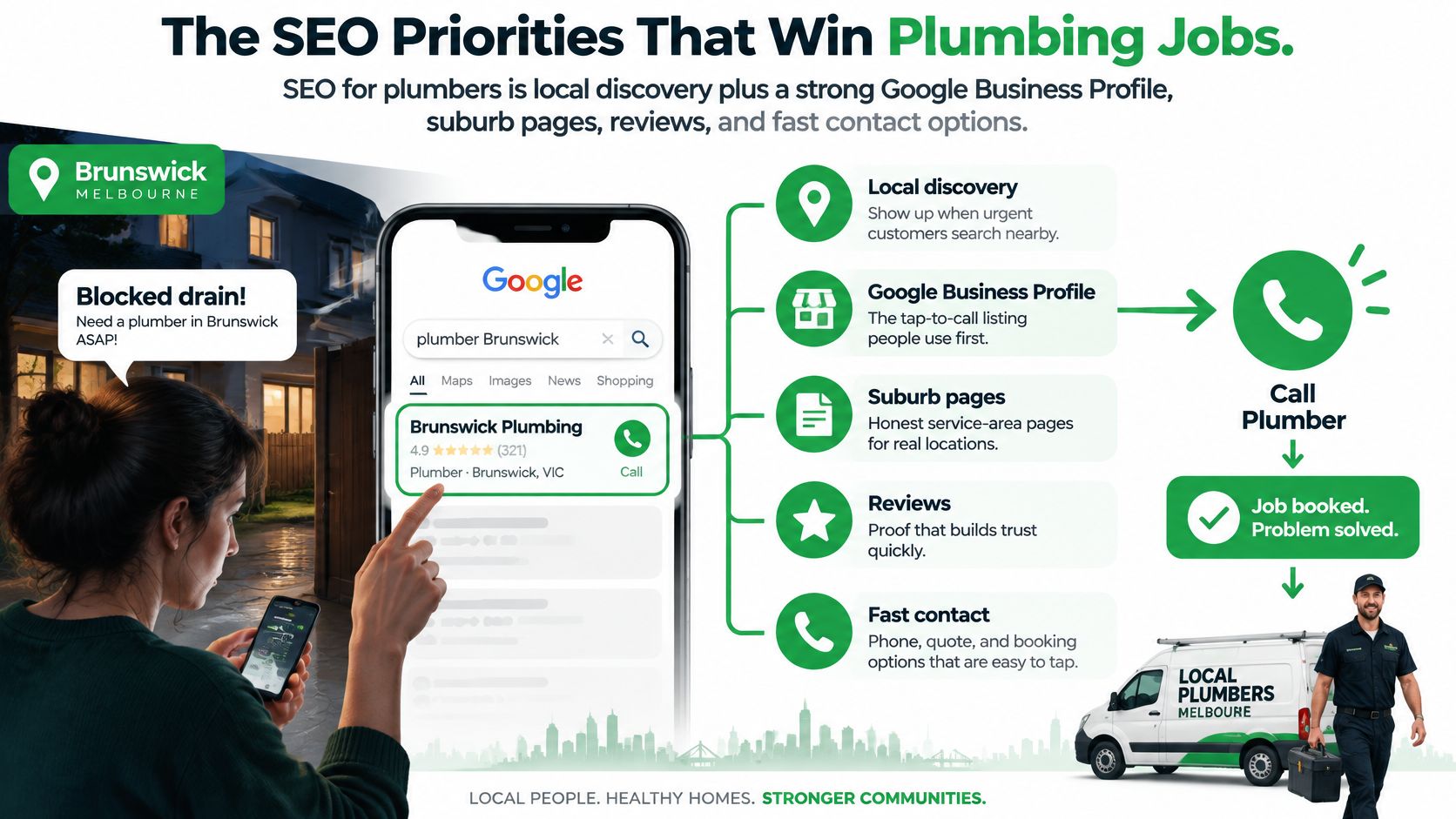
Say a homeowner in Brunswick discovers a blocked drain late at night. Holding a phone, they search for an emergency plumber, tap a local result showing suitable hours and call the number. A general article about drain maintenance isn't the result they need.
SEO for plumbers combines local discovery with a clear route to contact. The business needs to appear relevant and available, then make the next action straightforward. A polished website won't compensate for an unanswered number or misleading opening hours.
SEO priorities for a plumbing business
| Priority | Search job it serves | First action |
|---|---|---|
| Google Business Profile | Show for Maps and near-me searches | Set categories, hours, phone, service area and emergency availability |
| Service pages | Rank for the job the customer names | Build pages for emergency, blocked drains, hot water and gas |
| Genuine service areas | Match suburbs the business can attend | Group real coverage instead of cloning every suburb |
| Mobile speed | Let someone call before they leave | Meet good Core Web Vitals on commercial pages |
| Specific reviews | Show how the last similar job went | Ask for suburb, problem, response and outcome |
| Enquiry tracking | Know which page booked the job | Track calls, quote forms and booked work by page |
The Google Business Profile earns its place first because Maps and the local pack can appear above ordinary website links on urgent searches. Customers can inspect availability and contact details without opening the website. Categories should describe the work offered, rather than every loosely related trade.
Dedicated service pages come next because customers name problems, not marketing categories. Emergency plumbing, blocked drains, hot-water repairs and gas work need different explanations, equipment and booking expectations. Sending every search to a generic homepage leaves customers to find those distinctions themselves.
The diagram summarises the path from discovery to contact.
Start at the first weak row
Service coverage belongs ahead of expansion because an enquiry has little value when dispatch must reject it. Mobile performance then determines whether an interested visitor can act, while detailed reviews help that visitor assess trust. Tracking completes the sequence by showing what happened after discovery.
Practical rule: Fix the first weak priority before adding another marketing channel.
A sole trader and a multi-van company can follow the same order. Their scope should differ: the sole trader may concentrate on selected services close to base, while the larger company can support broader coverage through its roster.
An initial check should therefore connect marketing with operations. Whoever answers the phone should confirm which jobs are wanted, which suburbs are practical and when technicians are available. Those answers are the starting point for search optimisation, not constraints to consider after leads arrive.
Suburbs, Service Areas and Honest Local Pages
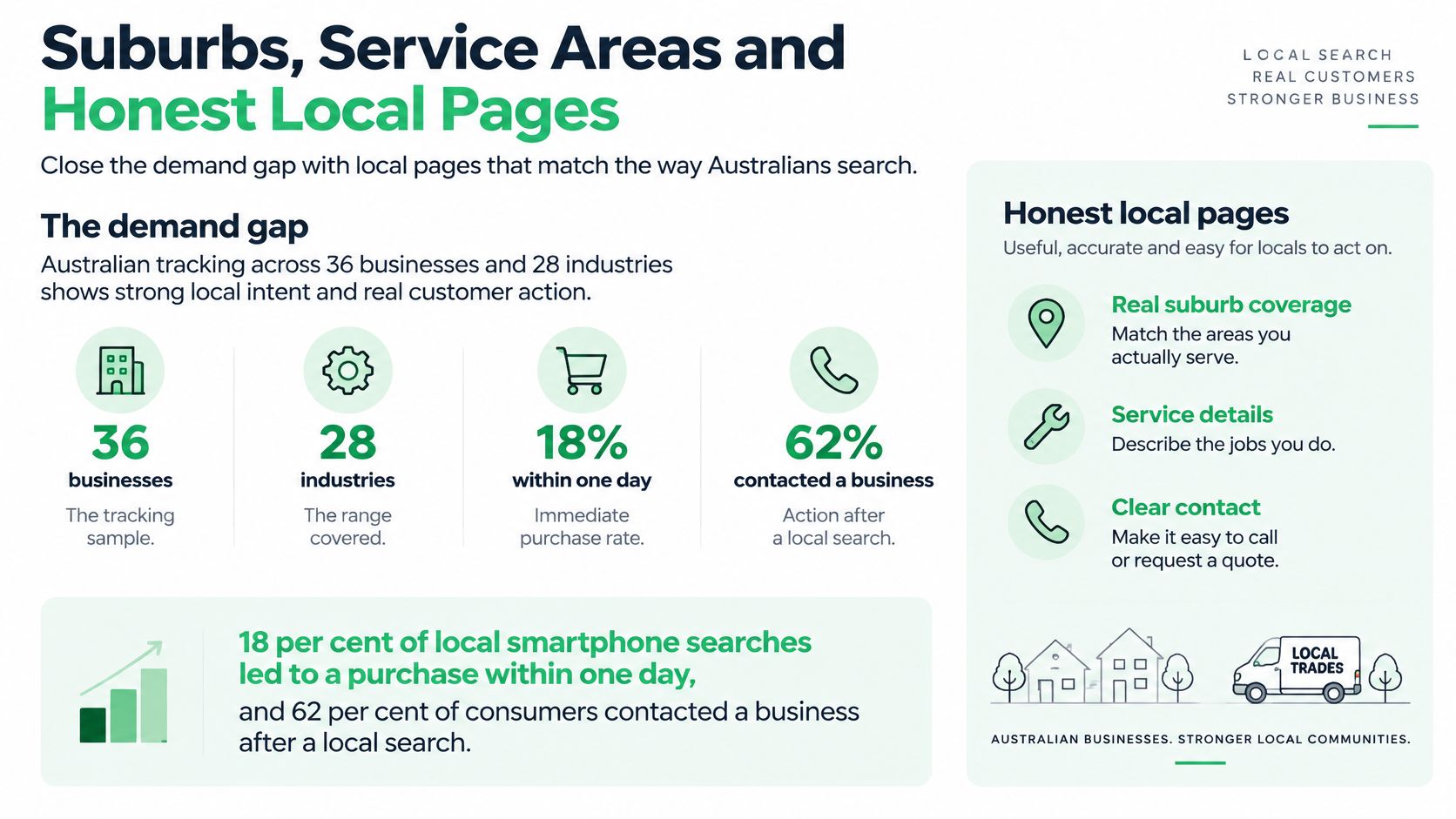
Australian tracking across 36 businesses and 28 industries, including plumbers, found that 18% of local smartphone searches resulted in a purchase within one day, compared with 7% of non-local searches, according to Websites That Sell's Australian local-search statistics. That comparison supports prioritising local commercial intent, though it isn't a plumbing-only conversion forecast.
A search for emergency plumber Carlton or blocked drain Richmond gives a business more booking context than a broad question about leaks. It identifies both the problem and the location. The page should help establish whether the business can attend, rather than merely repeating those search words.
Competition is geographically concentrated too: Jobs and Skills Australia's general-plumber profile reports approximately 43,100 general plumbers nationally, including about 14,000 in Victoria, or 32.5%, based on Census data. Those are workforce figures, not counts of Melbourne competitors, but they underline the need for a defined local position.
The following visual puts local demand beside the information a useful location page needs.
Draw the service boundary before creating pages
Start with dispatch records and travel realities. List suburbs reachable within the business's normal response window, then identify the services worth providing in each area. Emergency coverage may be narrower than scheduled maintenance coverage.
An inner-north cluster can make sense when technicians work across its suburbs. It doesn't justify separate, nearly identical pages for every postcode. Where local differences aren't substantial, a useful cluster page is preferable to repetitive suburb copy.
Location representation also needs care. Google's business-representation guidelines specifically use a plumber operating from a residential address as an example of a service-area business that should hide its address from customers. A home or depot shouldn't appear as a customer-facing shopfront merely to suggest proximity.
For service-area businesses such as trades, mobile services and home-service providers, SEO2RANK structures legitimate service coverage without fake office locations. The public information should instead make service areas, phone details, hours and genuine emergency availability clear.
Make each landing page useful
A commercial page needs enough information for a customer to decide whether calling makes sense:
- The problem: Describe symptoms in everyday language, such as overflowing drains or a hot-water system that won't heat.
- The visit: Explain assessment, access requirements and how the next step is agreed.
- The coverage: State the relevant areas and operating hours without implying guaranteed attendance.
- The evidence: Include accurate licence information, genuine work photos and permitted testimonials.
- The contact path: Provide a working tap-to-call button, enquiry option and concise answers to common questions.
The guide to what a good SEO service page should include offers a useful structure for checking those elements. Local details should come from actual work, such as building access, response zones or recurring issues, not assumptions about a suburb's housing.
The final test is operational: every named suburb should be somewhere the business will attend on the stated terms. Calls, quote forms and booked jobs should then be attributed to the landing page that generated them.
Mobile Speed Before the Customer Hangs Up
Technical SEO matters at the last metre before contact. A visitor dealing with a burst pipe shouldn't have to wait for a decorative image or chase a call button that moves when a chat widget loads.
Good Core Web Vitals for plumbing pages
| Metric | Good threshold | First fix on a plumbing page |
|---|---|---|
| Largest Contentful Paint | 2.5 seconds or less | Compress and correctly size the hero image |
| Interaction to Next Paint | 200 milliseconds or less | Delay chat, extra tracking and animation |
| Cumulative Layout Shift | 0.1 or less | Reserve space for images, reviews and the call button |
Google's good thresholds are Largest Contentful Paint of 2.5 seconds or less, Interaction to Next Paint of 200 milliseconds or less, and Cumulative Layout Shift of 0.1 or less, assessed at the 75th percentile of real visits, as documented in SEO Summer's Core Web Vitals benchmarks.
In plain language, these measure how quickly the main content appears, how promptly the page responds and whether the layout jumps. A desktop Lighthouse score is a diagnostic aid, not proof that customers on phones receive a good experience.
Fix the pages receiving commercial visits
Search Console and analytics should be reviewed by mobile device, page template and landing page. Emergency, blocked-drain and hot-water pages already attracting relevant searches deserve attention before decorative parts of the site.
A sensible implementation order is:
- Optimise the first image: Compress it, serve the correct dimensions and use WebP or AVIF where supported.
- Prioritise selectively: Preload only the actual above-the-fold image when needed, rather than competing images throughout the page.
- Remove blocking scripts: Review third-party tools that delay rendering without helping the immediate booking task.
- Stabilise the layout: Reserve dimensions for images, reviews and contact widgets.
- Reduce interaction delays: Defer non-essential chat, animation and extra tracking until the call or form interface is usable.
Changes should preserve measurement rather than disable it indiscriminately. A developer should identify which scripts are essential, then test that events still fire after optimisation.
Check access as well as speed
A fast page that search engines can't fetch or index won't fulfil its search role. Search Console's URL Inspection tool can help identify accidental exclusions, while a crawl can expose broken internal links, redirects and inaccessible service pages.
The technical SEO checklist for small business provides a broader diagnostic sequence. A small plumbing website doesn't automatically need rebuilding because a report lists technical warnings.
A speed badge isn't a booking. The useful result is a stable mobile page that lets an interested customer complete the next action.
Validation should combine field performance over time with completed calls and qualified enquiries. A phone-button click alone doesn't establish that a conversation occurred, let alone that the business booked suitable work.
Reviews That Explain the Job
Chasing a higher star average isn't a complete review strategy. A prospective customer needs to understand whether the plumber communicated clearly, arrived as agreed, handled the problem competently and left the property tidy.
A short compliment can be sincere yet offer little help with those questions. Customers comparing providers also want relevant context: whether the job was urgent, whether the quote was explained, and whether the business attended their suburb. Reviews can describe those experiences, but they don't replace verification of licensing or qualifications.
Spotlight Local's discussion of Australian local search connects review information with profile quality and conversion measurement. Its broad consumer-search percentages come from commercial coverage, so they shouldn't be treated as a guaranteed uplift for an individual plumbing company.
Request detail without writing the review
Review requests belong after completed work, when the customer can comment on the outcome. The request should be neutral and non-incentivised, without payment, gifts or a prewritten endorsement.
Useful prompts invite customers to describe:
- The problem: What prompted the call?
- The suburb: Where was the work completed, if the customer is comfortable sharing?
- The response: What happened between the initial enquiry and attendance?
- The outcome: What was fixed, explained or arranged next?
The customer should choose the wording and level of detail. Staff shouldn't manufacture text, insist on particular keywords or turn a qualified comment into an unconditional promise.
The distinction between trust and ranking is explored further in how Google reviews relate to SEO and local rankings. Reviews can help a prospect evaluate the business without providing a predictable ranking or revenue result.
Compare feedback with the booking process
Review language becomes more useful when considered beside Business Profile actions, enquiry records and booked work. Call recordings may also help where lawful and appropriate, with suitable privacy and consent arrangements.
Say customers repeatedly praise workmanship but complain about waiting for quotes. Publishing stronger promises won't solve that mismatch. The business needs to improve quote handling or adjust its stated expectations.
Operational check: When customer feedback contradicts the website, investigate the service process before requesting more praise.
If a strong rating accompanies flat call volume, the next check should include categories, opening hours, suburb relevance and the mobile contact route. More reviews won't repair a wrong number or make an unavailable technician attend.
Replies should acknowledge the actual concern without disclosing private job details. Used this way, reviews support an ongoing feedback process rather than a star-count target.
Ads AI Answers and Honest Claims
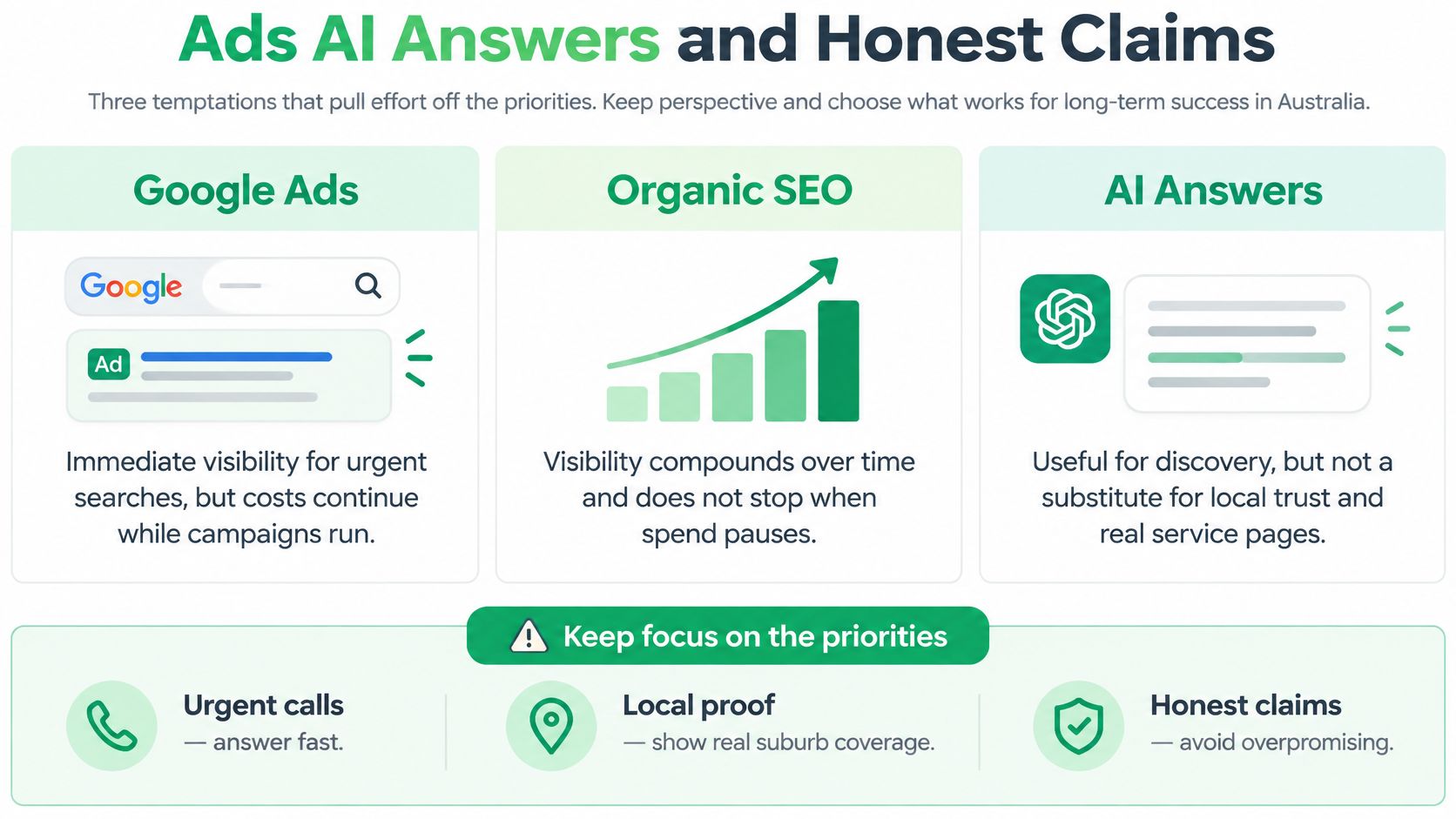
Google Ads, organic SEO and AI visibility serve different purposes. Treating them as interchangeable can divert effort from the work most likely to produce suitable enquiries.
Australian plumbing campaigns averaged $10.49 cost per click and a 4.97% click-through rate in RockingWeb's Australian industry benchmark for 2025. Those figures are a cost signal, not a Melbourne quote or a forecast of booked jobs.
Paid campaigns can provide visibility while ads run and may suit a launch, available roster capacity or a gap in organic coverage. Organic work takes longer to establish, but its visibility doesn't automatically disappear when advertising spend pauses. Neither channel guarantees profitable work, and organic visibility still needs maintenance.
The comparison below separates their roles.
Keep AI work proportionate to buying intent
AI summaries create a different measurement problem. A homeowner reading an answer about a leaking tap may never need a local provider, even if that answer references a plumbing website.
Jezweb's Australian analysis of AI summaries and clicks found no publicly reported study separately measuring AI Overview effects for Australian searches such as plumber in a suburb. It also discusses reporting that summaries were more common for informational questions than targeted transactional plumbing searches.
That uncertainty argues against shifting the content budget into generic DIY articles to pursue citations. Troubleshooting content is worthwhile when it demonstrates genuine expertise, provides safe boundaries and supports a relevant service. It shouldn't encourage hazardous work or make an AI mention the main success measure.
The discussion of AI search and potentially reduced website clicks is useful context, but local calls and bookings remain the commercial test.
Apply the truth test to every promise
Consumer Affairs Victoria's guidance on false or misleading representations states that businesses must not make false or misleading representations when supplying, offering or promoting services. Plumbing claims need to reflect actual capability.
- Availability: Around-the-clock emergency wording needs a matching service operation.
- Arrival: Same-day claims shouldn't conceal limitations that materially change the offer.
- Qualifications: Licensed-service descriptions must match the relevant licence position.
- Price and coverage: Fixed-price wording, guarantees and Melbourne-wide claims need substantiation.
Testimonials require the same care. Editing a review mustn't create invented response times, prices or guarantees. A ranking is not a defence for an untrue claim.
Start With the Jobs You Can Attend
A useful plumbing SEO program makes the business findable for suitable work, removes obstacles to contact and records what becomes a booking. Expansion should follow dispatch capacity rather than a list of suburbs available to target.
A manageable starting schedule keeps implementation focused. The following sequence is a planning framework, not a promise of ranking changes within that period.
A four-week implementation sequence
- Week one, verify the profile. Compare categories, phone details, hours and service areas with the actual operation. Remove any customer-facing address that customers shouldn't visit, and establish a baseline of relevant profile actions and enquiries.
- Week two, improve the highest-value page. Rewrite or create the service page most closely aligned with wanted work. Give it a clear search title, useful service detail, internal links and an appropriate connection from the Business Profile.
- Week three, test the booking route. Open that page on a phone, check the visible contact action and submit the form. Resolve obvious delays or layout movement, then confirm that calls and forms are recorded without counting test enquiries as leads.
- Week four, compare promises with feedback. Request honest reviews from completed jobs and review the language against the page's claims. Check whether incoming enquiries match the intended service, area and availability.
After that sequence, the business may need refinement rather than more pages. If technicians are already fully occupied, improving job fit and reducing unsuitable calls can be more valuable than increasing enquiry volume.
Set expectations around scope and capacity
Profile corrections and page edits can be implemented promptly when access is available. Ranking and enquiry changes generally need longer observation, often over months, and depend on competition, location, existing visibility and implementation quality. A fixed deadline for a ranking outcome isn't a reliable planning basis.
Cost also follows scope. Relevant factors include the number of genuine areas and pages, technical repairs, content preparation, measurement requirements and how much work staff can complete internally.
SEO2RANK's Local SEO service includes Google Business Profile optimisation, local keyword and competitor research, location and service-area strategy, local landing page optimisation, business citations and NAP consistency, local internal linking and local search performance monitoring. NAP means name, address and phone, with address handling appropriate to the business type.
SEO2RANK starts by identifying the biggest visibility gaps and highest-value opportunities. Its eight-step process is Audit & Benchmark, Map the Opportunity, Fix the Foundations, Build Relevance, Build Trust, Track Visibility, Refine, and Grow Coverage.
Outside assistance is reasonable when indexing problems persist, coverage becomes complex or implementation has stalled. The immediate next step remains modest: verify the profile against the jobs the business can attend.
SEO2RANK offers Melbourne plumbing businesses integrated local, technical and service-page SEO with enquiry measurement. Visit SEO2RANK to discuss the highest-value service areas, the main barriers to discovery and how progress can be assessed through qualified calls and booked work.
Find Out What Is Holding Your
Website Back
Get a practical SEO Snapshot showing the biggest issues and opportunities we can see across your search visibility, website and local presence.
Get Your Free SEO Snapshot→