A business needs SEO when Google can't reliably discover, index or rank its important pages, or when visible traffic isn't turning into qualified enquiries. In Australia, 93% of people search online for hyperlocal businesses and 88% of local searches lead to a call or visit within 24 hours, so weak search visibility can become a lead problem very quickly for a service business.
That's why “needs SEO” is rarely just a ranking complaint. Sometimes the issue is that Google can't crawl key pages. Sometimes pages are indexed but irrelevant for the terms that matter. Sometimes the business is visible, gets clicks, and still misses enquiries because the page experience, trust signals or measurement setup is poor.
For a Melbourne tradie, clinic, accounting firm or B2B service provider, the right sequence matters. Crawling means Google can access a page. Indexing means Google has stored it and may show it in results. Ranking means Google considers it relevant enough to place in front of searchers. If a page isn't indexed, content tweaks alone won't fix it. If it ranks but doesn't convert, more traffic may only waste more opportunity.
The most useful way to assess SEO is to diagnose in order. Start with whether Google can find and index the site. Then check local visibility, especially in Google Business Profile and Maps. After that, review page relevance, mobile experience and commercial outcomes. Search Console should guide the process, and where available, server logs can confirm whether Googlebot is reaching important URLs. Assumptions usually slow the fix.
Table of Contents
- 1. Your Website Doesn't Appear on the First Page of Google for Local Searches
- 2. Your Website Receives Traffic But Very Few Enquiries or Conversions
- 3. Your Competitors Rank Higher Than You Despite Offering Similar Services
- 4. Your Website Rarely Appears in Search Results for Keywords You'd Expect to Rank For
- 5. Your Website Has a High Bounce Rate or Low Average Session Duration
- 6. You're Not Attracting Enquiries from High-Intent Local Searches
- 7. You Have No Blog or Content Strategy, Just Static Service Pages
- 8. Your Website Has Slow Page Load Speed or Poor Mobile Experience
- 9. Your Website Doesn't Show Up When Prospects Search with Your Business Name
- 10. You Don't Know Which Keywords Your Ideal Customers Are Actually Searching For
- 10 Signs Your Business Needs SEO, Comparison Guide
- Turn the Signs Into a Prioritised SEO Roadmap
1. Your Website Doesn't Appear on the First Page of Google for Local Searches
For many service businesses, this is the first obvious warning sign. If someone searches for “plumber Melbourne”, “dentist Fitzroy” or “accountant Southbank” and the business is buried past page one, local competitors are taking the easiest leads.
Australian local search behaviour is strongly action-oriented. One Australian local-search compilation reports that 51% of consumers use Google Maps for local search, which makes Google Business Profile, location pages and review signals central to discovery for suburb-based businesses (Australian local SEO statistics from Red Search).

A Melbourne electrician might offer the same emergency callout service as better-ranked competitors, but still miss visibility because the site has no suburb pages, the Google Business Profile is thin, or the business details are inconsistent across the web. A dental clinic may have a solid website yet still lose map visibility because its profile lacks complete services, current photos or review activity.
What to check first
- Search in a clean browser: Use incognito mode and search the main service plus location terms that a customer would use.
- Review Search Console query data: Check which local terms generate impressions but weak positions.
- Audit the local footprint: Look at category selection, opening hours, photos, service descriptions and reviews in the profile.
- Check location relevance on-site: Businesses serving multiple suburbs usually need distinct pages, not one generic service area paragraph.
Practical rule: If a business isn't visible where nearby customers are searching, it's not dealing with a branding issue first. It's dealing with missed demand.
For businesses that depend on suburb-level discovery, practical local SEO tips for Melbourne businesses usually matter more than broad, generic optimisation.
2. Your Website Receives Traffic But Very Few Enquiries or Conversions
A site can attract search visits and still fail at the job the business needs it to do. For a small service business, the core question is simple: do the right visitors arrive on the right page and take a clear next step?
This sign usually appears after the earlier checks. Google can find the site. Some pages already rank. Search Console shows impressions and clicks. Yet the phone stays quiet, forms barely come through, or the enquiries are poor quality.
That points to a different problem.
In practice, I see four common causes. The search term has mixed intent, so the page attracts researchers instead of buyers. The service page is too vague, so visitors cannot tell whether the business fits their job. The page asks for trust before earning it, with little proof, no pricing context, no process, and no clear location coverage. Or the conversion path is awkward on mobile, where many local service enquiries begin.
A clinic might rank for a broad informational term and get traffic from people looking for general advice, not appointments. A plumber might rank for "blocked drain" but send visitors to a generic homepage instead of an emergency service page with suburb coverage, call options and response details. In both cases, traffic is present. Commercial intent is leaking away.
Rather than treating this as an SEO volume issue, check the handoff between search and enquiry:
- Compare top landing pages against the queries that bring users in. Look for mismatches between what people searched and what the page offers.
- Review mobile usability on the exact pages that get organic traffic. Test tap-to-call buttons, form length, page speed and whether key information appears before a long wall of text.
- Check enquiry paths in analytics and call tracking. A page with clicks but no form starts or phone calls often has a page problem, not a ranking problem.
- Look for proof near the decision point. Reviews, licences, service areas, before-and-after photos, FAQs and turnaround details often matter more than extra word count.
Small changes can shift results here. Tightening a headline, adding suburb-specific reassurance, shortening a form from eight fields to three, or placing the phone number and booking button higher on the page can improve enquiry rate without increasing traffic at all.
If the page itself is weak, more visitors just produce more wasted visits. A practical review of what a good SEO service page should include helps diagnose whether the constraint is intent match, page clarity, trust, or friction in the enquiry process.
3. Your Competitors Rank Higher Than You Despite Offering Similar Services
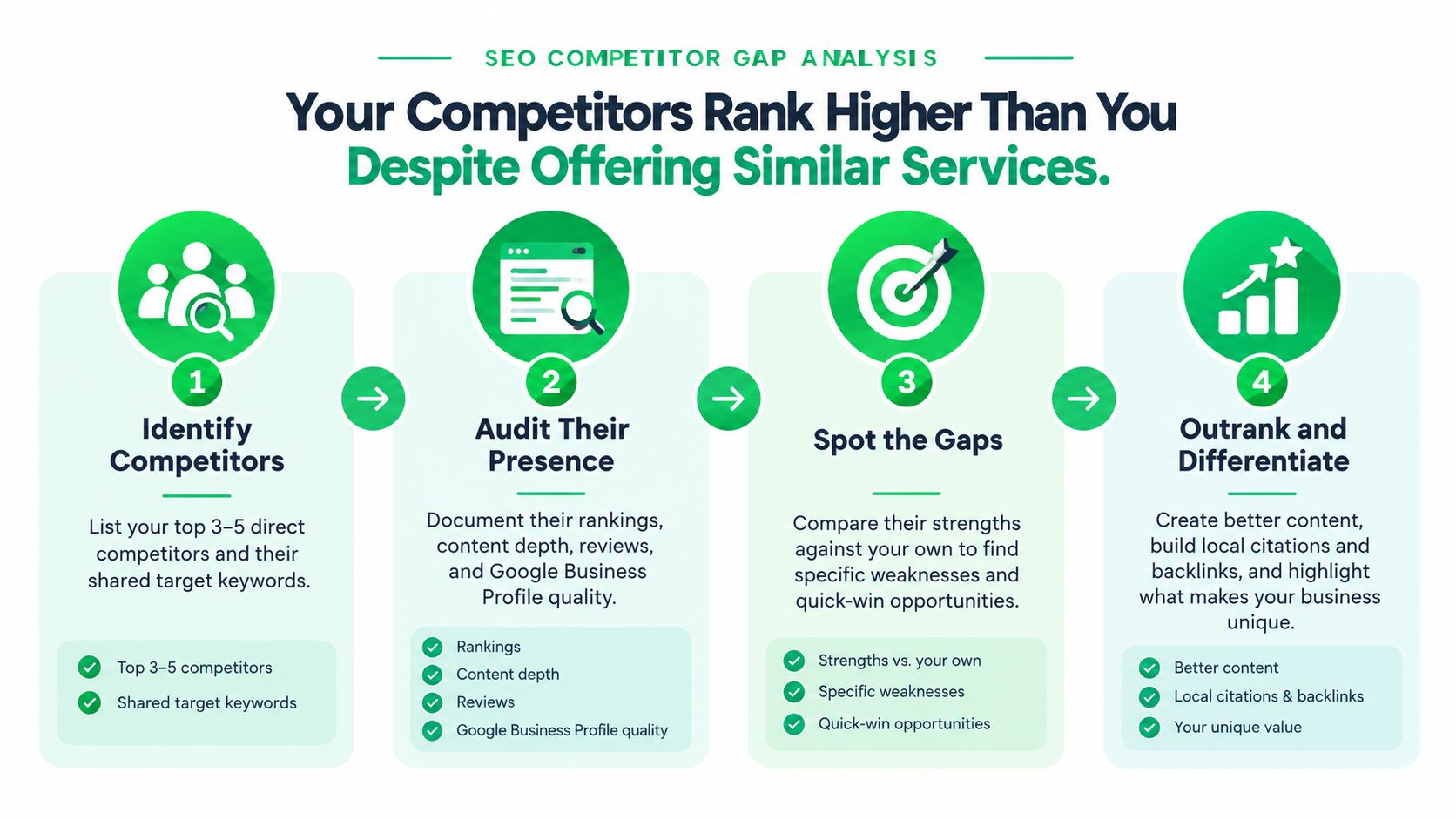
This sign matters because it removes one excuse. If direct competitors with similar services, pricing levels and service areas consistently outrank the business, the gap is usually fixable.
The comparison shouldn't focus only on aesthetics. A competing plumbing company may rank better because it has clearer service pages, stronger internal linking, better suburb targeting and a more complete local profile. A rival dental practice may have separate pages for implants, emergency care and each major location while another clinic pushes everything onto one broad page.
How to compare without overcomplicating it
Start with a manual review of three to five local competitors. Search the main commercial terms. Open the pages that rank.
Then compare practical elements:
- Page targeting: Do they have one page per service, per suburb, or both?
- Content depth: Do they answer the exact buying questions a customer has?
- Trust and proof: Are reviews, team details, qualifications and photos visible?
- Internal structure: Can users and Google move easily from homepage to service pages to contact points?
Competitor analysis isn't about copying a rival's website. It's about identifying the minimum standard Google already rewards in the market.
A B2B accountant might discover that stronger competitors publish guides, FAQs and industry pages that support their commercial services. A home-services business may find that every visible rival has a stronger title tag, clearer headings and location relevance built into the page structure.
When keyword gaps are still unclear, this guide on how to find keywords your customers are searching can help turn competitor observations into a practical page plan.
4. Your Website Rarely Appears in Search Results for Keywords You'd Expect to Rank For
If a service page is missing from Google for the exact searches it was built to target, treat that as an indexing or site-structure check before treating it as a writing problem.
This sits early in the diagnostic sequence for a reason. Before reviewing local relevance, content depth or conversion paths, confirm that Google can crawl, understand and store the page in its index. If it cannot, no amount of copy refinement will fix the underlying issue.
I see this after redesigns, CMS changes and rushed page launches. A plumber adds separate pages for blocked drains, hot water repairs and gas fitting, then wonders why none of them appear. The cause is often ordinary. The pages are set to noindex, canonicals point back to a broader service page, internal links were removed, or Google has little reason to prioritise thin near-duplicates.
A quick check usually answers the main question. Search for the exact URL in Google. Then inspect that URL in Search Console. If the page is excluded, the exclusion reason matters more than the keyword target.
Common patterns to look for:
- Blocked or excluded pages: noindex tags, robots.txt rules, login walls, or accidental staging settings
- Canonical confusion: the page exists, but signals tell Google a different URL is the preferred version
- Weak discovery: important pages are orphaned, buried, or missing from navigation and contextual links
- Low-value duplication: several suburb or service pages say almost the same thing, so Google indexes one and ignores the rest
The trade-off for small service businesses is straightforward. Publishing more pages can improve keyword coverage, but only if each page is accessible, distinct and supported by internal links. Ten thin pages usually underperform three properly built ones.
For a practical check, use a technical SEO checklist for small business websites to review indexing status, crawl paths, canonicals, sitemaps and internal linking. Measure the fix by watching whether key URLs move from excluded to indexed in Search Console first. Rankings come after that.
5. Your Website Has a High Bounce Rate or Low Average Session Duration
When people land on a page and leave almost immediately, the business shouldn't jump straight to a ranking explanation. The more likely issue is that the page didn't satisfy the search.
A home services homepage often attracts poor engagement because it tries to say everything at once and explains nothing quickly. A person searching for “emergency dentist Melbourne” doesn't want a vague practice overview. They want urgent availability, location, contact method, services covered and reassurance that the clinic can help now.
What this usually means
Poor engagement can come from several sources at once:
- Mismatched search intent: The keyword and the page don't belong together.
- Misleading snippets: The title tag or meta description promises one thing, the page delivers another.
- Weak first screen experience: The important message is hidden below banners, sliders or generic branding.
- Slow or unstable pages: Visitors leave before the content becomes usable.
A B2B service page might technically rank, but if the opening copy is abstract and the next step is unclear, users won't stay. A local clinic page may lose mobile visitors because the phone number isn't tappable and the appointment path is buried.
The useful response is page-specific, not site-wide. Review analytics by landing page, compare mobile and desktop behaviour, and then manually test the page like a customer would. If the page doesn't answer the likely search within a few seconds, the engagement problem makes sense.
6. You're Not Attracting Enquiries from High-Intent Local Searches
High-intent local searches are where local SEO stops being abstract and starts affecting the phone.
A person searching for "dentist Melbourne" may still be comparing options. A person searching for "emergency dentist Hawthorn open Saturday" is much closer to booking. If a service business gets some search visibility but very few calls, this is one of the first gaps to check after confirming the site can be crawled and indexed.
The pattern is usually easy to spot in practice. Search Console may show impressions for broad service terms, while enquiries come mainly from referrals, repeat customers, or branded searches. The business is visible enough to appear online, but not visible in the searches that carry urgency, location, and action.
Three checks usually reveal the problem:
- Search the main service plus suburb combinations manually and note who appears in the local pack and organic results.
- Review the Google Business Profile for missing categories, weak service descriptions, inconsistent hours, or too few recent reviews.
- Check whether the website has pages that match how people search, such as emergency, same-day, suburb-specific, or service-plus-location terms.
A physiotherapy clinic might have one general services page for the whole city, while competitors have clear pages for sports physio in Southbank, post-surgery rehab in Richmond, and same-day appointments near the clinic. An electrician might describe every service well but still miss "24 hour electrician Carlton" because the site gives Google very little local context and the business profile does not reinforce that offering.
This is also where small businesses can waste effort. Publishing more blog posts will not fix weak local intent coverage if the core issue is an incomplete business profile, thin review signals, or no useful landing pages for the suburbs that generate jobs.
Fix the highest-intent gaps first. Start with the services and locations that bring the best margins or the fastest close rate. Then measure whether local pack visibility, calls, direction requests, form fills, and landing-page enquiries improve over the next few weeks.
7. You Have No Blog or Content Strategy, Just Static Service Pages
A brochure-style website can still win some local searches, but it usually hits a ceiling. Service pages alone only cover a narrow set of commercial terms, and they often don't answer the questions people ask before they enquire.
An accounting firm without content may miss searches around tax timing, structures, compliance questions or industry-specific concerns. A tradie without educational content may lose visibility for the exact problems people search when they first notice something wrong. Those searches may begin as research, but they often become future enquiries.
Why supporting content still matters
Content works best when it supports commercial pages rather than replacing them.
- It captures earlier-stage searches: People often research symptoms, problems and options before choosing a provider.
- It improves internal linking: Good supporting articles strengthen service pages by linking into them naturally.
- It demonstrates expertise: Useful answers build trust before the first phone call.
- It helps long-tail visibility: The site becomes relevant for more than a few broad terms.
A dental practice might publish pages on emergency symptoms, payment questions and treatment comparisons, all linking back to booking pages. A B2B service provider might answer recurring pre-sales questions that otherwise get handled one by one in calls and emails.
Static sites often underperform not because every page is bad, but because the site gives Google and users too little context. SEO usually becomes necessary at that point because the business needs wider topical coverage and stronger pathways into its money pages.
8. Your Website Has Slow Page Load Speed or Poor Mobile Experience
A slow mobile site can make every other SEO signal harder to read. Rankings may look acceptable, branded demand may exist, and service pages may target the right terms, yet the site still loses enquiries because people cannot use it comfortably on a phone.
For small service businesses, this usually shows up in a practical way. Someone taps through from Google, waits on a bulky hero image, tries to close a pop-up, misses the call button because the layout shifts, then leaves. The page visit is recorded. The enquiry never happens.
Australian benchmark reporting shows that only 58% of Australian ecommerce sites pass Google's Core Web Vitals assessment, and Google's thresholds for good performance are LCP under 2.5 seconds, INP under 200 milliseconds and CLS under 0.1 (Australian Core Web Vitals benchmarks and thresholds). Those benchmarks are useful for service sites too because the same problems affect local search traffic. Slow rendering, delayed taps and shifting layouts all get in the way of bookings, calls and form submissions.

The diagnosis matters here. A performance problem is not always a full-site rebuild job. In many cases, the worst offenders sit on a few commercial pages: oversized images, autoplay video, stacked tracking scripts, chat tools, booking plugins, or a theme that loads far more code than the page needs. A plumber's quote page and a clinic's contact page often deserve attention before lower-value pages because that is where delay turns into lost revenue.
I usually prioritise this work by asking two questions. Which pages bring in high-intent visitors, and what blocks those visitors from acting quickly on a phone?
Useful fixes tend to be plain, not flashy:
- Resize and compress images on key landing pages: Large banners often slow the first meaningful view.
- Remove or delay non-essential scripts: Chat widgets, heatmaps and old plugins often cost more than they return.
- Stabilise tappable elements: Phone buttons, forms and sticky headers should stay in place while the page loads.
- Test on real mobile devices: Lab scores help, but a manual check on an actual phone often exposes the friction faster.
- Measure page-level outcomes after changes: Look for improvement in calls, form starts, and conversion rate on the pages you fixed.
There is a trade-off. Extra tools can help capture leads or track behaviour, but every script adds weight and complexity. For a small business site, the better choice is often a faster page with fewer features, especially on service and contact pages where speed and clarity matter more than design extras.
Poor performance can look like an SEO issue, a UX issue and a conversion issue at the same time. In practice, it often is all three.
9. Your Website Doesn't Show Up When Prospects Search with Your Business Name
If Google cannot reliably surface your site for your own business name, treat that as a diagnostic warning, not a minor branding issue.
At this point in the sequence, the first question is simple. Is the site indexed and associated with the brand, or are stronger signals pointing elsewhere? Branded searches should usually be the easiest searches to win because the intent is explicit. A referred prospect has heard your name, typed it in, and wants the official site. If Google returns Facebook, directories, an old domain or a map result without a clear path to your website, the problem often sits closer to indexation, site signals and profile consistency than to content strategy.
That matters for small service businesses because branded searches often come from high-trust moments. Someone sees your van, gets your name from a neighbour, or finds you through your Google Business Profile and wants to confirm you are legitimate before calling.
A quick check usually reveals the issue faster than a long audit:
- Search the exact business name in Google.
- Check whether the homepage appears in the results.
- See which page ranks first. The current site, a social profile, a directory listing, or an outdated domain.
- Confirm that the business name is used clearly in the homepage title and major profile listings.
- Check whether Google has indexed the correct version of the site, including preferred domain and HTTPS version.
The causes are usually practical:
- The homepage title or H1 barely mentions the business name
- Google has indexed multiple versions of the site
- An old website or microsite still has stronger brand relevance
- The Google Business Profile, website and citations use inconsistent business details
- The homepage has weak internal prominence because service pages, directories or social profiles carry clearer signals
I have seen this with trades, clinics and professional services. A tradie's Facebook page outranks the main site because the website title tag says only "Home" and the GBP points to a different URL version. A clinic keeps an old booking subdomain live, so Google splits branded relevance across two properties. An accounting firm rebrands but leaves directory listings and page titles on the old name for months, which muddies the query.
Fix the brand query before chasing broader rankings. In many cases, that means consolidating domain versions, updating titles, aligning the Google Business Profile with the live site, and removing confusion from old assets. It is not glamorous work, but it is high priority because it affects both findability and trust.
Measurement is straightforward. Search the brand name, check whether the correct page ranks first, and monitor branded impressions and clicks in Google Search Console after the fixes are indexed. If your own name is hard to win, that usually signals a foundational SEO problem earlier in the chain.
10. You Don't Know Which Keywords Your Ideal Customers Are Actually Searching For
This is one of the most common signs because it affects every decision that follows. Without keyword clarity, businesses build pages around internal language instead of customer language.
A plumbing company might talk about “plumbing services” while prospects search for blocked drains, burst pipes or gas checks. A dentist might optimise for general “dental care” terms when the commercial demand sits in emergency, booking and treatment-specific searches. An accounting firm might create broad finance content that never lines up with what local businesses type into Google.
Why this creates wasted SEO effort
SEO needs a target. If the business doesn't know the relevant queries, it can't judge whether weak performance comes from poor rankings, wrong content, thin intent alignment or simple measurement gaps.
Australian business data gives this issue a wider context. The ABS reported 2,814,778 actively trading businesses at 30 June 2026, including 996,203 employing businesses, and an ABS-linked report also stated that only 47.1% of Australian businesses had an online presence, with just under 20% of medium-sized businesses still lacking a web presence (Australian business and online presence figures). In a market that large, vague targeting is a real competitive disadvantage.
Good SEO starts with the language customers use, not the language the business prefers internally.
The practical fix is simple but not always quick. Use Search Console to review existing queries. Check autocomplete suggestions for core services. Review competitor page titles and headings. Sort target terms by intent. Then connect each meaningful keyword group to a specific page. Until that map exists, SEO work tends to drift.
10 Signs Your Business Needs SEO, Comparison Guide
| Issue | Core indicators | Quality / UX ★ | Commercial impact 💰 | Target audience 👥 | Quick fix & USP ✨🏆 |
|---|---|---|---|---|---|
| Your site not on page one for local searches | Absent from local pack, incomplete GBP, no location pages | ★★☆☆☆ | 💰💰💰 | 👥 Tradies, dentists, local service SMBs | ✨ GBP + suburb pages, citations; 🏆 fast local wins, Melbourne focus |
| Traffic but few enquiries / conversions | High bounce on money pages, weak CTAs, low time on page | ★★☆☆☆ | 💰💰 | 👥 Service businesses with existing traffic | ✨ On‑page CRO, trust signals, tracking; 🏆 hands‑on implementation |
| Competitors consistently outrank you | Rivals in top 3, stronger backlinks & content | ★★☆☆☆ | 💰💰💰 | 👥 Competitive local markets, B2B services | ✨ Competitor gap analysis, backlink/content plan; 🏆 targeted catch‑up roadmap |
| Site rarely appears in search results | Few indexed pages, GSC shows no impressions, robots issues | ★☆☆☆☆ | 💰💰💰💰 | 👥 New sites, sites with technical issues | ✨ Technical SEO & indexing remediation; 🏆 audits → dev fixes |
| High bounce rate / low session duration | Bounce >60–70%, avg session <30s, poor mobile UX | ★★☆☆☆ | 💰💰 | 👥 Sites with weak UX/content alignment | ✨ UX tweaks, content alignment, internal links; 🏆 measurable engagement wins |
| Not attracting high‑intent local searches | Missing for “[service] near me”, no service‑specific pages | ★★☆☆☆ | 💰💰💰 | 👥 Booking‑driven services (plumbers, dentists) | ✨ Service landing pages, GBP optimisation, reviews; 🏆 quick conversion lift |
| No blog or content strategy | Only static pages, few supporting assets, low keyword reach | ★★☆☆☆ | 💰💰 | 👥 Businesses lacking educational content | ✨ Content calendar, topic clusters, internal linking; 🏆 long‑term authority gains |
| Slow page load or poor mobile experience | LCP/CLS/FID issues, >3s mobile load, broken layouts | ★☆☆☆☆ | 💰💰💰 | 👥 Mobile‑first prospects, retail & local services | ✨ Core Web Vitals fixes, image & caching optimisation; 🏆 technical speed wins |
| Site doesn't show for your business name | Website outranked by socials/third‑party, multiple domain versions | ★★☆☆☆ | 💰💰💰 | 👥 Established businesses, brand‑aware prospects | ✨ Indexing, redirects, GBP & schema; 🏆 brand protection & visibility |
| No idea which keywords customers use | No keyword research, gut‑based pages, no intent mapping | ★★☆☆☆ | 💰💰 | 👥 Businesses starting SEO or re‑targeting strategy | ✨ Keyword research + intent mapping, Search Console usage; 🏆 strategic roadmap |
Turn the Signs Into a Prioritised SEO Roadmap
The ten signs make more sense when treated as a sequence instead of a random list. First, confirm that Google can access and index the important parts of the site. If service pages are blocked, excluded or orphaned, there's no point rewriting copy before those technical barriers are fixed. Search Console should be the first checkpoint, and more complex cases may need crawl analysis or server log review.
Once indexability is stable, the next priority is usually high-intent local visibility. For most Melbourne service businesses, that means improving Google Business Profile completeness, checking NAP consistency, tightening suburb and service relevance, and building or refining the core money pages that should rank for local commercial searches. Australian technical guidance recommends matching the trading name, address, phone number and spelling between the Google Business Profile and the website because inconsistent details can weaken local relevance signals (Australian technical SEO checklist for business detail consistency).
After that, attention should move to user experience and page effectiveness. Slow mobile pages, weak calls to action, confusing layouts and thin trust signals can suppress enquiries even when rankings improve. This is also where content strategy becomes useful. Supporting content can expand topical coverage, improve internal linking and help the site rank for more than a small set of generic service terms.
The final step is measurement. Progress should be judged through indexed priority URLs, impressions, clicks, rankings, local visibility, qualified calls, forms and bookings. Traffic on its own isn't enough. A business can grow sessions and still fail commercially if the visits are low intent or the conversion path is poor.
A practical roadmap usually looks like this:
- Document the issue: Record which pages, queries or locations are underperforming.
- Assign an owner: Someone needs responsibility for implementation, not just reporting.
- Set a review date: Recheck Search Console, analytics and enquiry data after changes are made.
- Escalate technical risk: Bring in technical help when robots directives, migrations, canonicals, manual actions or server behaviour are involved.
For small businesses that want outside support, SEO2RANK is one relevant option for audit, implementation and plain-English measurement support. The useful next step isn't to buy everything at once. It's to review the site, confirm which of these signs are present, and prioritise fixes in the right order.
SEO2RANK helps Melbourne service businesses diagnose whether they have an indexing problem, a local visibility problem, a content alignment problem or a conversion tracking gap. Businesses that want a practical review of their current site and priorities can visit SEO2RANK to explore audit, implementation and ongoing SEO support sized for small-business needs.
Find Out What Is Holding Your
Website Back
Get a practical SEO Snapshot showing the biggest issues and opportunities we can see across your search visibility, website and local presence.
GET YOUR FREE SEO SNAPSHOT