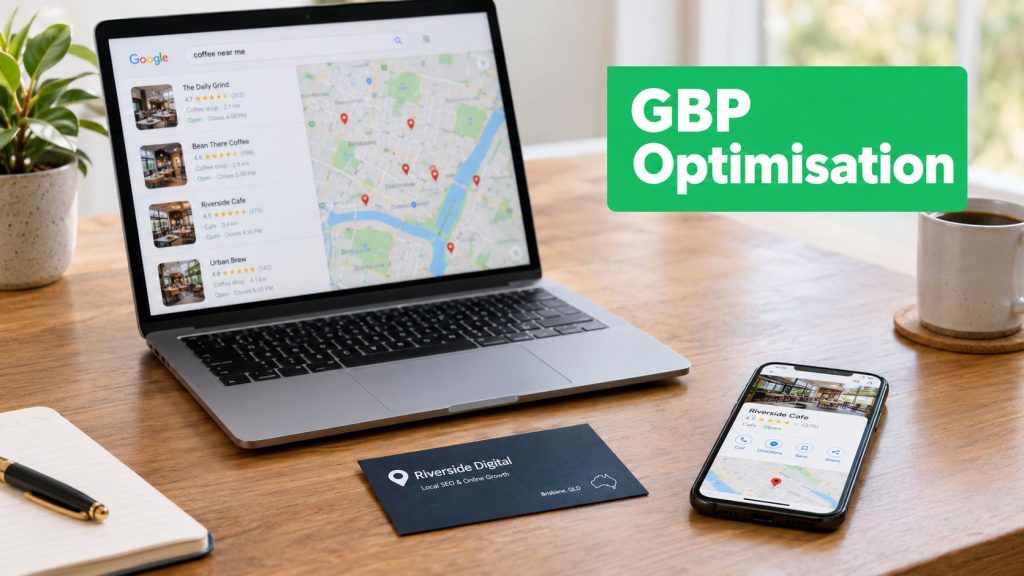
A Melbourne tradie, clinic owner or café operator usually notices the problem the same way. The phone slows down, Maps traffic gets patchy, and a competitor starts showing up first for the suburb searches that used to belong to your business. Google Business Profile Optimisation is the work that keeps your profile relevant, visible and usable, so it can drive calls, direction requests and bookings instead of sitting there as a static listing. In Australia, that matters even more now because Google's local results are built on relevance, distance and prominence, and those signals feed both the classic Map Pack and newer AI-driven local answers.

For Australian service businesses, this isn't about polishing a directory entry. It's about building a profile that matches real search intent, passes Google's verification and compliance checks, and converts the people already looking for you into actual leads. Australian local search data shows how heavily buyers rely on Google for hyperlocal discovery, and complete, active profiles can earn far more engagement than neglected ones as reported in Australia-focused local SEO guidance. When a profile is set up properly, it becomes a measurable asset, not a vanity asset. That is the difference between being found and being chosen.
Table of Contents
- Why Google Business Profile Matters for Australian Businesses Right Now
- Setting Up and Verifying Your Profile the Right Way
- How Relevance, Distance and Prominence Actually Work in Australia
- Building a Profile That Converts, Not Just Looks Complete
- Reviews, Q&A and Posts as an Ongoing Reputation System
- AI Search, Suspension Risk and Compliance for Australian Profiles
- Measuring What Your Profile Actually Delivers
- A Practical 90-Day Optimisation Checklist for Melbourne Businesses
Why Google Business Profile Matters for Australian Businesses Right Now
A Brunswick café can do everything right on the website and still lose the walk-in if its profile is stale, incomplete or missing the right category. A Heidelberg dentist faces the same issue, except the missed action is often a call or booking rather than a coffee order. Google Business Profile now sits at the front of the buying journey for local services, and it influences both Map Pack visibility and the information Google can reuse in AI-generated answers.
Australian consumers rely on Google heavily when choosing local businesses. One Australia-focused source says 93% of Australians search online for hyperlocal businesses source. That makes GBP one of the few channels where search visibility, trust signals and direct response live in the same place. Another Australian source says a complete, active profile can earn 7× more clicks than an empty one source, which is why profile work is a commercial task, not a branding extra.
Why the profile has become a conversion channel
What used to be a “set it and forget it” listing now needs regular management. Google Business Profile Insights gives owners visibility into calls, website clicks and direction requests, so the work can be tied back to lead flow rather than gut feel. That shift matters because the profile is often the first place a customer sees hours, service area, reviews, photos and booking options. If any of those are off, the business loses the enquiry before the website ever gets a chance.
Practical rule: treat every field in GBP as a conversion asset, not a form to complete.
The stakes are obvious in seasonal or urgent service businesses. A suspension during a busy patch in Dandenong, or a quiet January in Hobart, can cut off a major part of the inbound pipeline. That's why the rest of this guide focuses on making the profile technically sound, commercially useful and resilient enough to keep working when local search changes again.
Setting Up and Verifying Your Profile the Right Way
The first job is eligibility. Google's Australian Business Profile verification flow requires a real business with in-person customer contact during stated hours, and the business must be verifiable through the methods Google offers. For service-area businesses, that means the profile should reflect a genuine operation, not a hidden shell with no real local footprint.
Storefront or service area
A storefront profile shows a physical address and suits businesses that receive customers at the premises. A service-area profile hides the address and defines where the business works, which is usually the right structure for tradies, mobile vets, cleaners and similar operators across greater Melbourne. The address and service area should make sense together, because a mismatch can confuse Google and irritate customers who expect clarity.
A service-area business does not need a public storefront sign, but it does need a real operating base and a sensible service footprint.
Google's Australian verification options include phone, SMS, email, postcard and video verification where offered Google support. Verification is handled through the Business Profile manager, and bulk verification is available for chains with 10 or more locations under the same parent company, provided the locations are not service-area businesses and sit in the same account Google support. For most single-location businesses, postcard verification remains the normal path.
Your details need to be tight. Use the exact business name, a consistent NAP record, the right address or service area settings, and hours that match the actual operating pattern. The primary category should be the most specific fit, then secondary categories can cover different services. A plumber, for example, should not dilute relevance with a broad label if a tighter category is available and accurate.
For owners dealing with profile errors or visibility problems, this internal resource is worth keeping handy: business not showing on Google Maps.
How Relevance, Distance and Prominence Actually Work in Australia
Google's local system is simple in theory and unforgiving in practice. It looks at relevance, distance and prominence, then decides which businesses best fit the query and location. That means a profile has to match the search, be close enough to matter, and look established enough to trust.
Relevance starts with the category
The primary category drives how Google interprets the business. A Brunswick café choosing Cafe instead of Coffee shop will match a different set of queries, and that choice matters because categories shape the search terms the profile can reasonably appear for. The category should be based on real search demand and actual services, not on what sounds broadest.
Distance is the easiest factor to understand. A plumber in Cranbourne targeting “emergency plumber Cranbourne” has a natural advantage on proximity. A St Kilda physio trying to rank for “sports physio Melbourne” has a different job, because the query is broader and the business must lean harder on prominence.
Prominence is built, not claimed
Prominence comes from a mix of reviews, citations, links, brand mentions and behavioural signals such as bookmarks and directions. In Australian suburb markets, that often means the business with the better reputation footprint wins even when it is slightly farther away. The practical implication is clear, keep the profile consistent across the web, earn real reviews and make sure the website and citations back up the same business identity.
| Ranking Factor | Business A, Closer, Lower Prominence | Business B, Slightly Farther, Stronger Prominence |
|---|---|---|
| Category match | Broad or slightly loose | Exact and specific |
| Reviews and citations | Thin footprint | Better review profile and cleaner citations |
| Local trust | Weak signals | More established across the web |
| Likely outcome | Can lose despite proximity | Can outrank on overall fit |
A Geelong tyre shop comparison makes the point. One shop can sit closer to the searcher and still lose if the other has stronger relevance and prominence signals. That is why the work has to happen across all three axes at once, not just by chasing one lever and hoping Maps sorts the rest out. A useful companion read is how to rank on Google Maps in Melbourne.
Building a Profile That Converts, Not Just Looks Complete
A complete profile can still underperform if it reads like filler. The fields that convert are the ones that help a customer decide quickly, especially on mobile where people are scanning under time pressure. Services, attributes, products and photos all carry weight because they reduce doubt.
Services and products should sound searchable
A plumber in Brunswick should test whether the category and service labels reflect the queries locals use. “Hot water system replacement Brighton” is more useful than a generic “plumbing services” entry when the goal is to catch specific intent. Secondary categories should only be added when they represent distinct services that the business sells, not because the dashboard has room for more.
Attributes matter because they shape filters and perception. Wheelchair access, women-owned, online booking and payment options can influence whether a user clicks through or keeps scrolling. In some cases they also help Google interpret the profile more clearly in the AI layer, where structured data is easier to reuse than vague language.
The photo set should look like a real business, not a stock library. The three sets that usually matter most are:
- Exterior photos, taken in daylight with signage clearly visible.
- Interior photos, especially reception, waiting areas and treatment rooms.
- Work-in-progress or completed job photos, which show capability and standards.
A steady photo cadence is better than a burst followed by silence. One new image a week is a practical minimum for businesses that want the profile to feel active without becoming a full-time content job.

Google Posts work best as short, useful updates, not as noise. Weekly posting keeps the profile fresh, and a rhythm of around 8 to 10 posts a month is a solid operational target for active service businesses. Posts should link to the relevant page with tracking in place so the business can tell whether calls and bookings came from the profile, not just from organic search generally.
Reviews, Q&A and Posts as an Ongoing Reputation System
Reviews, Q&A and Posts work best as one system. A profile with good reviews but no recent activity looks less trustworthy than one that shows steady engagement, recent answers and current offers. Customers notice that mix quickly, and Google does too.
Reviews need timing and discipline
The cleanest way to request reviews is a short SMS or email sent within 24 hours of the job, while the interaction is still fresh. Requests should be personal and straightforward, and they should never gate or script customer feedback. The reply matters too, because every review should be answered within 48 hours where possible, using specifics from the job such as the suburb, service and outcome.
Practical rule: never chase volume at the expense of authenticity. Real reviews age well, fake engagement creates risk.
Google's review reporting flow is also straightforward if a review is spammy, off-topic or shows a conflict of interest. The support flow lets users open the review in the Reviews section, choose the three-dot menu, click Report review and pick a violation reason such as spam or off-topic Google support. Google's own product terms also make clear that fake or policy-violating reviews can be removed and may trigger enforcement Google policy.
Q&A and Posts should pre-empt friction
Owners can seed the Q&A area with common questions and answer them themselves, which is useful for parking, pricing, after-hours work or suburb coverage. That removes basic objections before the customer rings. Posts should then keep the profile active with What's New, Offers, Events and Product updates, because those formats still give Google fresh, structured content to work with.
A simple one-person workflow works well for many small businesses. Thirty minutes on Monday can cover review requests, Q&A checks and a new post. Fifteen minutes on Friday can handle replies, photo uploads and a quick sweep for anything that needs updating.
AI Search, Suspension Risk and Compliance for Australian Profiles
Ranking is not the finish line anymore. Google's AI Overviews have been available in Australia since May 2025, and tracking cited in the search results shows their prevalence rose from about 6.5% of queries in January 2025 to roughly 16% by late 2025 source. That means a thin profile can lose twice, once in the Map Pack and again in the AI answer layer.
AI systems prefer structured profiles
Profiles with clear services, accurate descriptions and current attributes are easier for Google to reuse. A business description written in plain question-and-answer style tends to help because it mirrors how people search and how AI systems summarise information. Service names should match Australian search language, and attributes should stay current because AI answers often filter against structured profile fields rather than broad marketing copy.
Compliance risk is just as real. Australian-facing guidance notes that the primary website URL should be a dedicated landing page on the business's own domain, return a 200 status, be crawlable and avoid redirect chains, while link shorteners, social profiles, app-store links and some booking platforms are risky as primary URLs source. That same guidance also flags a one-shot appeal system with a strict 60-minute evidence window after suspension, which makes prevention far easier than recovery.
| Suspension Trigger | Compliant Alternative |
|---|---|
| Virtual office used as a fake base | Real operating location or properly defined service-area setup |
| Address masking that doesn't reflect operations | Correct storefront or service-area configuration |
| Keyword-stuffed business name | Exact real-world business name |
| Risky primary URL choice | Dedicated, crawlable landing page on the business's own domain |
| Bulk shortcuts that sidestep verification | Normal verification path through Google |
For Australian service-area businesses, the service footprint should be defined by a real operating region, not a grab-bag of postcodes chosen for convenience. Clinics also need to stay mindful of sector-specific rules, including AHPRA expectations where applicable, while tradies should keep representation aligned with ABN and business identity norms. Offers should also stay truthful and consistent with Australian Consumer Law expectations when they're posted publicly.
A quick compliance audit can be done in 20 minutes. Check the name, address or service area, website URL, hours, categories, photos, review patterns and any claims made in Posts. If any part of that looks shaky, the profile needs fixing before it gets suspended.
For broader context on AI-led local search, this resource is useful: AI search and local visibility.
Measuring What Your Profile Actually Delivers
GBP Insights is useful, but only when it's read alongside Google Search Console and GA4. A profile can generate lots of views and still produce poor-quality leads, so the goal is to understand which signals correlate with actual enquiries. That means looking at search terms, direction requests, calls, website visits and form completions together.
The signals that matter most
For Australian service businesses, the most useful indicators are often the simplest:
- Suburb-based searches, such as a query containing the suburb name.
- Direction requests, especially when the business takes walk-ins or bookings on arrival.
- Calls from the profile, which point to direct intent.
- Photo views, which help show whether the visual content is pulling attention.
- Discovery versus direct searches, which tells the owner whether the profile is being found broadly or by people already looking for the brand.
GBP Insights has limitations, though. Reporting lags can make a recent change look flat for a while, and call-duration data is anonymised enough that it should be treated as directional rather than exact. A slow lift in discovery searches often shows the profile is gaining trust before visible ranking movement catches up.
| Metric from GBP Insights | What it actually shows | Business action it informs | Risk of over-reading |
|---|---|---|---|
| Discovery searches | New people finding the profile | Category, photos, services and posts | Mistaking curiosity for qualified demand |
| Direction requests | Local intent and physical visit interest | Hours, parking and map accuracy | Overstating revenue without conversion data |
| Calls | Direct response intent | Phone handling and call capture | Assuming all calls are sales-ready |
| Photo views | Visual engagement | Better exterior, team and job photos | Treating views as bookings |
| Website clicks | Traffic interest | Landing page and offer quality | Ignoring what happens after the click |
A Melbourne café can use this mix to make a practical choice. If discovery searches rise but calls do not, the profile may need better photos or clearer offers. If calls rise but website sessions do not, the business may need stronger call handling or clearer directions. The point is to move from “profile looks busy” to “profile supports a real business outcome.”
A Practical 90-Day Optimisation Checklist for Melbourne Businesses
A sensible rollout works better than trying to do everything at once. Small businesses usually get the best result by fixing the foundations first, then layering in content and review habits. The first 90 days should be about making the profile stable, searchable and easy to trust.
A phased plan that an owner can actually run
Days 1 to 14
- Claim and verify the profile.
- Clean up NAP consistency across the website and major Australian citations.
- Choose the primary category and set the correct storefront or service-area structure.
- Review the linked website page and make sure it matches the profile.
Days 15 to 45
- Upload strong exterior, interior and job photos.
- Add services and products with specific names.
- Turn on relevant attributes, including accessibility or booking options where they apply.
- Start asking recent customers for reviews.
Days 46 to 90
- Publish a weekly post cadence.
- Seed Q&A with common objections.
- Add UTM-tagged links to posts where bookings or enquiries matter.
- Review Insights monthly and compare them with website sessions and conversions.
A useful Melbourne-specific checklist is available here: local SEO checklist for Melbourne businesses.

Some situations do call for specialist help. Multi-location rollouts, suspended profiles, re-verification after a service-area change, or preparing for heavier AI visibility work are usually better handled with experienced support. For a single-location small business, a sensible monthly maintenance budget is the cost of steady attention, not a one-off fix, because GBP rewards businesses that keep the profile alive.
SEO2RANK works with Melbourne service businesses on local SEO, Google Business Profile optimisation, technical fixes and measurement, so the profile work ties back to calls and enquiries rather than vanity metrics. If this profile has been underperforming, SEO2RANK can help assess the setup, clean up the local signals and build a practical plan for suburb-level visibility.
Find Out What Is Holding Your
Website Back
Get a practical SEO Snapshot showing the biggest issues and opportunities we can see across your search visibility, website and local presence.
GET YOUR FREE SEO SNAPSHOT